
 Worksheets
Unit 3 Review - Forces and Newton's Laws
Total questions: 34
Worksheet time: 2hrs 42mins
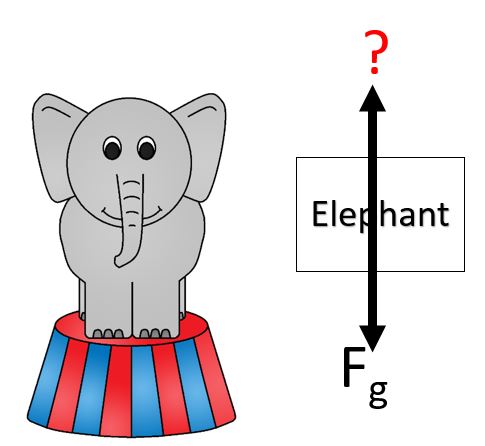
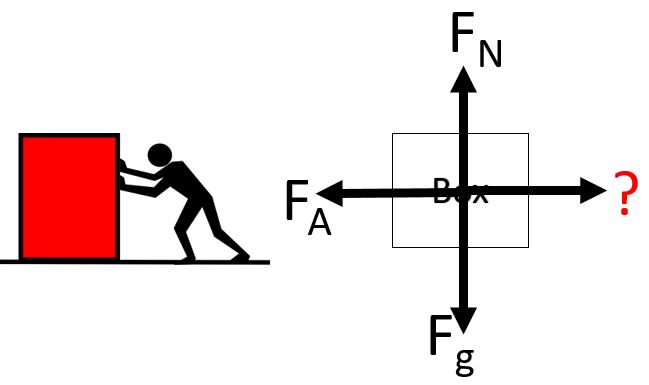
A leftward force is applied to a crate to push it across the floor at a constant speed. Which is the correct force diagram?


A downward-moving skydiver who has just opened the parachute is slowing down.


Which way is the object accelerating?
It is not or moving at a constant speed
moving to the right
moving to the left
going up


Which direction will the object accelerate?
Right
Left
Up
Down
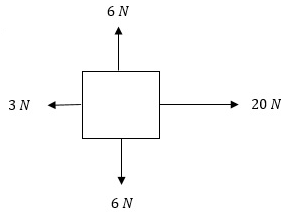
What is the NET FORCE of this diagram?
17 N, right
17 N, left
23 N, right
12 N, up
What is the force on a 40kg object that's accelerating 10m/s^2
4N
4
400N
40
When force is 20 N, mass is 5 kg, what is acceleration?
25 m/s/s
5 m/s/s
100 m/s/s
4 m/s/s
Newton's 2nd law states that an object's mass
increases as it's acceleration increases
decreases as its acceleration decreases
increases as its acceleration decreases
What Unit do we Measure Force in?
Newtons
Joules
Force
Kilograms
Which of these best states Newton's Second Law?
The greater the mass of an object the greater the force needed to change its motion.
The greater the mass of an object the less force needed to change its motion.
The mass of an object does not effect the force needed to change its motion

Will it take more force to push an empty shopping cart or a shopping cart that is full?
The empty shopping cart
The full shopping cart
They will take the same amount of force
Depends on what is in the full shopping cart
Newton's Second Law can be expressed as
v = d / t
E = mc2
F = ma
m1v1 = m2v2

When a heavy football player and a light one run into each other, who exerts more force? (pushes harder)
The light one
They exert the same force on each other
The heavy one
Action reaction forces never cancel each other out because
They act on different objects.
They act on the same objects
They do not act on objects.
The Law of Conservation of Momentum states:
The total momentum before a collision is equal to the total momentum after a collision.
The total momentum before a collision is greater than the total momentum after a collision.
The total momentum before a collision is less than the total momentum after a collision.
The total momentum before a collision is not related to the total momentum after a collision.

