
 Worksheets
SHC FORM 4 WEEK 5: Skeletal System (Joints)
Total questions: 50
Worksheet time: 46mins

What bone is highlighted?
Skull (Cranium)
Mandible
Femur
Scapula
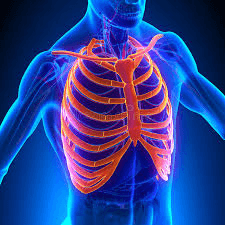
What bone is highlighted?
Ribs
Cranium
Clavicle
Femur

What bone is highlighted?
Vertebrae
Femur
Cranium
Ribs

What bone is highlighted?
Femur
Cranium
Ribs
Skull


What is the place where two bones meet?
bones
tendons
ligament
joint

What is the name for the connector that attaches muscle to bone?
ligament
tendon
joint
bones

What is the name for the connector that attaches bone to bone?
ligament
tendon
joint
cartilage
The _________________ gives the body its shape and supports and protects the internal organs.
nervous system
skeletal system
muscular system
body system
What does the cranium protect?
heart
eyes
brain
lungs
What is the largest and strongest bone in the body?
skull
vertebrae
femur
ribs
What is a flexible connective tissue that is found in your nose and ears?
cartilage
joints
ligaments
cranium
What is the purpose of the rib cage?
Helps us to think
make blood for the body
Protects our brain
Protects our vital organs like heart and lungs
What type of joints do not allow for movement?
hinge joints
immovable joints
ball and socket joints
movable joints
Select all the types of joints.
long joint
ball and socket joint
immovable joint
short joint
hinge joint
Select the examples of ball and socket joints.
hip
elbow
toes
shoulder
Select the examples of hinge joints.
elbow
shoulder
fingers
skull
What is an example of an immovable joint?
ankle
skull
fingers
hip
What type of joints allow for circular motion?
hinge joints
movable joints
ball and socket joints
cartilage joints
What type of joints allow for back and forth movement?
circular joints
immovable joints
gliding joints
hinge joints
Which one is NOT a joint?
Knee.
Wrist.
Humerus.
Neck.
Which one is a joint? More than one could be correct.
Shoulder.
Wrist.
Tibia.
Knee.
What type of joints is used to protect your soft organs?
movable joints
fixed joints
slightly movable joints
Which type of joint gives you the largest range of motion?
Pivot joint
Ball-and-socket joint
Hinge joint
Gliding joint
The joint in your knees is most similar to:
The pendulum in a grandfather clock
The wheels on an office chair
The sliding mechanism on a drawer
The hinge on a cupboard door
Which pair of joints has the most in common?
Your ankle joints and shoulder joints
The joints in your spine and hip joints
Your elbow joints and knee joints
Your wrist joints and shoulder joints
What might happen if you snapped or tore one of your ligaments?
Your joints would not be able to move
Your bones would be in danger of breaking
Your joints might slide out of place easily
You would become double-jointed
The joint that allows you to chew food is most similar to a:
Ball-and-socket joint
Hinge joint
Pivot joint
Immovable joint
The main purpose of synovial fluid is:
Keeping bones moist
Lubrication
Strengthening tendons and cartilage
Protecting the spinal cord

Where can you find this joint?
Between femur and tibia
Between humerus and ulna
Between pelvic girdle and femur
Between carpals
The joint which allows the maximum movement is the
Slightly movable joint
Ball and socket joint
hinge joint
Gliding joint
This joint helps the bowler in the game of cricket
Hinge joint
Pivot joint
Ball and socket joint
Slightly movable joint
What task would be difficult if your knee joints did not work?
Running
Throwing
Eating
Writing
Which of there body parts uses a pivot joint?
Spine
Neck
Finger
shoulder
What are the four types of bones?
Long, short, medium, thin
Regular, long, flat, short
Flat, short, long, Irregular
None of the options
What are examples of long bones?
Tibia
Humerus
Vertebrae
Pelvis
Femur
What is the main function of long bones?
Protection
Shape
Support
Movement
What is an example of a short bone?
Phalanges
Carpals
Patella
Vertebrae
What is the main function of short bones?
Movement
Storage of minerals
Support and stability
Protection
Which is a characteristic of a slightly moveable joint?
Allow for many movements to occur
Can move only left and right
Bones are seperated by a layer of cartilage
What is one example of a slightly moveable joint?
Vertebrae
Phalanges
Carpals
Tarsals
How many types of synovial joints are there?
4
5
3
6


The skull is an example of what type of joint?
Cartilaginous (amphiarthrosis)
Synovial (diarthrosis)
Fibrous (synarthrosis)

Bones that have complex shapes are called...
Flat bones
Irregular bones
Sesamoid bones
Long bones

