
 Worksheets
AP Chemistry Unit 3
Total questions: 65
Worksheet time: 2hrs 58mins
According to kinetic molecular theory, in which of the following gases will the root mean square speed of the molecules be the highest at 200ºC?
SF6
H2O
HCl
Cl2
None, the molecules of all gases have the same root mean square speed at any given temperature.
A sample of a gas (5.0 mol) at 1.0 atm is expanded at constant temperature from 10.0 L to 15.0 L. The final pressure is ___ atm.
1.5 atm
15 atm
0.67 atm
3.3 atm
7.5 atm
A sample of He gas (2.35 mol) occupies 57.9 L at 300.0 K and 1.00 atm. The volume of this sample is ___L at 423 K and 1.00 atm.
0.709 L
57.9 L
41.1 L
81.6 L
1.41 L
The volume of a sample of gas (2.49 g) is 752 mL at 1.98 atm and 62ºC. What is the gas?
NO2
SO3
SO2
Ne
NH3
Gases generally have
low density
high density
closely packed particles
no increase in volume when temperature is increased
no decrease in volume when pressure is increased
What is the pressure in a container that has 3 atm H2, 2 atm of N2 and 5 atm of F2?
2 atm
3 atm
5 atm
10 atm
How are pressure and temperature related?
Directly
Indirectly
They aren't related
Which substance would have the weakest intermolecular forces of attraction?
CH4
NaCl
H2O
MgF2
Which substance has the weakest intermolecular forces?
Substance A, boiling point of 75 °C
Substance B, boiling point of 105 °C
Substance C, boiling point of 25 °C
Substance d, boiling point of 45 °C
Chromatography separates solutions on the basis of _____ while distillation separates solutions on the basis of ______.
IMFs; solubility
solubility; conductivity
IMFs; boiling point
boiling point; solubility
Which does not affect the rate at which a solid solute dissolves?
the vapor pressure of the solvent
the temperature of the solvent
the surface area of the solid
the speed at which the solution is stirred
Which of the following occurs as temperature increases?
solubility decreases
solubility increases
solubility remains the same
molarity doubles
Which of the following will be the least soluble in water?
CH3CH2CH2OH
CH3OH
CH3CH2OH
None of them are soluble in water.
They are all equally soluble in water.
How can you increase the solubility of a gas in a liquid?
Decrease the IMFs between the gas the and the liquid.
Increase the temperature of the solution.
Increase the pressure of the solution.
All of these would work.
In general, how could you increase the solubility of a solid in a liquid?
Increase the pressure.
Decrease the pressure.
Increase the temperature.
Decrease the temperature.


A photon is a (a) of light
If the frequency of electromagnetic radiation is high, then the wavelength will be (a)
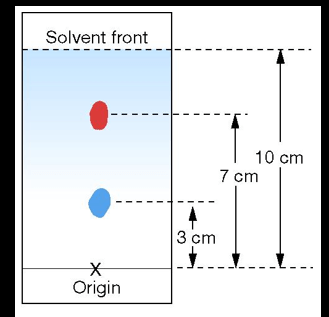
In paper chromatography, if water is the mobile phase, what kind of substance will move up the farthest?
polar substance
non polar substance
List the 4 Intermolecular forces from weakest to strongest
hydrogen bonding, ion-dipole, london dispersion, dipole dipole
london dispersion, hydrogen bonding, ion-dipole, dipole dipole
london dispersion, dipole dipole, hydrogen bonding, ion-dipole
dipole dipole, hydrogen bonding, ion-dipole, london dispersion
“More polarizable” refers to which Intermolecular Force?
hydrogen bonding
london dispersion
dipole dipole
List ALL the Intermolecular forces that exist in PCl3
hydrogen bonding, london dispersion
london dispersion, hydrogen bonding, dipole dipole
london dispersion, dipole dipole
london dispersion

The dashed line is a representation of a hydrogen bond.
True
False

The dotted line is a representation of a hydrogen bond.
True
False
Name a property that decreases as Intermolecular Forces increase.
Vapor pressure
Conductivity
Melting point
Solubility
What is an example of a covalent network solid?
Salt
Diamond
Sugar
Water
What type of solid will not conduct electricity until it is liquid or aqueous?
Ionic Solid
Covalent Network Solid
Molecular Solid
Metallic Solid
When a molecular solid melts or boils, which bonds break?
Intermolecular
Intramolecular
What causes gas pressure?
large space between the molecules
random motion of particles
collisions with the walls of the container
P and V are ___________________ related?
inversely
directly
The more molar mass a gas has, the_________________ it moves
faster
slower
Average Kinetic Energy is another term for _____________.
Heat
Temperature
Pressure
Activation energy
Which of the following probably has the highest solubility in hexane, C6H14?
Metals
Polar covalent molecules
Ionic compounds
Nonpolar covalent molecules
Of the following molecules, which is the most polar?
CO
CO2
O2
HF
F2

Consider a sample of helium gas in a container fitted with a piston, as pictured below. The piston is frictionless, but has a mass of 10.0 kg. How many of the following processes will cause the piston to move away from the base and decrease the pressure of the gas? Assume ideal behavior.
I. heating the helium
II. removing some of the helium from the container
III. turning the container on its side
IV. decreasing the pressure outside the container
0
1
2
3
4

A gaseous mixture containing 7.0 moles of nitrogen, 2.5 moles of oxygen, and 0.5 moles of helium exerts a total pressure of 0.90 atmosphere. What is the partial pressure of the nitrogen?
0.13 atm
0.27 atm
0.63 atm
0.90 atm
NH4NO3(s) → N2O(g) + 2 H2O(g)
A 0.03 mol sample of NH4NO3(s) is placed in a 1 L evacuated flask, which is then sealed and heated. The NH4NO3(s) decomposes completely according to the balanced equation above. The total pressure in the flask measured at 400 K is closest to which of the following? ( The value of the gas constant, R, is 0.082 L atm mol–1 K–1)
3 atm
1 atm
0.5 atm
0.1 atm
1. Liquids are more ordered than gases because liquids have ?
Weaker Intermolecular Forces And Lower Mobility Of The Particles
stronger intermolecular forces and lower mobility of the particles.
weaker intermolecular forces and greater mobility of the particles
stronger intermolecular forces and greater mobility of the particles
Absorbing microwave radiation is associated with changes in
molecular rotation (molecules changing spin)
molecular vibration (temporary changes in bond length or angles)
electronic energy levels (electrons changing orbitals)
No changes
Absorbing infrared radiation is associated with changes in
molecular rotation (molecules changing spin)
molecular vibration (temporary changes in bond length or angles)
electronic energy levels (electrons changing orbitals)
No changes
Absorbing UV radiation or visible light is associated with changes in
molecular rotation (molecules changing spin)
molecular vibration (temporary changes in bond length or angles)
electronic energy levels (electrons changing orbitals)
No changes

