
 Worksheets
Water and pH
Total questions: 29
Worksheet time: 32mins
Name
Class
Date
1.
Chemical bond formed when electrons are shared.
a)
Covalent Bond
b)
Hydrogen Bond
c)
Suspension
d)
Solution
2.
Molecule that has oppositely charged regions
a)
Solution
b)
Mixture
c)
Solvent
d)
Polar Molecule
3.
Hydrogen has a ______ charge.
a)
negative
b)
positive
c)
neutral
4.
Weak interactions between hydrogen and fluorine, oxygen, or nitrogen
a)
Covalent Bond
b)
Hydrogen Bond
c)
Solution
d)
Polar Molecule
5.
The property that allows water molecules to be attracted to different substances
a)
cohesion
b)
solution
c)
adhesion
d)
solute
6.
Property that allows water molecules to be attracted to other water molecules
a)
cohesion
b)
adhesion
c)
mixture
d)
covalent bond
7.
Water based mixtures where ALL the components are evenly dispersed
a)
solution
b)
solvent
c)
mixture
d)
polar molecule
8.
A substance that is dissolved in a solvent to make a solution
a)
mixture
b)
solvent
c)
solute
d)
cohesion
9.
A substance in which a solute is dissolved to form a solution
a)
adhesion
b)
polar molecule
c)
cohesion
d)
solvent
10.
A scale that indicates the concentration of (H+) hydrogen ions in a solution that ranges from 0-14
a)
solvent
b)
solution
c)
pH Scale
d)
cohesion
11.
Compounds that produce (H+) hydrogen ions in a solution and ranges from 0-6.5 on the pH scale
a)
acid
b)
base
c)
neutral
12.
Compounds that produce (OH-) hydroxide ions in a solution that range from 7.5-14 on the pH scale
a)
neutral
b)
base
c)
acid
13.
Compounds that produce equal amounts of H+ and OH- ions in a solution and have a pH of 6.5-7.5
a)
neutral
b)
acid
c)
base
14.
A solution with a pH of 8.5 is considered a _____.
a)
strong acid
b)
weak acid
c)
strong base
d)
weak base
15.
A solution with a pH of 1 is considered a _____.
a)
strong acid
b)
weak acid
c)
strong base
d)
weak base
16.
Drinking water typically has a pH of ____.
a)
1
b)
4
c)
7
d)
10
17.
Water is essential for life. Its special properties make water the single most important molecule in plant life. Which of the following properties of water enables it to move from the roots to the leaves of plants?
a)
Water expands as it freezes.
b)
Water is an excellent solvent.
c)
Water exhibits capillarity.
d)
Water is able to moderate temperature.
18.
Large bodies of water, such as lakes and oceans, do not quickly fluctuate in temperature. What is the reason for this phenomenon?
a)
Water is an acid.
b)
Water is a versatile solvent.
c)
Water has a high heat capacity.
d)
Water acts as a buffer.
19.
Why does ice stay at the top of oceans instead of sinking to the bottom?
a)
Ice is colder than liquid water.
b)
Ice is less dense than liquid water.
c)
Ice is more dense than liquid water.
d)
Ice is warmer than liquid water.
20.
Water is often called the "universal solvent" because many substances can be dissolved in water. What property of water allows it to be such a versatile solvent?
a)
purity
b)
polarity and cohesion
c)
high heat capacity
d)
expansion upon freezing
21.

Small insects can walk across the surface of calm water. Their feet push the surface of the water down slightly, somewhat like a person walking across a trampoline, but they do not break the surface. What is the best explanation for why this happens?
a)
The insects are light enough so that they do not break the hydrogen bonds holding the water molecules together
b)
The insects actually use their wings to hover slightly above the water's surface and they only skim it with their feet
c)
The insects' feet are non-polar, so they are repelled by the polar water molecules and are pushed away from the water's surface
d)
The insects are small enough to see the individual water molecules, so they are able to step carefully from one molecule to the next
22.
Water has a much higher specific heat than most other covalent compounds. What do you predict might happen if water had a low specific heat instead?
a)
Flooding would occur and animals would be forced to migrate
b)
Harmful organisms living in water would reproduce at a rapid rate
c)
Organisms that are sensitive to changes in temperature would die
d)
Plants would not have enough water to effectively carry out photosynthesis
23.
Many fish and aquatic plants can survive a cold winter because the layer of ice that forms at the top of the lake insulates the water below and prevents the lake from freezing solid. What unique property of water contributes to this effect?
a)
Water absorbs heat when it evaporates and forms a gas
b)
Water expands and becomes less dense when it freezes.
c)
Water molecules completely separate into ions in solutions.
d)
Water forms hydrogen bonds with ions and other polar substances.
24.
Which of the following characteristics of water is not a result of hydrogen bonding?
a)
adhesive strength
b)
capillarity
c)
cohesive strength
d)
All of the above are a result of hydrogen bonding.
25.

Which of the following makes up a molecule of water?
a)
one atom of oxygen, two atoms of hydrogen
b)
one atom of hydrogen, two atoms of oxygen
c)
one atom of chlorine, one atom of sodium
d)
one atom of hydrogen, one atom of oxygen
26.

Capillary action is....
a)
adhesion
b)
cohesion
c)
change in matter (heat of fusion)
d)
both adhesion and cohesion
27.

What word describes when water is attracted to other substances?
a)
cohesion
b)
adhesion
c)
capillary action
d)
surface tension
28.

Why does water move from the roots to the leaves of plants?
a)
Water is pushed by solutes
b)
Capillary action pulls the water molecules like a chain
c)
Water is pulled by gravity
d)
Water’s cohesion causes it to “pull” towards the leaves
29.
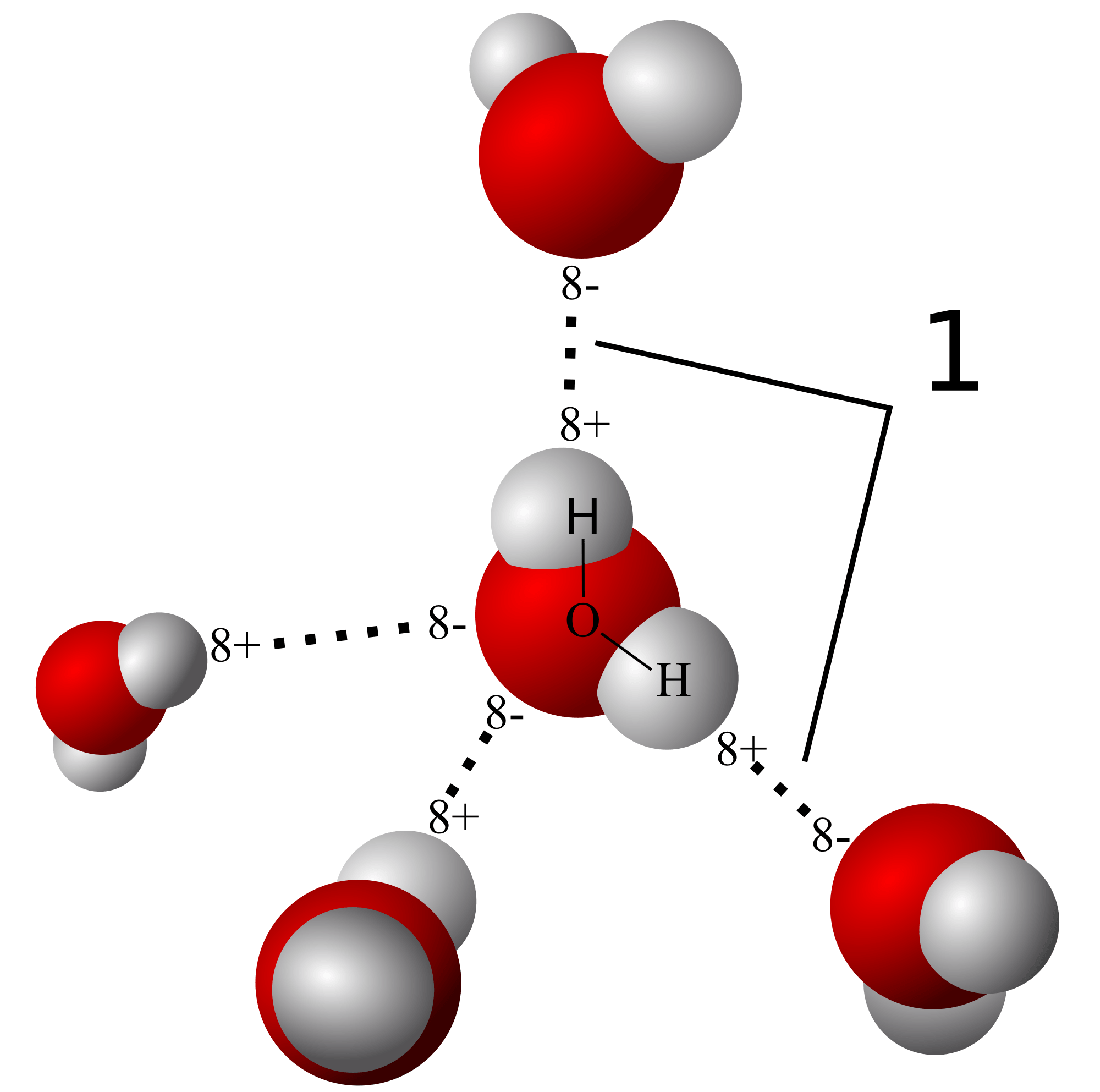
Attractions between water molecules are called
a)
Covalent bonds
b)
Ionic bonds
c)
Polar bonds
d)
Hydrogen bonds
100 %

