

wayground logo

Free Printable Worksheets

NEW

Font size

S
M
L
XL
Worksheets

PS chapter 6

Total questions: 60

Worksheet time: 1hrs 14mins
Name
Class
Date
1.
Electricity that flows in a closed path is called a
a)
path
b)
current
c)
circuit
2.
The flow of electricity in a circuit-
a)
current
b)
flow
c)
circuit
3.
____________ stops the flow of electricity.
a)
A conductor
b)
An insulator
c)
A magnet
4.
Two types of circuits are
a)
parallel and magnetic
b)
electromagnetic and series
c)
series and parallel
5.
The unit for current is the 
a)
Volt
b)
Ohm
c)
Electron
d)
Amp
6.
In a ________ circuit there are multiple paths for the current to take.
a)
Series
b)
Parallel
7.
In a _________ circuit, if one bulb goes out then the entire circuit doesn't work.
a)
Series
b)
Parallel
8.
The continuous flow of electric charges through a material is called...
a)
Electric Field
b)
Electric Force
c)
Electric Current
d)
Electric Circuit
9.
Identify the conductor below.
a)
cloth rag
b)
plastic bottle
c)
gold ring
10.
What is the unit for resistance?
a)
Volts
b)
Amperes
c)
Ohms
11.
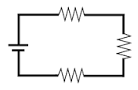
What type of circuit is pictured?
a)
series
b)
parallel
12.
What kind of circuit is this?
a)
Series
b)
Consecutive
c)
Parallel
d)
Training
13.
Lightning is an example of _________.
a)
static electricity
b)
current electricity
c)
watts
d)
voltage
14.
Identify the insulator below.
a)
aluminum foil
b)
paperclip
c)
rubber eraser
15.
Thicker wires have _______ resistance than thinner wires.
a)
more
b)
less
c)
the same
16.
As the resistance in a circuit increases, the electric current __________.
a)
increases
b)
decreases
c)
stays the same
17.
Which formulas represents Ohm's law?
a)
V=IR
b)
R=IV
c)
I=RV
18.
Which subatomic particles have a positive charge?
a)
neutrons
b)
electrons
c)
protons
19.
An accumulation of electrons on an object is known as ___________.
a)
current
b)
AC
c)
static electricity
20.
Electricity is the flow of _________.
a)
protons
b)
neutrons
c)
electrons
21.
What type of circuit is pictured?
a)
series
b)
Parallel
22.
Which type of current comes from a battery?
a)
alternating current (AC)
b)
direct current (DC)
23.
A material in which electrons are able to move easily
a)
Circuit
b)
Insulator 
c)
Resistance 
d)
Conductor 
24.
A material in which electrons are not able to move easily 
a)
Circuit 
b)
Insulator 
c)
Resistance 
d)
Conductor
25.
The process of transferring charge by touching or rubbing 
a)
Induction 
b)
Conduction 
c)
Friction 
d)
Conductor 
26.
The rearrangement of electrons on a neutral object caused by a nearby charged object 
a)
Induction 
b)
Conduction 
c)
Friction 
d)
Conductor 
27.
Electric current that flows in only one direction. 
a)
Voltage 
b)
Direct Current 
c)
Alternating Current
d)
Series Circuit 
28.
Electric current that reverses its direction of flow in a regular pattern  
a)
Voltage 
b)
Direct Current 
c)
Alternating Current 
d)
Parallel Circuit 
29.
The tendency for a material to oppose the flow of electrons, changing electrical energy into thermal energy and light.
a)
Voltage
b)
Current
c)
Resistance
d)
Circuit 
30.
According to this law, the current in a circuit equals the voltage difference divided by the resistance. 
a)
Law of Conservation of Energy 
b)
Ohm's Law 
c)
Law of Conservation of Charges
d)
Newton's First Law 
31.
This circuit contains two or more branches for current to move through. 
a)
Series Circuit 
b)
Parallel Circuit 
32.
Which on the following is NOT an example of an insulator.
a)
Rubber
b)
Glass
c)
Penny 
d)
Wood
33.
What does a resistor do? 
a)
Reduces the flow of electrons
b)
Reduce the flow of the current
c)
Increase flow of electrons
d)
Decreases the flow of electrons 
34.
Where do electrons pick up their energy from? 
a)
Battery
b)
wire
c)
Lightbulb
35.
Which of the following is not a source of electricity 
a)
Windmills
b)
Batteries
c)
wires
d)
Hydroelectric dams
36.
The job of the electron is to ...?
a)
Control which way the current flows.
b)
Use electricity in a circuit
c)
Carry electricity around a circuit
37.
What it the formula to find voltage. 
a)
I= V/R
b)
R=V/I
c)
V= I x R 
38.
What is static electricity?
a)
the flow of electric charges
b)
the build-up of an electrical charge on a surface.
c)
the opposition of current flow. 
39.

In a series circuit what happens when you add another bulb?

a)

The bulbs gets brighter

b)

The bulbs gets dimmer

c)

Nothing changes

40.
Voltage difference is related to the force that causes electric charges to flow. 
a)
True
b)
False
41.

Electric current flows from

a)

detect electric current

b)

negative terminal to positive terminal

c)

positive terminal to negative terminal

d)

the flow rate of electric charges through a conductor

42.

Electric current is defined as

a)

detect electric current

b)

negative terminal to positive terminal

c)

positive terminal to negative terminal

d)

the flow rate of electric charges through a conductor

43.
What is voltage measured in?
a)
Ω (Ohms)
b)
V (Volts)
c)
A (Amps)
d)
W (Watts)
44.
What is resistance measured in?
a)
Ω (Ohms)
b)
V (Volts)
c)
A (Amps)
d)
W (Watts)
45.
How do you calculate current
a)
Resistance X Voltage
b)
Voltage X Resistance
c)
Resistance ÷ Voltage
d)
Voltage ÷ Resistance
46.
How do you calculate resistance?
a)
Voltage X Current
b)
Current ÷ Voltage
c)
Voltage ÷ Current
d)
Current X Amps
47.

Which of the following substances is the best conductor of electricity?

a)

Glass

b)

Wood

c)

Water

d)

Mercury

48.

A higher resistance in a circuit causes a _____________.

a)

higher voltage

b)

larger current

c)

smaller current

d)

lower voltage

49.

Opposite charges ____________________.

a)

repel

b)

attract

50.

Like charges ______________________.

a)

repel

b)

attract

51.
How do wires work?
a)
they become an electrical charge
b)
they bend electricity easily
c)
they keep the charge from moving randomly
d)
they allow a current of electricity to flow 
52.
What is the main purpose of a battery?
a)
to pump electricity through the wires
b)
to make things go
c)
to provide just the right amount of energy needed
d)
to replace household electricity
53.
How is electricity generated in a battery?
a)
through a solar reaction
b)
through kinetic energy
c)
by a chemical reaction
d)
by the flow of particles
54.
Which best describes a parallel circuit?
a)
Electricity flows along one pathway.
b)
The flow of electricity comes from one source. 
c)
Electricity flows along more than one pathway. 
d)
The flow of electricity comes from more than one source. 
55.
Which best describes a series circuit? 
a)
It has two light bulbs. 
b)
The same current flows through both light bulbs. 
c)
It uses a single battery.
d)
The current is divided between the light bulbs. 
56.
What is one problem with using a series circuit? 
a)
It has a lot of series. 
b)
If one goes down, they all go down! 
c)
It doesn't work properly.
d)
There are no problems. 
57.
What is one benefits of using a parallel circuit?  
a)
It gets confusing.
b)
There are no problems.
c)
If one goes down, it does not affect the others. 
d)
Porque es para llelio. 
58.
brass is a _____?
a)
insulator
b)
conductor
59.
Is a house in a good idea for a parallel circuit
a)
Yes 
b)
No
60.
What will happen if one light bulb is removed from this circuit?
a)
the other bulbs will go out
b)
the other bulbs will get dimmer
c)
the other bulbs will get brighter
d)
the battery will become stronger
