wayground logo

Free Printable Worksheets

NEW

Font size

S
M
L
XL
Worksheets

Thermochemistry Review

Total questions: 38

Worksheet time: 49mins

Name
Class
Date
1.
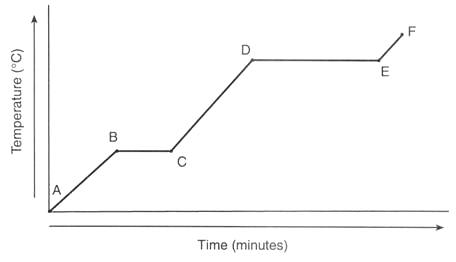
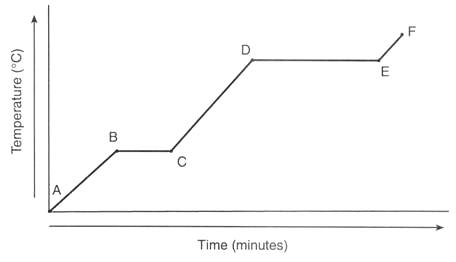
What line segment represents only the solid state?
a)
A-B
b)
B-C
c)
C-D
d)
D-E
2.
Which segment represents the heat of fusion?
a)
A-B
b)
B-C
c)
C-D
d)
D-E
3.
In which segment is the kinetic energy remaining constant?
a)
A-B
b)
B-C
c)
C-D
d)
E-F
4.
What state(s) of matter are present at D-E?
a)
Solid-liquid
b)
Liquid
c)
Liquid-gas
d)
Gas-Solid
5.
Between which points is the temperature of the substance remaining constant?
a)
A-B only. 
b)
A-B, C-D, E-F
c)
B-C only. 
d)
B-C, D-E
6.
Between which points is the temperature of the substance increasing?
a)
A-B only. 
b)
A-B, C-D, E-F
c)
B-C only. 
d)
B-C, D-E
7.
Between which points is the substance changing state?
a)
A-B only. 
b)
A-B, C-D, E-F
c)
B-C only. 
d)
B-C, D-E
8.
This type of graph is called a:
a)
Phase diagram
b)
Heating curve
c)
State of matter
d)
Temperature chart
9.
What state of matter is X?
a)
solid 
b)
liquid
c)
gas
d)
supercritical fluid
10.
What state of matter is Y?
a)
solid 
b)
liquid
c)
gas
d)
supercritical fluid
11.
What state of matter is Z?
a)
solid 
b)
liquid
c)
gas
d)
supercritical fluid
12.
What is point A?
a)
triple point
b)
critical point
c)
equilibrium point
d)
normal melting point
13.
What is point B?
a)
triple point
b)
critical point
c)
equilibrium point
d)
normal melting point
14.
What change occurs from F to E?
a)
sublimation
b)
deposition
c)
melting
d)
condensation
15.
What change occurs from E to C?
a)
sublimation
b)
freezing
c)
melting
d)
boiling
16.
What change occurs from C to D?
a)
condensation
b)
vaporization
c)
melting
d)
sublimation
17.
The pressure is increased on a sample of water at 0 °C from 0 mmHg to 800 mmHg.  In order, what changes occur?
a)
deposition, melting
b)
sublimation, melting
c)
condensation, freezing
d)
deposition, freezing
18.
What is true regarding CO2 for temperatures above 31 °C?
a)
It can never be liquified.
b)
It decomposes.
c)
It has a high pressure.
d)
It is a plasma.
19.
What would happen to the liquid substance if the pressure were decreased until a phase change occurred? It would undergo...
a)
melting
b)
vaporization
c)
condensation
d)
sublimation
20.
What is the normal boiling point of this substance?
a)
150 °C
b)
100 °C
c)
-50 °C
d)
0 °C
21.
What is the normal melting point of this substance?
a)
150 °C
b)
100 °C
c)
-50 °C
d)
0 °C
22.
Water exists as a _____________ at 700 mmHg and 50 °C.
a)
solid
b)
liquid
c)
gas
d)
supercritical fluid
23.
Water exists as a _____________ at 3 mmHg and 50 °C.
a)
solid
b)
liquid
c)
gas
d)
supercritical fluid
24.
Above the temperature and pressure of point B, this substance exists as a ____________.
a)
solid
b)
liquid
c)
gas
d)
supercritical fluid
25.

What would happen if the gaseous substance with a pressure of 10-3 atmospheres were cooled until a phase change occurred?

a)

condensation

b)

vaporization

c)

sublimation

d)

deposition

26.
7. All phase changes (changing states) requires energy to be added or taken away.
a)
True
b)
False
27.

What happens to particles when they increase in temperature?

a)

They speed up

b)

They slow down

c)

They are pushed together

d)

They spread out

28.
Boiling is ...
a)
liquid to gas
b)
gas to solid
c)
gas to liquid
d)
solid to liquid
29.
What is sublimation?
a)
phase change between solid and liquid
b)
pahse change from gas to solid
c)
phase change from solid to gas
d)
phase change from solid to solid
30.
4. What type of state of matter is a gas that has electrons flowing through it?
a)
Gas
b)
Liquid
c)
Plasma
d)
Solid
31.

What happens to particles when they undergo boiling?

a)

They speed up

b)

They slow down

c)

They are pushed together

d)

They spread out

32.
Copper, Stainless Steel, Carbon Steel, and Zinc were all heated using the same thermal energy.  What material would be the coolest after being heated?
a)
Copper
b)
Carbon Steel
c)
Zinc
d)
Stainless Steel
33.
The specific heat of aluminum is 0.21 cal/g°C.  How much heat(Q) is released when a 10 g piece of aluminum foil is taken out of the oven and cools from 100° to 50°?
a)
105 J
b)
10.5 J
c)
1.05 J
d)
50 J
34.

A 15.75-g piece of iron absorbs 1086.75 joules of heat energy, and its temperature changes from 25°C to 175°C. Calculate the specific heat capacity of iron.

a)

0.46 J/goC

b)

1.654 J/goC

c)

2,567,446.875 J/goC

35.

Latent heat is

a)

the heat absorbed or released at a boiling process during a change of phase

b)

the heat absorbed or released at a constant temperature during a change of phase

c)

the heat absorbed or released at a constant temperature during a change of phase of 1 kg object

d)

the heat absorbed or released by an object to increase or decrease its temperature by 1 degree Celcius

36.

Calculate the energy absorbed by 30 g of water at 100 ⁰C that boiled completely. (heat of vaporization of water is 2260 J/g)

a)

67 800 J

b)

6780 J

c)

678 J

d)

67.8 J

37.

A pot of 240g of water at a temperature of 25˚C, boils, and completely evaporated. Determine the heat energy needed for this entire process to occur. (heat of fusion of water is 2260 J/g)

a)

133.76 J

b)

542,400 J

c)

75, 312 J

d)

617,712 J

38.

A 20.0g of iron cools from 134.0°C to 25.0°C when placed into a pot of water at 22.1°C. If iron has a specific heat of 0.10 J/g°C, what is the mass of the water in the pot?

a)

17.0 g

b)

18.0 g

c)

20.0 g

d)

19.0 g