

wayground logo

Free Printable Worksheets

NEW

Font size

S
M
L
XL
Worksheets

Unit 3 Review - Cell Structure, Function, and Transport

Total questions: 69

Worksheet time: 52mins

Name
Class
Date
1.
This scientist concluded that animals and, in fact, all living things are made of cells:
a)
Hooke
b)
Leeunwenhoek
c)
Schleiden
d)
Schwann
2.
This scientist proposed that all cells come from other cells:
a)
Leeunwenhoek
b)
Schleiden
c)
Schwann
d)
Virchow
3.
This scientist concluded that plants are made of cells:
a)
Virchow
b)
Schwann
c)
Schleiden
d)
Leeunwenhoek
4.
This scientist observed live cells and observed greater detail:
a)
Hooke
b)
Leeunwenhoek
c)
Virchow
d)
Schwann
5.
The Cell Theory states...
a)
atoms create all matter
b)
living things evolve
c)
the cell is the backbone of all matter
d)
cells are the basic unit of structure and organization of organisms
6.
Cells come only from what?
a)
existing cells
b)
nucleus
c)
fission
d)
budding
7.
This is the most basic unit of life
a)
atom
b)
cell
c)
nucleus
d)
DNA
8.
These cells have DNA surrounded by a nucleus.
a)
Eukaryotic
b)
Prokaryotic
c)
Neither
d)
Both prokaryotic and eukaryotic
9.
What type of cell is pictured?
a)
Prokaryotic
b)
Eukaryotic
c)
Plant
d)
Animal
10.

All cells have cell membranes. What is the function (job) of the cell membrane?

a)

Allow certain things to enter and exit the cell.

b)

Allows all things to enter the cell.

c)

Does not allow anything to enter and exit.

d)

It is made out of wood.

11.
What does it mean when you see a nucleus in a cell?
a)
The cell is empty
b)
The cell is prokaryotic
c)
The cell is eukaryotic
d)
This would not be a cell
12.
What is cytoplasm? 
a)
The outside of the cell
b)
Another name for cells
c)
Another name for a nucleus
d)
The gel like liquid inside all cells
13.
Ribosomes are found in both prokaryotic and eukaryotic cells. What is the main function of ribosomes.
a)
to make proteins 
b)
to make sugar
c)
to make oil
d)
to make cells 
14.
Which of the following would be found in both eukaryotic AND prokaryotic cells?
a)
chloroplast
b)
cytoplasm
c)
nucleus
d)
endoplasmic reticulum
15.
Which is true of prokaryotic and eukaryotic cells?
a)
Prokaryotic cells are larger than eukaryotic cells.
b)
Eukaryotic cells do not have nuclei, and prokaryotic cells do have nuclei.
c)
Prokaryotic cells lack membrane-bound organelles, and eukaryotic cells contain membrane-bound organelles.
d)
Eukaryotic cells are simpler than prokaryotic cells.
16.

Aaniyah is examining a cell under a microscope. She notices a mitochondria inside. Which of the following is a conclusion she might draw?

a)

She is examining a eukaryotic cell.

b)

She is examining a prokaryotic cell.

c)

This cell could be either eukaryotic or prokaryotic.

17.

This organelle digests dead cell parts and contains enzymes

a)

lysosome

b)

golgi body

c)

smooth ER

d)

Rough ER

18.
The ____________ packages and processes material before it exports out of the cell.
a)
Vacuoles
b)
mitochondria
c)
Golgi apparatus 
d)
nucleus 
19.

What am I? I break down glucose from food and use it to make ATP energy (to power the cell).  

a)

chloroplast

b)
ribosome
c)
mitochondria
d)
lysosome
20.

which of the following transports material WITHIN the cell?

a)
Golgi apparatus 
b)
Endoplasmic reticulum
c)
cell wall 
d)
ribosomes
21.

Which structure would be found in a grass cell but NOT in one of your own cells?

a)
cell wall
b)
nucleus
c)
mitochondria 
d)
vacuoles 
22.

Unlike Smooth ER, Rough ER has ________________ attached to it. 

a)
ribosomes 
b)
chromosomes 
c)

carbohydrate chains 

d)

proteins

23.
What is the function of vacuoles?  
a)
make protein
b)
store genetic information
c)
storage of salt, H2O, food, and waste
d)
transports material outside the cell
24.
Which of these statements best describes the function of the cell membrane?
a)
It allows things to freely enter and exit the cell
b)
it controls which substances enter and exit the cell
c)
it prevents substances from entering the cell
d)
it prevents substances from leaving the cell
25.
Plant cell structures that turn energy from sunlight into food.
a)
Cell Wall
b)
Mitochondria
c)
Chloroplast
d)
Cytoplasm
26.

In passive transport, the concentration gradient goes from..

a)

Low to low

b)

High to low

c)

Low to high

d)

High to high

27.
The cellular process in which materials are moved across a membrane from an area of low concentration to an area of high concentration is called
a)
Osmosis
b)
Simple Diffusion
c)
Active Transport
d)
Passive Transport 
28.
Osmosis is the diffusion of __________.
a)
water
b)
glucose
c)
air
d)
passive transport
29.
Passive transport requires no
a)
concentration gradients
b)
osmosis
c)
motion
d)
energy
30.
Large molecules, such as glucose, can easily pass through the cell membrane without any help...
a)
True- they pass right through
b)
False- they need a protein channel 
31.
When particles move out of a cell through facilitated diffusion, the cell ____________.
a)
Gains energy
b)
Uses energy
c)
Releases energy
d)
Does not use energy
32.
Which type of Passive Transport is being represented in this picture?
a)
Passive Diffusion
b)
Simple Diffusion
c)
Active Diffusion
d)
Facilitated Diffusion
33.
Hydrophobic region of the cell membrane?
a)
E
b)
B
c)
C
d)
34.
Hydrophilic portion of cell membrane?
a)
A
b)
C
c)
D
d)
35.

The purple structures of the image represent:

a)

phospholipid

b)

cholesterol

c)

proteins

d)

carbohydrates

36.
A phospholipid has 2 parts. What are they called? 
a)
Hydrophilic Head, Hydrophobic Tail 
b)
Hydrophobic Head, Hydrophilic Tail 
37.
"Water Fearing" 
a)
Hydrophobic
b)
Hydrophilic 
c)
Hydroelectric 
d)
Hydroloric
38.
"Water Loving"
a)
Hydrophobic
b)
Hydrophilic 
c)
Hydroelectric 
d)
Hydroloric
39.
Describes the arrangement of the cell membrane as bendable and made of many parts. 
a)
The Fluid Mosaic Model 
b)
The Major Mobility Model 
c)
The Crazy Cell Model
d)
The Maze Model
40.

Something is ___________ ____________ when some molecules can pass through it while others cannot. 
a)
Selectively (or Semi) Permeable 
b)
Totally Transparent
c)
Liquid Licorice 
d)
Heavily Patrolled 
41.
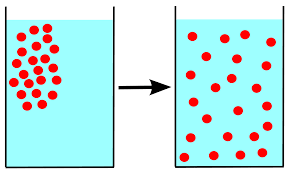
The picture below is an example of _________________.
a)
osmosis
b)
isotonic
c)
diffusion
d)
active transport
42.
Which type of movement requires energy?
a)
osmosis
b)
active transport
c)
diffusion
d)
facilitated diffusion
43.
What are the three types of passive transport?
a)
osmosis, diffusion, active transport
b)
active transport, facilitated diffusion, osmosis
c)
diffusion, osmosis, facilitated diffusion
d)
facilitated diffusion, active transport, diffusion
44.
Which type of movement has channels that help large molecules move through the cell membrane?
a)
active transport
b)
diffusion
c)
osmosis
d)
facilitated diffusion
45.

Which type of movement has proteins that act like energy-powered pumps to move molecules through the cell membrane?

a)

protein pumps

b)
diffusion
c)

osmosis

d)
facilitated diffusion
46.

What type of solution is a cell in when it gets bigger than it normally would?

a)

hypertonic

b)

isotonic

c)

hypotonic

47.

What type of solution is a cell in when it shrinks or shrivels up?

a)

hypertonic

b)

isotonic

c)

hypotonic

48.
What type of solution is a cell in when it stays the same size?
a)
hypertonic
b)
isotonic
c)
hypotonic
49.
What type of solution is this cell in?
a)
Isotonic
b)
Hypertonic
c)
Hypotonic
d)
diffused
50.
What type of solution is this cell in?
a)
Isotonic
b)
Hypertonic
c)
Hypotonic
d)
diffused
51.
What type of solution is this cell in?
a)
Isotonic
b)
Hypertonic
c)
Hypotonic
d)
diffused
52.
The process of engulfing food or liquid particles into the cell.
a)
Osmosis
b)
Exocytosis
c)
Endocytosis
d)
Diffusion
53.
Which type of cellular transport moves molecules from low concentrations to high concentrations?
a)
Osmosis
b)
Diffusion
c)
Passive Transport
d)
Protein Pumps
54.
The release of large particles, often waste materials from the inside of the cell to the outside of the cell.
a)
Osmosis
b)
Exocytosis
c)
Endocytosis
d)
Diffusion
55.
A cell with a 5% salt solution is placed into a beaker with a 10% salt solution.  This solution is considered to be _____ to the cell.
a)
Isotonic
b)
Hypertonic
c)
Hypotonic
d)
None of the Above
56.
A cell with a 5% salt solution is placed into a beaker with a 10% salt solution.  What will happen to the cell?
a)
It will shrink
b)
It will swell
c)
No change
d)
Cytolysis
57.

An animal cell with a 20% salt solution is placed into a beaker of pure water. What will happen to the cell?

a)

It will shrink

b)

Plasmolysis

c)

No change

d)

It will expand and explode

58.
A cell with a 10% salt solution is placed into a beaker with a 40% salt solution.  How will water move?
a)
It will leave the cell
b)
It will enter the cell
c)
It will move in and out equally
d)
There will be no movement
59.

Where can carbohydrates be found when part of a plasma membrane?

a)

On the outside of the membrane

b)

On the inside of the membrane

c)

Embedded part of the way into the membrane

d)

Embedded the whole way through the membrane

e)

All of the above

60.

The cell membrane is made up of a phospholipid bilayer. What does "bilayer" mean?

a)

one layer

b)

two layers

c)

laminated

d)

bilateral

61.

The 'membrane' pictured below would not be able to form because

a)

the 'heads' would repel each other

b)

the 'tails' would repel water on either side

c)

the cell membrane isn't a bilayer

d)

the membrane does not contain phospholipids

62.

The term "mosaic" applies to the cell membrane because...

a)

cell membranes are able to bend, stretch and change shape

b)

Cell membranes are able to flow

c)

Cell membranes are made from a variety of different molecules

63.

The term "fluid" applies to the cell membrane because...

a)

Cell membranes only allow SOME molecules to pass across the membrane

b)

Cell membranes are able to flow

c)

Cell membranes are made from a variety of different molecules

64.

What is the function of the cholesterol of the cell membrane?

a)

allows large molecules to pass through the cell membrane

b)

allows small, non-polar molecules to pass through the cell membrane

c)

identifies the cell and allow for cell-to-cell communication

d)

stabilizes the fluidity of the cell membrane

65.
What type of transport is this?
a)
Endocytosis
b)
Diffusion
c)
Exocytosis
d)
Osmosis
66.
What type of transport is this?
a)
Endocytosis
b)
Facilitated Diffusion
c)
Active Transport Pump
d)
Osmosis
67.
What type of transport is this?
a)
Endocytosis
b)
Exocytosis
c)
Diffusion
d)
Sodium-Potassium Pump
68.

During phagocytosis, a cell

a)

takes in solid food (eats)

b)

takes in liquids (drinks)

c)

sends liquids out of the cell

d)

sends solids out of the cell

69.

During pinocytosis, a cell

a)

takes in solid food (eats)

b)

takes in liquids (drinks)

c)

sends solids out of the cell

d)

sends liquids out of the cell
