
 Worksheets
Atoms and Light Review
Total questions: 116
Worksheet time: 2hrs 56mins
The number of _______ determines the element
Protons
Electrons
Neutrons
Light is given off from an atom when...
electrons move to a higher shell
electrons drop from a higher shell

How many electrons does this oxygen atom have?
6
8
10
4


Atoms of the same element with a different number of neutrons
Ion
alloy
Isotope
Quarks
How many neutrons are in 157N?
15
7
8
22
How many neutrons are in 10947Ag?
47
62
109
156
How many protons are in 2512Mg+2?
12
13
10
14
How many electrons are in 2512Mg+2?
12
13
10
14
How many neutrons are in 168O-2?
17
8
10
6
How many electrons are in 168O-2?
17
8
10
6
What electromagnetic wave . has . the shortest wavelengths and the highest frequencies?
Gamma Rays
Ultraviolet Rays
Radio Waves
X Rays
What happens to wavelength as the frequency of a wave increases?
increase
stays the same
decreases
becomes faster
What electromagnetic wave has the longest wavelengths and lowest frequencies?
Microwaves
Ultraviolet Rays
Infrared Waves
Radio Waves

What electromagnetic wave do humans emit as heat energy?
infrared light
ultraviolet light
visible light
microwaves
Which of the following is correct in order from lowest to highest energy?
X Rays, Visible Light, Microwave
Ultraviolet, Visible Light, Gamma-Rays
Microwave, Visible Light, Gamma Rays
The color blue has more energy than the color red.
True
False

The _______________ determines the color of visible light.
wavelength (and frequency)
speed
amplitude
particles of the medium


What is the mass number for this atom/ion?
16
18
34
32
What is the number of electrons for this atom/ion?
16
18
34
32

How many protons does this ion have?
13
27
10
14
How many neutrons does this ion have?
13
27
10
14
How many electrons does this ion have?
13
27
10
14

Is this isotope symbol correctly written?
Yes
No

Is this isotope symbol correctly written?
Yes
No
Which of these are isotopes of Hydrogen?
1 p+, 1 n0, 1 e-
2 p+, 1 n0, 1 e-
1 p+, 2 n0, 1 e-
1 p+, 1 n0, 2 e-
As the frequency of a wave increases, the wavelength _________.
increases
decreases
stays the same
The low level energy state for an electron is called the ______________________.
excited state
low state
ground state
elevated state
As electrons leave the ________________, energy is emitted as light.
excited state
low state
ground state
elevated state
The common ion of Sodium (Na) will have a charge of ___________.
0
+1
-1
+2

How many of each type of subatomic particle are in this atom?
79 p+, 199 n0, 79 e-
120 p+, 199 n0, 79 e-
79 p+, 120 n0, 79 e-
79 p+, 120 n0, 120 e-
What is the charge of an electron?
Positive
Negative
Neutral
Depends on the atom
Which subatomic particle determines the identity of an element?
Electron
Neutron
Proton
Quark
What atomic particle determines the element?
protons
neutrons
electrons
nucleus
What atomic particle determines the element?
protons
neutrons
electrons
nucleus
What particle(s) are located in the nucleus?
protons only
neutrons only
electrons only
protons and neutrons
protons and electrons
What particle in the atom has no charge and a mass of 1?
proton
neutrons
electrons
ion
What particle(s) have a charge?
protons only
electrons only
protons and electrons
electrons and neutrons
(challenge) An atom has 10 protons and 10 electrons. What happens to the charge if you add 1 more electron?
It becomes a negative ion
It becomes a positive ion
nothing changes
It becomes a different element
An atom of HELIUM has 2 protons. If you add 1 more proton, what happens?
It becomes an ion
It becomes a different kind of element
Nothing
Challenge: what is the mass of an atom with 2 protons, 2 neutrons, and 2 electrons?
mass = 2
mass = 4
mass = 6
mass = 8
Challenge: What is the charge of an atom with 3 protons and 2 electrons?
0 (neutral)
+1
-1
The atomic number is the same as......
the number of protons
the number of electrons
the number of neutrons
the number of protons plus neutrons

How many neutrons does lithium have?
3
4
6
7

What is the atomic number of silicon?
14
28
42
7

What is the best mass number for silver?
47
107
108
154

How many neutrons does beryllium have?
4
5
9
13

How many electrons does helium have?
2
4
6
8
How do you find the number of neutrons in an atom?
It's the same as the atomic #
It's the same as the mass number
Subtract the atomic # from the mass number
Add the mass number and the atomic #
How many PROTONS / ELECTRONS does Potassium- K have?
11
19
37
87
How many PROTONS & ELECTRONS does Neon- Ne have?
7
8
9
10
What is the ATOMIC # (number on top) of Oxygen- O?
6
7
8
9

This picture shows different isotopes of hydrogen written in isotope notation. What is the mass number of deuterium?
1
2
3
This picture shows different isotopes of hydrogen written in isotope notation. What is the atomic number of deuterium?
1
2
3
Can you use the periodic table to find the atomic number of an element?
yes
no
Can you use the periodic table to find the mass number of an element?
yes
no
Different isotopes of an element contain different numbers of ___.
protons
neutrons
electrons
elements
If a proton is added or removed from an atom, what happens?
It becomes a different element.
It becomes a different isotope.
Nothing happens.

How many neutrons are in 1 atom of Carbon-13?
6
13
7
20

How many protons are in an atom of Nitrogen-16?
7
9
16
What is the difference between Neon-20 and Neon-22?
They have different numbers of electrons.
They have different numbers of neutrons.
Only 1 is radioactive.
No difference.

Which atom of these isotopes has 3 protons? The symbol for lithium is Li.
Lithium-6
Lithium-7
All of them.
Lithium-9

How many neutrons are in this isotope?
20
41
61
21
Which is the correct symbol for Fluorine-18?


Bromine-80 has how many neutrons?
41
42
44
45
How do you calculate mass number?
Mass x percent
Protons + Electrons
Protons + Neutrons
Neutrons + Protons + Electrons

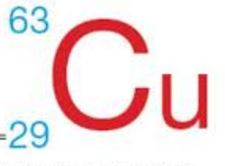
How many protons are in the isotope pictured above?
29
34
63
92

How many electrons does this magnesium ion have?
24
12
10
14

How many protons, neutrons, and electrons?
proton = 16, neutron = 8, electron = 10
proton = 8, neutron = 16, electron = 8
proton = 8, neutron = 8, electron = 10
proton = 6, neutron = 2, electron = 6
IN AN ION THE NUMBER OF PROTONS_________ THE NUMBER OF ELECTRONS.
>
<
=
≠
IN A NEGATIVE ION, THE # OF ELECTRONS _____ # PROTONS
>
<
=

How many ELECTRONS does copper have if it has the following charge: Cu2+ ?
64
35
27
29
If an atom has 9 protons 10 electrons and 10 Neutrons. What is the Charge of the Atom?
(a)
Which term means the number of waves that pass a point in 1 second?
Amplitude
Frequency
Wavelength

A wave with a large wavelength will have...
Low Frequency & Low Energy
High Frequency & High Energy
High Frequency & Low Energy
Low Frequency & High Energy

Which has the LONGEST wavelength and therefore the lowest frequency/energy? These waves are used in broadcasting, wifi, and texting.
Gamma rays
Visible light
Radio waves
Infrared rays

Which electromagnetic waves are used in devices such as heat lamps and TV remote controls?
Ultraviolet rays
Infrared Rays
Microwaves

Which section of the electromagnetic spectrum is the ONLY part humans can see?
X-Rays
Gamma Rays
Visible Light
Ultraviolet Rays

Which electromagnetic waves are used by doctors to detect broken bones inside your body?
X-Rays
Gamma Rays
Ultraviolet Rays
Infrared Rays
Which has the SHORTEST wavelength and therefore the highest frequency/most energy? Hint: These waves are also used in cancer treatments.
Gamma Rays
Radio Waves
Ultraviolet Rays
X-rays

Which wave has a high frequency, a short wavelength, and high energy?
A
B
Not enough information to determine

Which wave has a low frequency, a long wavelength, and low energy?
A
B
Not enough information to determine
On the electromagnetic spectrum, radio waves are found on the end of the spectrum considered to possess a low amount of energy. Which statement most accurately describes the wavelength/frequency relationship present in radio waves?
Radio waves possess both low frequencies and small wavelengths.
Radio waves possess both high frequencies and large wavelengths.
Radio waves possess high frequencies and small wavelengths.
Radio waves possess low frequencies and large wavelengths.
Which of the following best explains why ultraviolet rays can cause sunburn but visible light from a light bulb does not damage skin?
Ultraviolet rays come before the visible light in the EM spectrum, which means anything before visible light automatically causes cancer.
Ultraviolet rays have lower frequencies than visible light rays and thus have higher energy than light rays from a light bulb.
Ultraviolet rays have higher frequency than visible light rays and thus have more energy than light rays from a light bulb.
Ultraviolet rays have higher frequencies than visible light rays and thus have less energy than light rays from a light bulb.

Based on the attached diagram, which of the following types of electromagnetic radiation has the LOWEST energy?
microwave
ultraviolet
infrared
x-rays
As the wavelength of a wave gets longer, what is also true?
Frequency of the wave will increase
Energy of the wave with increase
Frequency of the wave will decrease
The wave will travel at a slower speed
As wavelength increases, frequency __________ and energy ________.
Increases, decreases
Increases, increases
Decreases, decreases
Decreases, increases
Which two variables of the electromagnetic spectrum have a direct relationship?
(there may be more than one correct answer)
Crests and trough
Energy and frequency
Wavelength and energy
Frequency and wavelength
The visible light that we can see travels in waves. Blue light has a wavelength of 450 nm and orange light has a wavelength of 600 nm. Based on this information, what is true about the energies of blue and orange light?
Energy of blue light will be lower than that of orange light.
Energy of blue light will be higher than that of orange light.
Energy of blue light and orange light will be the same.
Wavelengths of light and energy of light are independent of each other.
What is the ground state?
none of these
where all the electrons are located
the highest energy level
the lowest energy level
What is an energy level?
Orbit/ring of the electron as it moves around the nucleus
Orbit/ring of electron as it moves inside the nucleus
Red light has _____?
the lowest energy, longest wavelength
highest energy, smallest wavelengths
neither
What is a flame test?
When a compound is burned causing different colors of visible light to be released
When a compound is frozen causing different colors of visible light to be released
When a compound is put in water causing different colors of visible light to be released
none of these

Which type of visible light has the highest energy?
Red
Yellow
Green
Violet


Light is emitted when electrons
move from one atom to another.
collide with one another, releasing energy.
move from a lower energy level to a higher energy level.
move from a higher energy level to a lower energy level.

Look carefully at the picture. It shows an electron in the excited state on the left, and the electron returning to its ground state on the right. When the electron return to the ground state it emits a_______________________.
blast of cold air
electrostatic charge
proton
photon (light)

An atom that has gained energy beyond normal is said to be ...
excited
grounded
naturalized
In order to go from ground state to an excited state, an electron must
emit energy
absorb energy
rotate
wiggle

Each of the following diagrams shows a hydrogen atom that is initially in an excited state. In each case, the electron transitions from a higher energy level to a lower energy level, emitting a photon. For which case is the energy of the emitted photon the greatest?



