
 Worksheets
First Semester Exam Pretest
Total questions: 120
Worksheet time: 2hrs 0mins
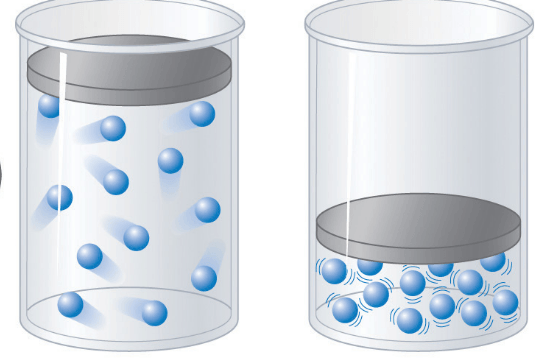
Charles's Law relates which 2 variables?
pressure and volume
temperature and pressure
temperature and volume
amount and volume
What units are used to measure volume? CHECK ALL CORRECT ANSWERS
Liters
mL
L
Kelvin
Celsius
What units for temperature must be used in gas law equations?
T
Celsius
Liters
Kelvin
What type of relationship is Charles' Law?
Direct
Inverse
A balloon with 3L of air starts at a pressure of 233 kPa, then it rises several thousand feet to a pressure of 190 kPa. Which gas law would let you solve for the new volume?


5. According to Charles Law, if Temperature of a gas increases Volume will also....
Increases
Stays the same
Decreases

10. A 500L container filled with a gas. This gas heated from 200K to 400K. If the pressure remains constant, what is the new volume of the container?
250 L
1000 L
500 L
2000 L
A gas occupies 900.0 mL at a temperature of 27.0 °C. What is the volume at 132.0 °C?
(a)
600.0 mL of air is at 20.0 °C. What is the volume at 60.0 °C?
(a)
What is the variable for V for idea gas laws
mm Hg
mL
gallons
L
How can you convert from mL to L
(a)
What is the variable for T ideal gas
K
oC
F
How do you convert from oC to K
(a)
What are the variables we can use for P in ideal gas
mm HG
kPa
Pa
atm
What is the variable for n in ideal gas
g
mol
What does R stand for
Ideal gas constant
Real gas constant
Temperature constant
Ideal gas law
Which is a correct unit for R?
L.atm/mol.k
L.atm
mmHg/mol.K
L.atom/mol
What is the equation for Ideal Gas Law (hint what we have been studying)
(a)
1 atm =
760 mm Hg
920 mm Hg
102 mm Hg
786 mm Hg
1 atm =
1829 kPa
91.9 kPa
101.3 kPa
111.3 kPa
PV=nRT


If a hairspray can is heated, what can be expected of the pressure of the gas inside the can?
The pressure will increase
The pressure will decrease
The pressure will remain constant
The pressure will equalize
Pressure is
defined as the mass that an object exerts when at rest.
not a measurable in gases.
defined as the number of moles of substance divided by the mass of the substance.
created by the force of the gas particles impacting the walls of the container.
A student inflates a balloon with helium then places it in the freezer. The student should expect
the balloon's volume to increase
the balloon's volume to decrease
the balloon's moles to increase
the balloon's moles to decrease


IF we are using Boyles' law and our Pressure goes UP, what must our volume do?
Go UP
Go DOWN
Stay the same
Wrong law.

PCl5+_ H2O→_ HCl+H3PO4
_Zn+_HCl-->_ZnCl2 +_H2
_Mg + _Cl2 --> _MgCl2

Mg(OH)2 --> __________
P4+O2 --> P2O3
Al2O3 --> Al + O2
LiNO3 +CaBr2 --> Ca(NO3)2 + LiBr
Si(OH)4+NaBr--> SiBr4+NaOH
__Ag2O →__ Ag +___O2
Balance this equation.
__SnO2 +__H2-->__Sn +__H2O
1,1,2,1
1,2,1,1
1,2,1,2
1,2,2,1
Balance this equation.
__CF4 + __Br2 --> __CBr4 + __F2
2,1,2,1
1,2,2,1
1,2,1,2
2,2,2,2
Balance this equation
__Al +__HCl -->__H2 +__AlCl3
2, 6, 3, 2
it is already balanced
4, 12, 3, 4
2, 1, 4, 5
Balance this equation.
__CH4 + __O2 --> __CO2 + __H2O
1,2,1,1
2,1,2,1
1,2,1,2
0,2,0,2
Balance this equation
__Zn +__HCl-->__ZnCl2 +__H2
1,1,2,1
1,1,1,2
1,2,1,1
2,1,1,1
Balance this equation.
__Mg + __Cl2 --> __MgCl2
1, 2,1
already balanced
2,1,1
1,1,2
What coefficients are needed to balance the reaction?
__P4 + __O2 --> __P2O3
Balance this equation.
__Mg + __Cl2 --> __MgCl2
1, 2,1
already balanced
2,1,1
1,1,2
_CH4 + _O2 --> _CO2 + _H2O
Balance this equation
__Zn +__HCl-->__ZnCl2 +__H2
1,1,2,1
1,1,1,2
1,2,1,1
2,1,1,1
__KNO3 --> __KNO2 + __O2
What coefficients are needed to balance the reaction?
2, 2, 1
2, 3, 2
1, 2, 2
1, 3, 1
How many HCl molecules do you need to balance this equation?
2Mg + (a) HCl ---> 2MgCl2 + 2H2
What coefficient should be used to make the following equation balanced?
N2+O2--> __?__NO
1
2
3
4
Drag and drop the coefficients that balance this equation 2 Fe + (a) Cl2 ----> (b) FeCl3
Balance this equation (a) N2 + (b) H2 --> (c) NH3
Balance this equation. _CF4 + _Br2 → _CBr4 + _F2
3,1,2,1
1,2,1,2
2,2,2,2
12CO2 +H2O --> C6H12O6 + O2
CO2 + 9H2O --> C6H12O6 + O2
CO2 + H2O --> 3C6H12O6 + O2
6CO2 + 6H2O --> C6H12O6 + 6O2
What's unbalanced about this equation?
Al + O2 --> Al2O3
Oxygen (O) only
Aluminum (Al) only
Both oxygen and aluminum
Nothing; it is balanced.
What is wrong with how this student balanced the equation?
Original equation: Ag + O2 ---> Ag2O
Solution: Ag + O2 ---> 2Ag2O
They changed the molecular structure of the products/reactants.
The silver (Ag) still isn't balanced.
The oxygen (O) still isn't balanced.
They left out the reactants.

Balance this equation:
(a) Fe + (b) O2 --> (c) Fe2O3
What is the correct coefficient for Fe in the balanced equation below?
__Fe + 3O2 → 2Fe2O3
4
3
1
2
Which of the following equations is NOT balanced?
CaCO3 → CaO + CO2
2K + Cl2 → 2KCl
Na + H2O → NaOH + H2
2H2 + O2 → 2H2O
Using the following equation:
_Fe2O3(s) + 3H2(g) → 2Fe(s) + 3H2O(l)
How many moles of iron can be made from 6 moles H2?
4 moles Fe
6 moles Fe
9 moles Fe
2 moles Fe
2 NaClO3 (s) → 2NaCl (s) +3 O2 (g)
12.00 moles of NaClO3 will produce how many grams of O2?
64 g of O2
576 g of O2
288 g O2
0.563 g O2
How many moles of oxygen are consumed if 8 moles H2 are used?
2
4
6
8
How many moles of oxygen are produced when 6.7 moles of KClO3 decompose completely?
Fe2O3(s) + 3H2(g) → 2Fe(s) + 3H2O(l)
How many moles of iron can be made from 6 moles H2?
4 moles Fe
6 moles Fe
9 moles Fe
2 moles Fe
Fe2O3(s) + 3H2(g) → 2Fe(s) + 3H2O(l)
How many moles of iron can be made from 6 moles H2?
4 moles Fe
6 moles Fe
9 moles Fe
2 moles Fe
12.00 moles of NaClO3 will produce how many grams of O2?
256 g of O2
576 g of O2
288 g O2
How many moles of HCl are consumed in the production of 7.5 moles of MgCl₂?
3.8 moles
15 moles
7.5 moles
23 moles
how many grams of Ca(OH)₂ would be formed with 3.20 moles of CaC₂?
119 g
21.2 g
114 g
237 g
NaIO3(aq) + 6HI(aq) --> 3I2(s) + NaI(aq) + 3H2O(l)
How many moles of iodine can be made from 6.55 moles of NaIO3?
Mg(s) + HCl(aq) --> MgCl₂(aq) + H₂(g)
How many grams of HCl are consumed by the reaction of 2.50 moles of magnesium?
how many grams of H₂O are needed if 3.20 moles of CaC₂ are consumed?
115 g
28.8 g
0.0889 g
6.40 g
Determine the mass of lithium hydroxide produced when 0.38 grams of lithium nitride reacts with water according to the following unbalanced chemical equation: Li3N (s) + H2O (l) → NH3 (g) + LiOH (aq)
(a) g LiOH
What mass of sodium chloride is produced when chlorine gas reacts with 0.29 grams of sodium iodide? The unbalanced equation is given below: NaI (s) + Cl2 (g) → NaCl (s) + I2 (g)
(a) g NaCl
Determine the mass of carbon dioxide produced when 0.85 grams of butane (C4H10) reacts with oxygen according to the following balanced chemical equation: 2 C4H10 (l) + 13 O2 (g) → 8 CO2 (g) + 10 H2O (g)
Determine the mass of antimony produced when 0.46 grams of antimony (III) oxide reacts with carbon according to the following balanced equation: Sb2O3 (s) + 3 C (s) → 2 Sb (s) + 3 CO (g)
Hydrogen peroxide decomposes to produce oxygen gas and water. What mass of hydrogen peroxide (H2O2) must decompose to produce 0.77 grams of water?
In the combustion of carbon monoxide, what mass of CO is required to produce 0.69 grams of carbon dioxide? The unbalanced equation is shown below: CO (g) + O2 (g) → CO2 (g)
Determine the mass of sodium nitrate produced when 0.73 grams of nickel (II) nitrate reacts with sodium hydroxide according to the following unbalanced chemical equation: Ni(NO3)2 (aq) + NaOH (aq) → Ni(OH)2 (aq) + NaNO3 (aq)
Determine the mass of calcium hydroxide produced when calcium carbide (CaC2) reacts with 0.64 grams of water according to the following balanced chemical equation: CaC2 (s) + 2 H2O (l) → Ca(OH)2 (aq) + C2H2 (g)

