
 Worksheets
Chemistry Final Review
Total questions: 120
Worksheet time: 30hrs 0mins
_N2 + _H2 --> _NH3
Example: H2
__ Al + __ FeO → Al2O2 + __ Fe
1, 1, 2
2,1,2
2, 2, 2
2,4,2
How many moles of oxygen are produced when 6.7 moles of KClO3 decompose completely?
How many grams of hydrogen are produced if 120 g of Na are available?
How many liters of carbon dioxide are produced from 10L of carbon monoxide?
2CO + O2 → 2CO2
Fe2O3(s) + 3H2(g) → 2Fe(s) + 3H2O(l)
How many moles of iron (Fe) can be made from 6 moles H2?
In the equation 2 Al2O3 --> 4 Al + 3 O2, what is the mole ratio of aluminum to oxygen (aluminum is asked for, oxygen is given)?
10/6
3/4
4/3
2/3
What is the molarity of a 0.5L sample of a solution that contains 60.0 g of sodium hydroxide (NaOH)
0.8 M
1.5M
3.0M
6.0M
A student is preparing solutions for a laboratory experiment by dissolving solid solutes in liquid solvents. Which action will increase the rate of solubility
lowering the temperature of the solvent
stirring the solute in the solution
increasing the pressure on the solution
increasing the particle size of the solute
Which of the following is the correct formula for calculating molarity?
moles/liters of solution
moles/kg of solvent
# particles/Avogadro's #
theoretical yield/actual yield
Which of the following types of solutions has more room to dissolve solute?
supersaturated
saturated
unsaturated
What does pH measure?
the amount of hydrogen (H+) ions
the amount of hydroxide (OH-) ions
amount of water
all of the above
As one moves down the pH scale from 14 to 1, what happens to the concentration of H+ in the solution?
concentration of H+ decreases
concentration of H+ increases
concentration of H+ stays the same
If pure water is added to an acid with a pH of 3, what happens to the pH of the solution?
the pH increases to above 3
the pH decreases to below 3
the pH stays the same at 3
For a solution at 25oC, pH + pOH =
7
14
1.0 x 10⁻¹⁴
-log (1.0 x 10 -14)
If the pH of a solution is 4.0, what is the pOH?
4.0
10.0
1.0 x 10 -4
cannot be determined from the information
If the [H3O+] of a solution is 1 x 10⁻³ M, the pH is
11
-3
3
1
If a nitrogen gas occupies a volume of 500 mL at a pressure of 0.971 atm. What volume will the gas occupy at a pressure of 1.50 atm, assuming the temperature remains constant?
323.6 mL
728.25 mL
772.39 mL
0.002 mL
According to Boyle's law, at constant temperature, as the pressure of a given sample of gas is increased, the volume will –
Increase
Decrease
Remains the same
They are not related

A student measures the pressure and volume of an empty water bottle to be 1.4 atm and 2.3 L. She then decreases the pressure to 0.65 atm. What is the new volume?
2.1 L
5.0 L
8.2 L
3.9 L
A scientist needs to store 28.0 moles of xenon gas at STP in the lab. What size gas tank will he need?
628 L
473 L
219 L
376 L
A water bottle at STP is cooled to -155°C. What is the new pressure?
3.2 atm
0.43 atm
1.8 atm
0.27 atm
The pressure of a 6.5 L sample of oxygen gas is measured to be 3.8 atm. If the gas is transferred into a 12 L tank, what is the new pressure?
6.6 atm
3.9 atm
4.5 atm
2.1 atm


Stirring the solution increases the rate of dissolution (rate of dissolving).
True
False
The smaller the particle size the faster the rate of dissolution (rate of dissolving).
True
False
Which will dissolve faster? Crushed table salt or a cube of table salt. Assume they have an equal mass.
crushed table salt
crystal of table salt
When no more solute dissolves the solution is _________
supersaturated
unsaturated
saturated
extra saturated
What is the molar mass of Sr(NO3)2?
211.64 g/mol
163.64 g/mol
149.63 g/mol
197.63 g/mol
How many octane molecules would be in 8.4 moles of octane (C8H18)?
959.8
5.06 x 1024
5.06

The symbol represents a(n) ___ particle.
positron
beta
gamma
alpha
In ___ decay, an neutron is changed into an electron and a proton.
alpha
beta
gamma
positron
A(n) ___ particle consists of 2 protons and 2 neutrons.
alpha
beta
gamma
positron
When a proton decays into a neutron and a(n) ___, this is called ___ decay.
electron, beta minus
electron, beta plus
positron, beta minus
positron, beta plus
The time it takes for half of a sample of radioactive particles to decay is called ___.
decay time
half-life
one life
years


Which Lewis Dot Model drawing correctly shows an O2 molecule?


What is the correct Lewis Dot Structure for ammonia NH3


MgO- name?
oxygen magnesium
magnesium oxide
magnesium oxate
magnesium oxygenate
Name the following ionic compound: Cr(NO3)3
chromium III nitride
chromium II nitride
chromium II nitrate
chromium III nitrate
Name the following ionic compound: MgSO4
magnesium (II) sulfide
magnesium sulfide
magnesium sulfate
magnesium (II) sulfate

How many protons are in the nucleus of the element shown?
19
9
10
28

What is the mass number of the element shown?
15
7
8
0
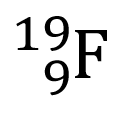
How many protons and neutrons are in the nucleus of the atom shown?
9 protons and 19 neutrons
19 protons and 9 neutrons
10 protons and 9 neutrons
9 protons and 10 neutrons

Which name is correct for the atom shown?
Carbon-6
Carbon-14
Carbon-8
Carbon-0-
An atom has 12 protons and 13 neutrons in its nucleus. Which is the correct symbol?


An atom has 9 protons and 10 neutrons in its nucleus. Which is the correct symbol?


If you need to know what something smells like you will
never put the chemical directly near your face
Waft the air above it
sniff directly
never smell in the lab , always cover your nose
What should you not do in the lab?
follow directions
run
prank
walk
push/shove

H2 + O → H2O

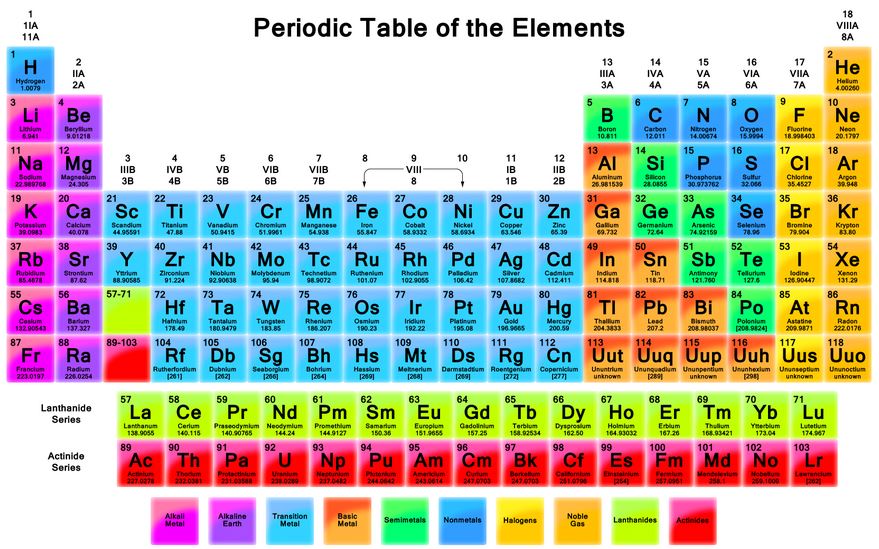
The law that states that the repeating chemical and physical properties of elements relate to and depend on the elements' atomic numbers is _______.
How was Dmitri Mendeleev's periodic table organized?
atomic number
atomic mass
it wasn't organized
nuetrons
Why were there blank spaces left in Mendeleev's periodic table?
He didn't know what to put there.
Undiscovered elements not yet known.
Multiple elements could have fit
He forgot to add the elements in
______arranged elements in a periodic table according to the increasing order of atomic number
John Newlands
Dimitri Mendeleev
Henry Moseley
Lothar Mayer
What happens to the reactivity of the alkali metals as you move down the group?
increases
decreases
As you move down the group, halogens' reactivity...
increases
decreases
doesn't change
shows no trend.
Which halogen is the most reactive?
iodine
chlorine
bromine
fluorine
Which halogen is the least reactive?
iodine
chlorine
bromine
fluorine
Classify:
2H2 + O2 ---->2H2O
synthesis reaction
decomposition reaction
single replacement reaction
double replacement reaction
Classify:
2KClO3 ---->2KCl + 3Os
synthesis reaction
decomposition reaction
single replacement reaction
double replacement reaction
Classify:
Mg + 2HCl ----> MgCl2 + H2
synthesis reaction
decomposition reaction
single replacement reaction
double replacement reaction
Classify:
2HCl + 2NaOH -----> NaCl + H2O
synthesis reaction
decomposition reaction
single replacement reaction
double replacement reaction
Classify:
CH4 + O2 → CO2 + H2O
single replacement
double replacement
synthesis
combustion

