Wayground logo

Free Printable Worksheets

Font size

S
M
L
XL
Worksheets

Energy & Electricity Revision

Total questions: 73

Worksheet time: 48mins

Name
Class
Date
1.
The faster an object moves, the ________ kinetic energy it has. 
a)
more
b)
less
c)
none of the above
d)
all of the above 
2.
What would have the greatest kinetic energy?
a)
A car driving down a hill.
b)
A person running down a hill. 
c)
A ball rolling down a hill. 
3.
Energy in motion is called...
a)
flying tomatoes!
b)
potential energy
c)
Face plant down the stairs
d)
kinetic energy
4.
This states that energy cannot be created or destroyed. 
a)
law of motion
b)
law of conservation of energy
c)
convection
d)
thermal energy
5.
This is the energy that can be released by breaking the bonds between compounds. 
a)
electromagnetic
b)
nuclear 
c)
kinetic 
d)
chemical 
6.
The energy from the random movement of particles is _______ energy.
a)
chemical 
b)
potential 
c)
thermal 
d)
interesting 
7.
The is the energy due to the splitting of atoms. 
a)
nuclear 
b)
chemical 
c)
mechanical 
d)
sound 
8.
Light is a form of __________ energy. 
a)
Sound 
b)
Electromagnetic
c)
Fun
d)
Thermal 
9.
This is the energy that moves objects. 
a)
cool 
b)
nuclear 
c)
chemical 
d)
mechanical 
10.
Energy stored in a flexed or compressed object
a)
gravitational potential energy
b)
mechanical energy
c)
kinetic energy
d)
elastic potential energy
11.
Energy of motion
a)
gravitational potential energy
b)
mechanical energy
c)
kinetic energy
d)
elastic potential energy
12.

define heat

a)

The transfer of heat by the movement of a fluid

b)

The transfer of heat between two substances that are in direct contact.

c)

Is thermal energy that is transferred from hotter object to a cooler object.

13.

list the types of heat transfer

a)

conduction,convection,radiation

b)

thermometer,heat,thermal energy

c)

temperature,convection current

14.
A measure of how hot or cold something is; specifically a measure of the average kinetic energy of the particles in an object.
a)
Thermometer
b)
Temperature
c)
Absolute Zero
d)
Specific Heat
15.
In nature, heat always flows from a:
a)
cold object to a warm object.
b)
small object to a big object.
c)
warm object to a cold object.
d)
large object to a small object.
16.
Which type of energy increases when you compress a spring?
a)
elastic potential energy
b)
kinetic energy
c)
radiant energy
d)
sound energy
17.

Energy stored because of gravity is called:

a)

Gravitational Potential Energy

b)

Kinetic Energy

c)

Mechanical Advantage

d)

Chemical Energy

18.

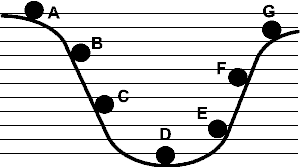
At which point does the ball has the greatest gravitational potential energy (GPE)?

a)

A

b)

G

c)

D

d)

C

e)

G

19.

Which would have the LEAST gravitational potential energy (GPE)?

a)

A ball sitting on the ground

b)

Moon viewed from the Earth

c)

An airplane flying 30,000 feet above the ground

d)

A rock sitting on top of Mt. Everest

20.

How could you increase the gravitational potential energy of an object without changing its mass and gravity?

a)

Make the object larger

b)

Lower the object towards the ground

c)

Raise the object farther off the ground

d)

Allow the object to roll on the ground
21.
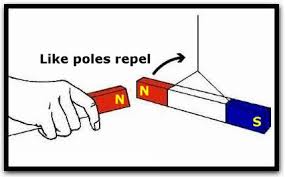
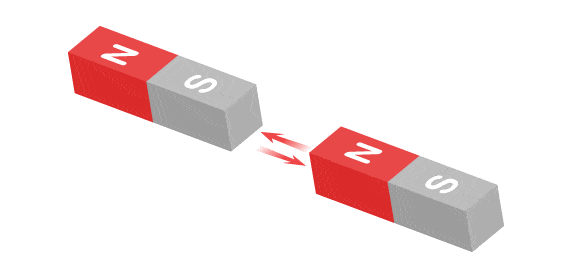
What will happen to the potential energy of the magnets as the N and S get close?
a)
increase
b)
decrease
c)
stay the same
d)
there is none
22.
What will happen to the magnetic potential energy of the magnets when the N and N get close?
a)
increases
b)
decreases
c)
stays the same
23.
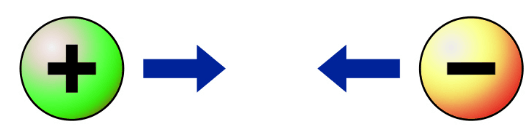
These opposite charges are far apart. What happens to the electrical potential energy when opposite charges are far apart?
a)
increases
b)
decreases
c)
stays the same
24.

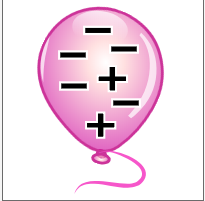
This model of the balloon shows ______ positive charges than negative charges. So this balloon is _____ charged.

a)

fewer/positively

b)

more/positively

c)

fewer/negatively

d)

more/negatively

25.
Which is the best example that something has kinetic energy?
a)
a. a car parked on a steep hill 
b)
b. a tennis ball rolling across the court
c)
c. a picture hanging on the wall 
d)
d. a piece of coal before it's burned 
26.
What is kinetic energy?
a)
energy of work
b)
energy of motion
c)
energy of gravity
d)
energy of power
27.

What two factors affect an object's kinetic energy?

a)

area and volume

b)

mass and weight

c)

weight and height

d)

mass and speed

28.

Where would this tossed baseball have the least amount of kinetic energy?

a)

point W

b)

point X

c)

point y

d)

point z

29.

What is potential energy?

a)

The energy an object has due to its position or condition.

b)

The energy an object has due to its motion.

c)

The energy an object has due to its chemical composition.

d)

The energy as object has due to its atomic structure.

30.

All of the pictures are examples of what type of energy?

a)

gravitational potential energy

b)

elastic potential energy

c)

chemical potential energy

d)

kinetic potential energy

31.
Some students observing a classroom device being used, noticed the below energy transformations. 
Electrical → Mechanical → Sound
Which device were the students most likely observing?
a)
A triple beam balance measuring an object’s mass.
b)
A pencil sharpener plugged into a wall outlet.
c)
A projector displaying a diagram on the screen.
d)
A working flashlight used to light up a dark corner.
32.
Which type of energy transformation occurs when a flashlight shines?
a)
chemical → thermal → electrical
b)
chemical → electrical → light
c)
thermal → chemical → light
d)
chemical → electrical → chemical
33.
When water falls through a dam and turns a turbine connected to a generator, electricity is produced. This electricity is often used to light our homes and offices. Which of the following shows the energy transformations that occurs?
a)
electrical → light → mechanical
b)
chemical → mechanical → electrical
c)
mechanical → chemical → light
d)
mechanical → electrical → light
34.
A lamp that plugs into a wall socket draws energy which flows through a thin wire in the bulb causing it to glow. What energy transformations are taking place?
a)
chemical → light → electrical
b)
mechanical → sound → light
c)
thermal → solar → electrical
d)
electrical → thermal → light
35.
Which of the following shows the correct order of the energy transformations that occur when green plants produce their food from the Sun’s energy?
a)
chemical → thermal
b)
light → chemical
c)
thermal → light
d)
chemical → electrical
36.
The Theory of the Conservation of Energy states -
a)
Energy can be created, just not destroyed. It changes its form from one type to another.
b)
Energy can never be created nor destroyed. It can only change its form from one type to another.
c)
The total energy in our Universe changes, as different forms of energies can be transformed from each other under certain circumstances.
d)
Energy transformations do not passively occur in our lives, rather we actively make use of energies and transform energies.
37.
Solar Energy is transferred to _____ Energy.
a)
Mechanical
b)
Solar
c)
Sound
d)
Electrical
38.
Kinetic Energy is transferred to _____ Energy.
a)
Solar
b)
Electrical
c)
Thermal
d)
Potential
39.
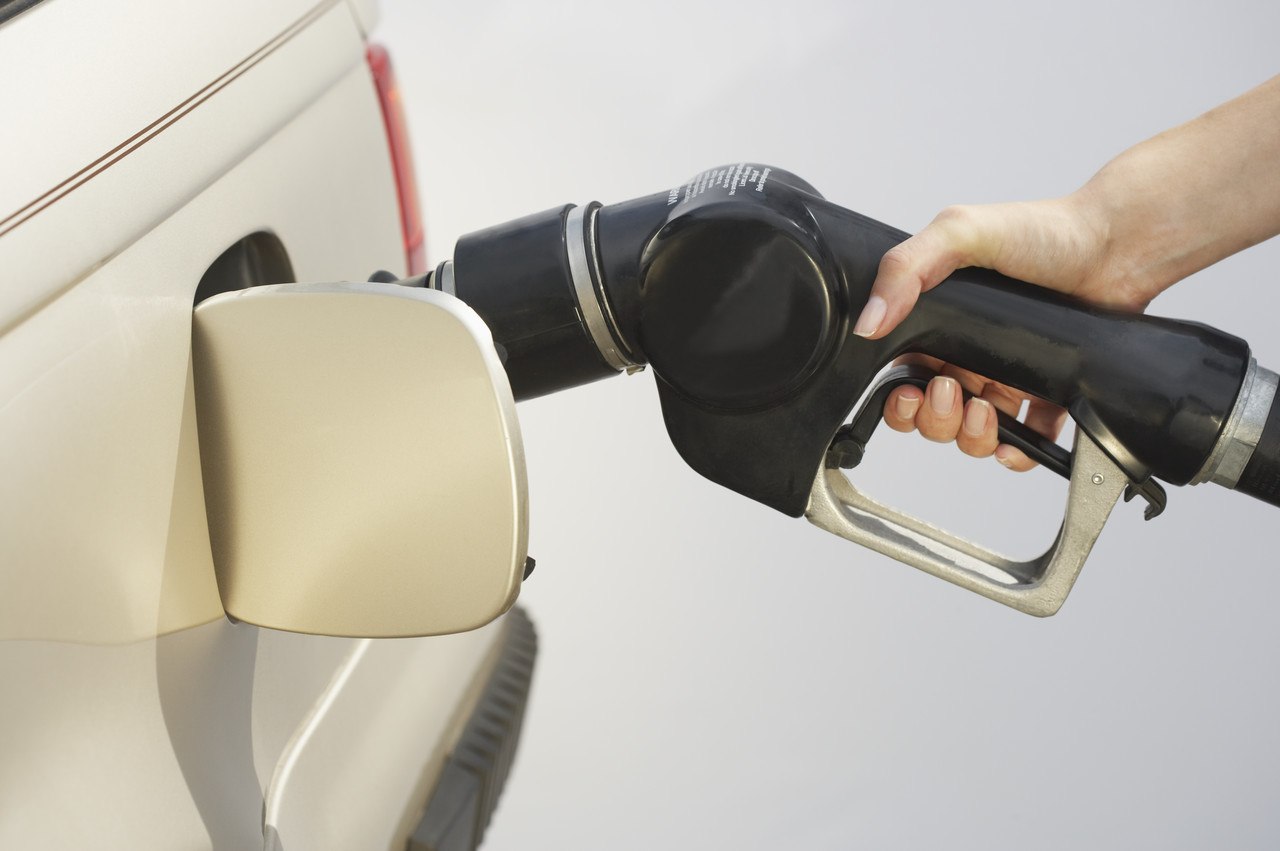
Which energy conversion is taking place when you put gasoline in a car?
a)
thermal -> electrical
b)
mechanical -> electrical
c)
chemical -> mechanical
d)
mechanical -> electromagnetic
40.
what type of energy is stored in a battery?
a)
electrical
b)
chemical
c)
thermal
d)
mechanical
41.
Which of these is an example of light energy being transformed into chemical energy?
a)
A glow stick lights up when broken.
b)
Water heated by the sun evaporates.
c)
A plant makes sugar in the sunlight.
d)
A battery causes a buzzer to vibrate.
42.
The law of conservation of energy states that when one form of energy is converted into another,
a)
energy is destroyed in the process
b)
no energy is destroyed in the process
c)
energy is created in the process
d)
some amount of energy cannot be accounted for
43.

Efficiency is calculated by useful energy output divided by total energy input, expressed as a percentage

a)

False

b)

True

44.

Total energy = 200J
Useful energy = 20J

Workout the efficiency of this lightbulb.
 efficiency = useful enegytotal energy in ×100efficiency\ =\ \frac{useful\ enegy}{total\ energy\ in}\ \times100  

a)

100%

b)

80%

c)

40%

d)

10%

45.

Total energy = 350J
Useful energy = 70J

Workout the efficiency of this iphoneX.
 efficiency = useful energytotal energy in ×100%efficiency\ =\ \frac{useful\ energy}{total\ energy\ in}\ \times100\%  

a)

100%

b)

80%

c)

40%

d)

20%

46.

Total energy = 34000J
Useful energy = 340J

Workout the efficiency of this vintage VW Beetle.
 efficiency = useful energytotal energy in ×100%efficiency\ =\ \frac{useful\ energy}{total\ energy\ in}\ \times100\%  

a)

100%

b)

10%

c)

40%

d)

20%

47.

This car needs 8600J of energy to power it. If 5000J is changed into useful energy, how much energy is wasted?

a)

13600J

b)

3600J

c)

5000J

d)

8600J

48.

A car transfers 100 J of chemical energy in order to gain 50 J of kinetic energy. The efficiency of the car is

a)

20%

b)

0.5%

c)

50%

d)

200%

49.

Which of these equations is correct?

a)

 efficiency = useful energy transferredtotal energy transferredefficiency\ =\ \frac{useful\ energy\ transferred}{total\ energy\ transferred}  

b)

 efficiency = total energy transferreduseful energy transferredefficiency\ =\ \frac{total\ energy\ transferred}{useful\ energy\ transferred}  

c)

 energy = efficiency ×100%energy\ =\ efficiency\ \times100\%  

d)

 efficiency = wasted energy transferredtotal energy tranferredefficiency\ =\ \frac{wasted\ energy\ transferred}{total\ energy\ tranferred}  

50.
What is the efficiency of a machine if 55.3 J of work are done on the machine, but only 14.3 J is produced by the 1machine?
a)
0.25 J
b)
26%
c)
386%
d)
3.86 J
51.
What is the efficiency of the machine if the input is 263 J and the output is 142 J? 
a)
6.26%
b)
54%
c)
100%
d)
260%
52.
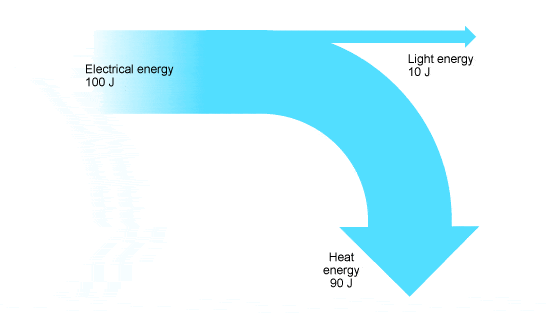
Where does most of the energy go in this transformation.
a)
Electrical energy
b)
Light
c)
Heat
d)
other
53.
What type of device might this Sankey be about?
a)
A very efficient LED light bulb
b)
A very inefficient incandescent light bulb
c)
A coal power plant
d)
A wind turbine
54.
Where does most of the energy go for this transformation.
a)
heat
b)
electrical
c)
light
d)
joules
55.
What might a title be for this sankey?
a)
Electrical energy
b)
Efficient light bulb
c)
25 Joules of heat
d)
Sankey for a good heater.
56.
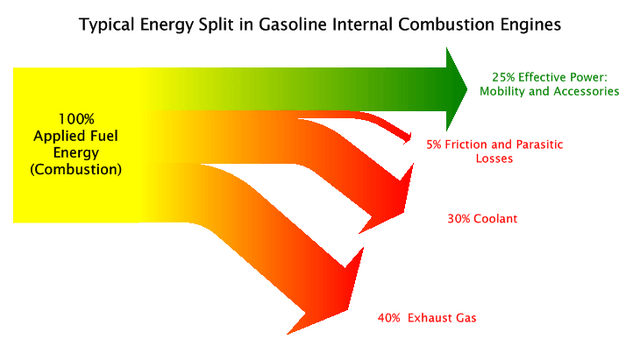
Assume there are 10 pieces of energy.  Which is a close approximation to the number of pieces that transform into kinetic energy?
a)
1
b)
3
c)
6
d)
10
57.
Which of the following is NOT a form of energy?
a)
movement
b)
body mass
c)
heat
d)
food
58.
Which fraction best describes, of the part of the gasoline that is put into a car, that actually makes the car move. 
a)
4/10
b)
1/4
c)
2/4
d)
3/5
59.
Think back to the first question.  Which is more efficient, a car or an incandescent light bulb?  Why?
a)
A car because it helps you move.
b)
A car because a higher percent of energy goes where you want it to.
c)
The light bulb because light is important to see at night.
d)
The light bulb because a high percent of the energy goes where you want it.
60.
If a typical house uses 10 pieces of energy, how many pieces go to heating and cooling?
a)
About 4
b)
About 5
c)
Most of the energy
d)
About a quarter of the energy
61.
If this household wanted to use less energy, where should they first focus their efforts.
a)
Water heater
b)
Better lighting
c)
Unplugging electronics
d)
More efficient air conditioning
62.
What happens when my glass of water is sitting in the sun and disappears into a gas?
a)
evaporation
b)
burning
c)
melting
d)
freezing
63.
Which form of matter does not take the shape of its container?
a)
liquid
b)
gas
c)
solid
d)
air
64.
How is a gas defined?
a)
Indefinite shape, indefinite volume
b)
Definite shape, definite volume
c)
Found in stars
d)
Definite volume, indefinite shape
65.
What term describes a solid changing to a gas?
a)
Deposition
b)
Sublimation
c)
Evaporation
d)
Freezing
66.
What term describes a liquid changing to a solid?
a)
Deposition
b)
Sublimation
c)
Evaporation
d)
Freezing
67.
Particles of a liquid
a)
are tightly packed together and stay in a fixed position.
b)
have no viscosity.
c)
decrease in volume with increasing temperature.
d)
are free to move around one another but still touch.
68.
Particles (molecules) in a ______________________ have more energy than the other states of matter.
a)
gas
b)
solid
c)
liquid
69.
______________________ takes place when a liquid changes to a solid.
a)
freezing
b)
melting
c)
boiling
d)
sublimation
70.
Molecules are closest together in a 
a)
Solid
b)
Liquid
c)
Gas
71.
a)
It remains the same.
b)
It changes greatly.
c)
It changes minimally.
d)
Unable to tell.
72.
The combination of pressure and temperature where all three states of matter will exist at the same time
a)
triple point
b)
temperature point
c)
pressure point
d)
the point of three states
73.
Evaporation is when liquid particles absorb enough energy to leave the 
a)
surface
b)
bottom
c)
center
d)
liquid throughout