
Font size
 Worksheets
Nature of Matter
Total questions: 58
Worksheet time: 55mins
Which of the following is NOT matter?
a chair
air
light
water
Which of the following may be heterogeneous?
elements only
compounds only
mixtures only
elements and compounds
Which of the following is pure?
elements only
compounds only
mixtures only
elements and compounds
Which of the following consists of more than one substance?
elements only
compounds only
mixtures only
elements and compounds
Which of the following are types of matter?
elements only
compounds only
mixtures only
all of these
Which of the following is a type of mixture?
elements only
compounds only
solutions only
elements and compounds
Which of the following is matter?
love
ideas
rock
heat
Which of the following is NOT composed of two or more types of atoms?
element
compound
solution
mechanical mixture
Which represents a homogeneous mixture? (1) Solid Copper Sulfate CuSO4(s) (2) Salt water NaCl(aq) (3) Elemental Bromine Gas Br2(g) (4) Carbon Dioxide CO2(g)
CuSO4(s)
NaCl(aq)
Br2 (l)
CO2(g)
Which substance can be decomposed by a chemical change? (1) Ammonia [NH3] (2) Iron [Fe] (3) Argon [Ar] (4) Helium [He]
Ammonia [NH3]
Iron [Fe]
Argon [Ar]
Helium [He]

1
3
2
4

The three states of matter are represented by diagrams X, Y and Z. Which change occurs during condensation?
X to Y
X to Z
Y to X
Z to X
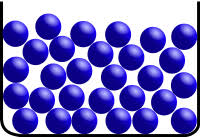
Which description best matches this particle model?
Closely packed and vibrate about a fixed position.
Particles are close together but can slide past each other.
Particles have lots of energy and can move around.
In a solid, ___________________. (Select all that apply).
Particles are packed closely together
Particles have a fixed shape
Particles vibrate about their fixed positions
Particles slide across one another
There are strong forces of attraction between particles.
What is a pure substance that cannot be broken down into simpler substances by physical or chemical means?
Compound
Molecule
Element
Atom
What is the smallest particle of an element that retains the chemical identity of an element?
Compound
Molecule
Element
Atom
What is matter that contains a combination of different elements and/or compounds and can be separated by physical means?
Compound
Mixture
Pure Substance
Molecules
Which option is a homogeneous mixture?


Matter is a term used to describe anything that has _________ and takes up ___________.
Volume; Density
Mass; Space
Elements; Space
Mass; Air
An iron nail rusting is what kind of property?
Physical
Chemical
Identifying the texture of the iron nail is what kind of property?
Physical
Chemical
Which change of state takes place during evaporation?
gas to liquid
liquid to gas
liquid to solid
solid to gas
A sugar cube is dropped into a hot cup of tea.
The tea is not stirred.
Which statement explains why the tea becomes sweet?
The heated water molecules penetrate the sugar cube.
The hot tea causes the sugar to melt.
The sugar cube dissolves and its molecules diffuse.
The sugar molecules get hot and evaporate.
In which substance are the particles close together and slowly moving past each other?
air
ice
steam
water

The diagram shows how the molecules in the exhaust gases diffuse into the air.
Which statement describes what happens to these molecules next?
The molecules fall to the ground because they are heavier than air molecules.
The molecules go back together as they cool.
The molecules spread further into the air.
The molecules stay where they are.
Which statement about liquids is correct?
They have a fixed shape and a fixed volume.
They have a fixed shape but not a fixed volume.
They have no fixed shape but they do have a fixed volume.
They have no fixed shape and no fixed volume.
The particles of gases ________________
vibrate about their fixed postions
are able to slide over each other
move about freely at high speeds and in random direction
do not move
1. Melting crayons is an example of _____________.
physical change
physical property
chemical change
chemical property
While outside playing ball, Naisir slid on the ground and ripped a hole in his pants. Choose the statement that correctly identifies the type of change that occurred and the supporting evidence.
A chemical change happened because a new substance was created.
A chemical change happened because there was a permanent change to his pants.
A physical change happened because there is not a new substance being formed.
A physical change happened because he physically slid on the ground to cause the rip.


Colloids are
Clear mixtures that have fully dissolved parts
A mixture that will separate into different parts when left to settle
A suspension that appears cloudy and scatters light
A solution that has all parts visible

IF we are using Boyles' law and our Pressure goes UP, what must our volume do?
Go UP
Go DOWN
Stay the same
Wrong law.

Charles' Law States...
As Pressure goes up volume goes down
As Pressure goes up temperature goes up
As Temperature goes up volume goes up
As Pressure goes down volume goes down

This principle states that the faster a fluid moves, the less pressure the fluid exerts.
Bernoulli's Principle
Newton's Principle
Pascal's Principle
Archimedes' Principle

