wayground logo

Free Printable Worksheets

Font size

S
M
L
XL
Worksheets

Photosynthesis Review

Total questions: 95

Worksheet time: 4hrs 35mins

Name
Class
Date
1.
What are the products of photosynthesis?
a)
water and carbon dioxide
b)
oxygen and glucose
c)
oxygen and carbon dioxide
d)
oxygen and water
2.
What molecule absorbs sunlight for photosynthesis?
a)
chloroplast
b)
thylakoid
c)
grana
d)
chlorophyll
3.
Use the diagram to answer the question. Between which parts of the molecule must the bonds be broken to form an ADP molecule?
a)
A and B
b)
A and C
c)
B and C
d)
C and D
4.
Plants need carbon dioxide from their environment to produce glucose during which stage of photosynthesis? 
a)
The light-dependent stage
b)
The light-independent stage (The Calvin Cycle)
c)
The electron transport chain
d)
ATP formation
5.
Most plants appear green because chlorophyll
a)
absorbs green light.
b)
absorbs violet light.
c)
does not absorb green light.
d)
does not absorb violet light.
6.
Where do the light-dependent reactions occur? 
a)
thylakoid membrane
b)
stroma
c)
mesophyll
d)
mitochondria
7.
Where does the Calvin Cycle occur?
a)
thylakoid
b)
stroma
c)
lumen
d)
mitochondria
8.
True or False.   The calvin cycle can happen at night.
a)
true
b)
false
9.
TRUE or FALSE.  The calvin cycle can happen during the day.
a)
True
b)
false
10.
What is the name of the simple sugar that is produced in photosynthesis?
a)
Sucrose
b)
Dextrose
c)
Glucose
d)
Lactose
11.
Which of these would be considered a C4 Pathway plant?
a)
cactus
b)
sugar cane
c)
oak tree
d)
aglae
12.
Which of these would be considered a CAM pathway plant?
a)
cactus
b)
corn
c)
elm tree
d)
algae
13.
In the Calvin Cycle, which enzyme helps keep the cycle going?
a)
Hydrolase
b)
Rubisco
c)
Pepsisco
d)
Re-starterase
14.
Which term is the part of photosynthesis when light energy is captured and transferred to a molecule, such as ATP?
a)
light- independent reactions
b)
cellular respiration
c)
light- dependent reactions
d)
 photosynthesis
15.
What supplies the electron that is lost in PS II?
a)
oxygen
b)
water
c)
glucose
d)
rubisco
16.
Chlorophyll is green because
a)
it absorbs green wavelengths of light
b)
it absorbs blue and yellow wavelengths of light
c)
it reflects green wavelengths of light
d)
it is an optical illusion caused by the transmission of light
17.
This molecule helps add a phosphate do a depleted energy molecule.
a)
PS 2
b)
PS 1
c)
Electron Transport Chain
d)
ATP Synthase
18.
After the electron leave PS II, where does it go next?
a)
Electron Transport Chain
b)
NADPH Reductase
c)
PS I
d)
Stroma
19.
What is the first stop in photosynthesis process?
a)
Photosystem I
b)
Photosystem II
c)
Electron Transport Chain
d)
stroma
20.
What is the output of photosynthesis?
a)
ATP
b)
Glucose
c)
CO2
d)
light
21.
Plants need what to do photosynthesis?
a)
Food absorbed from ground
b)
Sun's energy
c)
Food broken down
d)
Minerals from the soil
22.
What gas goes into the plant before photosynthesis?
a)
Carbon Dioxide
b)
Carbon Monoxide
c)
Oxygen
d)
Nitrogen
23.
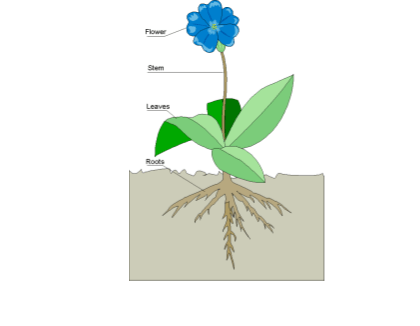
Which plant part absorbs water and nutrients?
a)
Leaf
b)
Stem
c)
Roots
d)
Flower
24.
Which plant part collects the sun's energy and makes food?
a)
Leaf
b)
Stem
c)
Roots
d)
Flower
25.
Which plant part transports water and nutrients to different parts of the plant?
a)
Leaf
b)
Stem
c)
Roots
d)
Flower
26.
Which of these is NOT A TRUE statement about why photosynthesis is important:
a)
It captures and makes the sun's energy available to all species
b)
It turns deadly COinto Oxygen for us to breath
c)
It helps plants create energy to send to rest of food chain
d)
It makes the water for our planet
27.
Which of these is NOT AN IMPACT photosynthesis has on an ecosystem:
a)
Oxygen for animals and humans to breathe
b)
Food for us to eat
c)
Taking CO2 out of the air
d)
Taking oxygen out of the air
28.

Which of the following is NOT a product of the light reactions?

a)

Oxygen

b)

NADPH

c)

ATP

d)

Glucose (Sugar)

29.
Where do the light reactions happen?
a)
mitochondria membrane
b)
thylakoid membrane
c)
stroma
d)
central vacuole
30.
What is the main purpose of the light dependent reactions?
a)
To provide the energy for the calvin cycle
b)
To capture energy and make sugar
c)
To reflect green light
d)
To make sugars
31.

What part of the plant cell performs photosynthesis?

a)

The Mitochondrion

b)

The Nucleus

c)

The Chloroplast

d)

The Cell Wall

32.
What are the two products of the light reactions that are needed for the calvin cycle?
a)
NAD and NADPH
b)
NADP + and Glucose
c)
NADPH and ATP
d)
Oxygen and NADPH
33.
What gas does the process of photosynthesis release into the atmosphere?
a)
oxygen
b)
carbon dioxide
c)
water
d)
nitrogen
34.
Thylakoids are arranged in stacks called ____.
a)
Lamellae
b)
Stroma
c)
Granum
d)
Glucose
35.
The gel-like material that surrounds the grana is called ____
a)
lamellae
b)
granum
c)
thylakoid
d)
stroma
36.

Autotrophs (producers) can perform photosynthesis because they have -

a)

Mitochondria

b)

Ribosomes

c)

A Nucleus

d)

Chloroplasts

37.
The principal chemical compound that living things use to store energy is
a)
DNA
b)
ATP
c)
H2O
d)
CO2
38.
What supplies the electron that is lost in PS II?
a)
oxygen
b)
water
c)
glucose
d)
rubisco
39.
In the ________________________, energy from the sun is used to make ATP 
a)
light-independent reaction
b)
dark reaction
c)
light-dependent reaction
d)
Calvin cycle
40.
ATP gets formed in the light dependent reaction by which process?
a)
Chemiosmosis
b)
Photosmosis
c)
Diffusion
d)
Active Transport
41.
If all four plants were watered daily but placed in a closet, receiving no sunlight, what process would NOT occur?
a)
Ingestion of carbon dioxide
b)
Filtration of water through the soil
c)
Photosynthesis
d)
Water absorbtion
42.
Leaves look green because.....
a)
they eat their vegetables
b)
to blend into their environment
c)
they contain a molecule named chlorophyll
d)
they are sick
43.

Which of the following equations represents the overall chemical reaction for photosynthesis?

a)

6O2+ 6H2O → C6H12O6+ 6O2

b)

C6H12O6 + 6H2O→ 6O2+ 6O2

c)

6CO2+ 6H2O→ C6H12O6+ 6O2

d)

6O2 + 6H2O→ C6H12O6 + 6CO2

44.

Sunlight is used during photosynthesis to-

a)

Break down the xylem

b)

Break down the stomata

c)

Break down the water

d)

Capture the water

45.
Why are green leaves green?
a)
Chlorophyll reflects green light
b)
Chlorophyll absorbs green light
c)
Chlorophyll absorbs blue and green light
46.
What is the main purpose of the light dependent reactions?
a)
To provide the energy for the calvin cycle
b)
To capture energy and make sugar
c)
To reflect green light
d)
To make sugars
47.
What does ATP synthase do?
a)
Create ATP in chemiosmosis.
b)
Break down ATP in chemiosmosis.
c)
Break down NADPH. 
d)
Create NADPH.
48.
What happens to the Ocreated in the light phase?
a)
Is transferred to the Calvin Cycle
b)
Donates its electrons to the Chlorophyll molecules
c)
Provides a carbon to form the unstable 6-carbon molecule
d)
Diffuses out through the stoma
49.
The energy required to pump H+ ions into the H ion reservoir comes from the _____________
a)
ATP molecules
b)
Electron Transport Chain
c)
Light 
d)
Thylakoid Membrane
50.
What supplies the electrons that are lost in photosystem I (PSI)?
a)
the electrons from PS II
b)
water
c)
glucose
d)
oxygen
51.
What is the function of NADP+?
a)
It absorbs light
b)
It is an electron carrier
c)
It is a light-reflecting pigment
d)
It acts as long-term energy storage
52.
What is formed during Photosystem 2?
a)
ATP
b)
NADPH
c)
NAD+
d)
glucose
53.
What is the final product of Photosystem 1 
a)
NADPH
b)
ATP
c)
NADP+
d)
glucose
54.
Water is split during
a)
photosystem 1 of the light dependent reaction
b)
photosystem 2 of the light dependent reaction
c)
calvin cycle
d)
cell respiration
55.
What are the two products of the light reactions that are needed for the calvin cycle?
a)
NAD and NADPH
b)
NADP + and Glucose
c)
NADPH and ATP
d)
Oxygen and NADPH
56.
Where does the light independent reaction take place?
a)
Matrix
b)
Stroma
c)
Thylakoid membrane
d)
Cytoplasm
57.
How many carbon atoms are in RuBP?
a)
2
b)
3
c)
4
d)
5
58.
How many carbon atoms are in GP?
a)
2
b)
3
c)
4
d)
5
59.
How many TP are needed to regenerate 3 RuBP?
a)
2
b)
3
c)
4
d)
5
60.
What provides the reducing power for the Calvin cycle?
a)
ATP
b)
ADP
c)
NADP
d)
NADPH2
61.
What provides the energy for the Calvin cycle?
a)
ATP
b)
ADP
c)
NADP
d)
NADPH2
62.
What are the products of the light independent reaction?
a)
hexose sugar
b)
triose phosphate
c)
carbon dioxide
d)
RuBP
63.
What reactants are needed for the Calvin cycle?
a)
Carbon dioxide
b)
Carbon dioxide, ATP and NADPH2
c)
Carbon dioxide and glucose
d)
Oxygen and water
64.
How many G3P molecules make one molecule of glucose? 
a)
1
b)
2
c)
3
d)
4
65.
What happens to NADPH and ATP after they are used in the Calvin Cycle?
a)
they recycle back to the light reactions
b)
they are used to make G3P
66.
What happens to the remaining G3P molecules in the last step of the dark reactions?
a)
They are used to make glucose.
b)
They are reshuffled to make CO2 by adding ATP.
c)
They exit the cycle.
d)
They are reshuffled to make RuBP by adding ATP. 
67.
In the Calvin Cycle, carbon from CO2 is added to one molecule of RuBP to create _________.
a)
RUDP
b)
An Unstable 6 Carbon Molecule
c)
PGA
d)
2 3-carbon molecules
68.
The Calvin Cycle occurs in the ___________.
a)
Stroma
b)
Thylakoid Membrane
c)
Enzyme ATP Synthase
d)
Chlorophyll
69.
The 5-Carbon molecules that the Calvin Cycle starts and ends with, is called _____________.
a)
PGA
b)
G3P
c)
RuBP
d)
RuDp
70.
After 12 G3P molecules are created, 10 are used to regenerate _________, while the other 2 are used to create __________.
a)
RuBP, C6H12O6
b)
Glucose, CO2
c)
ATP, Glucose
d)
Glucose, RUBP
71.

Which enzyme joins CO2 and RuBP?

a)

NADP+ reductase

b)

RUBISCO

c)

ATP synthase

d)

none of the above

72.

Where do NADP+ and ADP produced in the Calvin cycle go?

a)

Back to the light reactions

b)

out of the chloroplast

73.
Which of the following is NOT a reactant of the Calvin Cycle?
a)
NADPH
b)
ATP
c)
Oxygen
d)
Carbon dioxide
74.
How many carbons does G3P have?
a)
1
b)
2
c)
3
d)
6
75.

In green plants, the primary function of the Calvin cycle is to

a)

Use ATP to release carbon

b)

Split water to release oxygen.

c)

Construct sugar from carbon dioxide.

d)

Use NADPH to release carbon

76.
The two main stages of photosynthesis are the
a)
light reactions and respiration
b)
dark reactions and the Calvin cycle 
c)
light reactions and the Calvin cycle
d)
dark reactions and fermentation
77.
What does NADPH do? 
a)
carries electrons to the Calvin cycle
b)
carries electrons to the ETC
78.
What does carbon combine with to form glucose? 
a)
NADPH
b)
ATP
c)
RuBP
d)
G3P
79.
How many G3P molecules make one molecule of glucose? 
a)
1
b)
2
c)
3
d)
4
80.
Where do the dark reactions take place? 
a)
thylakoid membrane
b)
lumen
c)
stroma
81.
In green plants, the primary function of the Calvin cycle is to
a)
Use ATP to release carbon
b)
Split water to release oxygen.
c)
Construct simple sugars from carbon dioxide.
d)
Use NADPH to release carbon
82.
Which of the following is NOT a reactant of the dark reactions?
a)
NADPH
b)
ATP
c)
Oxygen
d)
Carbon dioxide
83.
Which of the following is NOT a product of the dark reactions? 
a)
NADP+
b)
NADPH
c)
ATP
d)
G3P (to form glucose)
84.
What is made during the light independent reactions?
a)
ATP
b)
NADPH
c)
sugar
d)
fat
85.
TRUE or FALSE.  The Calvin Cycle can happen during the day.
a)
True
b)
false
86.
True or False.   The Calvin Cycle can happen at night.
a)
true
b)
false
87.
What is the name of the simple sugar that is produced in photosynthesis?
a)
Sucrose
b)
Dextrose
c)
Glucose
d)
Lactose
88.
What is the product of the Calvin Cycle?
a)
Rubisco
b)
Glyceraldehyde 3-Phosphate (G3P)
c)
Oxygen
d)
Starch
89.
Cacti and pineapples are examples of plants that carry out the _____ pathway in photosynthesis.
a)
CAM
b)
C4
c)
C3
90.
Corn and sugarcane are examples of plants that carry out the _____ pathway in photosynthesis.
a)
CAM
b)
C4
c)
C3
91.
Most plants carry out the _____ pathway in photosynthesis.
a)
CAM
b)
C4
c)
C3
92.
Which enzyme joins CO2 and RuBP?
a)
NADP+ reductase
b)
rubisco
c)
ATP synthase
93.
Where do NADP+ and ADP produced in the Calvin cycle go? 
a)
Back to the light reactions
b)
out of the chloroplast
94.

What is going to be on the quiz tomorrow?

a)

Section 8.1-8.3

b)

chlorophyll and energy molecules

c)

light dependent and independent reactions

d)

factors affecting photosynthesis

e)

chemical formula of photosynthesis

95.

At this point in time, I think I will be able to score a ____________ on tomorrow's quiz.

a)

100 - 90 (A or A-)

b)

89 - 80 (B+, B, or B-)

c)

79 - 70 (C+, C, C-)

d)

69 - 60 (D+, D, D-)

e)

59 - 0 (F)