Wayground logo

Free Printable Worksheets

Font size

S
M
L
XL
Worksheets

Biology EOC Review

Total questions: 60

Worksheet time: 2hrs 33mins

Name
Class
Date
1.
Viruses are NOT considered to be living organisms because they are NOT made of…
a)
Protein
b)
Cells
c)
Nucleic Acids
d)
None of the abov
2.
What type of cell has a nucleus? 
a)
eukaryotic
b)
prokaryotic 
3.
What process best explains how muscle cells and nerve cells can develop from the same fertilized egg?
a)
genetic engineering
b)
survival of the fittest
c)
differentiation
d)
selective breeding
4.

what is the function of a lysosome?

a)

To create energy for the cell

b)

To command the cell what to do

c)

To remove waste using digestive enzymes from the cell

d)

To protect the cell

5.

Produces the energy a cell needs to carry out its functions

a)

mitochondria

b)

ER

c)

Golgi bodies

d)

vacuoles

6.
If a strand reads:
3' A A A T T T C 5'
The matching strand would read...
a)
5' T T T A A A G 3'
b)
3' T T T A A A G 5'
c)
5' A A A T T T C 3'
d)
3' U U U A A A G 5'
7.
This picture is illustrating the ____ nature of DNA.
a)
anti-parallel
b)
deoxyribosic
c)
helical
d)
radioactive
8.
Sometimes, DNA is called "semi-conservative." Why might this be?
a)
The old strand is "conserved" and used to make the new strands
b)
Uracil is "conserved" in that it is only used to make the new strands
c)
ATP is "conserved" via the usage of facilitated diffusion
d)
Ligase is "conserved" in that it is denatured by the process
9.
which process is shown?
a)
diffusion
b)
repiration
c)
recombination
d)
translation
10.
Which process?
a)
mutation
b)
transcription
c)
respiration
d)
translation
11.
The central dogma of biology states that information flows in one direction from 
a)
nuclei to RNA to cytoplasm
b)
ribosomes to proteins to DNA
c)
genes to nuclei to ribosomes
d)
DNA to RNA to proteins
12.

Chain of amino acids is called...

a)

Amino Acid

b)

Polypeptide

c)

Monomer

d)

Polymer

e)

Protein

13.
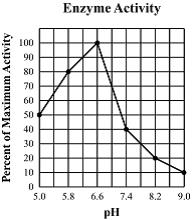
Which of the following conclusions can be drawn from this graph?
a)
The optimum pH of the enzyme is 6.6.
b)
The optimum pH of the enzyme is 5.8
c)
The enzyme’s activity increases as pH increases 5.0 to 9.0
d)
The enzyme’s activity is greater around pH of 8.0 .
14.

Normal body temperature is 37 degrees Celsius. At 40 degrees Celsius, your biological enzymes will...

a)

Function optimally

b)

Denature (change shape and break down)

c)

Wait until the temp. increases

d)

Wait until the temp. decreases

15.
Which is Metaphase?
a)
A
b)
E
c)
C
d)
F
16.
In mitosis, the two resulting cells are
a)
different from the starting cell and identical to each other.
b)
different from the starting cell and different from each other.
c)
identical to the starting cell and different from each other.
d)
identical to the starting cell and identical to each other.
17.

Meiosis results in

a)

two unique daughter cells

b)

four identical daughter cells

c)

two identical daughter cells

d)

four unique daughter cells

18.

What type of cells have not begun to differentiate into specialized cells?

a)

gametes

b)

stem cells

c)

somatic cells

d)

neurons

19.

Which statement correctly lists the stages of mitosis in order?

a)

P, R, Q

b)

Q, R, P

c)

R, P, Q

d)

P, Q, R

20.
The diagram below represents a cell and some molecules in its environment. Which molecule would require the use of energy in order to be brought into the cell?
a)
1
b)
2
c)
3
d)
4
21.

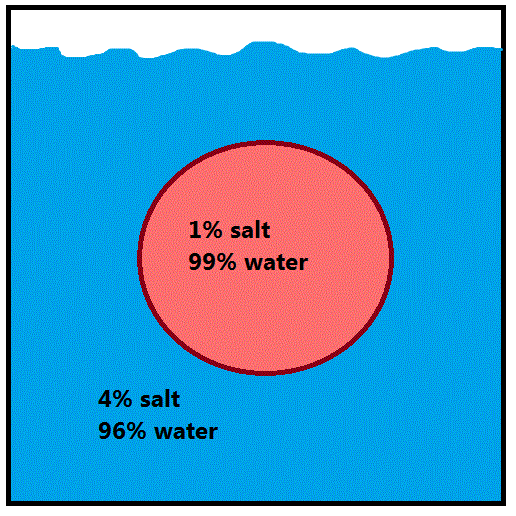
Where will the water go?

a)

Into the cell

b)

Out of the cell

c)

Equally in & out - it's isotonic

d)

There is no water

22.

Why do muscle cells have more mitochondria than skin cells?

a)

to increase oxygen production in muscles

b)

muscle cells use more energy than skin cells

c)

to ensure more carbon dioxide is released

d)

muscle cells use less energy than skin cells

23.

Which of the sentences below best describe the process of photosynthesis?

a)

In photosynthesis, plants absorb water through their roots.

b)

In photosynthesis, plants make chlorophyll, the pigment in the leaves.

c)

In photosynthesis, plants use light energy to transform water and carbon dioxide into glucose and oxygen.

d)

Through photosynthesis, plants take in carbon dioxide and release oxygen through their leaves.

24.

Which of the following statements best describes the flow of energy in the model?

a)

Light energy is converted to chemical energy through cell respiration.

b)

Chloroplasts convert light energy to glucose, and mitochondria convert glucose to chemical energy (ATP).

c)

Water is converted to oxygen, and vice versa.

d)

MItochondria produce light energy, which chloroplasts use for photosynthesis.

25.
Which type of respiration is most efficient?
a)
Aerobic
b)
Anaerobic
26.

If the diploid number of carrots is 18, the haploid number is

a)

18

b)

9

c)

27

d)

36

27.
Why do we need meiosis?
a)
To double the number of chromosomes going into sex cells
b)
To halve the number of chromosomes going into sex cells
c)
To triple the number of chromosomes going into sex cells
d)
To not change the number of chromosomes going into sex cells
28.
What process, and which type of resulting cells are represented?
a)
mitosis, gametes
b)
mitosis, body cells
c)
meiosis, gametes
d)
meiosis, body cells
29.

What are homologous chromosomes?

a)

Pairs of chromosomes with different genes on each.

b)

Pairs of chromosomes with the same genes on each.

c)

Pairs of chromosomes with no genes.

d)

Pairs of chromosomes with the wrong genes on each.
30.
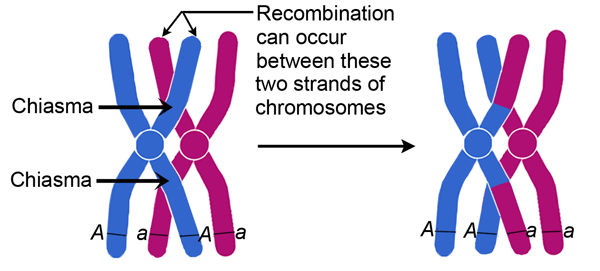
This image shows chromosomes during Prophase 1. Which of the following correctly describes the process shown?
a)
segregation of sister chromatids
b)
condensation and segregation of alleles
c)
mutationin which the DNA content of the gene is altered
d)
crossing - over in which alleles are exchanged
31.

What is the big advantage of sexual reproduction?

a)

Can quickly grow the population

b)

Offspring are guaranteed to be successful in an unchanged environment.

c)

Only one parent is required to reproduce.

d)

Can adapt to changing environments

32.

Mutations that effect gametes and that will be passed on

to the next generation

a)

Genetic change

b)

Protein synthesis

c)

Apoptosis

d)

Cell membrane

33.

Failure of homologous chromosomes

to separate during meiosis.

Results in gametes with either one extra or one missing chromosome.

a)

Translocation

b)

Nondisjunction

c)

Replication

d)

Transcription

34.

In order for offspring to get a genetic mutation, the mutation must occur in what type of cell?

a)

Cells with no nucleus.

b)

Any body cell after birth.

c)

Cells with no cell wall or cell membrane.

d)

Cells like eggs or sperm cells that are undergoing reproduction.
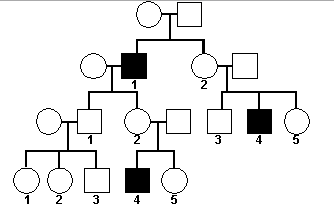
35.

What type of heredity is shown in the pedigree?

a)

Sex-Linked Dominant

b)

Sex-Linked Recessive

c)

Autosomal Dominant

d)

Autosomal Recessive

36.

The pedigree is showing a _____________ trait.

a)

autosomal dominant

b)

autosomal recessive

c)

sex linked recessive

37.
What is the genotype of the mother?
a)
BB
b)
bb
c)
Bb
d)
BB or Bb
38.

This is a __ trait.

a)

autosomal recessive

b)

sex-linked recessive

c)

autosomal dominant

39.
What type of heredity is shown in the pedigree?
a)
Sex-Linked Dominant
b)
Sex-Linked Recessive
c)
Autosomal Dominant
d)
Autosomal Recessive 
40.
What is the genotype of the father?
a)
AA
b)
aa
c)
Aa
d)
AA or aa
41.
This trait is recessive.  What is the genotype for person II-1?
a)
GG
b)
Gg
c)
gg
d)
can't be determined
42.
Give the genotype for person III-3
a)
GG
b)
Gg
c)
gg
43.

organs or skeletal elements of animals and organisms that, by virtue of their similarity, suggest their connection to a common ancestor. These structures do not have to look exactly the same, or have the same function.

a)

Analogous Structure

b)

Homologous Structure

c)

Vestigial Structure

d)

Molecular Homology

44.

Serves no useful purpose in the modern organism but did in its ancestral form.

a)

Analogous Structure

b)

Vestigial Structure

c)

Homologous Structure

d)

Adaptation

45.
If species A and B have very similar genes and proteins, what is probably TRUE?
a)
species A and B share a relatively recent common ancestor
b)
species A evolved independently of species B for a long period
c)
species A is younger than species B
d)
species A is older than species B
46.

What conclusion can you draw from the fact that many modern whale species have vestigial pelvic and leg bones?

a)

The ancestors of whales may have been land mammals

b)

Whales could walk if they wanted to

c)

Whales are preparing to evolve into land animals

d)

Someday whales will be able to walk and will have legs
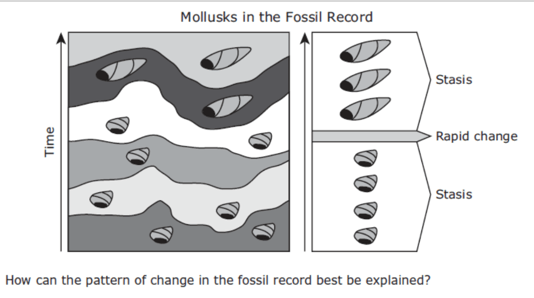
47.

How can the pattern of change in the fossil record best be explained?

a)

The mollusks were well adapted to their stable environment. A large, sudden change occurred in their environment. After the change the mollusks with the bigger shells were better adapted for the new environment.

b)

The mollusks were well adapted to their stable environment. The mollusks hybridized with a smaller species of mollusk. A new species of mollusk with a bigger shell resulted.

c)

The mollusks were not well adapted to their environment. The length of the mollusks' shells changed gradually over time. The mollusks in the original population that had small shells died over a period of many years.

48.
A few deer wander out of their native woods into a completely new park where no deer had ever been before. They go on to create an entirely new population.
a)
Genetic Drift
b)
Natural Selection
c)
Non-random mating
d)
Mutation
49.
Five hundred years after the deer had established a flourishing population in the park, a few of them venture back to their original woods and have babies with the deer there.
a)
Genetic Drift
b)
Mutations
c)
Non-random mating
d)
Gene flow
50.
What does the image represent?
a)
Founder effect
b)
Bottleneck effect
c)
Natural Selection
d)
Mutations
51.
Which organisms are most likely to survive?
a)
the best adapted
b)
the fastest
c)
the strongest
d)
the most domesticated (tamed)
52.
Gene Flow tends to ___________ genetic variation (diversity)
a)
Increase
b)
Decrease
c)
Stabilize
d)
Exaggerate 
53.

Bahamian female birds preferred mating with white-feathered males and produces more white-feathered offspring than dark feathered offspring. Which process apples to this scenario?

a)

Gene Flow

b)

Natural Selection

c)

Mutation

d)

Non-Random Mating

54.
In the energy pyramid here, how much of the energy in each level gets lost as heat or used by the organism for survival?
a)
80%
b)
90%
c)
10%
d)
20%
55.

Which animal is not the top predator but, a predator to a mouse?

a)

hawk

b)

rabbit

c)

snake

d)

grass

56.
How do lichens contribute to primary succession?
a)
Lichens decompose organic matter from animals and plants
b)
Lichens begin to break down rock to form soil
c)
Lichens are nitrogen fixing bacteria
d)
Lichens convert carbohydrates into fossil fuels.
57.
What type of succession is shown going from figure A to figure B?
a)
primary succession
b)
eutrophication
c)
secondary succession
d)
intermediate
58.

Which would result in primary succession?

a)

volcano destroying habitat leaving only soil and ash

b)

Tornado destroying a crop leaving very little soil

c)

Glacier retreating exposing bare rock

d)

limiting factors

59.
What is happening in step
1?
a)
Animals are decomposing and realizing carbon into the soil.
b)
Animals are releasing energy into the environment and storing carbon.
c)
Animals are turning carbon dioxide from the atmosphere into organic molecules.
d)
Animals are breaking down organic molecules and releasing carbon dioxide into the atmosphere.
60.
What is the process of combining nitrogen gas with other elements to make nitrogen into usable compounds?
a)
nitrogen composition
b)
ammonia 
c)
nitrogen fixation
d)
denitrification