wayground logo

Free Printable Worksheets

Font size

S
M
L
XL
Worksheets

Honors Biology- Semester 1 Review

Total questions: 109

Worksheet time: 2hrs 41mins

Name
Class
Date
1.

If an organism has 18 different chromosomes, what is its n number?

a)

18

b)

36

c)

8

d)

4

2.

What organic compound is the main component of cell membranes?

a)

steroids

b)

phospholipids

c)

carbohydrates

d)

glycoproteins

3.

Which suffix goes with enzymes?

a)

-ose

b)

-ase

c)

-ace

d)

-ly

4.

What type of bonds hold together two different water molecules?

a)

peptide bonds

b)

hydrogen bonds

c)

covalent bonds

d)

ionic bonds

5.

How are the atoms held together within a water molecule?

a)

peptide bonds

b)

hydrogen bonds

c)

covalent bonds

d)

ionic bonds

6.

When does ATP release it's stored energy?

a)

when it leaves the cell

b)

when it becomes ADP

c)

when it's in the cell membrane

d)

when it attaches to stuff

7.

What tells you that this diagram shows active transport?

a)

Low to High movement

b)

High to Low movement

c)

Energy is shown

d)

Carrier protein

8.

What must be present for diffusion to occur?

a)

a cell membrane

b)

a concentration gradient

c)

an equilibrium

d)

cytoplasm

9.
In mitosis, the two resulting cells are
a)
different from the starting cell and identical to each other.
b)
different from the starting cell and different from each other.
c)
identical to the starting cell and different from each other.
d)
identical to the starting cell and identical to each other.
10.
a)
Interphase
b)
Anaphase
c)
Telophase
d)
Prophase
11.
a)
Anaphase
b)
Cytonkinesis
c)
Interphase
d)
Prophase
12.
A human cell has 46 chromosomes before mitotic division.  How many chromosomes will the daughter cells after mitosis.
a)
12
b)
23
c)
46
d)
92
13.
In the G2 stage of cell division, ______________ are made.
a)
organelles
b)
structures for cell division
c)
proteins
d)
all of the above
14.
In the S stage of interphase_______________
a)
the cell grows
b)
the nucleus divides
c)
the cell membrane divides
d)
the DNA is replicated
15.
In the G1 stage of the cell cycle, the cell
a)
Grows
b)
Matures
c)
Carries on normal activities
d)
All of the above
16.
The cell spends most of it's life in ________________.
a)
mitosis
b)
cytokinesis
c)
Interphase
d)
None of the above
17.
A pair of chromosomes that consists of  XX is  a __________________.
a)
Male
b)
Female
18.
The individual strands on duplicated chromosomes are called_____________
a)
Centromeres
b)
daughters
c)
Chromatids
d)
Karyotypes
19.
Humans have ________ pairs of chromosomes.
a)
21
b)
23
c)
46
d)
None of the above
20.
The division of the nucleus is known as:
a)
Synthesis
b)
Mitosis
c)
G1
d)
G2
21.
Before cells can divide, what must be copied?
a)
mitochondria
b)
cytoplasm
c)
DNA
d)
Cell Wall
22.
Type of cell shown?
a)
Bacterial
b)
Prokaryotic
c)
Eukaryotic
d)
Red blood 
23.
Which of the following would be found in both eukaryotic AND prokaryotic cells?
a)
chloroplast
b)
cytoplasm
c)
nucleus
d)
endoplasmic reticulum
24.
Which is true of prokaryotic and eukaryotic cells?
a)
Prokaryotic cells are larger than eukaryotic cells.
b)
Eukaryotic cells do not have nuclei, and prokaryotic cells do have nuclei.
c)
Prokaryotic cells lack membrane-bound organelles, and eukaryotic cells contain membrane-bound organelles.
d)
Eukaryotic cells are simpler than prokaryotic cells.
25.
What type of cell is pictured?
a)
Prokaryotic
b)
Eukaryotic
c)
Plant
d)
Animal
26.
When cells are damaged, new cells are created by cell division. How does the cell theory support this fact?
a)
It states that all cells have a nucleus which divides.
b)
It states that all living things are made up of one or more cells.
c)
It states that cells come from previously existing cells.
d)
 It states that the basic units of structure and function are cells.
27.
What structures distinguish a plant cell from an animal cell?
a)
Plant cells have cell walls and ribosomes.
b)
Plant cells have cell walls and chloroplasts.
c)
Plant cells have chloroplasts and ribosomes.
d)
Plant cells have chloroplasts and mitochondria.
28.
Which statement reflects one of the major components of the cell theory?
a)
All living things are multi-cellular.
b)
Organs are the basic unit of structure and function for all living things.
c)
All cells come from previously existing cells.
d)
Every organism has a reproductive system to ensure survival of the species.
29.
What is number 18?
a)
stage
b)
stage clips
c)
coarse adjustment
d)
fine adjustment
30.
ATP is formed from photosynthesis and cellular respiration
a)
true
b)
false
31.
what is ATP?
a)
newly used word for ADP
b)
part of a membrane
c)
energy carrier
32.
Lactic acid fermentation occurs in your muscles after a workout because your cells are struggling to get...
a)
Glucose
b)
Sunlight
c)
Oxygen
d)
Water
33.
Because fermentation takes place in the absence of oxygen, it is said to be
a)
aerobic
b)
anaerobic
c)
cyclic
d)
oxygen-rich
34.
The process carried out by yeast that causes bread to rise is
a)
alcoholic fermentation
b)
lactic acid fermentation
c)
cellular respiration
d)
yeast mitosis
35.
What part of our cells holds our DNA?
a)
cytoplasm
b)
cell membrane
c)
nucleus
d)
ribosomes
36.
what travel through the electron transport chain?
a)
cells
b)
electrons
c)
blood
d)
thylokoid
37.
Where does ETC occur?
a)
Mitochondrial matrix
b)
Outer mitochondrial membrane
c)
Inner mitochondrial membrane
d)
Cytosol
38.
Where does glycolysis occur?
a)
Inner mitochondrial membrane
b)
Mitochondrial Matrix
c)
Cytosol
d)
At a ribosome
39.
What is one of the reactants of cellular respiration?
a)
energy
b)
glucose
c)
carbon dioxide
d)
water
40.
What pigment absorbs sunlight for photosynthesis?
a)
chloroplast
b)
thylakoid
c)
grana
d)
chlorophyll
41.
Which of the following is the correct equation for PHOTOSYNTHESIS?
a)
6CO2 + 6H2O --> 6O+ C6H12O6
b)
6CO+ C6H12O6 + 6H2O --> O
c)
6O2 + 6H2O --> 6CO+ C6H12O6
d)
C6H12O6 + 6O2 ---> 6H2O + 6CO2 
42.
The fluid like substance found inside the chloroplast is called
a)
Cytoplasm
b)
Stroma
c)
Thykloids
d)
Cell Wall
43.
What type of transport is this?
a)
facilitated diffusion
b)
active transport
c)
diffusion
d)
osmosis
44.
Which term means "water-fearing"?
a)
Adhesion
b)
Polar
c)
Hydrophilic
d)
Hydrophobic
45.
A saltwater fish is accidentally placed in a freshwater aquarium in a few short hours it sadly died. Which explains why this occurred?
a)
The cells of the fish body were dehydrated by the quick loss of water. 
b)
The cells of the fish quickly absorbed massive amounts of water and it ended up killing the fish.  
c)
The fish hated the new decor in the freshwater tank. 
d)
It was just its time. 
46.
A cell in an isotonic solution will
a)
swell
b)
shrink
c)
stay the same size
d)
impossible to tell
47.
A cell in a hypotonic solution will
a)
swell
b)
shrink 
c)
stay the same size
d)
impossible to tell
48.
The cell below is in a _____________ solution.
a)
Hypertonic
b)
Hypotonic
c)
Isotonic
49.
This picture represents which type of cellular transport?
a)
passive transport
b)
endocytosis
c)
exocytosis
d)
osmosis
50.
Which is true about active transport?
a)
It requires energy
b)
it does not require energy
c)
It moves substances down the concentration gradient
d)
it moves material from high to low concentration
51.
Osmosis is the movement of _____ across a membrane.
a)
food
b)
energy
c)
oxygen
d)
water
52.
Name the levels of organization in the human body in order from smallest to largest:
a)
Tissue, organ, organ system
b)
Organ system, tissue, organs, cells
c)
Cells, tissue, organs, organ system
d)
Cells , organs, tissue, organ system
53.
In a controlled experiment, how many variables can be worked with at a time? 
a)
one
b)
none
c)
two or more
d)
how ever many makes sense.
54.
This variable in an experiment is the one being deliberately changed by the scientist. 
a)
dependent variable
b)
independent variable
c)
data
d)
control group
55.

Mrs. Mack sets up an experiment to see how the mass of a ball affects the distance it rolls off a ramp. Identify the independent variable:

a)

distance traveled by the ball

b)

height of the ramp

c)

mass of the ball

d)

weight of the ball

56.
A student is planning an experiment to find out how the height from which he drops a ball affects how high the ball bounces. The dependent variable is the _____.
a)
Diameter of the ball
b)
Force acting on the ball
c)
Height that the ball bounces
d)
Height from which the ball is dropped
57.
When experimenting with the growth of a plant, a scientist uses three (of the same type of) plants, two different fertilizers, equal light, and equal water. What type of variable is the fertilizer?
a)
Dependent
b)
Independent
c)
Control
d)
Compound
58.

Explaining the color of a chemical would be what kind of observation?

a)

Qualitative data

b)

Quantitative data

59.
The type of cellular transport that requires no energy.
a)
Active Transport
b)
Protein Pumps
c)
Passive Transport
d)
Endocytosis
60.
What is diffusion?
a)
when molecules move from a low concentration to a high concentration 
b)
when molecules move from a high concentration to a low concentration.
c)
no movement 
d)
molecules move everywhere
61.
A phospholipid has 2 parts. What are they called? 
a)
Hydrophilic Head, Hydrophobic Tail 
b)
Hydrophobic Head, Hydrophilic Tail 
62.

Which wavelengths of light do chlorophyll absorb the best

a)

Green and red

b)

Green and blue

c)

Red and blue

d)

Red green and blue

63.

The products of Alcoholic Fermentation are....

a)

Glucose, O2, Ethyl alcohol

b)

Ethanol, CO2

c)

ATP, CO2, H2O

64.

Fermentation recycles ________ back to glycolysis

a)

NADH

b)

NADP

c)

ATP

d)

NAD+

e)

ADP

65.
Which of the following is a phenotype?
a)
Aa
b)
red hair
c)
heterozygous
d)
DNA
66.
In a heterozygous genotype, the ___________ allele takes over in the phenotype.
a)
recessive
b)
dominant
c)
lower case letter
d)
both 
67.
Tt  x  Tt
What would the phenotypic ratio for this cross?
a)
1  Dominant : 1 Recessive
b)
4 Dominant : 0 Recessive
c)
3 Dominant : 1 Recessive
d)
9 Dom Dom : 3 Dom Rec : 3 Rec Dom: 1 Rec Rec
68.
Phenotype refers to an organism's:
a)
Genes for the trait
b)
Expression of the trait
c)
Ration of genes
d)
Parents' apperance
69.
The genotype Bb is considered homozygous dominant.
a)
True
b)
False
70.
This principle states that alleles separate during the formation of gametes.
a)
Law of dominance
b)
Law of recessive
c)
Law of segregation
d)
Law of independent assortment
71.
Meiosis is a type of cell division that produces
a)
chromosomes
b)
DNA
c)
zygotes
d)
gametes
72.
Meiosis results in ____
a)
2 haploid cells
b)
4 haploid cells
c)
2 diploid cells
d)
4 diploid cells
73.
A cell with a diploid number of 24 chromosomes undergoes meiosis, how many chromosomes are in each daughter cell?
a)
6
b)
12
c)
24
d)
48
74.
Cancer creates abnormal cells by disrupting
a)
the cell cycle
b)
red blood cell formation
c)
DNA replication
d)
ATP synthesis
75.

What is a polar molecule?

a)

a molecule with no positive or negative poles

b)

A molecule that gives up an electron and becomes more positive

c)

a molecule with an unequal distribution of charges

d)

A molecule that takes an electron and becomes more negative

76.

What is cohesion?

a)

the attraction between molecules of different substances

b)

regulating temperature

c)

the attraction between molecules of the same substance

d)

ability to dissolve a substance

77.

How does a nonpolar molecule react to being placed in water?

a)

Dissolves in water

b)

Does not dissolve in water

78.

The monomer of carbohydrates are:

a)

Polysaccharides

b)

Monosaccharides

79.

Which is not a function of proteins?

a)

Transporting substances in and out of the cell

b)

Producing hormones to regulate cell processes

c)

Forming bones and muscles

d)

Long-term energy storage

80.

Which macromolecule provides the best/most energy storage?

a)

Carbohydrates

b)

Protein

c)

Lipids/Fats

d)

Glucose

81.
Where do substrates bind on an enzyme?
a)
voltage-gated channels
b)
surface receptor
c)
calcium channels
d)
active site
82.

What happens to an enzyme when it denatures?

a)

The activation energy of the reaction is doubled.

b)

The activation energy of the reaction is lowered.

c)

It's optimal conditions for temperature of the enzyme are doubled.

d)

The shape of the enzyme molecule is changed.
83.
What is the purpose  of an enzyme?
a)
give permission for the reaction
b)
raise activation energy
c)
speed up reactions
d)
control how many reactions occur
84.
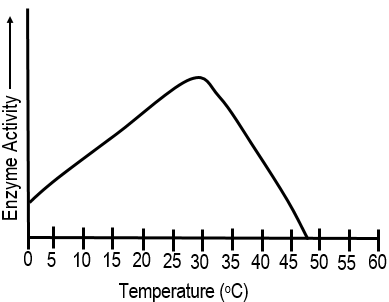
Based on the graph, what is the optimal temperature for this enzyme? 
a)
15oC
b)
40oC
c)
30oC
d)
35oC
85.
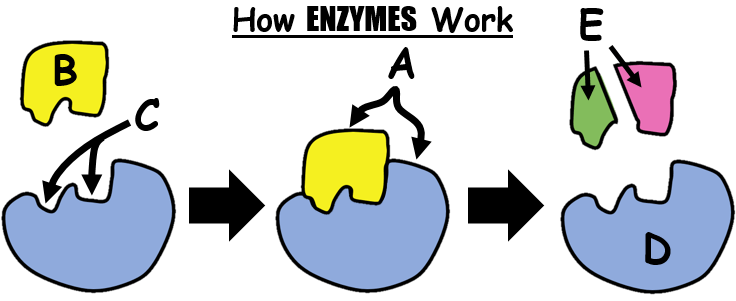
Letter B...
a)
active site
b)
enzyme
c)
substrate
d)
products
86.

Which of the following converts food into energy for the cell?

a)

vacuole

b)

mitochondria

c)

cytoplasm

d)

cell membrane

87.
These molecules represent which organic molecule?
a)
proteins
b)
lipids
c)
nucleic acids
d)
carbohydrates
88.
Name structure #5.
a)
rough ER
b)
nucleus
c)
vesicle
d)
cytoplasm
89.
The _____ determines which element the atom is.
a)
protons
b)
chemicals
c)
electrons
d)
neutrons
90.
What particle has a no charge?
a)
proton 
b)
neutron 
c)
electron
d)
cells
91.
What is dissolved in the solvent?
a)
solute
b)
solvent
c)
solubility
d)
solubility
92.
Acids are found on the pH scale between which numbers?
a)
0-7
b)
7
c)
7-14
d)
19-42
93.
What is a solution that has an excess of hydroxide (OH-) ions?
a)
pH
b)
acid
c)
neutral
d)
base
94.
What is a peptide bond?
a)
Bond that holds two amino acids together.
b)
A bond that holds hydrogen and oxygen molecules together.
c)
A bond that holds the phosphate group of one nucleotide and a sugar of a neighboring nucleotide.
d)
A bond that is formed by the sharing of electrons.
95.
Do reactants in an endothermic reaction have a higher or lower energy than the products? 
a)
Higher
b)
Lower
96.
The monomer of a nucleic acid is
a)
Monosaccharide
b)
Amino Acid
c)
Nucleotide
d)
Triglyceride (3 Fatty Acids and 1 Glycerol)
97.
What organelle is associated with the production of proteins?
a)
nucleus
b)
ribosome
c)
mitochondria
d)
cell membrane
98.
This is found in an animal cell and digests food molecules (waste).
a)
Lysosome
b)
Vacuole
c)
Centriole
d)
Cytoplasm
99.
Which of the following is NOT a type of passive transport?
a)
Facilitated diffusion
b)
Diffusion
c)
Endocytosis
d)
Osmosis
100.
Nuclear membrane forms around chromosomes and begins to separate.
a)
Anaphase
b)
Telophase
c)
Prophase
d)
Interphase
101.
How does cytokinesis differ in plant and animal cells?
a)
Cytokinesis only takes place in animal cells.
b)
Cytokinesis only takes place in plant cells.
c)
Plant cells form a cell plate, animal cells form a cleavage furrow.
d)
Animal cells form a cell plate, plant cells form a cleavage furrow.
102.
What is the result of mitosis?
a)
1 cell
b)
2 genetically identical cells
c)
2 genetically different cells
d)
4 genetically identical cells
103.

What is the next phase of mitosis?

a)

Prophase

b)

Metaphase

c)

Anaphase

d)

Telophase

104.
What phase is  shown in the picture?
a)
anaphase 1
b)
anaphase 2
c)
metaphase 1
d)
telophase 1
105.
Unlike mitosis, meiosis in male mammals results in the formation of
a)
one haploid gamete
b)
three diploid gametes
c)
four diploid gametes
d)
four haploid gametes
106.
When an area of a chromatid is exchanged with the matching area on a chromatid of its homologous chromosome, _________________ occurs
a)
crossing over
b)
mutagenesis
c)
hybridization
d)
fertilization
107.
If the Diploid number of Carrots is 18, the haploid number is
a)
18
b)
9
c)
27
d)
36
108.
The process of crossing over occurs in what phase of meiosis?
a)
anaphase 1
b)
prophase 1
c)
prophase 2
d)
telophase 1
109.
The chromosomes that pair up during meiosis, are called __________ chromosomes.  
a)
homozygous 
b)
asexual
c)
homologous
d)
genes