
 Worksheets
Electrostatics
Total questions: 69
Worksheet time: 47mins
Guss's theorem of vector calculus connects
volume integral with surface integral
surface integral of divergence of a vector with volm integral of a scalar
surface integral of divergence of a vector with volm integral of the same vector
surface integral of divergence of a vector with volm integral of a different vector
Physical meaning of Guss's law of electrostatics is
Net outward flux through a closed surface is equal to charge enclosed by the volume element
Net inward flux through a closed surface is equal to charge enclosed by the volume element
Net outward flux through a closed surface is equal to charge density enclosed
Net flux through a closed surface is equal to charge density enclosed
Differential form of Guass's law is
div.E=0
div.E=charge density/epsilon-0
div.E=charge/epsilon-0
div.E=charge/epsilon of medium
Electric monopole
can exist as div of E is non zero
can exist as div of E is zero
can not exist as div of E is non zero
can not exist as div of E is zero

D<C<B<A
D>C>B>A
A<B=C<D
C<A=B<D

Total electric flux for the following closed surface which is kept inside water
A
B
C
D

Less than before
Same as before
More than before
Zero

1=4<2<3
2=4<3<1
2=3<1<4
3<1<2<4

A
B
C
D

A1 and A2
B1 and B2
Both directions
No stable
A physical quantity has a dimensional formula N/C, it is-
Electrostatic potential energy
Electric flux
Electric field
None of the above
If the electric flux entering and leaving an enclosed
surface respectively is f1 and f2 , the electric charge
inside the surface will be -
(a) (f2 – f1 )x epsilon not
(f2 + f1 ) / epsilon not
(f2 – f1 ) / epsilon not
(f2 + f1 )x epsilon not
When an electric dipole is placed in a uniform electric field, it experiences-
Zero force and zero torque
Non zero force and zero torque
Zero force and non zero torque
Zero force and torque depends on orientation
The electric flux due to any charge depends on
Enclosed Charge by Gaussian surface
Surface area of Gaussian surface
On both - Enclosed Charge by Gaussian surface and Surface area of Gaussian surface
The question is incomplete

An asymmetrically shaped conducting shell is uncharged and contains an isolated point charge +q inside as shown. Which of the following statements is true?
The electric field outside the shell is greatest at the tip of the shell
The electric field just above the surface of the conductor is 0
There electric field between the charge and the shell is 0
The electric potential between the charge and the shell is 0
There are no charges located on the interior of the conductor shell surface
The sum of the two point charges is 7 micro Coulomb. They repel each other with a force of 1 N when kept 30 cm apart in free space. Calculate the value of each charge?
6 micro coulomb and 1 micro coulomb
5 micro coulomb and 2 micro coulomb
3 micro coulomb and 4 micro coulomb
4.5 micro coulomb and 2.5 micro coulomb
An electric dipole of dipole moment 20*10^-6 Cm is enclosed by a closed surface. What is the net flux coming out of the surface?
12
5
6
0
Which of the physical quantities has the unit N/C? It is a vector or scalar quantity ?
Electric Field, vector
Electric potential,Scalar
Electric Field,Scalar
Electric potential,Vector
What is the amount of work done in moving a 100 nC charge between two point 5cm apart on an equipotential surface?
55
1
0
don't know
Which physical quantity has unit Joule per Coulomb is it a vector or scalar quantity?
potential difference,vector
Electric field, vector
potential difference,scalar
Electric field,scalar
What orientation of an electric dipole in a uniform electric field corresponds to its stable equilibrium?
30 degree
perpendicular
dipole moment along the direction of the electric field then it will be in stable equilibrium.
parallel

A metal sphere with radius r1 has a total electric charge of magnitude q. An uncharged metal sphere with radius r2 (with r1 > r2) is then connected by a wire to the first sphere, as illustrated above. The separation of the spheres is much greater than the radius of either sphere. When equilibrium is reached, the spheres will have
charges on their surfaces of equal magnitude and the same sign
charges on their surfaces of equal magnitude and opposite sign
equal electric fields at their surfaces
equal capacitances
equal electric potentials
A positive electric charge is moved at a constant speed between two locations in an electric field, with no work done by or against the field at any time during the motion. This situation can occur only if the
charge is moved in the direction of the field
charge is moved opposite to the direction of the field
charge is moved perpendicular to an equipotential line
charge is moved along an equipotential line
electric field is uniform
A proton moving along the positive x-axis enters an electric field that is directed along the positive y-axis. What is the direction of the electric force acting on the proton after it enters the electric field?
along the negative z-axis
along the positive z-axis
along the negative y-axis
along the positive y-axis
The direction cannot be determined since the magnitude of the electric field is not known
A capacitor is constructed of two identical conducting plates parallel to each other and separated by a distance d. The capacitor is charged to a potential difference of V0 by a battery, which is then disconnected.
A sheet of insulating plastic material is inserted between the plates without otherwise disturbing the system. What effect does this have on the capacitance?
It causes the capacitance to increase
It causes the capacitance to decrease
None; the capacitance does not change
Nothing can be said about the effect without knowing the dielectric constant of the plastic
Nothing can be said about the effect without knowing the thickness of the sheet.

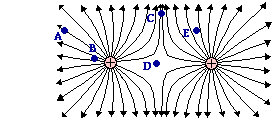
Two small spheres are arranged along a line and carry charges of +4Q and –3Q, as shown in the figure above. The vertical lines are equally spaced.
At which of the labeled points does the electric field point toward the right with the smallest magnitude?
A
B
C
D
E

A charge +𝑄 is inside a hollow region in an electrically neutral piece of solid metal, as shown above. The dashed line represents a Gaussian surface within the metal that completely encloses the hollow region.
At which of the three labeled points is the electric field equal to zero?
X only
Y only
X and Z only
Y and Z only
X, Y, and Z

The conducting sphere in Figure 1 has a charge of −Q
and is electrically isolated so that there is no conducting path to or from the conducting object shown in Figure 2. The charges on the sphere are in equilibrium. The same charge −Q
is on the isolated conducting object. Which of the following correctly describes a change between the sphere in Figure 1 and the object in Figure 2?
The charge is no longer located entirely on the surface of the object.
The electric field inside the object is no longer zero everywhere
The electric potential is no longer the same at all points inside the object.
The electric field is no longer directed perpendicular to the surface at all points on the object
The magnitude of the electric field is no longer the same at all points on the surface
If the only force acting on an electron is due to a uniform electric field, the electron moves with constant
acceleration in a direction opposite to that of the field
acceleration in the direction of the field
acceleration in a direction perpendicular to that of the field
speed in a direction opposite to that of the field
speed in the direction of the field

A battery or batteries connected to two parallel plates produce the equipotential lines between the plates shown above.
The force on an electron located on the 0-volt potential line is
0 N
1 N, directed to the right
1 N, directed to the left
directed to the right, but its magnitude cannot be determined without knowing the the distance between the lines
directed to the left, but its magnitude cannot be determined without knowing the distance between the lines

A battery or batteries connected to two parallel plates produce the equipotential lines between the plates shown above.
The force on an electron located on the 0-volt potential line is
Q2 = 16Q1
Q2 = 4Q1
Q2 = Q1
Q2 = 0.25Q1

The above circuit is designed with an ideal battery and a capacitor. When the capacitor is fully charged, the charge on the capacitor plates has a magnitude Q. Which of the following is a correct hypothesis for what will happen to the capacitor when a material of dielectric constant κ is inserted between the capacitor plates?
The charge stored on the capacitor will increase
The charge stored on the capacitor will decrease
The potential difference across the plates of the capacitor will increase
The potential difference across the plate of the capacitor will decrease
The energy stored on the capacitor will remain the same
A capacitor with unknown capacitance is used for an experiment. Students connect the capacitor to a battery, allow the capacitor to become fully charged, and then isolate the capacitor. The students then insert dielectrics with different dielectric constants κ, one at a time, between the plates of the capacitor and measure the potential difference V across the capacitor. Which of the following hypotheses can be tested with this data?
For a given the potential difference V, the charge stored in a capacitor will increase as the dielectric constant of the material between the plates increases.
For a given the potential difference V, the energy stored in a capacitor will increase as the dielectric constant of the material between the plates increases.
For a given the potential difference V, the charge stored in a capacitor will increase as the capacitance of the capacitor increases.
For a given stored charge, the breakdown voltage of a capacitor will decrease as the dielectric constant of the material between the plates increases.
For a given stored charge, the potential difference across the plates of a capacitor will increase as the dielectric constant of the material between the plates increases.
If a dielectric is inserted between the plates of a capacitor while the capacitor maintains its connection to a constant voltage source, which of the following is true?
The capacitance of the capacitor is unchanged
The charge on the capacitor plates increases
The potential difference across the capacitor increases
The electric field between the capacitor plates increases
The electric field between the capacitor plates decreases

A hollow conducting sphere is surrounded by a larger concentric spherical conducting shell, as shown above. The inner sphere has a net charge of –Q, and the outer sphere has a net charge of +3Q.
What is the net charge on the outer surface of the spherical shell?
0
+Q
+2Q
+3Q
+4Q
A solid, conducting sphere with zero net charge is placed into a uniform electric field. Which of the following happens immediately after the sphere is placed in the field?
An electric field is momentarily set up on the conducting sphere, redistributing the charges until the surface again becomes equipotential.
A nonuniform electric field is permanently set up inside the conducting sphere, pushing charges to the surface of the sphere.
The external electric field redistributes the charges evenly inside the sphere, resulting in the electric field becoming zero inside the sphere.
The electric field aligns the charges inside the sphere in such a way that they create a uniform electric field inside the sphere that is equivalent to the external electric field.
The electric field does not interact with the sphere since it has zero net charge.
When two metal objects, X and Y, are connected to each other by a conducting wire, object X gains electrons. From this information, it can be inferred that before the connection was made, object X, compared with object Y, must have had
less capacitance
more electrical potential energy
a smaller dielectric constant
a greater electric charge
a greater electric potential
A uniform electric field exists in which of the following regions?
I. Around an infinite line of uniform linear charge density
II. On either side of an infinite thin sheet of uniform charge density
III. Between the spherical shells of a charged spherical capacitor
I only
II only
III only
II and III only
I, II, and III

The figure above shows an object in the shape of an arc. The object has a uniform charge distribution. The three labeled vectors show possible directions of the electric field at point P
at the center of the arc. Which of the following options indicates the vector that shows the correct direction of the electric field and provides a correct physical explanation for this direction?
Vector A: the charge distribution is positive, and there are more charges to the left of point P
.
Vector A: the charge distribution is negative, and there are more charges to the left of point P
.
Vector B: the charge distribution is positive, and there are more charges above point P
.
Vector B: the charge distribution is negative, and there are more charges above point P
.
Vector C: the charge distribution is positive, and there are no charges below and to the left of point P
to cancel the field from charges above and to the right of point P
.
Which of the following must be true for a Gaussian surface through which the net flux is zero?
I. There are no charges inside the surface.
II. The net charge enclosed by the surface is zero.
III. The electric field is zero everywhere on the surface.
I only
II only
III only
I and II only
I, II, and III

The graph above shows the electric field E as a function of x, where x is the distance from a given charge arrangement in an xyz-coordinate system. Which of the following could be the arrangement?
A positive point charge at x = 0
Positive charges uniformly distributed inside a sphere with x = 0 on the sphere’s surface
Positive charges uniformly distributed on the surface of a sphere with x = 0 on the sphere’s surface
Positive charges uniformly distributed along the y-axis
Positive charges uniformly distributed over the yz-plane

A
B
C
D
E

Four charges are placed at the corners of a square of sides 2a as shown above. What is the magnitude and direction of the electric field at the origin?
a2kq2 left
a2kq2 right
a24kq2 left
a24kq2 right
4a2kq2 right
Four charges are placed at the corners of a square of sides 2a as shown above. What is the electric potential at the origin?
zero
2kq
24kq
2−kq
2−4kq
An electron is released in an area of space occupied by an electric field. Which of the following statements is true?
The electron will move from high to low potential
The electron will feel a force in the direction of the electric field
The electron will move parallel to the equipotential lines
The field will do work on the electron
The electron will accelerate at a rate directly proportional to its mass

A
B
C
D
E

An insulator plate is rubbed with a cloth to give it a charge. A conducting plate, attached to an insulating handle, is then placed on top to the insulator and briefly grounded by touching it. The conductor is held by the handle and lifted from the insulator plate. Which of the following is true?
After grounding, the insulator plate is no longer charged
After grounding, the conductor has no charge
The cloth used to rub the insulator plate has no charge
The cloth and the conducting plate will be attracted to each other
The cloth and the conducting plate will be repelled by each other

A
B
C
D
E

A
B
C
D
E

A proton is traveling to the left when in enters the space between two charged plates as shown. Which path will the proton take?
A
B
C
D

+ + +
+ 0 0
0 0 +
0 + +

FA=FC>FB
FB>FC=FA
FA=FB>FC
FA>FC>FB

Two pieces of neutral tape are stuck together. The sticky side of the top piece is stuck to the back of the bottom piece and then pulled apart quickly. Afterward, the nonsticky sides of both are brought near each other and they attract. This is evidence that:
The two pieces of tape have equal amounts of excess charge
The are two types of charge, and these two attract each other
The charge on the top piece is negative and the charge on the bottom is positive
The charge on the pieces is due to electrons moving from one piece to the other

Four charges are arranged as shown. A proton is brought from very far away and placed at each of the points, A, B, and C. Rank the energy required to move the proton from very far away to each of these points.
A>B>C
B>C>A
C>A>B
C>B>A

Where is the electric field stronger?
A
B
Which point is at a lower electric potential?
A
B
A solid non-conducting sphere has a radius R and a charge of +Q uniformly distributed throughout its volume. Which graph below describes the electric field as a function of distance r from the center of the sphere?


A spherical conductor is given a positive charge. Under electrostatic conditions, which of the following is TRUE of the electric field just beneath the surface of the sphere?
The electric field is directed away from the center of the sphere.
The electric field in infinitely large.
The electric field is zero.
The electric field depends on the radius of the sphere.
The electric field is directed tangential to the surface of the sphere.
A billion electrons are added to a body, its charge becomes
1.6 X 10⁻¹⁹ C
1.6 X 10⁻²⁸ C
-1.6 X 10⁻¹⁰ C
-1.6 X 10⁻²⁸ C
Which graph best represents the relationship between the strength of an electric field and distance from a point charge?


The S.I. unit of electric flux is
Joule per coulomb
Newton per coulomb
Weber
Volt metre
If the electric flux entering and leaving an enclosed surface respectively is ϕ1 and ϕ2 the electric charge inside the surface will be
(ϕ1+ϕ2)∈0
(ϕ1−ϕ2)∈0
∈0(ϕ1+ϕ2)
∈0(ϕ1−ϕ2)
A conducting sphere has a charge +Q and a radius R. Which graph below describes the electric field as a function of distance r from the center of the sphere?
A charge -2Q is placed at A ( 3,0,0) cm and another charge 8Q is placed at B ( 1,0,0)cm. Find the ratio of electric flux through concentric spheres S1 and S2 centered at the origin with radius 2 cm & 5 cm respectively
4/3
4
1/4
4/5
1/8

