wayground logo

Free Printable Worksheets

Font size

S
M
L
XL
Worksheets

AP Bio Fall Final Review

Total questions: 195

Worksheet time: 2hrs 38mins

Name
Class
Date
1.
An unknown molecule contains a sugar and a phosphate group. It is likely what?
a)
carbohydrate
b)
protein
c)
lipid
d)
nucleic acid
2.
Larger polymers are formed when monomers are joined together by a _______ reaction.
a)
dehydration synthesis
b)
digestion
c)
hydrolysis
d)
redox
3.
What is the ratio carbon:hydrogen:oxygen in carbohydrates?
a)
1:1:1
b)
1:2:1
c)
2:1:1
d)
2:1:2
4.
Identify the macromolecule in the image below.
a)
carbohydrate
b)
nucleic acid
c)
protein
d)
lipid
5.
The image depicts which level of structure in proteins?
a)
primary
b)
secondary
c)
tertiary
d)
quaternary
6.
Which of the following is NOT involved in capillary action in plants?
a)
Capillary ActXylem (transport tissue)ion
b)
Adhesion
c)
Cohesion
d)
pH
7.
When atoms share electrons unequally...
a)
a nonpolar covalent bond is formed.
b)
an ionic bond is formed.
c)
a polar covalent bond is formed.
d)
a hydrogen bond is formed.
8.
When water freezes the molecules form a matrix by forming hydrogen bonds and
a)
sinking in water
b)
becomes more dense than water
c)
becomes less dense than water
d)
becoming more tightly packed
9.
If a hydroxyl functional group is present, which of the following is likely to be true?
a)
The compound will dissolve in water.
b)
The compound is hydrophobic.
c)
The compound will not form hydrogen bonds.
d)
The compound is nonpolar.
10.
What is the difference between carbon-12 and carbon-14? (Hint: 12 and 14 are mass #)
a)
The number of protons in the nucleus.
b)
The number of protons and neutrons in the nucleus.
c)
The number of neutrons in the nucleus.
d)
The number of electrons in the orbitals.
11.

Which of the following is not a function of a protein?

a)

Act as hormones and enzymes

b)

Do much of the work in cells and transport materials

c)

Build tissues and muscles

d)

store and transmit genetic information

12.
Where do substrates bind on an enzyme?
a)
voltage-gated channels
b)
surface receptor
c)
calcium channels
d)
active site
13.
Changes in pH and temperature can damage an enzymes active site.  What is this called?
a)
reusable
b)
catalyst
c)
specific
d)
denature
14.
Amino acids all have the same general morphology except for the:
a)
Amino Group
b)
Carboxyl Group
c)
'R' Group
d)
Carbonyl Group
15.
The bond that joins amino acids are called:
a)
Peptide Bonds
b)
Ester Bonds
c)
Glycosidic Linkages
d)
Phosphodiester Bonds
16.
Which of the following explains why a cell's size is limited?
a)
volume increases faster than surface area
b)
surface area increases faster than volume
17.
A signal molecule that binds to a plasma-membrane protein is a
a)
ligand
b)
second messenger
c)
protein kinase
d)
receptor protein
18.
Which of the following can activate a protein by transferring a phosphate group to it?
a)
cAMP
b)
G Protein
c)
protein kinase
d)
protein phosphatase
19.
What does a protein kinase do?
a)
removes phosphates
b)
transfers phosphates from ATP to proteins
c)
activates an enzyme
20.
What is a phosphorylation cascade?
a)
travelling of hormones through the air
b)
travelling of hormones through the blood
c)
the removal of a phosphate
d)
a series of molecules that get phosphorylated
21.
What determines whether a cell is a target cell for a particular signal molecule?
a)
phosphorylation cascade
b)
cAMP
c)
signal receptors
d)
phosphatase
22.
Which of the following is a chemical message that usually travels through the bloodstream to target cells?
a)
hormone
b)
local regulator
c)
endocrine cell
23.
Hormones are used in ____ signaling.
a)
endocrine
b)
juxtacrine
c)
autocrine
d)
paracrine
24.
The 3 steps of signal transduction in order are
a)
reception, transduction, response
b)
response, transduction, reception
c)
reception, response, transduction
d)
transduction, reception, response
25.
Each of the following numbered processes are involved in signal transduction pathways:  
 I.  Response
 
II.  Amplification
 
 III.  Reception
 
IV.  Transduction
Which of the following represents the sequence of events in a typical signal transduction pathway?
a)
I, II, III, IV
b)
III, I, IV, II
c)
II, IV, I, III
d)
III, IV, II, I
26.

What is being depicted in the image?

a)

Amplification of the signal molecule

b)

Enzymatic proteins inhibiting process of the signal transduction pathway

c)

Kinase groups adding dimer groups to other enzymes

d)

Diffusion of molecules within the cell due to the signaling molecule

27.

Which letter represents the cell surface receptor protein?

a)

A

b)

B

c)

C

d)

D

e)

E

28.

Which letter represents the secondary proteins?

a)

A

b)

B

c)

C

d)

D

e)

E

29.

Which letter represents the ligand?

a)

A

b)

B

c)

C

d)

D

e)

E

30.

Which letter(s) can be proteins? (multiple answers are correct)

a)

A

b)

B

c)

C

d)

D

e)

E

31.

The final activated molecule in a signaling pathway may function as a what?

a)

transcription factor

b)

second messenger

c)

kinase

d)

phosphatase

32.

One signal molecule can yield different results based on which receptor receives it.

a)

true

b)

false

33.

What word means programmed cell death?

a)

apoptosis

b)

mitosis

c)

Ced-9

d)

bleb

34.

Cell death is a bad thing.

a)

true

b)

false

35.
Glucose levels in the blood are controlled by the:
a)
Pancreas
b)
Thyroid
c)
Parathyroids
d)
Adrenal Glands
36.
A person who is having an anaphylactic reaction is given an inject of epinephrine. The purpose of this is primarily to:
a)
Dilate pupils
b)
Open air passage ways
c)
Increase blood sugar
d)
Dilate blood vessels in muscles
37.
The hormone that lowers blood sugar is:
a)
Insulin
b)
Glucagon
c)
Cortisol
d)
GnRH
38.
Hormones that enter cells directly to cause changes are usually:
a)
Steroids
b)
Proteins
39.

What hormone is responsible for the "fight or flight" response?

a)

Testosterone

b)

Cortisol

c)

Adrenaline

d)

Parathyroid Hormone

40.
Which of the following anterior pituitary hormones stimulates growth of long bones?
a)
Prolactin
b)
Thyrotropin
c)
Adrenocorticotropic hormone
d)
Human growth hormone
41.
Insufficient production during childhood results in dwarfism, while overproduction results in gigantism.
a)
Insulin
b)
Follicle stimulating hormone
c)
Oxytocin
d)
Human growth hormone
42.
Cells that ingest pathogens are
a)
plasma cells
b)
phagocytic cells
c)
helper T cells
d)
antibodies
43.
Anything that triggers an immune response is a/n
a)
lymph cell
b)
antigen
c)
antibody
d)
neutrop
44.
 Like all other body systems, the immune system helps the body maintain homeostasis.  Which statement best describes how the immune system does this?  
a)
it protects other organs and tissues from infection and disease
b)
it breaks down food to provide cells with nutrients
c)
it gathers information through the senses and controls all other body systems
d)
 it transports oxygen and carbon dioxide
45.
What do B cells produce?
a)
antigens
b)
macrophages
c)
T cells
d)
antibodies
46.
What do antibodies attach to on the pathogen?
a)
Anti inflammatory
b)
Antigens
c)
Antiseptic
d)
Antibodies
47.
Pathogens are recognized by their...
a)
antigens
b)
antibodies
c)
killer t-cells
d)
B-cells
48.
Out of t-cells and b-cells which is the helper cell?
a)
b-cells
b)
t-cells
c)
neither
d)
both
49.

Which of the following is NOT an example of acquired immunity?

a)

production of antibodies

b)

helper T cell making memory cells

c)

cytotoxic T cell killing infected body cell

d)

creation of histamine during a splinter infection

50.

Which cell is directly associated with cell mediated responses

a)

macrophage

b)

helper T cell

c)

cytotoxic T cell

d)

B cell

51.

Which of the following is NOT true of autoimmune diseases

a)

the immune system targets "self"

b)

the immune system has been deactivated

c)

the immune system has over active cytotoxic T cells

d)

mutliple sclerosis is an autoimmune disease

52.

Vaccines will trigger your body to make all of the following EXCEPT

a)

antibodies

b)

memory cells

c)

white blood cells

d)

red blood cells

53.

Vaccinations will

a)

give you a deadly disease

b)

give you autism

c)

give you memory cells

d)

give you autoimmune diseases

54.

Which of the following is NOT specific?

a)

Helper T cell

b)

Cytoxic T cell

c)

B cell

d)

Macrophage

55.

Which is the most important thing used in the first line of defense?

a)

macrophage

b)

fever

c)

skin

d)

antigens

56.

Each antibody is specifically made to attach to only one type of antigen

a)

True

b)

False

57.

What type of response is this

a)

nonspecific and humoral

b)

nonspecific and cell mediated

c)

specific and humoral

d)

specific and cell mediated

58.
Which is an example of passive immunity?
a)
You have been infected
b)
You have been vaccinated
c)
You made antibodies
d)
You got your mother's antibodies
59.
What do memory cells do?
a)
Kills the virus
b)
Eats the virus
c)
Patrol the area and make the immune system work faster next time.
d)
Makes antibodies
60.
Which of the following is an example of active immunity?
a)
You get a vaccination
b)
You create antibodies
c)
You get infected
d)
All of these are correct
61.

Diffusion with the help of transport proteins is called

a)

phagocytosis

b)

Na-K Pump

c)

Facilitated Diffusion

d)

Active Transport

62.

Enables cell to engulf bulk quantities of specific large molecules is called

a)

pinocytosis

b)

phagocytosis

c)

receptor-mediated endocytosis

d)

exocytosis

63.

Fusion of membrane-bound vesicle with membrane and dumping contents outside cell is known as

a)

endocytosis

b)

diffusion

c)

osmosis

d)

exocytosis

64.

How does oxygen and carbon dioxide enter and leave the cells?

a)

osmosis

b)

facilitated diffusion

c)

active transport

d)

diffusion

65.

Aquaporins are involved in which type of transport?

a)

active transport

b)

facilitated diffusion

c)

phagocytosis

d)

simple diffusion

66.

What happens to a cell when exposed to a hypertonic solution?

a)

shrivels

b)

swells

c)

stays the same

67.

What happens to a single-celled organism placed in a drop of pure water?

a)

shrivels

b)

swells

c)

stays the same

68.

Plant cells are happy when they are turgid, which solution would maintain a plant's turgidity?

a)

hypotonic solution

b)

hypertonic solution

c)

isotonic solution

69.

Which type of solution would cause a plant cell to be flaccid, not plasmolyze, but flaccid?

a)

hypotonic

b)

hypertonic

c)

isotonic

70.

When given an IV of fluid, why are humans given a salt solution of 0.7M?

a)

It is hypertonic to your own cells

b)

It is hypotonic to your own cells

c)

It is isotonic to your own cells

71.

Animal cells prefer ____ solutions and plant cells prefer _______ solutions for homeostasis.

a)

hypertonic, hypotonic

b)

hypotonic, hypertonic

c)

isotonic, hypotonic

d)

isotonic, hypertonic

72.

When you are sick and your white blood cells engulf the foreign bacteria, how would this occur?

a)

By diffusion

b)

By phagocytosis

c)

By pinocytosis

d)

By facilitated diffusion

73.
How many electron pairs does carbon share in order to complete its valence shell?
a)
1
b)
3
c)
4
d)
8
74.
Identify the asymmetric carbon in this molecule
a)
A
b)
B
c)
C
d)
D
75.
Which property is most closely associated with the hydroxyl functional group?
a)
Polar
b)
Nonpolar
c)
Basic
d)
Acidic 
76.
The endocrine system interacts with the _____ system because most hormones travel throughout our bodies in our blood.  
a)
digestive
b)
circulatory
c)
excretory
d)
nervous
77.
The two body systems that work together to protect you from foreign pathogens are...
a)
Integumentary and immune
b)
Reproductive and muscular
c)
Endocrine and digestive
d)
Respiratory and circulatory
78.
Which reactant is used as the final electron acceptor in cellular respiration?
a)
water
b)
carbon dioxide
c)
oxygen
d)
glucose
79.
2 energy rich molecules created by Light Dependent Reactions of Photosynthesis are:
a)
ATP and ADP
b)
ATP and NADPH
c)
ADP and FADH
d)
ADP and NADP
80.
Where do the light-dependent reactions occur? 
a)
thylakoid membrane
b)
stroma
c)
lumen
d)
mitochondria
81.
2 energy rich molecules created by Light Dependent Reactions of Photosynthesis are:
a)
ATP and ADP
b)
ATP and NADPH
c)
ADP and FADH
d)
ADP and NADP
82.
Is this reaction endergonic or exergonic?
a)
Exergonic
b)
Endergonic
83.
Is this reaction endergonic or exergonic?
a)
Exergonic
b)
Endergonic
84.
Based on your knowledge of the process of photosynthesis, plants placed under a red light would
a)
absorb no CO2
b)
absorb the same amount of 
COas plants under both green light and normal sunlight
c)
absorb less 
COthan the plants under green light
d)
absorb more 
COthan the plants under green light
85.
The enzyme used in chemiosmosis to produce ATP is called
a)
phosphorylase
b)
ADP synthase
c)
ATP synthase
d)
Rubisco
86.
Here is a graph showing the rate of photosynthesis of a green plant plotted against light intensity.
Which of the following statements accurately accounts for the shape of the graph?
a)
The rate of photosynthesis stops increasing because chlorophyll molecules begin to decompose due increased heat, not increased light.
b)
The rate of photosynthesis  slows as chlorophyll molecules, which are proteins, denature.
c)
Photosynthesis ceases when protons are no longer released by the photolysis of water.
d)
The rate of photosynthesis increases until the light-harvesting apparatus in the thylakoid membranes become saturated and cannot make use of additional light
87.
The property of water that allows water molecules to stick to each other is
a)
adhesion
b)
cohesion
c)
density
d)
specific heat
88.
Which of the following is correctly defined as the attraction of the hydrogen from one molecule to the oxygen of a different molecule?
a)
amphipathic
b)
hydrophobic
c)
hydrogen bonding
d)
adhesion
89.
A large molecule made up of many similar or identical subunits. 
a)
Monomer 
b)
Lipids 
c)
Polymer 
d)
Enzyme 
90.
Which of the following conclusions can be drawn from this graph?
a)
The optimum pH of the enzyme is 6.6.
b)
The optimum pH of the enzyme is 5.8
c)
The enzyme’s activity increases as pH increases 5.0 to 9.0
d)
The enzyme’s activity is greater around pH of 8.0 .
91.
Water molecules require a lot of energy to break the hydrogen bonds.  This gives water a high
a)
density
b)
polarity
c)
solvency
d)
specific heat
92.
Which type of bonding causes all of water's unique properties?
a)
hydrogen bonding
b)
ionic bonding 
c)
Van der Waals bonding
d)
covalent bonding
93.
What property of water allows insects to walk upon it?
a)
adhesion
b)
surface tension
c)
high heat capacity
d)
high heat of vaporization
94.
Show proper bonding for CO2
a)
C=O=C
b)
C-O-C
c)
O=C=O
d)
O-C-O
95.
ATP is a very important molecule because of the energy it provides. What functional group provides this energy?
a)
Hydroxyl
b)
Carboxyl
c)
Amine
d)
Phosphate
96.
Which of the following is a chemical message that usually travels through the bloodstream to target cells?
a)
hormone
b)
local regulator
c)
endocrine cell
97.
What determines whether a cell is a target cell for a particular signal molecule?
a)
phosphorylation cascade
b)
cAMP
c)
signal receptors
d)
phosphatase
98.
What determines whether a signal molecule binds on the surface or enters the cell?
a)
size
b)
polarity
c)
ability to cross the membrane
d)
all of these are correct
99.
Cell Membrane:
a)
The protective outer layer that controls what enters and leaves the cell.
b)
Stores information on DNA molecules / Directs and controls the activities of the cell.
c)
A folded membrane that moves materials around inside cells / Also acts as the site of manufacturing materials needed by the cell.
d)
The smallest organelle with a huge job / Makes proteins, which are the building blocks of the body.
100.
Endoplasmic Reticulum:/ER
a)
The smallest organelle with a huge job / Makes proteins, which are the building blocks of the body.
b)
A folded membrane that moves materials around inside cells / Also acts as the site of manufacturing materials needed by the cell.
c)
A small sack that stores water and food until the cell needs it /  Stores waste temporarily until the cell  gets rid of it.
d)
The protective outer layer that controls what enters and leaves the cell.
101.
Ribosomes
a)
a part of the cell containing DNA and RNA and responsible for growth and reproduction
b)
non membrane-bound organelles responsible for protein synthesis;found in eukaryotes and prokaryotes
c)
System of internal membranes within the cytoplasm. Membranes are rough due to the presence of ribosomes. functions in transport of substances such as proteins within the cytoplasm
d)
An endomembrane system where lipids are synthesized, calcium levels are regulated, and toxic substances are broken down.
102.
What 4 structures are common between plant, animal, and bacterial cells?
a)
Golgi Apparatus, Chloroplasts, Ribosomes, Nucleus
b)
Cell Wall, Mitochondria, Cell Membrane, Cytoplasm
c)
Rough ER, Smooth ER, Nucleus, Ribosomes
d)
DNA, Cytoplasm, Ribosomes, Cell membrane
103.
Rough Endoplasmic Reticulum
a)
non membrane bounded organelles responsible for protein synthesis;found in eukaryotes and porkaryotes
b)
a part of the cell containing DNA and RNA and responsible for growth and reproduction
c)
System of internal membranes within the cytoplasm. Membranes are rough due to the presence of ribosomes. functions in transport of substances such as proteins within the cytoplasm
d)
An endomembrane system where lipids are synthesized, calcium levels are regulated, and toxic substances are broken down.
104.
What is the function of the Golgi Apparatus?
a)
To produce ribosomes
b)
To transfer materials
c)
To protect the cell
d)
To hold DNA
105.
Which of the following is NOT found in bacteria? 
a)
cell wall
b)
plasma membrane
c)
nucleus
d)
ribosome
106.
When electrons flow along the electron transport chains of mitochondria, which of the following changes occurs?
a)
The pH of the intermembrane space decreases.
b)
ATP synthase pumps protons by active transport.
c)
The electrons gain free energy.
d)
The cytochromes phosphorylate ADP to form ATP.
107.
How is a molecule reduced?
a)
electrons are given to the molecule
b)
electrons are taken from the molecule
c)
money is taken from the molecule
d)
protons are given to the molecule
108.
Plants with the largest amount of which pigment will be best suited for growing conditions where light has a green hue.
a)
Chlorophyll A
b)
Chlorophyll B
c)
Carotenoids
d)
A combination of all 3
109.
During which phase of photosynthesis is O2 created?
a)
Light dependent reactions
b)
Calvin Cycle
c)
Citric Acid Cycle
d)
Glycolysis
110.
Which pigment is most efficient at higher energy areas of the electromagnetic spectrum?
a)
Chlorophyll A
b)
Chlorophyll B
c)
Carotenoids
d)
No pigment is efficient at high energies
111.
Why must plants keep their stomata closed during hot days?
a)
Open stomata release too much CO2, starving the plants.
b)
Open stomata release water, causing the plant to dry out.
c)
Open stomata cause the plant to lose access to CO2 molecules
d)
Open stomata lead to a buildup of O2 molecules in the cells.
112.
At what point in cellular respiration is the majority of the NADH produced?
a)
Glycolysis
b)
Pyruvate Oxidation
c)
Citric Acid Cycle
d)
Electron Transport Chain
113.
Where does Glycolysis take place?
a)
In the cytoplasm
b)
Across the outer mitochondrial membrane
c)
Across the inner mitochondrial membrane
d)
In the mitochondrial matrix
114.
What is produced through Glycolysis?
a)
Pyruvate
b)
2 molecules of pyruvate
c)
Acetyl Coenzyme-A
d)
2 molecules of acetyl coenzyme-A
115.
Where does the majority of ATP come from during Cellular Respiration?
a)
Glycolysis
b)
Kreb's Cycle
c)
Electron transport chain
d)
Fermentation
116.
Which gas is removed from the atmosphere during photosynthesis?
a)
hydrogen
b)
oxygen
c)
nitrogen
d)
carbon dioxide
117.
The mitochondria is responsible for ...
a)
photosynthesis
b)
anaerobic respiration
c)
aerobic respiration
d)
fermentation
118.
During aerobic respiration, electrons travel downhill in which sequence?
a)
food -> citric acid cycle -> ATP -> NAD+
b)
food -> NADH -> electron transport chain -> oxygen
c)
glucose -> pyruvate -> ATP -> oxygen
d)
glucose -> ATP -> electron transport chain -> NADH
119.

Most chemical reactions in the body rely on enzymes. Why are enzymes are necessary for many cellular reactions?

a)

The reactions are too slow to meet the needs of the cell if enzymes are missing

b)

The reactions take up too much space in the cell if enzymes are missing

c)

Enzymes change reactants from solid to liquid during the reactions.

d)

Enzymes supply the oxygen necessary for the reactions.

120.

The human body maintains a temperature of around 98.6 degrees at all times. Enzymes are involved in almost every chemical reaction in the body. Which of the following describes the connection between these two statements?

a)

The body is kept relatively warm to prevent too much enzyme action.

b)

The body needs to be warm to prevent hypothermia.

c)

Enzymes function best at a specific temperature.

d)

There is no connection between the two statements.

121.
Any substance that is acted upon by an enzyme is called a(n)?
a)
Coenzyme
b)
Substrate
c)
Vitamin
d)
Polypeptide
122.
Which of the following conclusions can be drawn from this graph?
a)
The optimum pH of the enzyme is 6.6.
b)
The optimum pH of the enzyme is 5.8
c)
The enzyme’s activity increases as pH increases 5.0 to 9.0
d)
The enzyme’s activity is greater around pH of 8.0 .
123.

What's going on in this picture?

a)

The enzyme is taking the red substrate and turning it blue

b)

The enzyme's active site is blocked by a competitive inhibitor

c)

The enzyme can't function if too many substrates are trying to bind

d)

This is an example of an anabolic enzyme reaction

124.

An activor or inhibitor binding place that is not the active site, causing the enzyme to change conformation (shape) is an example of ...

a)

competative inhibition

b)

allosteric control

c)

optimum conditions

d)

induced fit

125.
A plant has a unique photosynthetic pigment. The leaves of this plant appear to be reddish yellow. What wavelengths of visible light are being absorbed by this pigment?
a)
green and yellow
b)
blue, green, and red
c)
green, blue, and yellow
d)
blue and violet
126.
In a plant cell, where are the ATP synthase complexes located?
a)
In a plant cell, where are the ATP synthase complexes located?
b)
thylakoid membrane and plasma membrane
c)
plasma membrane only
d)
thylakoid membrane and inner mitochondrial membrane
127.
In mitochondria, chemiosmosis translocates protons from the matrix into the intermembrane space, whereas in chloroplasts, chemiosmosis translocates protons from
a)
the stroma to the thylakoid space.
b)
the thylakoid space to the stroma.
c)
the matrix to the stroma.
d)
the stroma to the photosystem II.
128.
The splitting of carbon dioxide to form oxygen gas and carbon compounds occurs during
a)
photorespiration
b)
photosynthesis.
c)
respiration.
d)
neither photosynthesis nor respiration.
129.
When oxygen is released as a result of photosynthesis, it is a direct by–product of
a)
chemiosmosis.
b)
splitting water molecules.
c)
the electron transfer system of photosystem II.
d)
the electron transfer system of photosystem I.
130.
If photosynthesizing green algae are provided with CO2 synthesized with heavy oxygen (18O), later analysis will show that all but one of the following compounds produced by the algae contain the 18O label. That one is
a)
O2.
b)
3–phosphoglycerate.
c)
glucose
d)
glyceraldehyde 3–phosphate (G3P).
131.
Where does the Calvin cycle take place?
a)
interior of the thylakoid (thylakoid space)
b)
outer membrane of the chloroplast
c)
thylakoid membrane
d)
stroma of the chloroplast
132.
Because water has a positively charged end and a negatively charged end, it can be described as
a)
amphipathic
b)
hydrophobic
c)
polar
d)
nonpolar
133.
 Small insects can walk across the surface of calm water. Their feet push the surface of the water down slightly, somewhat like a person walking across a trampoline, but they do not break the surface. What is the best explanation for why this happens?
a)
The insects are light enough so that they do not break the hydrogen bonds holding the water molecules together
b)
The insects actually use their wings to hover slightly above the water's surface and they only skim it with their feet
c)
The insects' feet are non-polar, so they are repelled by the polar water molecules and are pushed away from the water's surface
d)
The insects are small enough to see the individual water molecules, so they are able to step carefully from one molecule to the next
134.
A florist places a bouquet of white carnations in water containing blue dye. After a time, the flowers turn blue. What process helped the carnations to change color?
a)
Specific heat 
b)
Surface tension
c)
Cohesion and adhesion of water molecules 
d)
Formation of covalent bonds between hydrogen and oxygen molecules
135.
Water makes up approximately 60% of the human body and plays a vital role in regulating body temperature. Which property of water makes it good at regulating temperature?
a)
Water is a good solvent.
b)
Water exhibits strong cohesion.
c)
. Water has an unusual crystalline structure.
d)
Water has a high capacity for heat.
136.
Water has a much higher specific heat than most other covalent compounds. What do you predict might happen if water had a low specific heat instead?
a)
Flooding would occur and animals would be forced to migrate
b)
 Harmful organisms living in water would reproduce at a rapid rate
c)
Organisms that are sensitive to changes in temperature would die
d)
Plants would not have enough water to effectively carry out photosynthesis
137.
 Many fish and aquatic plants can survive a cold winter because the layer of ice that forms at the top of the lake insulates the water below and prevents the lake from freezing solid. What unique property of water contributes to this effect? 
a)
Water absorbs heat when it evaporates and forms a gas 
b)
 Water expands and becomes less dense when it freezes.
c)
Water molecules completely separate into ions in solutions.
d)
 Water forms hydrogen bonds with ions and other polar substances. 
138.
 Which of the following characteristics of water is not a result of hydrogen bonding?
a)
adhesive strength
b)
capillarity
c)
cohesive strength
d)
All of the above are a result of hydrogen bonding.
139.
What type of transmembrane receptor is being shown?
a)
G-protein receptor
b)
tyrosine kinase receptor
c)
gated ion channel
140.
G proteins are a family of proteins involved in transmitting chemical signals originating from outside a cell into the inside of the cell. G proteins function as molecular switches.
Which of the following best describes the role in which the G protein is most intimately involved in the process shown above?
a)
Production of the ligand molecule.
b)
Reception of the signal.
c)
Transduction of the signal.
d)
Production of response to signal.
141.

Type of cell signaling where the ligand is released and will affect cells in its "neighborhood"

a)

autocrine signaling

b)

juxtracrine signaling

c)

paracrine signaling

d)

endocrine signaling

142.

Testosterone does not affect all cells of the body because __________.

a)

testosterone cannot cross the plasma membrane

b)

not all cells have cytoplasmic receptors for testosterone

c)

not all cells in the body have membrane receptors for testosterone

d)

it is a local regulator

e)

it affects only cells that have ion-channel receptors

143.
Which of the following statement is correct?
a)
Cell communicate with one another in multicellular organisms using extracellular signaling molecules or hormones
b)
Cell communicate with one another in unicellular organisms using extracellular signaling antigen and antibody
c)
Cell communicate with one another in multicellular organisms using intracellular signaling molecules only
d)
Cell communicate with one another in unicellular organisms using intracellular signaling antigen and antibody
144.
A cell is known to respond to a particular signaling molecule. Which of the following must be true of this cell?
a)
It is in the heart muscle
b)
it is also the site of production for the signaling molecule
c)
It contains the receptor for the signaling molecule
d)
It is incapable of signal transduction
145.

Why is apoptosis required?

a)

Glycolysis

b)

Cell division: Meiosis and mitosis

c)

Growth and elimination of threats such as viruses and DNA damage

146.

As organisms get more complex, cells become specialized to perform specific functions in the body. What is the function for the cell shown?

a)

contract and shorten movement

b)

provide coverage and protection

c)

carry impulses around the body

d)

connects parts together

147.
The nervous system is composed of the ___, ___, and ___.
a)
heart, brain, kidneys
b)
lungs, liver, stomach
c)
brain, spinal cord, nerves
d)
eyes, pancreas, veins
148.

What are the two divisions of the nervous system?

a)

Central and Lower nervous systems

b)

Central and Peripheral nervous systems

c)

Lower and Cerebral nervous systems

d)

Central and Muscular nervous systems

149.

The space between an axon of a neuron that is communicating with a dendrite of another neuron is called a ________________.

a)

Neuron

b)

Brain message

c)

Stimulus

d)

Synapse

150.

A nerve cell is called a:

a)

neutron

b)

nerve

c)

neuron

d)

synapse

151.
What are the 2 major divisions of the peripheral nervous system (PNS)?
a)
Sensory & Motor
b)
Peripheral & Central
c)
Somatic & Autonomic
d)
Brain & Spinal Cord
152.
a signal molecule that transmits nerve impulses across synapses
a)
neuron
b)
neurotransmitter
c)
nerve
d)
action potential
153.
nerve impulse
a)
action potential
b)
resting potential
c)
membrane potential
d)
synapse
154.
part of a neuron that receives information from other neurons
a)
axon
b)
dendrites
c)
myelin sheath
d)
synapse
155.

The part of the neuron that sends information away from the cell body is called a(n) _____________.

a)

dendrite

b)

axon

c)

cell body

d)

Schwann cell

156.

Label the Neuron-What does the letter "E" represent?

a)

Myelin Sheath

b)

Axon

c)

Axon Terminal

d)

Dendrite

157.
Label the Neuron-What does the letter "C" represent?
a)
Dendrite
b)
Axon
c)
Axon Terminal
d)
Cell Body
158.
Label the Neuron-What does the letter "A" represent?
a)
Dendrite
b)
Axon
c)
Myelin Sheath
d)
Node of Ranvier
159.
These carry signals from tissues and organs to the brain and spinal cord
a)
Sensory Neurons
b)
Motor Neurons
c)
Efferent Neurons
d)
Glial Cells
160.

Why is signal transmission faster in myelinated axons?

a)

they have higher depolarization values than unmyelinated axons

b)

they are thinner and have less resistance to voltage flow

c)

they use electrical synapsis rather than chemical synapsis

d)

the action potential can jump from node to node making it faster

e)

these axons are thicker and provide less resistance to voltage flow

161.

Which of the following occurs when a stimulus depolarizes a neuron's membrane?

a)

the inside of the neuron because more positive because sodium moves into the neuron

b)

potassium ions diffuse into the cell

c)

the action potential approaches zero

d)

the depolarization is negative feedback

162.
Where does Photosystem II get its electrons?
a)
photosystem I
b)
splitting of water
c)
ATP
d)
NADPH
163.
 During chemiosmosis
a)
Carbon is fixed.
b)
ATP is synthesized from ADP
c)
NADPH is synthesized from NADP+
d)
 Electrons are removed from chlorophyll molecules.
164.
What are the carbohydrates in the cell membrane for?
a)
to form channels and pumps
b)
to help cells identify one another
c)
to make the membrane strong
165.
If a molecule passes through a protein, but goes down a gradient, it is called
a)
active transport
b)
endocytosis
c)
facilitated diffusion
d)
exocytosis
166.
How many ATP molecules are created by fermentation?
a)
0
b)
2
c)
12
d)
36
167.
Which reactant is used as the final electron acceptor in cellular respiration?
a)
water
b)
carbon dioxide
c)
oxygen
d)
glucose
168.
Which macromolecule is shown?
a)
phospholipid
b)
protein
c)
steroid
d)
glucose (carbohydrate)
169.
A sugar, a phosphate group, and a nitrogen base form the building blocks of which organic compound?
a)
carbohydrates
b)
nucleic acids
c)
lipids
d)
proteins
170.
Microtubles make up all of the following structures except ____.
a)
cilia
b)
centrioles
c)
flagella
d)
mitchondria
171.
Which letter represents the activation energy of a non-catalyzed reaction?
a)
a
b)
b
c)
c
d)
d
172.
Which of the following is the process used to bond the monomers together?
a)
Hydrolysis
b)
Water Removal
c)
Dehydration Synthesis
d)
Water Synthesis
173.
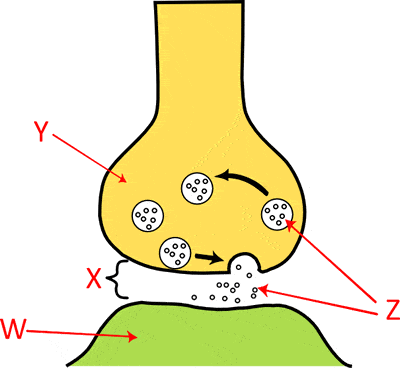
Z
a)
Dendrite
b)
Axon Terminal
c)
Neurotransmitters
d)
Synapse
174.
Y
a)
Axon 
b)
Neurotransmitters
c)
Dendrite
d)
Synapse
175.
W
a)
Axon Terminal Button
b)
Neurotransmitters
c)
Dendrite
d)
Synapse
176.
Which is the correct nerve pathway?
a)
dendrite > axon > cell body > synapse > dendrite
b)
dendrite > cell body > axon > synapse > dendrite
c)
axon > cell body > dendrite > synapse > axon
d)
axon > cell body > dendrite > synapse > axon
177.
These cells are responsible for making antibodies
a)
Plasma cells and memory cells
b)
Killer T Cells
c)
Helper T Cells
d)
Macrophages
178.
What are two parts of the innate immune system?
a)
barriers and phagocytes
b)
B-cells and mast cells
c)
antibodies and phagocytes
d)
T cells and B cells
179.
  A substance or part of a substance (living or nonliving) that the immune system recognizes as foreign and activates the immune system and reacts with immune cells or their products, such as antibodies.
a)
pathogen 
b)
allergen 
c)
antigen 
d)
antibody
180.
What initiates an immune response?
a)
antibody
b)
antigen
c)
histamine
d)
antibiotic
181.
Disease-causing microorganism, such as a bacterium or virus.
a)
pathogen 
b)
allergen
c)
toxin
d)
antigen 
182.
What function does mucus play in the immune system?
a)
traps foreign particles from entering the body
b)
moistens food
c)
produces WBCs
d)
acts as a lubricant
183.
Types of lymphocytes
a)
B cells, Cytotoxic T cells, Helper T cells
b)
Macrophages and Neutrophils
c)
erythrocytes and leukocytes
d)
erythrocytes and B cells
184.
_____ are the major organs of the endocrine system?
a)
Blood
b)
Hormones
c)
Glands
185.
Usually triggered when you're scared by something in your enviornment?
a)
Pancreas
b)
Adrenal glands
186.
Is it true the Adrenal Glands helps your body prepare for the "Fight or Flight" reflex?
a)
True
b)
False
187.
What produces the hormones insulin?
a)
Liver
b)
Ovary
c)
Pancreas
d)
Hormones
188.
What produces male hormones?
a)
Ovaries
b)
Sperm
c)
Testis 
d)
None of the above 
189.
Which plant hormone is a gas?
a)
auxin
b)
gibberellin
c)
ethylene
d)
cytokinin
190.
Which plant hormone is heavily involved in cell division and metabolism?
a)
auxin
b)
cytokinin
c)
gibberellin
d)
ethylene
191.
what hormone is secreted from the ovaries ?
a)
estrogen 
b)
testrone
c)
eggstrone
d)
estroganie
192.
What is glucagon's major role in the body?
a)
to raise blood sugar
b)
to lower blood sugar
c)
to receive signals from the pituitary
193.
The pancreas produces _____ when your blood sugar level is high.
a)
GH
b)
ADH
c)
Glucagon
d)
Insulin
194.
When glucose levels in the blood rise, your brain sends a signal to your pancreas. The pancreas releases insulin, which opens channels in cell membranes to allow glucose to enter the cell, lowering blood sugar levels. 
a)
Positive Feedback Response
b)
Negative Feedback Loop 
195.
Most enzymes have the ending:
a)
-ase
b)
-ose
c)
-ic acid
d)
-ate