
 Worksheets
Standard SPS6 Mid-Term Review
Total questions: 191
Worksheet time: 1hrs 4mins
The substance doing the dissolving
solute
solvent
solution
solubility
The substance that dissolves in a solution
solvent
solution
solute
solubility curve
when the solution can hold no more solute
saturated
unsaturated
super saturated
solubility
This is a physical combination of one substance dissolved in another (lemonade)
solvent
solute
solubility
solution
Which scenario would dissolve the fastest.
sugar cubes in cold water
powdered sugar in hot water
sugar cubes in hot water
powdered sugar in cold water.
select the statements that are true
stirring will make a substance dissolve slower
grinding up a substance will make it dissolve faster
heating up a substance will make it dissolve faster
grinding slows down the rate at which something can dissolve because it gives it more surface area
all but one effect the rate at which something dissolves
agitation
temperature
pressure
surface area
Which of these would be classified as agitation
turning up the temperature
stirring
grinding the substance up
melting the substance

if 40g of KBr were added to a 100g of water at 20 degrees Celsius the solution would be...
supersaturated
unsaturated
saturated
complete solution

if 150g of NaClO3 were added to a 100g of water at 60 degrees Celsius the solution would be...
saturated
supersaturated
unsaturated
over saturated

if 60g of KNO3 were added to a 100g of water at 20 degrees Celsius the solution would be...
over saturated
supersaturated
saturated
unsaturated

if 40g of KBr were added to a 100g of water at 80 degrees Celsius the solution would be...
unsaturated
over saturated
supersaturated
saturated

if the pH level is between 1 and 6 it is
basic
acidic
neutral
soluble

if the pH level is between 8 and 14 it is
acidic
soluble
basic
neutral

if the pH level is 7 it is
basic
acidic
soluble
neutral

if red litmus paper turns blue when placed in a substance what is the pH
acidic
neutral
basic
soluble

Which household item would be the strongest base
drain cleaner
milk
water
bleach

Which household item would be the strongest acid
coffee
blood
battery acid
lemon
If baking soda has a pH of 9 it would be
basic
acidic
neutral
soluble
what would water be on the pH scale
acidic
basic
soluble
neutral
The substance doing the dissolving
solute
solvent
solution
solubility
The substance that dissolves in a solution
solvent
solution
solute
solubility curve
when the solution can hold no more solute
saturated
unsaturated
super saturated
solubility
This is a physical combination of one substance dissolved in another (lemonade)
solvent
solute
solubility
solution
Which scenario would dissolve the fastest.
sugar cubes in cold water
powdered sugar in hot water
sugar cubes in hot water
powdered sugar in cold water.
select the statements that are true
stirring will make a substance dissolve slower
grinding up a substance will make it dissolve faster
heating up a substance will make it dissolve faster
grinding slows down the rate at which something can dissolve because it gives it more surface area
all but one effect the rate at which something dissolves
agitation
temperature
pressure
surface area
Which of these would be classified as agitation
turning up the temperature
stirring
grinding the substance up
melting the substance
if 40g of KBr were added to a 100g of water at 20 degrees Celsius the solution would be...
supersaturated
unsaturated
saturated
complete solution
if 158g of NaClO3 were added to a 100g of water at 60 degrees Celsius the solution would be..
saturated
supersaturated
unsaturated
over saturated
if 60g of KNO3 were added to a 100g of water at 20 degrees Celsius the solution would be...
over saturated
supersaturated
saturated
unsaturated
if 40g of NaCl were added to 100g of water at 80 degrees Celsius, the solution would be...
unsaturated
over saturated
supersaturated
saturated
if the pH level is between 1 and 6 it is
basic
acidic
neutral
soluble
if the pH level is between 8 and 14 it is
acidic
soluble
basic
neutral
if the pH level is 7 it is
basic
acidic
soluble
neutral
if red litmus paper turns blue when placed in a substance what is the pH
acidic
neutral
basic
soluble
Which household item would be the strongest base
drain cleaner
milk
water
bleach
Which household item would be the strongest acid
coffee
blood
battery acid
lemon
If baking soda has a pH of 9 it would be
basic
acidic
neutral
soluble
what would water be on the pH scale
acidic
basic
soluble
neutral
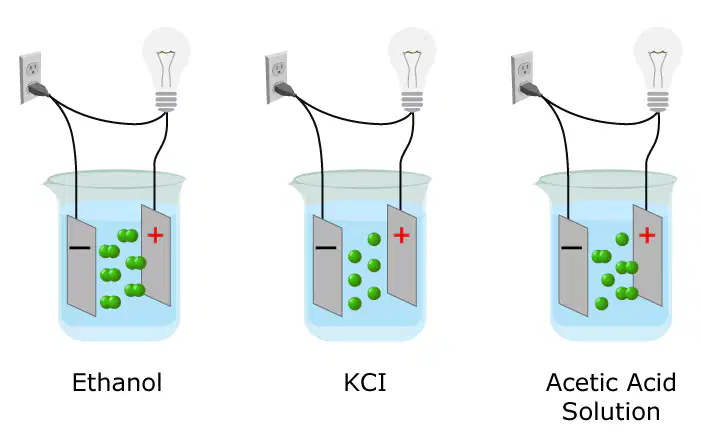
Which solution will have the highest conductivity?
The acetic acid solution will have the highest conductivity because acids release H+ ions that will conduct electricity.
The ethanol will have the highest conductivity because ethanol is a molecular compound, so the molecules will conduct electricity.
The acetic acid and KCl solutions will have similar conductivity because they both contain ions that will conduct electricity.
The KCl Solution will have the highest conductivity because KCl is an ionic solute that is completely dissociated to form ions in solution.
How does surface area affect the rate at which solutes dissolve in a specific solvent?
Larger surface area increases the rate
Smaller surface area increases the rate
Surface area has no effect
Surface area decreases the rate
How does agitation affect the rate at which solutes dissolve in a specific solvent?
Agitation decreases the rate
Agitation increases the rate
Agitation causes separation
Agitation has no effect
After spilling battery acid in your garage, you need to neutralize it with a strong base.
Which of the following substances would be the BEST base to use and why?
baking soda, pH = 9; because the lower pH value indicates a stronger base
drain cleaner, pH = 13; because the higher pH value indicates a stronger base
milk, pH = 6; because the lower pH value indicates a stronger base
soda, pH = 2; because the lower pH value indicates a stronger base
Which of the following statements is true concerning acids and bases?
acids and bases don't react with each other
acids mixed with bases neutralize each other
acids mixed with bases make stronger bases
acids mixed with bases make stronger acids
Which term describes the substance that is being dissolved in a solution?
Solute
Solvent
Conductivity
Concentration
Distilled water has an equal concentration of acid and base making it neutral.
If 150 g of sucrose are stirred in 100 mL of water at 20°C, what kind of solution will be formed?

Unsaturated

undissolved

Saturated

Saturated with undissolved sucrose
What property of a solution determines its ability to conduct electricity?
Solute
Solvent
Conductivity
Concentration
Which term describes the amount of solute present in a given amount of solvent?
Solvent
Concentration
Solute
Conductivity
Which solution will have the highest conductivity?
The acetic acid solution will have the highest conductivity because acids release H+ ions that will conduct electricity.
The ethanol will have the highest conductivity because ethanol is a molecular compound, so the molecules will conduct electricity.
The acetic acid and KCl solutions will have similar conductivity because they both contain ions that will conduct electricity.
The KCl Solution will have the highest conductivity because KCl is an ionic solute that is completely dissociated to form ions in solution.
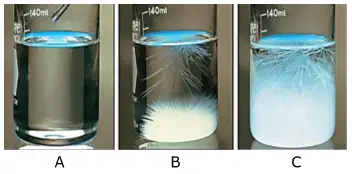
This picture represents a supersaturated solution of sodium acetate. After the sodium acetate stops forming crystals, what is the remaining liquid?
The remaining liquid is a supersaturated solution of sodium acetate in water.
The remaining liquid will be a saturated solution of sodium acetate in water.
The remaining liquid is an unsaturated solution of sodium acetate in water.
The remaining liquid contains only water because the sodium acetate formed crystals.
How does temperature affect the rate at which solutes dissolve in a specific solvent?
Temperature decreases the rate
Higher temperature increases the rate
Lower temperature increases the rate
Temperature has no effect
How does surface area affect the rate at which solutes dissolve in a specific solvent?
Larger surface area increases the rate
Smaller surface area increases the rate
Surface area has no effect
Surface area decreases the rate
How does agitation affect the rate at which solutes dissolve in a specific solvent?
Agitation decreases the rate
Agitation increases the rate
Agitation causes separation
Agitation has no effect
You are trying to increase the rate at which you can dissolve a large amount of sodium chloride into water to make a solution to use in lab.
Which of the following would be the BEST method of doing this?
heat the water and use small pieces of sodium chloride
heat the water and use a large piece of sodium chloride
stir and heat the mixture and use small pieces of sodium chloride
stir and heat the mixture and use a large piece of sodium chloride
Boiling points for ionic compounds are higher than boiling points for some covalent compounds and lower for other covalent compounds.Which of the following could James do next time to help prevent this from happening and why?
Wash the clothes in colder water, because lowering the temperature of the solvent increases the rate at which solutes dissolve.
Wash the clothes in colder water, because lowering the temperature of the solvent decreases the rate at which solutes dissolve.
Wash the clothes in hotter water, because raising the temperature of the solvent increases the rate at which solutes dissolve.
Wash the clothes in hotter water, because raising the temperature of the solvent decreases the rate at which solutes dissolve.
What does a solubility curve represent?
The effect of temperature on solubility
The effect of pressure on solubility
The effect of concentration on solubility
The effect of agitation on solubility
How does temperature affect the solubility of most solid solutes?
Temperature decreases solubility
Temperature has no effect
Higher temperature increases solubility
Lower temperature increases solubility
How does temperature affect the solubility of most gaseous solutes?
Temperature decreases solubility
Temperature has no effect
Lower temperature increases solubility
Higher temperature increases solubility
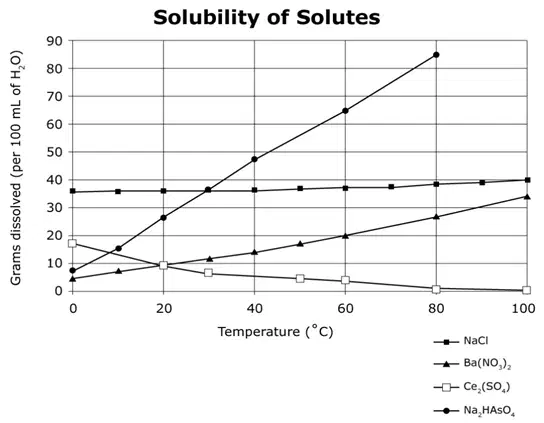
Which of the following solutes has the greatest overall increase in solubility as the temperature of the water is increased?
Ba(NO3)2
Ce2(SO4)
Na2HAsO4
NaCl
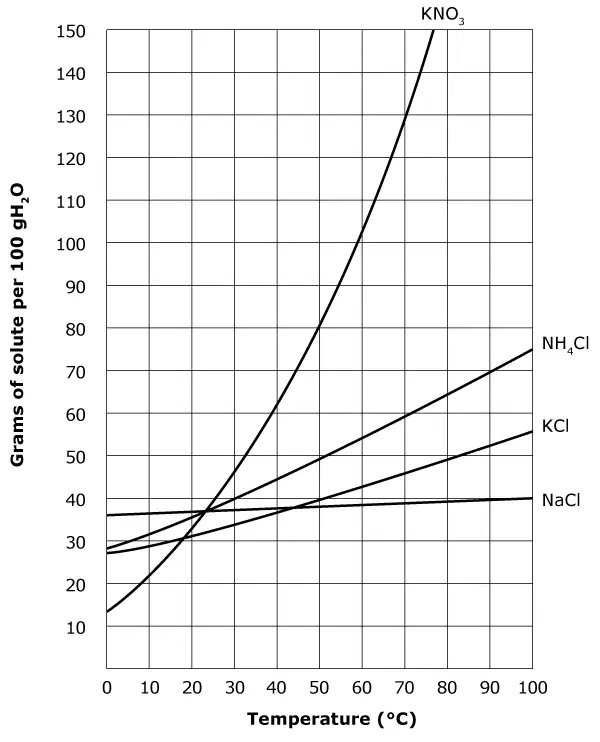
40 g of which substance is saturated in 100 g of water at a temperature of 500C?
KCl
NaCl
KNO3
NH4Cl
What ion is present in acids?
H+
OH-
Na+
Cl-
What ion is present in bases?
Cl-
Na+
OH-
H+

A group of students are going to conduct an investigation to determine if different chemicals are acids or bases using litmus paper as an indicator. The students know the vinegar changes blue litmus red and bleach changes red litmus blue.
Which table accurately predicts the color change of litmus paper and identifies the compound as an acid or a base?


Since HCl (hydrochloric acid) is a gas, scientists have to bubble it through water to make a solution. As it bubbles through, HCl dissociates according to the formula: HCl à H+ + Cl-.
Which of the following statements accurately explains what will happen if a student places Litmus paper in this solution?
The Litmus paper will turn red because the solution has more H+ ions than OH– ions, and its pH is low.
The Litmus paper will turn red because the solution has more OH– ions than H+ ions, and its pH is high.
The Litmus paper will turn blue because the solution has more OH- ions than Cl– ions, and its pH is high.
The Litmus paper will not change color because the solution has an equal amount of H+ ions and Cl– ions, and its pH is neutral.
How can common household substances be classified as acidic, basic, or neutral?
By testing their conductivity
By using pH indicators
By measuring their temperature
By observing their color
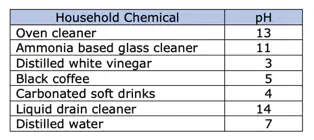
Many substances commonly found in the home can be classified as acids or bases based on the pH of aqueous (water-based) solutions. The following table lists several household chemicals and their pH.
Using the information in the table, which of the statements is TRUE?
Liquid drain cleaner has a higher concentration of hydroxide ions, so it is an acid.
Distilled white vinegar has a higher concentration of hydroxide ions, so it is a base.
Black coffee has an equal concentration of acid and base making it neutral.
Distilled water has an equal concentration of acid and base making it neutral.

Marina is presented with information about acids and bases from two different sources. Which THREE predictions can Marina make based on this information?
A solution of HI and water will turn blue litmus paper red.
A solution of HCl and water will turn blue litmus paper red.
A solution of H2S and water will turn red litmus paper blue.
A solution of LiOH and water will turn red litmus paper blue.
A solution of NaOH and water will turn blue litmus paper red.

A group of students investigated household substances to determine which are acidic, basic, or neutral. Which partial data table correctly classifies the substances?


After spilling battery acid in your garage, you need to neutralize it with a strong base.
Which of the following substances would be the BEST base to use and why?
baking soda, pH = 9; because the lower pH value indicates a stronger base
drain cleaner, pH = 13; because the higher pH value indicates a stronger base
milk, pH = 6; because the lower pH value indicates a stronger base
soda, pH = 2; because the lower pH value indicates a stronger base

Process in which an ionic compound separates into its positive and negative ions
Dissociation
Saturated solution
Solubility
Solution

Any solution that contains all the solute it can hold at a given temperature
Dissociation
Saturated solution
Solubility
Solution

Maximum amount of a solute that can be dissolved in a given amount of solvent at a given temperature
Dissociation
Saturated solution
Solubility
Solution

Homogeneous mixture that remains constantly and uniformly mixed and has particles that are so small they cannot be seen with a microscope
Dissociation
Saturated solution
Solubility
Solution

In a solution, the substance being dissolved
Solute
solvent
Supersaturated solution
Unsaturated solution

In a solution, the substance in which the solute is dissolved
Solute
solvent
Supersaturated solution
Unsaturated solution

Any solution that contains more solute than a saturated solution at the same temperature
Solute
solvent
Supersaturated solution
Unsaturated solution

Any solution that can dissolve more solute at a given temperature
Solute
solvent
Supersaturated solution
Unsaturated solution

compound that forms hydrogen ions (H+) in solution
acid
base
strong base
indicator

a base that completely dissociates into metal ions and hydroxide ions in aqueous solution
acid
base
strong base
indicator

a compound that produces hydroxide ions in solution
acid
base
strong base
indicator

A compound that changes color in the presence of an acid or a base
acid
base
strong base
indicator

A base that does not dissociate completely into ions in solution.
Neutralization
strong acid
weak acid
weak base

A reaction of an acid with a base, yielding a solution that is not as acidic or basic as the starting solutions were.
Neutralization
strong acid
weak acid
weak base

an acid that ionizes completely in aqueous solution
Neutralization
strong acid
weak acid
weak base

an acid that is only slightly ionized in aqueous solution
Neutralization
strong acid
weak acid
weak base

the scale used to specify how acidic or basic a water-based solution is
Neutralization
pH
weak acid
weak base
If a mixture is NOT uniform throughout, it is ______________.
heterogeneous
homozygous
homogeneous
a compound


_______ are corrosive substances characterized as having a strong smell, a sour taste, and a _______.
acidic or basic.
The substance in the beaker
What type of chemical does Carrie have?
Stirring the solution increases the rate of dissolution (rate of dissolving).
True
False
The smaller the particle size the faster the rate of dissolution (rate of dissolving).
True
False
Which will dissolve faster? Crushed table salt or a cube of table salt. Assume they have an equal mass.
crushed table salt
crystal of table salt
What combination would dissolve a solid solute the fastest?
high temperature, no stirring
no heat, no stirring
sugar cube, no heat
high temperature, stirring
Which of the following actions will NOT
increase the rate of dissolution
(dissolving) for solids?
Stirring the solution
Decreasing the temperature
Increasing the surface area of the
solute
Increasing the temperature
How does cold water affect the speed of dissolving?
Cold water slows down dissolving.
Cold water speeds up dissolving.
Cold water has no effect on dissolving.
Cold water has no effect on dissolving.
John has three cups of sugar particles. Cup 1 has large sugar particles, Cup 2 has medium-sized particles, and Cup 3 has small sugar particles. If John pours each cup in water, which cup of sugar particles will dissolve the fastest?
Cup 1 will dissolve the fastest.
Cup 2 will dissolve the fastest.
Cup 3 will dissolve the fastest.
They will dissolve at the same rate.
A soft drink that is more concentration is _____ in color and _______ in taste
lighter, stronger
darker, weaker
lighter, weaker
darker, stronger
Which pitcher is the most diluted?
100 mL water
125 g of mix
100 mL water
100 g of mix
100 mL water
50g of mix
100 mL water
25g of mix

Identify the solvent
Which is NOT a factor affecting Rate of Solution?
Pressure
Temperature
Agitation
Particle Size
You are given a small beaker of solution at room temp. You add a bit of solute to the solution and it dissolves. The solution was:
saturated
unsaturated
concentrated
warm
To separate a solution, you can ________________ it.
filter
evaporate
solute
saturate

What is this image representing?
Saturated
Unsaturated
Supersaturated
Insoluble

How much Ce2(SO4)3 solute is saturated at 80 degrees?
20
15
30
2
How much NaBr solute is saturated at 70 degrees?
110
120
130
140
Neutral solutions have a pH of:
0
1
7
14
NaOH may be found in drain cleaners and as a component of soaps. Is NaOH an acid or a base?
Acid
Base
Neither (Neutral)

HCl is found in household products, including some toilet bowl cleaners. Is HCl an acid or a base?
Acid
Base
Neither (Neutral)

Is laundry detergent an acid or a base?
Acid
Base
Neither (Neutral)
_______ are corrosive substances characterized as having a strong smell, a sour taste, and a _______.
Identify the solvent
A solution is made up of
Solvent
Solute
Both solvent and solute
when the solvent cannot dissolve any more solute
supersaturated
saturated
volume
mass
capable of being dissolved
saturated
soluble
volume
mass
when a solution contains more solute than it normally would at a given temperature or pressure
supersaturated
saturated
density
boiling point

