
 Worksheets
Chapter 11: Beyond Planet Earth
Total questions: 191
Worksheet time: 6hrs 36mins
The moon ____________ around the Earth.
revolves
rotates
up
down
How long does it take for the moon to revolve around the Earth?
365 days
24 days
27.3 days
24 hours
At any given time, how much of the moon's total surface is illuminated by the Sun?
half
a quarter
an eighth
full

What would we see from Earth when the moon is in position 1 ?


What would we see from Earth when the moon is in position 2 ?
What would we see from Earth when the moon is in position 3 ?
What would we see from Earth when the moon is in position 4 ?


What would we see from Earth when the moon is in position 5 ?
What would we see from Earth when the moon is in position 6 ?


What would we see from Earth when the moon is in position 7 ?


What would we see from Earth when the moon is in position 8 ?


Based on the above model of the Earth and moon, what phase of the moon will be observed when the moon is located between the Earth and Sun?
New Moon
Waxing Crescent
Waning Gibbous
Full Moon

Find the phases that represent the positions (A,B,C,D) in the diagram.


As the moon travels through the lunar month, what is the increasing of the visible portion called after the new moon?
waxing
waning
As the moon travels through the lunar month, what is the decreasing visible portion called after the full moon?
waxing
waning
Why does the moon shine?
it has its own light
it reflects Earth's light
it reflects the Sun's light


When does a solar eclipse occur
Daytime
Night time
Morning
Midnight


Which tide would be caused by the positions of the sun and moon in the picture?
High Tide
Low Tide
Spring Tide
Neap Tide

Which tide would be caused by the positions of the sun and moon in the picture?
High Tide
Low Tide
Spring Tide
Neap Tide
If a Spring Tide occurs during a New Moon or a Full Moon, when does a Neap Tide occur?
Never
Also during a New Moon and Full Moon
During a Half Moon (Waxing and Waning)
The tides are always at Neap Conditions
If a Neap Tide occurs during a Half Moon (Waxing or Waning), when does a Spring Tide occur?
Only in the Spring Season
During a New Moon and Full Moon
Also during a Half Moon (Waxing and Waning)
The tides are always at Neap Conditions

If the moon were to move CLOSER to Earth, which of the following would be true?
High tides would get higher
Low tides would get higher
There would be no change to the tides
High tide and Low tide would have litte difference in size.
Which tide results in the LARGEST movement of water?
Spring Tide
Neap Tide
Rip TIde
Ebb Tide
Which of the following has the GREATEST gravitational effect on the tides?
Earth
Moon
Sun
Which of the following has the LEAST gravitational effect on the tides?
Earth
Moon
Sun
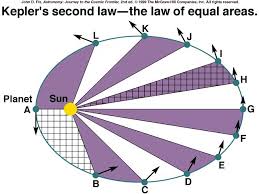
What will result in the most eccentric elliptical orbit
when the focal points are closest together
when the focal points are on top of one another
then the focal points are farthest apart

Which point is a FOCUS?
A
B
C
D
E
According to Kepler's Second Law, where in it's path does a planet move the fastest?
At the perihelion
At the aphelion
At the top of the semi-minor axis
The speed is constant.

Kepler's First Law states
objects attract other objects with a force that is directly proportional to the product of their masses
the square of the ratio of the periods of any two planets revolving around the Sun is equal to the cube of the ratio of their average distance from the Sun
An imaginary line joining a planet and the sun sweeps out an equal area of space in equal amounts of time.
Planets move about the Sun in an elliptical orbit with the Sun at one of the foci.

Kepler's Third Law states
objects attract other objects with a force that is directly proportional to the product of their masses
the square of the ratio of the periods of any two planets revolving around the Sun is equal to the cube of the ratio of their average distance from the Sun
An imaginary line joining a planet and the sun sweeps out an equal area of space in equal amounts of time.
Planets move about the Sun in an elliptical orbit with the Sun at one of the foci.

Which of the following most accurately describes the movement of the Earth around the Sun?
The Earth moves at a constant speed around the Sun.
The Earth moves faster when it is closest to the Sun.
The Earth moves slowest when it is closest to the Sun.
The Earth's speed varies dependent upon the phase of the moon.


What are the four inner planets?
Earth, Uranus, Mercury, Venus
Mercury Venus Earth Saturn
Mars, Earth , Mercury, Venus
What are the outer planets?
Jupiter, Saturn, Earth, Neptune
Uranus, Saturn, Neptune, Jupiter
Saturn, Neptune, Mars, Uranus
The outer planets are considered the Gas Planets
True
False
The Inner Planets are rocky and have craters on the surface
True
False
Pluto is considered a (a) planet
The sun is a ___________.
Star
Comet
Planet
This planet has the longest period of revolution.
Mercury
Mars
Saturn
Neptune
This planet has the longest period of rotation.
Mercury
Venus
Earth
Mars
This planet has a higher period of rotation than period of revolution.
Mercury
Venus
Earth
Mars
Rotation means...
to orbit.
to spin.
Revolution means...
to orbit.
to spin.
This planet is approximately half the size of Earth.
Mercury
Venus
Mars
Jupiter
This planet is 227.9 million kilometers from the Sun.
Mercury
Earth
Mars
Pluto
Pluto's not a planet!
This planet could float in water.
Earth
Jupiter
Saturn
You would need a huge bathtub.
This is the largest planet by size and mass.
Earth
Mars
Jupiter
Saturn
This planet has the most circular orbit.
Mercury
Venus
Earth
Mars
What is Neptune's period of revolution?
84 y
88 d
687 d
164.8 y
Which planet has a period of rotation similar to Earth?
Mars
Venus
Saturn
Jupiter
Which planet has the smallest diameter?
Mars
Earth's moon
Mercury
Jupiter
Which planet is closest in size to Earth?
Mercury
Uranus
Mars
Venus
Which celestial object has the same period of revolution as its period of rotation?
Sun
Earth
Saturn
Earth's Moon
This planet has the longest period of revolution.
Mercury
Mars
Saturn
Neptune
What is Jupiter's distance from the Sun?
1,426.7 million km
778.4 million km
11.9 y
227.9 million km
A characteristic of a Jovian planet is
high density
large equatorial diameter
rocky
small equatorial diameter
Saturn is how many millions of km away from the sun?
1426.7 million km
2871.0 million km
778.4 million km
227.9 million km
What is the period of revolution of Mercury?
88 days
59 days
57.9 days
224.7 days
Match the following terms with their definitions
Galaxy
A large grouping of stars, planets, gas, and dust in space held together by gravity.
Star
A self-luminous celestial body consisting of a mass of gas held together by its own gravity.
Universe
All space and the matter space contains.
Define the Doppler Effect
As sound gets closer to you, it gets louder, the wavelengths get shorter and more frequent.
As sound gets closer to you, it gets quieter, the wavelengths get longer and less frequent.
As sound gets closer to you, it gets louder, the wavelengths get longer and more frequent.
As sound gets closer to you, it gets quieter, the wavelengths get shorter and less frequent.
When galaxies are moving away from each other that means they have a (a) . When galaxies are moving towards each other, that means they have a (b) .
When glaxies have a redshift, they are moving (a) from eachother. As they move away from each other, they are moving (b) , and creating (c) space between galaxies.
Leftover radiation after the Big Bang is known as (a) .
True or False: The universe is expanding in two directions from many different points.
True
False
Define light spectra:
Wavelengths of just red and blue.
Wavelengths of red, orange, yellow and green.
Wavelengths of only some light waves.
The entirety of all wavelengths of light waves
What is one piece of evidence that supports the Big Bang Theory?
What is the another piece of evidence that supports the Big Bang Theory?
What is a third piece of evidence that supports the Big Bang Theory?
What is the best description of the big bang?
A massive explosion that created everything in the universe
Two planets collided, creating the Sun and other planets
A rapid expansion of a densely packed, small area that expanded into the universe that we know today
An explanation of how the universe is expanding and how big it is

What are two important pieces of evidence we have for the Big Bang?
Ptolemy’s work on epicycles and Hubble’s law (the expansion of the Universe)
Hubble’s law (the expansion of the Universe) and cosmic background radiation
The fact that we have multiple Universes to compare and study and cosmic background radiation (CBR)
The abundance of hydrogen, helium, and lithium found in the Universe and Ptolemy’s work on epicycles

The CMB (Cosmic Background Radiation) is:
the remaining energy from the big bang.
incredibly cool.
a cloud of light
only located in certain places in the universe.

A galaxy showing BLUE SHIFT is ___.
very cold
moving TOWARDS OR TO us
dying
about to supernova

Most distant galaxies show a RED SHIFT. This is considered EVIDENCE that the universe is ___.
getting cooler
expanding
condensing into a small point
swirling around

Galaxies that are REDSHIFTED are:
actually BLUE
really NEAR earth
invisible or not visible
moving AWAY from us.
Observations of space indicate that most matter in the universe is ___.
hydrogen, helium, and dark matter
gold and plutonium
oxygen and water vapor
carbon
Which description is considered most accurate regarding what actually happened during the Big Bang?
Two galaxies collided causing an immense explosion as stars crashed into one another
All of what would become the universe was concentrated in a single small point, or singularity, which rapidly expanded into what is now stars, planets, galaxies, matter, and energy.
All matter emerged from a massive black hole at the center of the universe.
Parts of the sun were ripped off by massive internal explosions and were thrown into space where they cooled to become other things, like plants, comets, and other galaxies.
All space and the matter space contains
Universe
Galaxy
Super Nova

All stars are composed of a mixture of elements. When these elements are heated they emit specific amounts of electromagnetic radiation, known as an emission spectrum. Each element emits a unique, identifiable, spectrum.
Using the Bright-line emission spectrum chart below, identify the elements present in this modeled star (found in the line labeled “mixture”).
Lithium and cadmium are in the mixture. Strontium is not in the mixture.
Lithium and strontium are in the mixture. Cadmium is not in the mixture
Cadmium and strontium are in the mixture. Lithium is not in the mixture
All of the shown elements are present in the mixture.

The unknown emissions spectra belongs to the element
Hydrogen
Mercury
Neon
Sodium

The unknown emissions spectra belongs to the element
Hydrogen
Mercury
Neon
Sodium


Which element(s) is/are found in the star's spectra below?
Hydrogen only
Hydrogen & Helium
Calcium only
Hydrogen & Calcium


The unknown emissions spectra belongs to the element
Hydrogen
Mercury
Neon
Helium
Nebula
Star left at the core of a planetary nebula
a large cloud of gas or dust in space
the earliest stage of a star's life
red super giant explodes
Protostar
Star left at the core of a planetary nebula
a large cloud of gas or dust in space
the earliest stage of a star's life
red super giant explodes
Supernova
Star left at the core of a planetary nebula
a large cloud of gas or dust in space
the earliest stage of a star's life
red super giant explodes
Neutron Star
The remains of a high mass star
Exerts such a strong gravitational pull that no light escapes
What a medium-mass star becomes at the end of its life
The star left at the core of a planetary nebula
Black Dwarf
The remains of a high mass star
Exerts such a strong gravitational pull that no light escapes
What a medium-mass star becomes at the end of its life
The star left at the core of a planetary nebula
What is the force that acts on a nebula to cause the formation of a protostar?
Inertia
Nuclear Fusion
Gravity
At which point in its development does a star exit the protostar stage and become a main sequence star?
When the nuclear fusion process begins
When collisions in particles result in an increase of temperature
When gravity squeezes it making it more dense
When it gets bigger and gravity gets stronger causing it to collide more often
Our Sun is considered slightly below average in mass. As it is a small to medium mass star, what would be the name of the phase that our Sun would enter after it exits the Main Sequence?
Red Super Giant
Yellow Super Giant
White Giant
Red Giant
Red Giants become unstable over time and expel their outer layers leaving a hot dense core called a _____ _____ that _____ undergo nuclear fusion
Black Hole; does not
White Dwarf; does not
White Dwarf; does
Black Hole; does
There are 2 points in the life cycle of a star that stars can take different paths. In each of these cases, it is the _______ of the star that determines the path it will take.
Color
Mass
Temperature
Brightness
A star is born when:
nuclear fusion starts
a nebula becomes a protostar
gases in a nebula condense
hydrogen is used up in fusion processes

Main sequence stars are made primarily of which elements?
Hydrogen only
Helium and Carbon
Carbon and Iron
Hydrogen and Helium
A star that has begun nuclear fusion will last for:
millions of years
a few thousand years
as long as the universe survives
forever
The formation of large atomic nuclei from smaller atomic nuclei in the core of stars by nuclear fusion is called :
nuclear fusion
nucleosynthesis
gravitational collapse

2 hydrogen will fuse together to form...
a large hydrogen
carbon
iron
helium

Put these in order of SIZE from SMALLEST to BIGGEST
Hydrogen
Helium
Carbon
Oxygen
Iron
Define nuclear fusion.
Combining lighter atoms to make heavier ones
Splitting lighter atoms to make heavier ones
Combining heavier atoms to make lighter ones
Splitting heavier atoms to make lighter ones

What element signals the end of the core of a star?
Oxygen
Carbon
Iron
Oh-no-ium.
What takes the longest to fuse inside a star?
Hydrogen
Helium
Silicon
Iron

What is the shortest element to fuse inside a star?
Hydrogen
Helium
Iron
Silicon
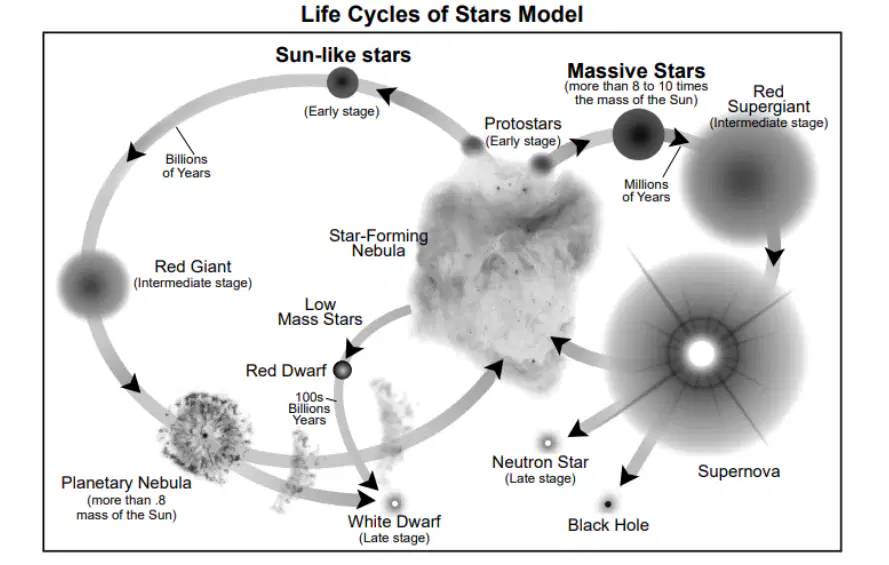
What is the first stage in the life cycle of a sun-like star?
Protostar
Red Giant
White Dwarf
Supernova
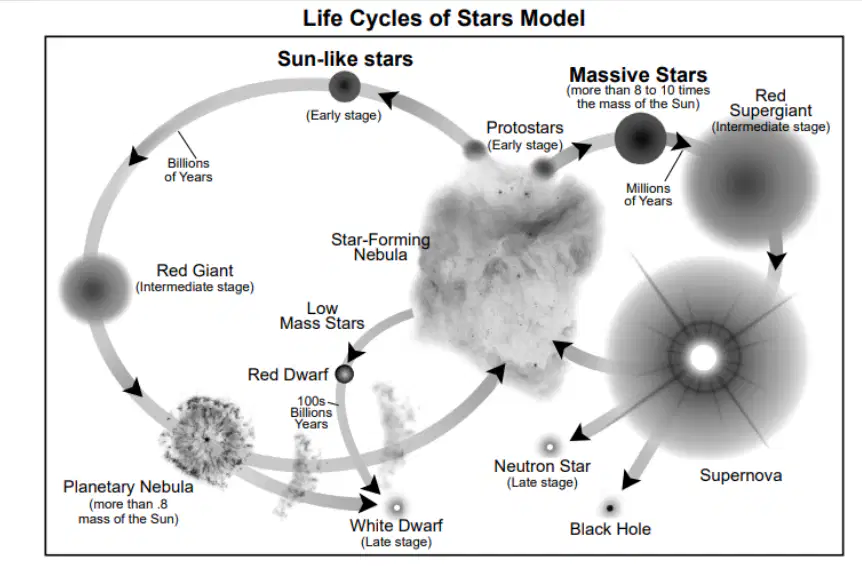
In the life cycle of massive stars, what stage follows the Red Supergiant?
Main Sequence
White Dwarf
Supernova
Neutron Star
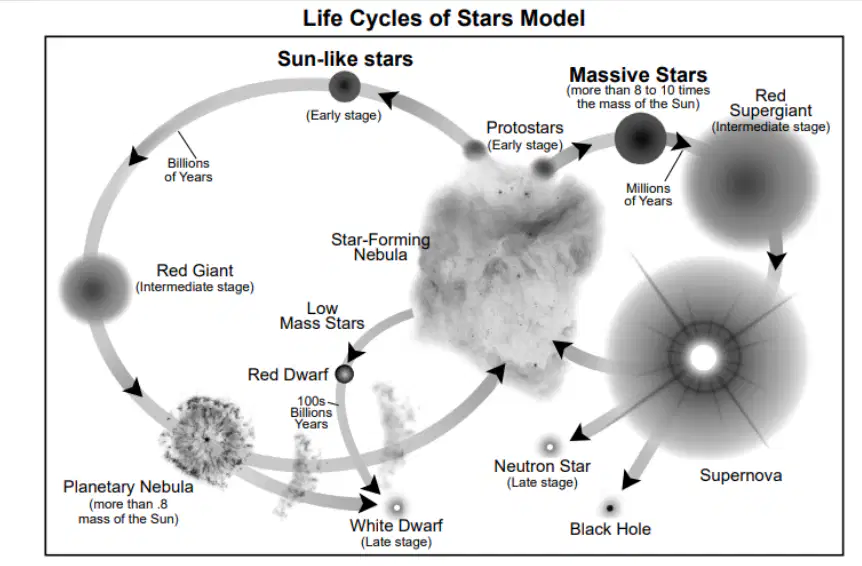
Which stage in the life cycle of a sun-like star lasts for billions of years?
Main Sequence
Red Giant
White Dwarf
Supernova
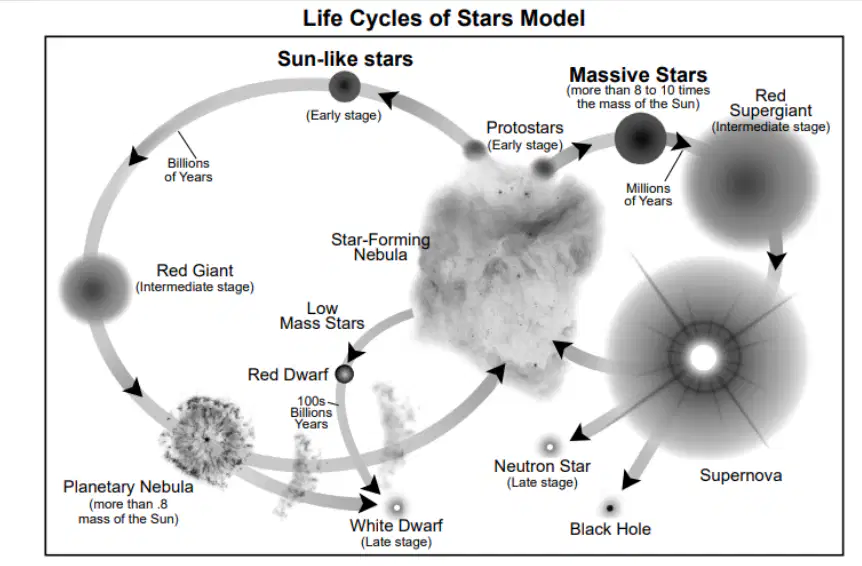
What is the final stage in the life cycle of a massive star?
Black Hole
White Dwarf
Neutron Star
Red Giant
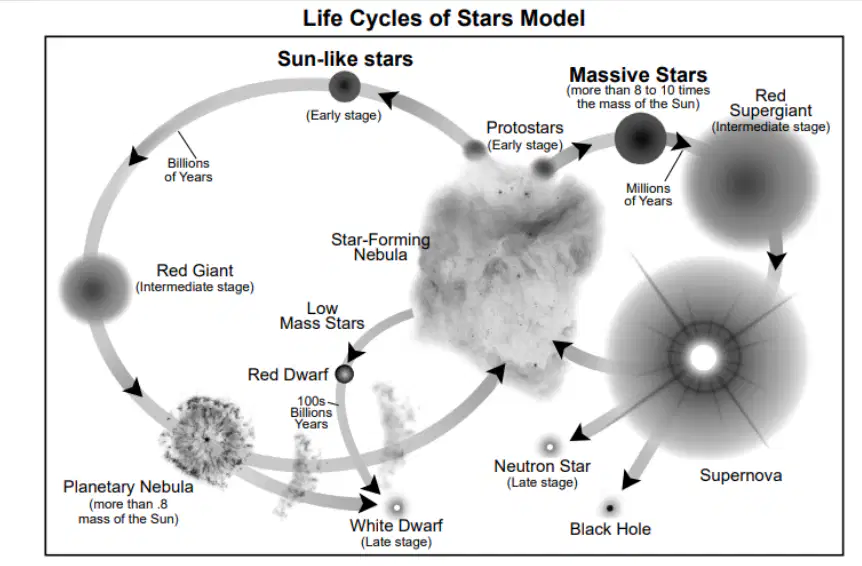
Which of the following is a stage in the life cycle of a sun-like star?
Neutron Star
Red Giant
Black Hole
Supernova
A big cloud of dust and gas where all
stars begin their life cycle is called a
solar system
universe
galaxy
nebula
Which is the stage where a massive star
explodes and releases a lot of energy?
Red supergiant
Supernova
Black hole
Main sequence
In about 5 billion years, our sun will
grow 100 times its size into its
next stage called a
Supernova
Neutron star
Red giant
White dwarf
What leads directly to the formation
of black holes?
Neutron Star
Planetary nebula
Supernova
Blue giant
What leads directly to the formation
of black holes?
Neutron Star
Planetary nebula
Supernova
Blue giant
The biggest most massive stars in the
universe are known as
Blue giants
Red giants
White giants
Red supergiants
Why do massive stars have shorter
life-spans than average stars?
They have less steps in their life-cycle
They have less fuel to burn
They burn through their fuel faster
They are cooler
When a supernova collapses, it can
squeeze electrons and protons together
into which type of star?
White dwarf
Neutron star
Black dwarf
Protostar
What is a star?
A cloud of particles held together
by its own gravity
A ball of gas
A large sphere of gas
that makes its own light
A nuclear explosion caused
by hydrogen on another planet

Looking at the provided image and your Earth Science Reference Tables, which star is most likely to become a supernova?
Sun
Deneb
Pollux
Barnard's Star
What process produces large amounts of energy in a star by combining lighter elements into heavier elements?
Convection
Radiation
Radioactive Decay
Nuclear Fusion
A star in a galaxy has a surface temperature of 8,000 K and a luminosity of 10. Identify the stage and color of this star.
Super Giant and White
Main Sequence and Red
White Dwarf and White
Main Sequence and White
Which star(s) are in the Late Stage of development?
40 Eridani B
Polaris
Rigel
Procyon B

The attached image is a graph based on a star's changing luminosity and temperature from formation to it's late stage. Based upon this image and your reference tables, what is the possible surface temperature of this star at point 2?
20,000 K
7,000 K
30,000 K
2,000 K

The attached image is the life cycle of different types of stars. Based upon this image and your reference tables, which star might have once been similar to our sun in mass and luminosity?
Deneb
Spica
Procyon B
Proxima Centauri
Which star has a hotter surface temperature and brighter luminosity than Sirius and will most likely end with a supernova event?
40 Eridani B
Betelgeuse
Rigel
Pollux
Compared to our Sun, the star Betelgeuse is
smaller, hotter, and less luminous
smaller, cooler, and more luminous
larger, hotter, and less luminous
larger, cooler, and more luminous

Which star color indicates the hottest star surface temperature?
Blue
White
Yellow
Red

According to the attached diagram, what determines if a star becomes a Supergiant or a Giant?
How massive it is.
If it is on the main sequence or not.
The shape of the nebula.

Using your reference tables, answer the attached question.
1
2
3
4
Which star is hotter, but less luminous than Polaris?
Deneb
Alderbaran
Sirius
Pollux


Which of the following are the brightest?
red supergiants
yellow main sequence
red dwarfs
white dwarfs


Which of the following stars is the hottest?
Bellatrix
Deneb
Polaris
Barnard's Star
Which of the following stars is the brightest?
Bellatrix
Deneb
Polaris
Barnard's Star
Where are the coolest stars on an HR Diagram found?
top
bottom
left
right
What galaxy do we live in?
Snickers
3 Muskateers
Mars
Milky Way
Which of the following is the largest structure in the universe?
Stars
Galaxies
Solar Systems
Universe
Fill in the blank: Red stars are the _______ and blue stars are the _______.
A) hottest, coldest
B) coldest, hottest
C) medium, hottest
D) coldest, medium

Which element has an emission line at approximately 656 nm?
Hydrogen
Helium
Carbon
Oxygen
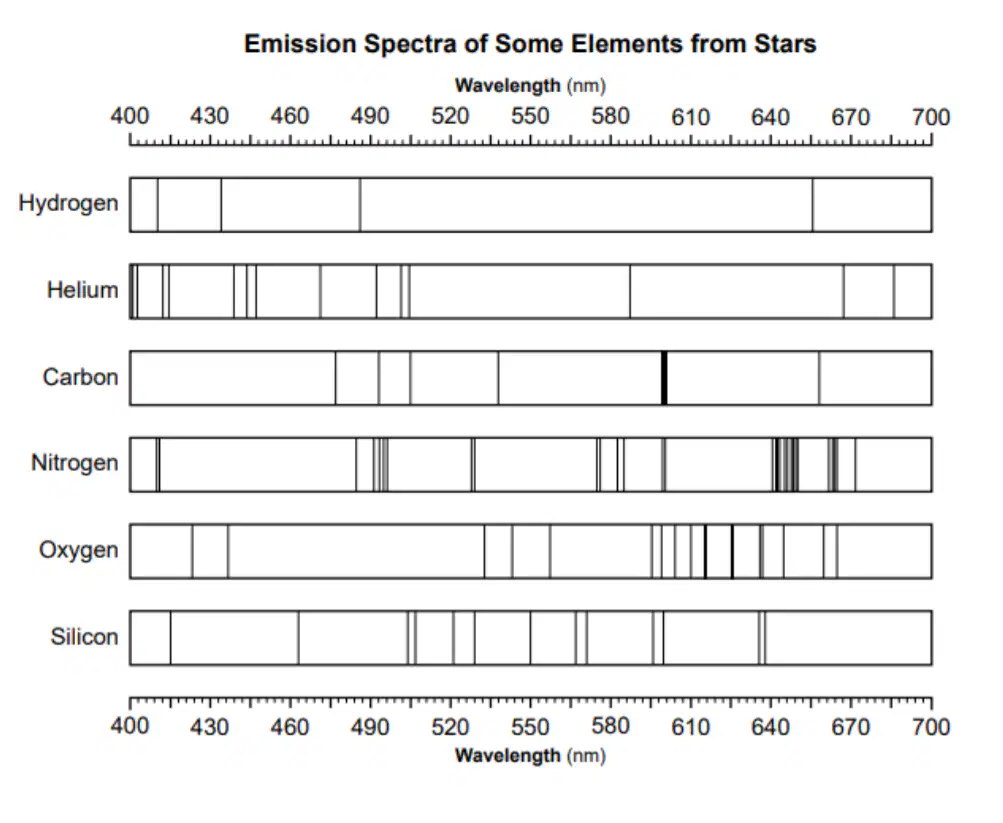
Fill in the blank: The element with emission lines at approximately 470 nm and 500 nm is ______.
A) Helium
B) Nitrogen
C) Oxygen
D) Silicon

The order of the Universe in which we live from biggest to smallest objects is:
Universe, planets, galaxies, stars, and moons
Universe, stars, galaxies, solar systems, and planets
Universe, planets, stars, moons, galaxies
Universe, galaxies, solar systems, stars, planets, moons

