wayground logo

Free Printable Worksheets

Font size

S
M
L
XL
Worksheets

IIT-JEE & NEET LEVEL-1 (9-O)

Total questions: 102

Worksheet time: 2hrs 42mins

Name
Class
Date
1.

Sebuah kubus memiliki panjang rusuk 8cm. Volume kubus tersebut adalah .... cm3

a)

16

b)

64

c)

384

d)

512

2.

jika sebuah kubus memiliki panjang rusuk 8cm, maka luas permukaannya adalah ....

a)

256

b)

384

c)

462

d)

512

3.

sebuah kubus mempunyai luas permukaan 864cm2. Panjang rusuk kubus tersebut adalah ....

a)

10 cm

b)

12 cm

c)

14 cm

d)

16 cm

4.

Sebuah kubus tanpa tutup memiliki volume 1000cm3. Luas permukaan dari kubus tersebut adalah .... cm2

a)

800

b)

700

c)

600

d)

500

5.

Diagonal ruang pada balok sebanyak ....

a)

4 buah

b)

6 buah

c)

8 buah

d)

12 buah

6.

volume balok yang memiliki panjang 7cm, lebar 4 cm dan tinggi 5 cm adalah ... cm3

a)

280

b)

140

c)

80

d)

16

7.

Luas permukaan balok tersebut adalah ... cm2

a)

90

b)

144

c)

180

d)

288

8.

Sebuah balok memiliki volume 1.200 cm3. Bila diketahui panjang 15 cm, lebar 10 cm, maka tinggi balok tersebut adalah ....

a)

20

b)

16

c)

12

d)

8

9.

sebuah balok berukuran panjang 7 cm lebar 3 cm dan tinggi 6 cm. luas permukaan kubus tersebut adalah...

a)

81

b)

126

c)

162

d)

216

10.

Find the surface area of a cube with sides 4 mm

a)

72 mm2

b)

96 mm2

c)

108 mm2

d)

64 mm2

11.

Find the surface area of a cuboid 4 cm in height, 2 cm length and 5 cm in width.

a)

40 cm2

b)

46 cm2

c)

58 cm2

d)

76 cm2

12.

Find the surface area of a cuboid with length = l, width = w and height = h

a)

2hl + 2wl + 2hw

b)

l*h*w

c)

6hl

d)

4hw

13.

If a rectangular cuboid is 15cm long, 10cm wide and 9cm high with volume of 500cm³ then surface area of cuboid is ....

a)

750 cm²

b)

800 cm²

c)

850 cm²

d)

700 cm²

14.

If a rectangular cuboid is 9 cm long and 8 cm wide with volume of 450 cm³ then height of cuboid in 'cm' is ....

a)

12.25

b)

6.25

c)

8.25

d)

9.25

15.

If a rectangular tank is 21 cm long, 13 cm wide and 18 cm high and contains water up to a height of 11 cm then total surface area is ....

a)

1450 cm²

b)

1350 cm²

c)

1200 cm²

d)

1021 cm²

16.

By converting 2,500,000 mm³ into cm³, answer will be ....

a)

250 cm³

b)

2,500 cm³

c)

25 cm³

d)

25,000 cm³

17.

A cube is coloured red on all faces. It is cut into 64 smaller cubes of equal size. How many cubes have no face coloured?

a)

24

b)

16

c)

8

d)

4

18.

A big cube whose all the corners are named as H, I, J, K, L, M, N and O. Its each portion is of 42 cm length. The cube is segmented into tiny cubes and length of the portion of each tiny cube is 6 cm. Then how many such cubes are possible?

a)

343

b)

385

c)

125

d)

364

19.

The volume of a cuboid of sides  12\frac{1}{2}  m, 20 cm, 10 cm is ....

a)

100  cm3cm^3  

b)

1,000  cm3cm^3  

c)

10,000  cm3cm^3  

d)

100,000  cm3cm^3  

20.

Two identical cubes each of total surface area of 6 cm2 are joined end to end. Which of the following is the total surface area of the cuboid so formed?

a)

12 cm2

b)

18 cm2

c)

10 cm2

d)

8 cm2

21.

log(4x)

a)

log4-logx

b)

log4+logx

c)

4logx

d)

xlog4

22.

log(xy2)

a)

logx+2logy

b)

logx+logy2

c)

logx-2logy

d)

logx+logy+log2

23.

 log(xy)\log\left(\frac{x}{y}\right)  

a)

logx+logy

b)

xlogy

c)

log(x-y)

d)

logx-logy

24.

 log(m3n)\log\left(\frac{m^3}{n}\right)  

a)

logm-log3-logn

b)

3logm+logn

c)

3logm-logn

d)

3log(m-n)

25.

log(3x)2

a)

2log(3+x)

b)

2log3+logx

c)

log3+2logx

d)

2(log3+logx)

26.

 log(8xyz) \log\left(\frac{8x}{yz}\right)\   

a)

log8+logx-logy-logz

b)

log8+logx-logy+logz

c)

log(8x)-log(yz)

d)

8logx-ylogz

27.

log(x7)

a)

log(7x)

b)

log7+logx

c)

xlog7

d)

7logx

28.

 log(94)\log\left(\frac{9}{4}\right)  

a)

log9+log4

b)

log(9-4)

c)

log9-log4

d)

4log9

29.

Rewrite log28 = 3 in exponential form

a)

28 = 3

b)

23 = 8

c)

32 = 8

d)

83 = 2

30.
Evaluate:
log416
a)
2
b)
4
c)
1/2
d)
-2
31.
Rewrite logpt = m in exponential form.
a)
pt = m
b)
tm = p
c)
mt = p
d)
pm = t
32.
Rewrite 34 = 81 in logarithmic form.
a)
log34 = 81
b)
log813 = 4
c)
log381 = 4
d)
log481 = 3
33.
Write in exponential form.
log232 = 5
a)
2-5 = 32
b)
232 = 5
c)
25 = 32
d)
325 = 2
34.
Write in exponential form.
log2(1/8) = -3
a)
2-31/8
b)
21/8 = -3
c)
-321/8
d)
-31/8 = 2
35.
Change to Exponential Form:
log636 = 2
a)
26=36
b)
62=36
c)
362=6
d)
366=2
36.
Solve for x
log8(x) = 2
a)
x = 256
b)
x = 64
c)
x = 16
d)
x = 32
37.
Solve for x
5x = 17
a)
x = log175
b)
x = log 5 + log 17
c)
x = log517
d)
x = (log 5)/(log 17)
38.
Factor completely: 0.25x + 4.75
a)
0.75(x + 4)
b)
0.25(x + 19)
c)
0.5(0.5x + 9.5)
d)
0.25(x + 4.5)
39.
log41 = 
a)
0
b)
1
c)
4
d)
DNE
40.
Write in logarithmic form.
2-41/16
a)
log2(1/16) = -4
b)
log-4(1/16) = 2
c)
log -4 2 = 1/16
d)
log2(-4) = 1/16
41.
What organelle of the cell produces energy?
a)
Mitochondria 
b)
Golgi Body 
c)
Vesicle 
d)
Vacuole 
42.
What kind of transport does not require energy?
a)
Active 
b)
Vacuole 
c)
Passive 
d)
Na/K Pump 
43.
What structure of the cell forms a frame that holds the cell up in the cytoplasm?
a)
centrioles 
b)
cell wall 
c)
flagella 
d)
cytoskeleton 
44.
What is something that prokaryotic and eukaryotic cells have in common?
a)
They have a nucleus. 
b)
They are multi-cellular. 
c)
They have DNA. 
d)
They have organelles that are membrane-bound.
45.
What is facilitated diffusion?
a)
Transport that uses proteins to help move molecules across the membrane. 
b)
Movements of substances through a membrane. 
c)
When molecules spread from High to Low concentration on their own. 
d)
When pressure pushes something through a membrane. 
46.
What macromolecules help to make the cell membrane? 
a)
Proteins 
b)
Carbohydrates 
c)
Phospholipids 
d)
All of the above 
47.
All of the following statements are true about prokaryotic cells EXCEPT 
a)
No nucleus 
b)
They are simple and small 
c)
Have a cell wall 
d)
Have organelles 
48.
This process uses pressure to push substances through the cell membrane. 
a)
Filtration 
b)
Active Transport 
c)
Osmosis 
d)
Endocytosis 
49.
Which of the following is the best example of osmosis? 
a)
NA/K Pump 
b)
Water moving though the cell membrane 
c)
Kidneys 
d)
Photosynthesis 
50.
What is the significance of the cell membrane? 
a)
Provides protection 
b)
Maintains homeostasis 
c)
Give a cell hydrophobic ends
d)
Provides cholesterol 
51.
The small intestines use filtration. 
a)
True 
b)
False 
52.
Movement of materials through a vesicle into the cell that requires energy is 
a)
exocytosis
b)
endocytosis 
c)
osmosis 
d)
simple diffusion 
53.
What are the 2 parts of a phospholipid? 
a)
Hydrophobic head, hydrophilic tails 
b)
Hydrophobic heads, hydrophobic tails 
c)
Hydrophilic heads, hydrophobic tails 
d)
Hydrophilic heads, hydrophilic tails 
54.
What is an isotonic solution?
a)
When solutions are in equilibrium 
b)
When the solution has more solute 
c)
When the solution has less solute 
d)
Has a greater pressure 
55.
Active transport does not require energy.
a)
True 
b)
False 
56.
The nuclear envelope encloses the nucleus and its contents.
a)
True 
b)
False 
57.
Molecules using simple diffusion move from 
a)
high to low concentrations 
b)
low to high concentrations 
c)
no concentrations  
d)
both concentrations  
58.
Osmosis is the movement of... 
a)
salt 
b)
sugar 
c)
water 
d)
none of these 
59.
The path that water molecules take into the cell is... 
a)
through cholesterol 
b)
between globular proteins 
c)
between phospholipids 
d)
through peripheral proteins 
60.
Which of the following is NOT a cell theory.
a)
All non-living things are made of cells
b)
All cells come from pre-existing cells
c)
Cells are the basic unit of structure and function of all living things
61.

Which part of the atom is responsible for chemical bonding?

a)

Core Electrons

b)

Valence Electrons

c)

Protons

d)

Neutrons

62.
What are ionic bonds?
a)
valence electrons transferred between atoms
b)
Inner most electrons transferred between atoms
63.
A chemical bond that involves the sharing of nonmetal electrons.
a)
ionic bond
b)
an Ion
c)
covalent bond
d)
a anion
64.
How are covalent bonds explained?
a)
When one atom takes the other atom's electron
b)
When the atom shares an electron with an another atom
c)
When the two nucleus merge
d)
When the neutrons leave the nucleus
65.

A positively or negatively charged particle.

a)

covalent bond

b)

ion

c)

oxidation number

d)

subscript

66.

A chemical bond between oppositely charged ions.

a)

Covalent bonds

b)

Ionic Bonds

c)

Ion

d)

Compound

67.

A chemical bond formed between shared atoms.

a)

covalent bond

b)

chemical bonds

c)

compound

d)

ionic bonds

68.

What are ionic bonds?

a)

Valence electrons transferred between atoms

b)

Core electrons transferred between atoms

c)

Protons are transferred between atoms

d)

Neutrons are transferred between atoms

69.

Which of these is NOT a chemical bond?

a)

Ionic bond

b)

Covalent bond

c)

Metallic bond

d)

Molecule bond

70.

Ions change from positive and negative, and back in forth, this is called the ______________________

a)

Molecule number

b)

Ionic number

c)

Polar number

d)

Oxidation number

71.

A group of covalent bond atoms are called a _________________

a)

Compound

b)

Molecule

c)

Ion

d)

Chemical

72.

Metal atoms drift free from one side to another forming a ____________________________

a)

sea of electrons

b)

sea of ions

c)

sea of molecules

d)

sea of compounds

73.

An ion that is negative is called a ____________________.

a)

polar ion

b)

nonpolar ion

c)

anion

d)

cation

74.

An ion that is positively charged is called a ________________.

a)

polar ion

b)

cation

c)

anion

d)

positive ion

75.

Polar bond is when electrons are _________________ shared.

a)

equally

b)

unequally

76.

Nonpolar bonds are when electrons are ______________ shared.

a)

equally

b)

nonequally

77.

Chemical bonding happens between _________________ of an element.

a)

atoms

b)

protons

c)

neutrons

d)

element

78.

What are the 2 types of ions?

a)

protons and neutrons

b)

molecules and compounds

c)

polar and nonpolar

d)

cation and anion

79.
What ending is used for the names of negative ions formed when atoms gain (steal) electrons?
a)
ade
b)
ate
c)
ion
d)
ide
80.
What type of bond is formed when electrons are transferred (stolen, or given) from one atom to another?
a)
Ionic Bond
b)
Covalent Bond
c)
Metallic Bond
d)
Acidic Bond
81.
What is the formula to calculate speed?
a)
S = t/d
b)
S = d/t
c)
S = d x t
d)
S = t x d
82.
What is speed?
a)
how far you go
b)
how much distance is covered over a period of time
c)
how fast you accelerate
d)
the change in the location of a object
83.
What is velocity?
a)
the quickness of an object
b)
the location of an object
c)
acceleration
d)
speed in a specific direction
84.
What is velocity?
a)
the quickness of an object
b)
the location of an object
c)
acceleration
d)
speed in a specific direction
85.
The unit we use to measure acceleration is ___. 
a)
meters / second 
b)
meters 
c)
seconds 
d)
meters / second / second 
86.
The speedometer on your car tells you
a)
average velocity
b)
instantaneous velocity
c)
average speed
d)
instantaneous speed
87.
What is this graph representing?
a)
Constant Speed
b)
Acceleration (speeding up)
c)
Deceleration (slowing down)
d)
No motion
88.
What two measurements are necessary for calculating speed?
a)
Mass and time
b)
Temperature and mass
c)
Mass and distance
d)
Distance and time
89.
What two measurements are necessary for calculating speed?
a)
Mass and time
b)
Temperature and mass
c)
Mass and distance
d)
Distance and time
90.
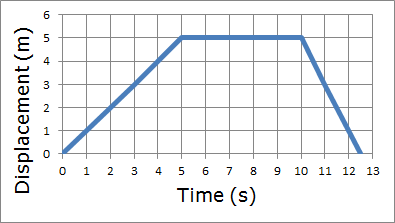
At 60 seconds, how far had this object traveled? 
a)
0 m
b)
10 m
c)
20 m
d)
40 m
91.
What is the person doing from 5 seconds to 10 seconds?
a)
Walking 
b)
Running
c)
Standing Still 
d)
Walking Fast
92.
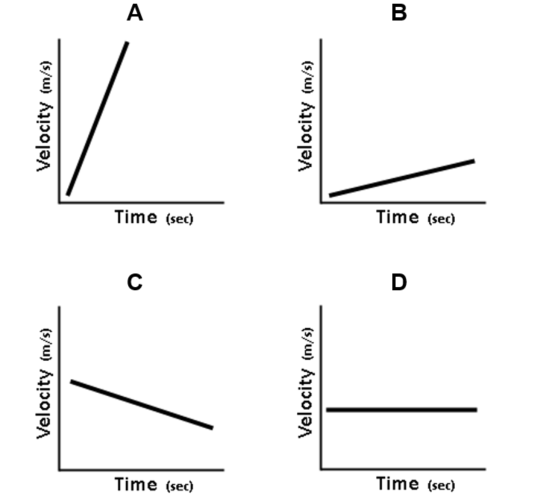
Which graph represents zero acceleration (constant velocity)?
a)
A
b)
B
c)
C
d)
D
94.
You run from your house to a friend's house that is 3 km away. You then walk home. The distance you traveled is 6 km. What is your displacement? 
a)
6  km
b)
0 km
94.
You run from your house to a friend's house that is 3 km away. You then walk home. The distance you traveled is 6 km. What is your displacement? 
a)
6  km
b)
0 km
95.
You run from your house to a friend's house that is 3 km away. You then walk home. The distance you traveled is 6 km. What is your displacement? 
a)
6  km
b)
0 km
96.
The fastest trains are magnetically levitated above the rails to avoid friction (and are therefore called
MagLev trains...cool, huh?). The fastest trains travel about 250 km in a half an hour. What is their
average speed in km/hour?
a)
250 km/hr
b)
500 km/hr
c)
125 km/hr
97.
A car slows down from +32 m/s to +8 m/s in 4 s. The acceleration is 
a)
6 m/s/s opposite the motion
b)
2m/s/s in the direction of motion
c)
8 m/s/s opposite the motion
98.
A cheetah travels 75 m in 3 s. What is her velocity over the interval?
a)
225 m/s
b)
25 m/s 
c)
0.04 m/s
99.

Which of the following terms describes a Vector and it's proper units?

a)

position in seconds

b)

distance in meters

c)

speed in hours

d)

velocity in m/s

100.

A car is traveling south for 250 meters over the course of 100 seconds. What was the car's average velocity?

a)

0.4 m/s south

b)

0.4 m/s

c)

2.5 m/s

d)

2.5 m/s south

101.

Horse A is running East at a speed of 6 m/s. Horse B is running at a speed of 8 m/s East as it passes Horse A. What is Horse B's velocity relative to Horse A?

a)

14 m/s

b)

-2 m/s

c)

2 m/s

d)

48 m/s

102.

Total distance an object travels with direction.

a)

Displacement

b)

Distance

c)

Path

d)

Velocity