
NEW
Font size
 Worksheets
Science Mid-Term Review
Total questions: 80
Worksheet time: 44mins
How many atoms of oxygen are present in C7H5(NO2)3?
2
6
3
7
What is the name for Group 18 on the periodic table?
alkali metals
halogens
noble gases
transition metals
NaCl is a(an) ___________.
element
compound
mixture
Lemonade is a(n) ________________.
element
compound
mixture
A substance changes from a solid directly to a gas. Which phase change is this?
evaporation
condensation
melting
sublimation
Phase change from liquid to a solid.
melting
condensation
freezing
evaporation
Determine the balanced equation for the following:
Fe2O3 + H2 --> 2Fe + 3H2O
2Fe2O3 + H2 --> 2Fe + 2H2O
Fe2O3 + 3H2 --> 2Fe + 3H2O
Fe2O3 + 6H2 --> 2Fe + 6H2O
Fe2O3 + H2 --> Fe + H2O
The ability of a metal to be hammered into sheets without breaking is called
ductility
flexibility
malleability
phase change
Which of the following is NOT a clue that a chemical reaction is occurring?
gas formation
color change
change in odor
change in the size and shape of a solid

What is the atomic mass of lithium?
3
6
7
4

What is the atomic number of lithium?
3
4
7
6

What is the number of protons in lithium?
3
4
6
7

What is the number of neutrons in lithium?
3
4
6
7

What is the number of electrons in lithium?
3
4
6
7

What is the atomic symbol for lithium?
3
6.941
Li
Lithium
If a chemical equation is balanced, it means that the number of ____________ of each element is the same on both sides of the equation.
molecules
atoms
elements
compounds
Where do we find the products of a chemical equation?
to the left of the yields sign
to the right of the yields sign
under the yields sign
What is a yields sign?

This figure shows a chemical reaction. In this chemical reaction, water is a _______________.
product
reactant
form of energy
lipid
The Law of Conservation of Mass states that the mass of the reactants is ______________ the mass of the products.
greater than
less than
equal to
If you heat a beaker of an unknown substance and the water evaporates and solid substance is left behind, you know the substance was a(n) _______________.
element
compound
mixture
atom
This can be separated by physical means.
an atom
a mixture
a compound
an element
What are the horizontal rows on the periodic table called?
groups
periods
In which phase of matter do particles move the most?
solid
liquid
gas
What is the BEST way to know that a compound has been formed?
increase in volume
a color change
can be separated back into its original parts
forms a new material with different properties.
Which is an example of a chemical change?
an electric current through a copper wire.
hammering a nail into wood.
cutting copper wire into small pieces.
burning small twigs to set a log on fire.
Rusting is an example of
physical property
physical change
chemical property
chemical change
What do all chemical changes have in common?
a gas is produced.
a new substance is formed.
heat is released into the environment.
the reactancts change color.
The most basic unit of all matter is
a molecule
a tissue
an atom
a compound
Which of these is an element and not a compound?
CO
CaO2
Cl
CO2
The atomic number of an element is determined by which subatomic particle(s)?
neutrons
protons
electrons
protons and neutrons

Which one is the correct Bohr model for Nitrogen?
a
b
c
d

Four diagrams representing four different states of matter are shown:
Which sequence shows the correct representation?
solid, liquid, plasma, gas
gas, solid, liquid, plasma
gas, plasma, solid, liquid
liquid, solid, plasma, gas
Which of these is MOST LIKELY the result of a chemical reaction?
solids broken down into smaller pieces.
liquids brought to a boil.
formation of white crystals as water evaporates.
formation of iron oxide as metal rusts.
Which of these molecules is made up of only one element?
water
carbon dioxide
sodium chloride
oxygen
You have an unidentified liquid in a beaker. What can you know about the contents without knowing any of its properties?
it is made up of atoms.
it is a good conductor of electricity.
it is a compound.
it is a non-metal.
Which of these is a compound and not a mixture?
lemonade
table salt
oil and vinegar
sand and water
Bubbles are an indication of a
physical change
chemical change
a phase change
The chemical formula for a substance is shown:
H20
The substance can best be described as:
an atom of water
the compound water
the element water
a mixture of water
Which is NOT a chemical change?
wood burning
rust forming on a bicycle
ice melting
adding baking soda to vinegar
Matter that can by PHYSICALLY separated into two or more pure substances is called:
a solid
a compound
an element
a mixture
Formulas for four different compounds are shown:
H2CO3, C6H12O6, Ca(OH)2, and HCl.
What element is in all four compounds?
carbon
oxygen
hydrogen
chlorine

What characteristics do the circled elements share?
They are nonmetals
they are alkali metals
they rarely form chemical bonds.
they have the same number of electrons.

An equation for a chemical reaction is shown.
Which correctly classifies the compounds in this chemical reaction a a reactant or a product?
The reactant is carbon dioxide and the products are water, glucose, and oxygen.
The reactants are carbon dioxide and water and the products are glucose and oxygen.
The reactants are glucose and oxygen and the products are carbon dioxide and water.

The diagram represents part of the periodic table of elements. Radon is a gas that does not usually form compounds.
In which numbered area is radon located on the periodic table?
1
2
3
4

A periodic table of elements is shown.
Which shaded element has metallic properties?
carbon (C)
neon (Ne)
chlorine (Cl)
vanadium (V)

How will the water move in this diagram?
water will not move
water will move out of the cell
water will move into the cell
water will move into and out of the cell equally
A drop of food coloring is added to a bowl of water. Several minutes later, all of the water is colored. What took place?
erosion
osmosis
diffusion
transfusion

Which diagram shows the end result of diffusion?
F
G
H
J

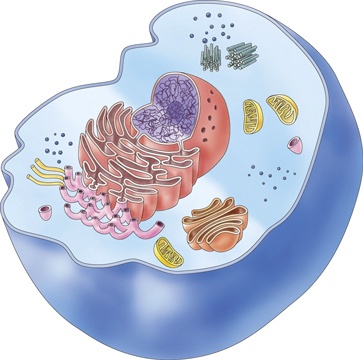


This organelle stores water and other materials. It is larger in plant cells.
vacuole
cell wall
chloroplast
cytoplasm

The golgi complex's function is to
make proteins for the cell
control what enters and leaves the cell
package and distribute proteins in the cell
provide energy for the cell

Which organelle is labeled A?
cell membrane
cell wall
cytoplasm
nucleus

Which organelle is labeled B?
cell wall
cell membrane
cytoplasm
ribosome

Which organelle is labled C?
Golgi body
ER
ribosome
mitochondria

Which organelle is labeled D?
golgi body
nucleus
ER
mitonchondria

Which organelle is labeled E?
ribosome
lysosome
golgi body
ER

Which organelle is labeled F?
ribosome
lysosome
golgi body
ER

Which organelle is labeled G?
ribosome
lysosome
mitochondria
ER

Which organelle is labeled H?
ER
Chloroplast
Vacuole
Golgi body

Which organelle is labeled F?
cell wall
chloroplast
vacuole
lysosome

Which organelle is labeled B?
cell wall
chloroplast
vaculole
lysosome

Which organelle is labeled A?
cell wall
chloroplast
vacuole
lysosome

What type of cell is this?
plant cell
animal cell

What type of cell is this?
plant cell
animal cell
The movement of water through a selectively permeable membrane from regions of high to low concentration.
diffusion
osmosis
active transport
facilitated transport
The movement of substances across the cell membrane that requires energy.
diffusion
osmosis
active transport
passive transport
The periodic table shows that an oxygen atom has eight protons. This means that an oxygen atom also has
eight electrons
eight neutrons
more protons than electrons
an atomic mass that equals eight
Sodium has 11 protons and 11 electrons. The electrons fill the energy levels in Sodium like this:
2 in the first level, 2 in the second, and 7 in the third
4 in the first level, 4 in the second, and 3 in the third
2 in the first level, 4 in the second, and 5 in the third
2 in the first level, 8 in the second, and 1 in the third
A red blood cell is placed in saltwater. Which of the following events would most likely occur?
nothing
salt would move into the cell
swelling of the cell until it bursts
shriveling of the cell
If a cell's cytoplasm contains 30% solute, which of the following best describes the rest of the cytoplasm?
70% solute
30% solute
70% water
30% water

Choose the beaker that contains an egg that would shrink?
Beaker A
Beaker B
Beaker C
Beaker D

How will the water move in the U tube after one hour if left undisturbed?
to the left of the tube
to the right of the tube
it will not move
it will all evaporate

