
 Worksheets
APES Unit 1-4 Review
Total questions: 100
Worksheet time: 2hrs 54mins
The study of environmental science primarily considers
interactions among human systems and those found in Earth
the effect of human systems
abiotic factors that influence the state of our environment
factors that affect global climate change
An ecosystem is a location on Earth that includes
only biotic components
only abiotic components
interacting biotic and abiotic components
positive and negative feedback loops
Living in a sustainable way refers to
recycling all paper, plastic, and metals
using resources in a way that does not deprive future generations
using Earth's resources efficiently
eating locally whenever possible
Which of the following is a qualitative observation?
15 inches
a liquid
a green solution
6 feet 1 inches
Place the ecology levels of organization in proper order (smallest to largest)
organism > population > community > ecosystem > biosphere
community > organism > ecosystem > biosphere > population
organism > community > biosphere > population > ecosystem
population > biosphere > ecosystem > community > organism
A tapeworm lives in the small intestines where it feeds and grows, robbing the human of essential nutrients. This is a _____ type of relationship.
Commensalism
Parasitism
Symbiotic
Mutualism
The cattle egret follows herds of cattle and eat the insects that the cattle stir up as they move through the grassland. The cattle appear to be unaffected by the egrets. This is a _____ type of relationship.
Commensalism
Parasitism
Symbiotic
Mutualism
A positive feedback loop occurs
when a system responds to a change by returning to its original state
when feedback into a system decreases a rate of response
when a system is in a steady state
when feedback into a system increases a rate of response
Which is a biotic factor?
producers
pH
energy
humidity
What law best relates to energy loss within an ecosystem?
First law of thermodynamics
Second law of thermodynamics
Third law of thermodynamics
Law of conservation of matter
Which best describes the concept of net primary production?
total amount of energy available from the Sun
total amount of cellular respiration conducted within an ecosystem
energy captured minus energy lost
total amount of energy available from the producer

In which biome would you expect to find an area with an average temperature of 10oC and 200 cm of precipitation annually?
Temperate seasonal forest
Temperate rainforest
Woodland/shrubland
Tropical seasonal forest
In which biome would you expect to find an area with an average temperature of 4oC and 50 cm of precipitation annually?
Tundra
Boreal forest
Temperate grassland/cold desert
Woodland/shrubland
What factors are used to classify a biome?
average temperature
average precipitation
distinctive plants adapted to area
all of these are correct
Which biome is characterized by the presence of permafrost?
temperate seasonal forest
woodland/shrubland
tundra
boreal forest
Terrestrial biomes are defined by ____ and ____ variables.
temperature; precipitation
temperature; animals
precipitation; plants
animals; plants
What is a herbivore?
receives energy from the sun
only eats meat
only eats plants
eats both plants and meat
A keystone species is best defined as
an organism that eats all others
an organism that runs the fastest
an organism that keeps the food web stable
an organism that has the most advantages
Which of the following are examples of wetlands?
swamps
marshes
bogs
all of these are correct
Which biome has warm temperatures, high precipitation, and little seasonal variation due to its location near the equator?
Boreal forest
Tropical rainforest
Woodland/shrubland
Subtropical desert
The direction of an arrow in a food chain represents
the flow of energy from organism B to A
the movement of organisms
the directionality of the sun
the flow of energy from organism A to B
All of the following is true about a niche generalist EXCEPT
thrives in multiple environments
feeds on specific food only
lives in various habitats
feeds on various food
What is an omnivore?
receives energy from the sun
only eats meat
only eats plants
eats both plants and meat
When two species attempt to use the same resource and one outcompetes the other
competitive exclusion
demographic transition
directional selection
resource partitioning
Five species of warblers coexist in the same fir tree by occupying different areas of the tree. This demonstrates
adaptive radiation
competitive exclusion
natural selection
resource partitioning
Why do biomes near the equator have greater biodiversity than those near the poles?
due to ecological succession
due to the invasion of exotic species
the temperature & precipitation is greater near the equator
the temperature & precipitation is greater near the poles
Why are phytoplankton more abundant near the surface of oceans?
to be more accessible to other organisms
sunlight cannot penetrate great depths
they are ba-ba-ba benthic organisms
because they feed on zooplankton that live there
Where would you find the greatest diversity in the ocean?
away from the shore near the surface
in the deepest parts of the ocean
in the middle depths of the ocean
near the shore and close to the surface
What two major processes are involved in the carbon cycle?
erosion and deposition
evaporation and transpiration
fixation and denitrification
photosynthesis and respiration
What is a primary source of nitrates & phosphates?
burning of coal
changes in environmental temperature
fertilizers and sewage
nitrogen fixation and lightning
Why is the main reason phosphorus is a limiting factor?
it cannot be readily taken up by plants
is cycles too quickly through the biosphere
it is insoluble in water and forms sediments like rock
there is too much of it in nature typically that it is toxic
Which element does NOT have a gas phase?
carbon
nitrogen
phosphorus
sulfur
Stage of the hydrologic cycle where plants lose water from their pores
condensation
evaporation
precipitation
transpiration
What is the NPP if the GPP is 5.8 kg C/m2/year and respiration is 2.4 kg C/m2/year?
2.4 kg C/m2/year
3.4 kg C/m2/year
5.8 kg C/m2/year
8.2 kg C/m2/year
Which of the following have the LOWEST net primary productivity?
agricultural land with crops
estuary
open ocean
temperate deciduous forest
Why are decomposers a significant part of ecosystems?
the neutralize acid deposition
they produce more oxygen than they consume
they recycle nutrients
they remove heavy metals from the air
What type of organism would be found at the lowest trophic level?
bear
grass
kangaroo
python snake
If producers capture 15,000 Joules of energy from the sun, how much energy would a secondary consumer receive?
15 Joules
150 Joules
1,500 Joules
15,000 Joules
What law explains the loss of energy as it goes through the food chain?
1st Law of Thermodynamics
2nd Law of Thermodynamics
3rd Law of Thermodynamics
Law of conservation of matter
Which latitude would have the greatest biodiversity? (Remember...the equator is at 0 degrees and the poles are 90 degrees)
0 degrees
30 degrees
60 degrees
90 degrees
What type of ecosystem is more resilient or likely to recover after a disturbance?
an ecosystem with low biodiversity
an ecosystem with high biodiversity
the level of biodiversity does not influence resilience of an ecosystem
a small population with specialized niches
Which type of species is most vulnerable and less able to adapt to changes in the environment?
species with a large population size
niche generalists
niche specialists
species with high genetic variation
What is the best reason Kudzu is considered an invasive species?
it produces little nectar
it has chemical defenses
it has no natural predators
it grows so slow
Which of the following would DECREASE island biodiversity?
increased amount of edge habitat
increased island size
increased proximity to the mainland
less competition
Species, like sea otters, on which many other species in an ecosystem greatly depend on are known as
alien species
endemic species
indicator species
keystone species
Native pollinators often are able to pollinate plants better than introduced species. What would explain this phenomenon?
they are resistant to pesticides
they are smaller that non-native species
they have coevolved with the native plants
they undergo metamorphosis more quickly
Which of the following is NOT true about ecological succession?
Animals replace plants due to their superior intelligence.
Large trees produce shade and compete for resources with small plants.
Lichens and small plants produce soil that allow larger plants to grow.
Secondary succession occurs more quickly than primary succession because it begins with soil.
If a tree species in the US survives best in cold temperatures, what would most likely result from global warming?
it would spread further east
it would spread further north
it would spread further south
no change
Which of the following diagrams correctly illustrates the nitrogen cycle?


Which of the following characteristics is most closely associated with a country that demonstrates the age structure diagram show above?
There is a low infant mortality rate
A high percentage of the population has access to medical care
There is a low population growth
There is a high total fertility rate
What type of age structure diagram represents a population with negative growth rate?


Countries undergoing rapid populations growth include which of the following?
I only
II only
III only
II and III
I, II, and III

Represents the maximum number of individuals that can be supported by a particular ecosystem on a long-term basis
A
B
C
D
E
Which of the following is a true statement about the total fertility of a society?
The total fertility of a society is the difference between the crude birth rate and the crude death rate.
The total fertility of a society is the number of children necessary for a couple to replace themselves in the next generation.
The total fertility of a society is positively correlated with the average education of women.
The total fertility of a society is negatively correlated with the number of women of child-bearing age.
The total fertility of a society decreases as the society progresses through the demographic transition.
Which of the following is most typically associated with the transition from a rural to an urbanized society?
Reduced birth rates
Reduced need for sewage-treatment facilities
Increased rates of population growth
Increased air quality in urban areas
Increased stabilization of microclimate in urban areas
Members of an r-selected species characteristically
grow slowly
produce few offspring
reach sexual maturity quickly
have long life spans
are very protective of their offspring

Which of the following characteristics in the table best supports the claim that:
Country A is a more developed country and that Country
B is a less developed country?
population size
land area
infant mortality rate
net migration rate
The crude growth rate, r , of a population is calculated by
multiplying the existing population size by life expectancy
dividing the crude birth rate by 2
dividing the doubling time by 70
adding the crude birth rate to the crude death rate
subtracting the crude death rate from the crude birth rate

Cycads are gymnosperms that were diverse and abundant during the Mesozoic era. Extant species of cycads share many traits with those from the Mesozoic era. Cycads bear cones, are long-lived with slow growth rates, show late reproductive maturity, and have very few offspring. Based on this description, the cycads are
K-strategists with a Type I survivorship curve.
r-strategists with a Type III survivorship curve.
K-strategists with a Type III survivorship curve.
r-strategists with a Type II survivorship curve.
In a certain country, the birth rate is high, the death rate is high, and there are many children that are part of the workforce. The country is most likely in which of the following stages of the demographic transition?
Stage 1
Stage 2
Stage 3
Stage 4

During which stage of the demographic transition shown above does a population begin to experience an explosive increase in growth?
Stage 1
Stage 2
Stage 3
Stage 4
After Stage 4
In a human population undergoing the demographic transition, which of the following generally decreases first?
Birth rate
Death rate
Average family size
Life expectancy
Level of education
Factors that affect the total fertility rate of a human population include which of the following?
I. Cultural traditions
II. Government policies and economic incentives
III. Education level and economic opportunities for females
I only
II only
I and II
II and III
I, II and III
If the population of a country grows at a rate of approximately 5 percent per year, the number of years required for the population to double is closest to
5 years
10 years
15 years
25 years
35 years
What is a primary producer?
autotrophs (plants, algae, phytoplankton)
heterotrophs
carnivores
herbivores
What is a generalist species?
Species with a broad range of tolerance
Species with a narrow range of tolerance

At which of the following sites is an earthquake likely to occur as two plates slide sideways past each other?
A
B
C
D

The location where new crust is being created at a divergent plate boundary
A
B
C
D

Which of the lettered choices in the soil profile represents the region with the greatest concentration of organic material?
A
B
C
D
A farm is experiencing extensive crop loss due to high rains causing overly saturated soils. Which of the following approaches would best help the farmer alleviate the problem?
Fertilizing the area with manure to eliminate the need for inorganic chemical fertilizers
Amending the soil with clay to increase the water-holding capacity of the soil
Amending the soil with sand to increase the permeability of the soil
Using contour plowing to decrease soil erosion
Which of the following shows the approximate concentration of CO2, N2, and O2 in dry air?
CO2 - 78%; N2 - <1%; O2 - 21%
CO2 - 43%; N2 - <1%; O2 - 56%
CO2 -36%; N2 - 8%; O2 - 56%
CO2 - <1%; N2 - 78%; O2 - 21%

Which of the following is the source of energy driving the circulation pattern labeled C in the diagram?
The Coriolis effect
Solar radiation
Earth's magnetic field
The spinning core of Earth

Which latitude shown on the diagram below experiences 24 hours of daylight on December 21?
A
C
D
E
The Sun's radiation provides the energy for all of the following except
Plant growth
Ocean currents
Hurricanes
Plate tectonics

The high sea surface temperature in 1998 was most likely due to
global warming
El Nino
Eutrophication
Salinization
What converts nitrogen gas into a usable form for plants and animals?
bacteria
rain
fungi
car exhaust
Gas that makes up 78% of our atmosphere.
Oxygen
Nitrogen
Hydrogen
Carbon Dioxide


Soil sample that is 60% clay, 30% silt, and 10% sand has which texture?
clay
clay loam
sandy loam
silt
In what layer of the atmosphere do all weather events occur?
Stratosphere
Exosphere
Mesosphere
Troposphere
The ozone layer is a sublayer of the ________ layer.
Troposphere
Stratosphere
Exosphere
Mesosphere
Which of the following can naturally "fix" atmospheric nitrogen so plants can utilize it?
only bacteria
bacteria and lightning
herbivores
carnivores
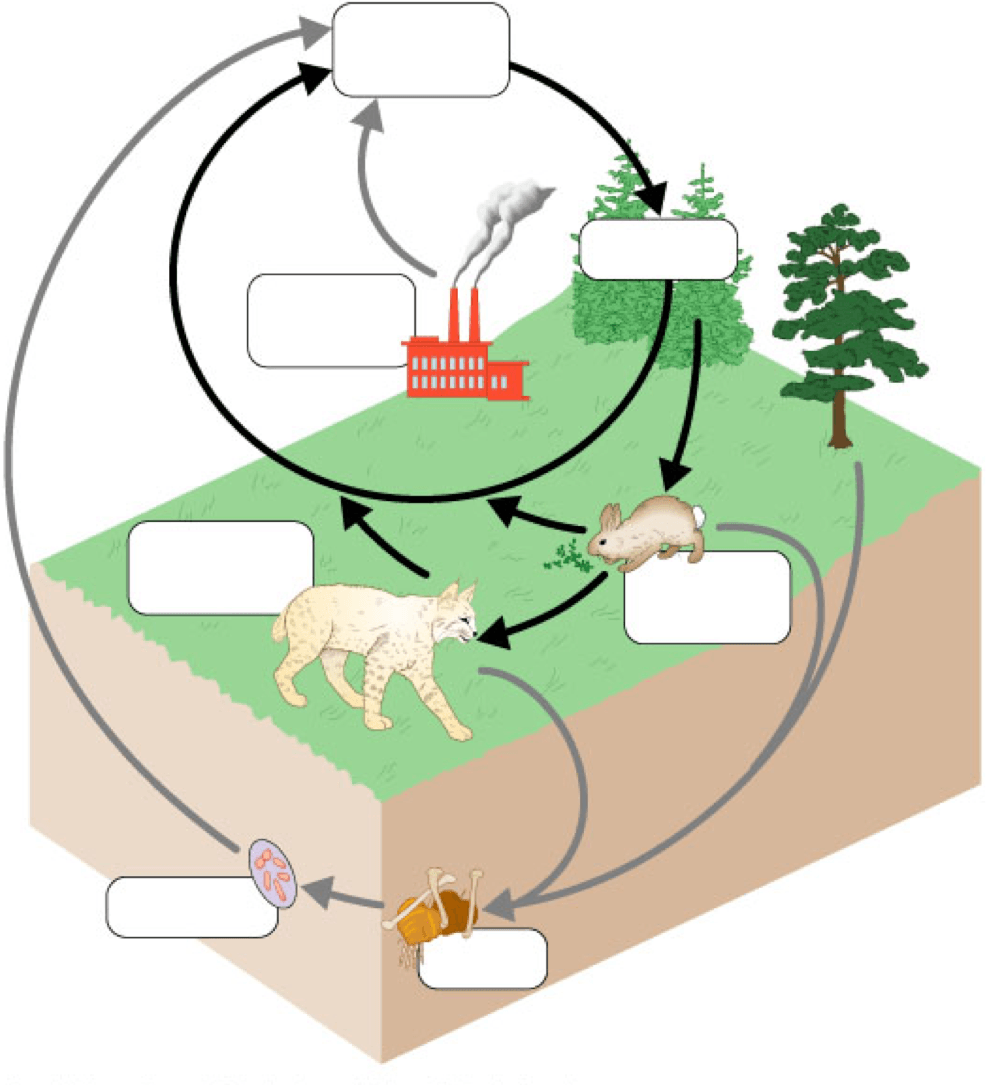

The introduction of an invasive (exotic) species affects biodiversity negatively if the species;
has a faster growth rate than native species
outcompetes the native species for resources
carries a new pathogen into the native species habitat
all of the above.
An environmental limiting factor such as predation, disease, and competition that depends on the number of members in a population per unit
dispersion
density- independent factor
density- dependent factor
population growth rate

VOCAB: The average number of children a female member of a population has during her lifetime
total fertility rate
replacement fertility rate
growth rate
death rate
Using the rule of 70, a population growing at 1% would double in
7 years
10 years
25 years
70 years
not enough information given
Which phase of the demographic transition is marked by decreasing birth rates and low death rates?
Phase 1 (Pre-Industrial)
Phase 2 (Transitional)
Phase 3 (Industrial)
Phase 4 (Post-Industrial)
What effect did over plowing and removal of native plants have in the Great Plains during the 1930’s?
It had little effect
It increased soil fertility
It was a primary cause of the Dust Bowl
Farmers had a great harvest

