
 Worksheets
Earth Science Exam Review
Total questions: 211
Worksheet time: 3hrs 49mins



Which layer is composed mostly of iron?
Z
Y
V
X

Which layer is the densest?
Z
X
W
V

Which layer is the thinnest?
V
Z
Y
X

Which layer is the liquid outer core?
Y
Z
V
W

Are layers X and Z cooler than V?
Yes
No
They are the same temperature.
What layer of Earth contains the plates that cause earthquakes and volcanic eruptions?
The asthenosphere which is solid with the core.
The asthenosphere which contains the crust and mantle.
The lithosphere which contains the crust and outer core.
The lithosphere which contains the crust and upper mantle.
How can you describe the “heat flow” or convection currents in the Earth’s mantle?
When magma is heated by the core, it becomes dense and sinks. When magma cools, it becomes dense and rises.
The heat flow in the mantle bubbles up under the surface causing the surface to be warm.
When magma is heated by the core, it becomes less dense and rises. When magma cools, it becomes dense and sinks.
Heat flow comes up through volcanoes making the Earth warm enough to sustain life.
What creates both solid and liquid parts in the Earth’s core?
Strong pressure and temperature
The crust and mantle holding the heat inside the Earth
Low pressure and temperature
Strong pressure and low temperature

Which layer is represented by the number 1?
outer core
inner core
mantle
crust
Which best describes the Asthenosphere?
molten metal
dense, solid metal ball
solid that flows
dry land and ocean floor
What is the rigid layer of the Earth's surface made up of the Crust and Upper Mantle called?
Asthenosphere
Lithosphere
Mesosphere
Continental Crust
Is the Outer Core a liquid or solid?
Liquid
Solid
Which layer of Earth is characterized by rock that is plastic, or soft enough to flow?
Asthenosphere
Crust
Lithosphere
Inner Core
This layer of Earth is the thickest part
Crust
Core
Mantle
Lithosphere
Which layer is the least dense?
Inner Core
Outer Core
Mesosphere
Asthenosphere
What is the correct order (starting from the surface) of Earth's Mechanical layers?
Lithosphere, Mesosphere, Asthenosphere, Inner core, Outer core
Mesosphere, Lithosphere, Inner Core, Outer Core, Asthenosphere
Inner Core, Outer Core, Mesosphere, Lithosphere, Asthenosphere
Lithosphere, Asthenosphere, Mesosphere, Outer Core, Inner Core
Which type of wave cannot travel through the outer core?
primary
secondary
The discontinuity that separates the crust from the mantle is
MOHO
LAB
Gutenberg
The discontinuity that separates the lithosphere from the asthenosphere is the
MOHO
LAB
Gutenberg
The cryosphere is
all dead things
all frozen water
the clouds in the atmosphere
all fresh water


Which of the following statements about minerals is FALSE?
Minerals have a crystalline structure.
Humans can create minerals to suit specific needs.
Minerals are inorganic materials.
Minerals cannot be liquids or gases.


Your group is to identify a mineral. You noticed that your mineral fell apart into thin layers or sheets. What mineral did you have?
gypsum
mica
quartz
talc

You and your group have been handed five mineral samples to identify. First, you sort the minerals by color. All five minerals are white! Two are glassy and transparent. You have identified two minerals. They are calcite and quartz. Compare and contrast the properties of the two minerals. How can you EASILY tell them apart?
check if one is shiny
check if one scratches glass
check to see which has bands
check to see if one splits into sheets

The Duluth Complex, one fo the world's largest undeveleoped mineral deposits, stretches across northeastern Minnesota and contains an estimated 4.4 billion tons of valuable metallic minerals. This particular mineral has a hardness of 3. It has a reddish color but the color can change to gray or black when exposed to air and/or water. It has luster and is malleable and ductile. What is this mineral?
cinnabar
copper
lead
silver

According to the Moh's Scale of Mineral Hardness, the sample mineral that will scratch gypsum but not apatite is MOST LIKELY
calcite
quartz
talc
topaz
When crystals form, they can form in different sizes. What contributes the most to the resulting size of the crystal during formation?
pressure
rate of cooling
surface composition
chemical composition
Minerals that are not elemental are usually
covalent bonds
ionic bonds
metallic bonds
Which of the following is not a way to form minerals?
cooling of magma
crystallization from a supersaturated solution
evaporation of a solvent leaving the solute
polishing rock
Which of the following properties is generally the least useful in identifying minerals?
color
cleavage
streak
hardness

The Table below shows the hardness of six minerals.
Using the table, which mineral will scratch Alabaster but will NOT scratch Ekanite?
Creedite
Boracite
Moissanite
Spectrolite

This rock is formed in layers.
Sedimentary
Igneous
Metamorphic

Fossils are often found in this rock.
Sedimentary
Igneous
Metamorphic
Sometimes the heat just changes the size of the mineral crystals in this type of rock.
Sedimentary
Igneous
Metamorphic

This rock may be formed from magma that hardens.
Sedimentary
Igneous
Metamorphic
This rock may be formed from lava.
Sedimentary
Igneous
Metamorphic

What kind of rock is "Granite"?
Sedimentary
Igneous
Metamorphic

What kind of rock is "Marble"?
Sedimentary
Igneous
Metamorphic
This rock is usually made up of pieces of rock called sediments that have been pressed and cemented together.
Sedimentary
Igneous
Metamorphic

Describe the texture of the following igneous rock.
smooth
coarse
vesicular
glassy

Describe the texture of the following igneous rock.
glassy
rough
vesicular
coarse

Describe the mineral composition of the following igneous rock.
felsic
mafic

Describe the mineral composition of the following igneous rock.
felsic
mafic

Describe the environment of formation for the following igneous rock.
intrusive
extrusive

Describe the environment of formation for the following igneous rock (grain size > 10 mm).
intrusive
extrusive


Which formation process do most sedimentary rocks follow?
cementation, compaction, deposition, erosion
erosion, compaction, cementation, deposition
erosion, deposition, compaction, cementation


Which substance is a mixture of organic matter & weathered rock?
Schist
Soil
Limestone
Granite
What is located beneath soil layers?
Bedrock
Humus
Lava
Tundra
Which layer of soil has the most humus?
A horizon
Bedrock
Subsoil
Regolith
Which layer in a soil profile would be most affected by weathering & erosion
C horizon
B horizon
R horizon
A horizon
The 4 agents of erosion are________
air, fire, water, & metamorphism
wind, water, gravity, & ice
topographic, sedimentary, igneous, & deposition
igneous, sedimentary, metamorphic, & gravity
The 2 types of weathering are _________
alpha & beta
physical & conventional
conduction & convection
chemical & physical

What most likely would cause a sinkhole to form?
Collapse of the roof of a limestone cave
Abrupt movement of two tectonic plates
Thinning of topsoil due to forest clearing
Impact of meteorite striking the surface of Earth

The Valley & Ridge province of VA has karst geologic features. Which best describes karst features?
Physical weathering of igneous rocks
Chemical weathering of metamorphic rocks
Physical weathering of foliated gneiss rock layers
Chemical weathering of limestone rock layers
Rivers, springs, & aquifers are all _________
frozen in winter
located above ground
sources of fresh water
human-made structures


Wind can move bigger pieces of rock than water can.
True
False
Wind can carry sand and dust farther than water can.
True
False
What is deflection?
wind erosion that removes surface soil
wind erosion that removes surface rocks
wind erosion that removes underground soil
wind erosion that removes everything from the surface
What are two kinds of wind erosion?
Physical and chemical
Deflation and abrasion


What is a glacier?
A slow moving river of ice.
A fast moving river of ice.
A walking ice berg.
A huge piece of ice that doesn't move.
How can ice cause weathering?
Water gets smaller when it freezes, so it helps rocks break.
Ice can not cause weathering.
Water expands when it turns into ice. When water goes into a crack in a rock and freezes, it makes that crack even bigger.
Ice can only cause weathering when it is a glacier.
Which force is more powerful?
abrasion
deflation
deposition
mirgration
Select the correct types of glaciers
continental
landscape
valley
cirque


The evidence is in ______________________, where coastlines and mountain ranges appear to fit together like a puzzle all over the world
Continental drift
Plate Tectonics
The Rock Cycle
Divergent boundaries
Other evidence include __________________ that plate tectonics does occurr in the crust of the Earth.
Rock formation, weather, fossils
Mountain formation, fossils, climate
Land features, fossils, climate
Valleys, Ocean trenches, climate
The __________________ are chains of undersea mountains.
Mid-Ocean Ridges
Ocean Trench
Divergent boundary
Transform boundary
______________________ continually adds materials to the ocean floor creating ocean floor.
Sea-floor spreading
Ocean trenches
Divergent mid-ocean ridges
Convergent mid-ocean ridges
Oceans plates sink back into the mantle at _______________ zones, keeping the crust the same size.
Mid-ocean ridges
Ocean trenches
Subduction
Transforming
_____________________ are undersea that are the deepest part of the ocean.
Divergent trenches
Ocean trenches
Transform trenches
Mid-ocean trenches


Who first proposed the idea of Continental Drift?
Harry Hess
Alfred Wegener
Albert Einstein
Galileo Galilee
Who first proposed the idea of seafloor spreading?
Alfred Wegener
Harry Hess
James Hutton
Nicolaus Copernicus


A small volcano with steep sides.
cinder cone
composite
strata
shield
A broad volcano with gently sloping sides is a ________________
Shield
Cinder Cone
Fire Fountain
Composite
A steep-sided volcano formed from layers of lava and ash.
Strata or composite
shield
cinder cone
fire fountain
Lava that is very thin and runny probably
has low silica content
is high in silica
Where are volcanoes most likely to form?
along plate boundaries
near the center of continents
near water
on the moon
One major belt of volcanoes that surrounds the Pacific Ocean
Ring of Fire
Ring of Asia
Ring o' earthquakes
Ring a ding ding

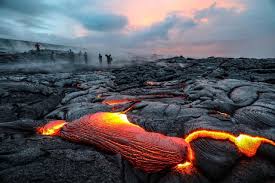
_________ lava has solidified as rounded masses, characteristic of eruption under water.
Aa
Pillow
Pahoehoe
Blocky

_______ lava moves slowly and has a smooth, billowy or ropey surface.
Aa
Pahoehoe
Pillow
Blocky
__________ is lava that forms a thick, brittle crust as it cools. The crust is torn into sharp pieces as lava moves underneath it.
Aa
Pahoehoe
Pillow
Blocky

What does the movement of tectonics plates cause?
Stress on rocks.
Deposition of sediments
Erosion of rocks
All of the above.
What is deformation?
Process when the rocks break apart or erode.
Process of when rocks melt away.
Process when rocks change shape under pressure.
The way your bedroom looks before you clean it.

What occurs during folding?
Rocks change color.
Rocks form and create a landslide.
Rock layers combine to create a mountain.
Rock layer bend under stress.

What happens in reverse faults?
The hanging wall move upward relative to the footwall.
The hanging wall moves downward relative to the footwall..
The fault causes a reaction having magma rises up and create a mountain.
The blocks move sideways relative to each other.

How do Fault-Block mountains form?
Tension pushes the blocks of lithosphere on top of each other.
Tension makes the lithosphere break into many pieces causing some to fall relative to others.
Shear stress makes the mountains break.
Compression makes the mountains rise up.


Normal faulting occurs where tensional stresses cause the crust to be stretched.


The place where an earthquake originates inside the Earth's surface is called...
Epicenter
Focus
Underground
Crust

The place on the Earth's surface, above the origin of the earthquake.
Epicenter
Focus
Surface
Crust

What is the instrument used to measure earthquakes?
Seismograph
Seismologist
Scale
Seismogram

Which city is closest to the epicenter?
A
B
C
5. Which type of wave travels the fastest?
Primary Wave
Secondary Wave
Long Wave
This is created by earthquakes that occur on the ocean floor.
longshore current
gulf stream
tsunamis
high tide
What scale determines the amount of damage an earthquake causes?
Richter scale
Mercalli scale
Moment magnitude scale
seismographic scale
What is the minimum number of seismograph stations needed to locate an earthquake epicenter?
1
2
3
5
Which wave can travel through all materials?
P - primary
S - secondary
L - Long
Measures the magnitude or size, of an Earthquake
epicenter
focus
Richter scale
Mercalli Scale
What is the measure of the amount of energy released in an earthquake?
Intensity
Epicenter
Magnitude
Seismogram
Most of the atmosphere is composed of the following gas
nitrogen
oxygen
carbon dioxide
argon
flatulence


Cool, sinking air creates _____ pressure zones.
high
low
curved
severe

Where does the air move in an ANTICYCLONE?
Upwards
Downwards

Where does the air move in a CYCLONE?
Upwards
Downwards
What type of weather does a CYCLONE bring?
Clear and calm
Stormy
What type of weather does an ANTICYCLONE bring?
Clear and calm
Stormy
Does a CYCLONE have low or high pressure?
Low
High
Does an ANTICYCLONE have low or high pressure?
Low
High

The closer the contour lines the ________ gradient?
gentler
steeper
ask the penguin sitting next to you

Isobar Lines that are very close indicate
sunny and dry conditions
calm winds
windy conditions
average temperatures


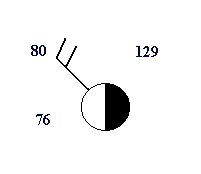
What is the temperature for the following station model?
4 ºF
76 ºF
80 ºF
129 ºF
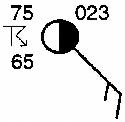
What is the dewpoint for the following station model?
10 ºF
23 ºF
65 ºF
75 ºF
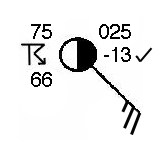
What is the wind speed for the following station model?
10 knots
15 knots
20 knots
25 knots

