Wayground logo

Free Printable Worksheets

Font size

S
M
L
XL
Worksheets

Module 9 The Geosphere

Total questions: 37

Worksheet time: 30mins

Name
Class
Date
1.
What is the outermost layer of the Earth?
a)
Outer core
b)
Inner core
c)
Mantle
d)
Crust
2.
What type of crust is the thickest?
a)
ocean
b)
continental
3.
What is the thickest layer of the Earth?
a)
crust
b)
mantle
c)
outer core
d)
inner core
4.
Which layer of the core is mostly liquid?
a)
inner core
b)
outer core
5.
Large chunks of the Earth's crust are called...
a)
mountains
b)
flats
c)
plates
d)
volcanoes
6.
What is caused when the tectonic plates slip?
a)
thunderstorms
b)
hurricanes
c)
tornadoes
d)
earthquakes
7.
The most dense layer of the Earth is the
a)
Inner Core
b)
Outer Core
c)
Lower Mantle
d)
Upper Mantle
8.
The crust is also know as the 
a)
Lithosphere
b)
Asthenosphere
c)
Mesosphere
d)
Mantle
9.
The upper mantle is also known as the 
a)
Lithosphere
b)
Asthenosphere
c)
Mesosphere
d)
Core
10.
Which is made up mostly of iron and nickel.
a)
Inner Core
b)
Outer Core
c)
Crust
d)
Mantle
11.
The measure of the energy released by an earthquake is called ____________________.
a)
Magnitude
b)
Seismic Waves
c)
Force
d)
Vectors
12.

Which type of plate movement creates earthquakes?

a)

Transverse

b)

Divergent

c)

Convergent

d)

Buffet plate movement

13.

Which type of plate movement involves the creation of mountains and/or volcanoes?

a)

Divergent

b)

Convergent

c)

Transverse

d)

Continental Breakfast Plates

14.

Which type of plate movement creates canyons and volcanoes?

a)

Divergent

b)

Convergent

c)

Transverse

15.

What is the correct order for the layers of earth from the outside to inside?

a)

crust, core, mantle

b)

core, mantle crust

c)

crust, mantle, core

16.

What is the correct order (starting from the surface) of Earth's layers?

a)

crust, outer core, inner core, mantle

b)

mantle, outer core, inner core, crust

c)

crust, mantle, outer core, inner core

d)

outer core, inner core, crust, mantle

17.

Which of the following is made mostly of Liquid Iron and generates the Earth's magnetic field?

a)

Inner Core

b)

Mantle

c)

Asthenosphere

d)

Outer Core

18.

Carbon is transferred from seawater to atmosphere through the process of

a)

diffusion

b)

excretion

c)

photosynthesis

d)

respiration

19.

The chart shows some sources, processes, and products in the carbon cycle. NOT ALL INFORMATION IN THE CHARE IS CORRECT.

Which of these statements best describes a method to correct the flaw in the chart?

a)

Replace decomposition with diffusion.

b)

Replace photosynthesis with respiration.

c)

Replace carbon in soil with carbon in air.

d)

Replace carbon in water with carbon in animals.

20.
a)
normal fault
b)
reverse fault
c)
strike-slip fault
21.
The cat is standing on the...
a)
foot wall
b)
hanging wall
c)
left
d)
weirdest elevator ever
22.
What type of fault is this?
a)
Normal
b)
Reverse
c)
Strike-slip
23.
What type of fault is the San Andreas?
a)
Convergent
b)
Transform
c)
Optimus Prime
d)
Divergent
24.
The supercontinent in the continental drift hypothesis was called ____.
a)
Pantry
b)
Pangaea
c)
Wegenerland
d)
Eurasia
25.
A divergent boundary at two oceanic plates can result in a ____.
a)
volcanic island arc
b)
continental volcanic arc
c)
earthquake
d)
ocean ridges (seafloor spreading)
26.
Which of the following is a geographic example of a transform fault boundary?
a)
continental volcanic arc
b)
volcanic island arc
c)
earthquakes
d)
uplifted mountains
27.
What forms when one oceanic plate is forced beneath another plate?
a)
subduction zone
b)
an ocean ridge
c)
a rift valley
d)
an ocean basin
28.
The formation of the Hawaiian Islands is associated with ____.
a)
a transform boundary
b)
hot spots
c)
convergent boundaries
d)
divergent boundaries
29.

When two plates in Earth's crust collide, what is formed?

a)

River

b)

Continent

c)

Country

d)

Mountain Ranges

30.

What happens to an earthquake's P-waves when they strike the liquid core?

a)

They bounce off.

b)

They are absorbed.

c)

They change into S-waves.

d)

They change into R-waves.

31.

What happens to an earthquake's S-waves when they strike the core?

a)

They bounce off.

b)

They are absorbed.

c)

They change into P-waves.

d)

They change into L-waves.

32.
Which type of wave is the most destructive wave?
a)
Primary Wave
b)
Secondary Wave
33.
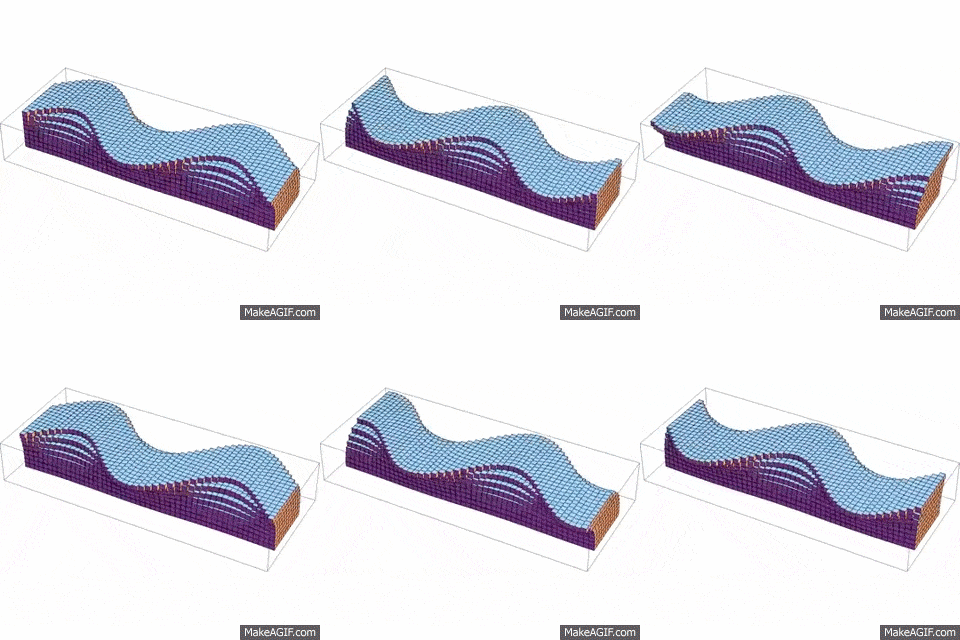
Which surface wave is pictured?
a)
P-Wave
b)
S-Wave
c)
Rayleigh Wave
d)
Love Wave
34.

The diagram shows a

a)

S wave

b)

P wave

35.

The diagram shows a

a)

S wave

b)

P wave

36.
Where is the epicenter for this earthquake located based on triangulation?
a)
A
b)
B
c)
C
d)
D
37.

Scientists use models to

a)

increase the duration of a volcanic eruption

b)

change the location of a volcanic eruption

c)

predict the damages due to an earthquake

d)

stop the occurrence of tsunamis due to an earthquake