
 Worksheets
ES Regents - Weathering, Erosion, Deposition Exam Review
Total questions: 80
Worksheet time: 51mins

The process by which water, ice, wind, or gravity moves weathered rock and soil from one place to another.
Weathering
Erosion
Waves dropping sand on the beach is an example of what?
Weathering
Erosion
Deposition
Compaction
This type of weathering occurs when rock is physically broken down into smaller pieces of rock.
physical weathering
chemical weathering
erosion weathering
deposition
This type of weathering occurs when rocks undergo a change in composition.
physical weathering
chemical weathering
erosion weathering
deposition
How is physical weathering different from chemical weathering?
Chemical weathering happens over much shorter time frame than physical weathering.
Chemical weathering changes the chemical composition of rocks; physical weathering does not.
Chemical weathering occurs only in tropical climates; physical weathering occurs only in cool climates.
Chemical weathering occurs only in the mountains; physical weathering occurs only on flat land.
Fastest chemical weathering =
colder, dry environments
colder, humid environments
hotter, dry environments
hotter, humid environments
Fastest physical weathering =
colder, dry environments
colder, wet environments
hotter, dry environments
hotter, wet environments
As weathering increases, sediment becomes
smaller, rounded, and smoother
smaller, angular, and rougher
larger, angular, and smoother
larger, rounded, and rougher
Frost action/Ice wedging = water seeps into cracks
freezes, expands, and widens cracks
freezes, contract, and narrows cracks
vaporizes, contract, and widens cracks
vaporizes, expands, and narrows cracks
Acid rain wearing away the face of a marble gravestone or statue is an example of?
physical weathering
chemical weathering
The formation of stalactites and stalagmites in a cave as water mixed with carbon dioxide creates carbonic acid, which dissolves away the limestone, is an example of:
physical weathering
chemical weathering
A piece of sandstone changing color (from brown to rusty red) from exposure to water and air is an example of:
physical weathering
chemical weathering
Rocks along a riverbed that are smoothed from continuously moving water and sediment rubbing against them is an example of:
physical weathering
chemical weathering
Weeds growing into the cracks in a sidewalk and the sidewalk begins to crumble is an example of:
physical weathering
chemical weathering
Potholes forming in the road after a cold winter is an example of:
physical weathering
chemical weathering
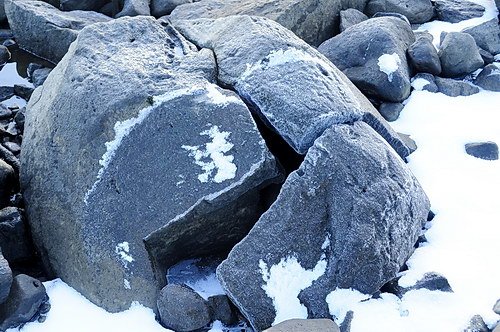
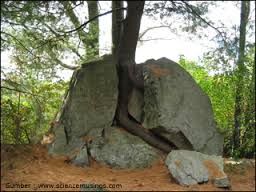
Rate of weathering ___________ affected by climate, particles size, and mineral composition.
is
is not
Smaller sediment has a _________________
smaller surface area, and weathers slower
smaller surface area, and weathers faster
larger surface area, and weathers slower
larger surface area, and weathers faster
Soil =
air
water
organic matter
weathered rock
all of the above
Soil is formed from
weathering and biological activity
erosion and water
weathering and erosion
Residual soil = soil that
moved and has the same properties as the bedrock below.
remains in place and has the same properties as the bedrock below.
remains in place and has different properties from the bedrock below.
moved and has different properties from the bedrock below.
Transported soil = __________________
moved and has different properties from the bedrock below.
remains in place and has the same properties as the bedrock below.
Gravity/Mass Movement/Mass Wasting
sediments are _______________, _______________, and jagged
angular, unsorted
angular, sorted
rounded, sorted
rounded, unsorted
Talus
sorted sediment found at the top of a cliff
unsorted sediment at the bottom of a cliff
Which agent of erosion is a landslide and mudslide?
mass movement
glacier
river
wave
Running water/River/Stream sediment =
unsorted, round, smooth
unsorted, angular, rough
sorted, round, smooth
sorted, angular, rough
Wind - sediment =_____________, picks up _____________.
sorted, picks up clay, silt and sand
unsorted, picks up boulders, pebbles, cobbles
Which is associated with hoodoos, ventifacts, frosted and pitted appearance
wind erosion
wave erosion
glacier erosion
gravity erosion
Sorted sediment is associated with
glacier and mass movement
wind, wave and running water
Unsorted sediment is associated with
glacier and mass movement
wind, wave and running water

Caves form from the ___________ weathering of ______________
chemical, limestone
physical, limestone
chemical, sand
physical, sand
What agent of erosion forms landslides and mudslides?
mass movement/gravity
glacier
river
wave
A curve in the river =
meander
waterfall
outwash plain
Which agent of erosion forms oxbow lakes, floodplains, and deltas?
water/river
glacier
wave
gravity
delta
beginning of the river
end of the river
Rivers can transport sediment in
solution, suspension, or by rolling, sliding and bouncing along the stream bed
evaporation, condensation and runoff
parallel and series circuit
Stream Discharge =
amount/volume of water in stream
distance of a stream
A river will move fastest when it travels down a ______________ slope with ________________.
flatter slope, less discharge
flatter slope, more discharge
steeper slope, less discharge
steeper slope, more discharge
In a straight river = water moves fastest _____________ of the river just below the surface.
in the middle
on the sides
Outside of meander = (slower, faster, erosion, deposition, shallower, deeper)
faster, erosion, deeper
slower, deposition, shallower
faster, deposition, shallower
slower, erosion, deeper
inside of meander = (slower, faster, erosion, deposition, shallower, deeper)
faster, erosion, deeper
slower, deposition, shallower
faster, deposition, shallower
slower, erosion, deeper
When a river slows, sediments that are ____________________ get deposited first.
largest, roundest, most dense
smallest, flattest, least dense
largest, flattest, least dense
smallest, roundest, most dense
Which sediments would get deposited last and be found furthest from the shore?
largest, roundest, most dense
smallest, flattest, least dense
largest, flattest, least dense
smallest, roundest, most dense
Vertical Sorting – __________ sediments on the bottom. A location may have multiple beds.
smallest
largest
Horizontal Sorting – River enters an ocean or lake, water velocity _____________, sediments are______________, and a ______________forms.
decreases, deposited, delta
increases, eroded, valley
decreases, eroded, delta
increases, deposited, delta
Wind - sediment = (sorted, unsorted), picks up (clay, silt, sand, cobbles, pebbles, boulders)
sorted, clay, silt and sand
unsorted, boulders, pebbles, cobbles
Which agent of erosion creates hoodoos, ventifacts, and gives sediments a frosted and pitted appearance?
wind
wave
glacier
gravity

On a sand dune, the wind comes from the
steep side
gentle side
Glacial erosion = leads to parallel _______________ & _______________ in ___________ bedrock and form __________ shaped valleys
grooves and striations, polished, U
sediments and scraps, unpolished, V
Which agent of erosion forms moraine, drumlin, outwash plain, erratic's and kettle lakes?
glacier
wave
wind
mass movement
An outwash plain is the only feature of a glacier with
sorted sediment
unsorted sediment
A moraine is a ridge of
sorted sediment
unsorted sediment
sand bar, sand spit, sand dune and barrier island, beach
wave
wind
glacier
river
Sediments are deposited in a river delta because the
velocity of the river decreased
force of gravity decreased
discharge of the river increased
kinetic energy increased

When a stream or river starts to slow down, it will deposits sediments in which order?
clay, silt, sand, pebbles, cobbles
cobbles, clay, pebbles, silt, sand
cobbles, pebbles, sand, silt, clay
clay, cobbles, silt, pebbles, sand

What is the largest sediment size that a stream flowing at 10 cm/s can carry?
1.0 cm
0.2 cm
0.1 cm
0.01 cm
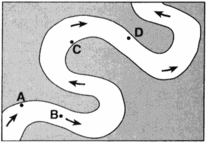
At which location is the greatest amount of sediment most likely being eroded?
A
B
C
D
A old age stream is best characterized as having
a gentle slope, slow velocity, meanders, foodplains and oxbow lakes
a V-shape with a steep gradient
a steep slope with lots of meanders
fast velocity
A young stream is best characterized as having
flat slope, meanders and floodplains
steep slopes, waterfalls and creating a V-shape
a gentle slope with lots of meanders
slow velocity

What do you call land where water runoff and ground water drain into a large body of water?
Runoff
Watershed
condensation
What are tributaries?
bends in the river
wide areas of water near the mouth
where the river reaches the sea
small streams or rivers that run into the main channel

Which erodes faster? Soft rock or Hard rock?
hard rock
medium rock
soft rock
none of the above

Rivers carry their sediment until reaching the ocean. The faster moving water of the river meets the ocean water and slows down. The slowing down of the river water creates what land feature?
a floodplain
an oxbow lake
A delta
a meander
Which rock was weathered by river water?


Based on the location of deposition along the jetties and groins, what direction was the longshore current moving?
West
East
North
South

Which letter is pointing to a spit?
A
B
C
D
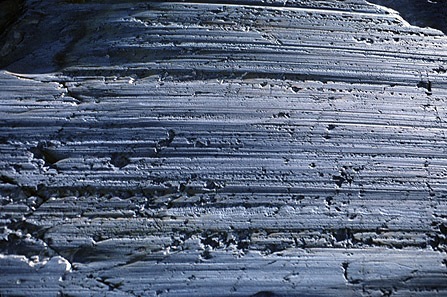
_____ are parallel grooves in bedrock formed by abrasion from a glacier.
Plucking
Abrasion
Striations
Till

_____ is unsorted sediment that is deposited by ice.
Outwash
Till
Erratic
Esker

_____ are long ridges of unsorted sediment left behind by a glacier.
Eskers
Till
Erratics
Moraines
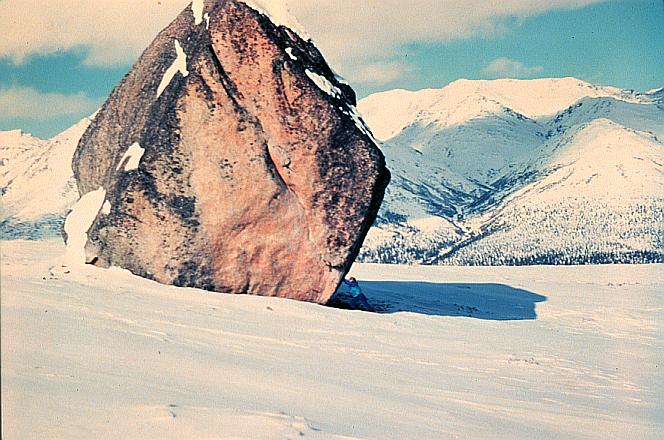
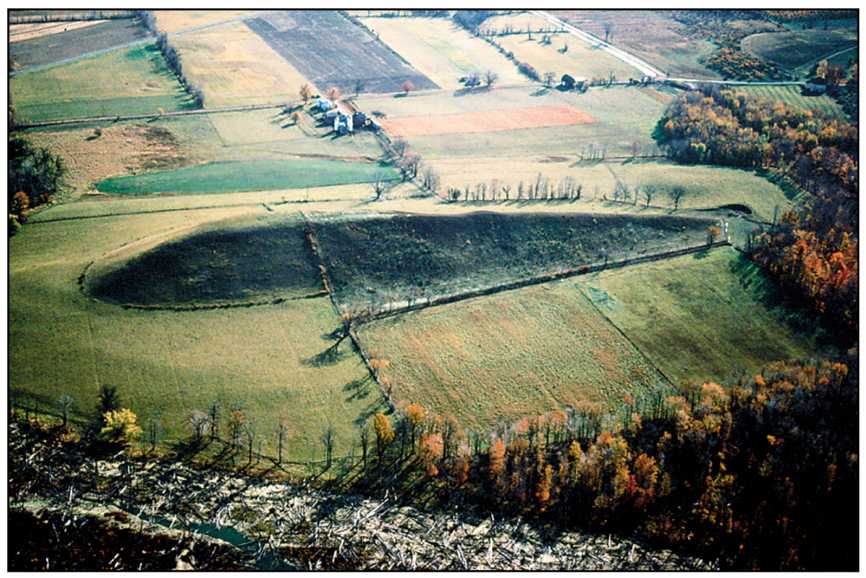

The cross sections show a three-stage sequence in the development of a glacial feature. Which glacial feature has formed by the end of stage 3?
kettle lake
finger lake
drumlin
parallel scratches

Base your answer to the following question on the diagram which represents a profile of a mountain glacier in the northern United States. Over a period of years, this glacier gains more snow mass than it loses. What will be the most likely result of this gain?
The glacier will decrease in size, and the ice front will retreat.
The glacier will decrease in size, and the ice front will advance.
The glacier will increase in size, and the ice front will retreat.
The glacier will increase in size, and the ice front will advance.

The diagram shows the edge of a continental glacier that is receding. R indicates elongated hills. The ridge of sediments from X to Y represents a landscape feature. The elongated hills labeled R = _______________ and are most useful in determining the _______________
moraines, age of the glacier
drumlins, direction the glacier has moved
kettle lakes, thickness of the glacier
striations, rate at which the glacier is melting

The diagram represents a stream valley. Which diagram below best shows how this valley might be modified after a glacier has moved through it?


The photograph shows scratched and grooved
bedrock with boulders on its surface. The scratches and grooves were most likely created when
alternating thawing and freezing of water cracked the bedrock
flooding from a nearby lake covered the bedrock
a glacier dragged rocks over the bedrock
rocks from a landslide slid along the bedrock
Which letter is pointing to a barrier island?
A
B
C
D

