wayground logo

Free Printable Worksheets

NEW

Font size

S
M
L
XL
Worksheets

Beyond the Big Bang Review

Total questions: 80

Worksheet time: 2hrs 31mins

Name
Class
Date
1.
The three pieces of evidence for our current theory of the universe are:
a)
blueshift, CMB, moon landing.
b)
redshift, IBM, Andromeda galaxy.
c)
redshift, CMB, distribution of elements.
d)
doppler effect, light spectra, fusion.
2.
Galaxies that are redshifted are:
a)
actually blue.
b)
really far away.
c)
invisible.
d)
moving away from us.
3.
Which electromagnetic waves have the highest frequencies and the shortest wavelengths?
a)
microwaves
b)
visible light
c)
gamma rays
4.
Which electromagnetic waves are used in ovens and cell phone communications?
a)
Infrared rays
b)
ultraviolet rays
c)
microwaves
5.
How much of the electromagnetic spectrum is made up of visible light?
a)
only a small portion
b)
a very l;arge portion
c)
about half
6.
A wave with a large wavelength will have a ______ frequency and _____ energy
a)
high, low
b)
high, high
c)
low, high
d)
low, low
7.
High frequency waves have _________ wavelengths.
a)
varying
b)
long
c)
the same
d)
short
8.
Curve in
a)
Converse
b)
Convex
c)
Convection
d)
Concave
9.
Curve Out
a)
Converse
b)
Concave
c)
Convex
d)
Convection
10.
The distance between one peak and the next in a wave
a)
Transpartent
b)
Scattering
c)
Wavelength
d)
Waste Pro
11.
The term for any wave that hits a surface and bounces off
a)
Transparent
b)
Translucent
c)
Refraction
d)
Reflection
12.
When light bends it is ______
a)
Reflection
b)
Absorption
c)
refraction 
d)
optical density
13.
When light bounces back it is _____
a)
Reflected
b)
Refracted
c)
Absorbed
d)
Optical Density
14.
A student placed a pencil in a cup of water.  The pencil appears broken because light-
a)
always travels in a straight line
b)
bends when it passes through water
c)
makes the water in the glass evaporate
d)
reflects the pencil on the water's surface
15.
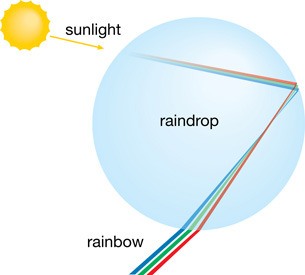
Light bending as it passes through a rain drop is an example of...
a)
Refraction
b)
Reflection
16.
Glass has a _____________ index of refraction than air.
a)
Equal
b)
Greater
c)
Less
d)
Impossible to say
17.
The law of universal gravitation is credited to whom? 
a)
Einstein 
b)
Galileo
c)
Darwin
d)
Newton 
18.
Two factors effecting the magnitude of force of gravity between 2 objects are...
a)
weight and mass 
b)
distance and weight 
c)
mass and matter 
d)
mass and distance 
19.
A person would weigh less on on the Moon than on the Earth because . . .
a)
Moon has more mass, and therefore more gravity
b)
Moon has less mass, and therefore more gravity
c)
Moon has more mass, and therefore less gravity
d)
Moon has less mass and therefore less gravity
20.
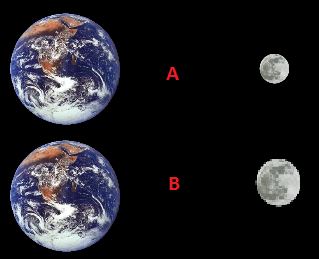
Which system has the greater gravitational attraction between the two objects (if any)?
a)
System A
b)
System B
c)
Same gravitational attraction fro System A and System B
21.
The outermost layer of the Earth that contains the continents and the oceans.
a)
mantle
b)
crust
c)
outer core
d)
inner core
22.
The layer of rock between the Earth's core and crust.
a)
outer core
b)
crust
c)
inner core
d)
mantle
23.
Liquid metal layer that surrounds the Earth's inner core.
a)
inner core
b)
crust
c)
outer core
d)
mantle
24.
What is the name of the Super-Continent that existed long ago?
a)
Wegener
b)
Pangaea
c)
Geocontinent
25.
Which sphere supports living things?
a)
Hydrosphere
b)
Biosphere
c)
Atmosphere
26.
Which sphere is made up of all the gases that surround Earth?
a)
Atmosphere
b)
Biosphere
c)
Lithosphere
27.
Which sphere of Earth contains rocks and stones, including all the mountains and land we can see?
a)
Atmosphere
b)
Biosphere
c)
Lithosphere
28.
Which sphere of the Earth contains all of Earth's water.
a)
Lithosphere
b)
Hydrosphere
c)
Biosphere
29.
What two specific continents fit together most noticeably?
a)
Africa and North America
b)
South America and Europe
c)
South America and Africa
d)
 Antartica and Africa
30.
Who is the person credited with developing the theory of continental drift?
a)
Harry Hess
b)
Galileo
c)
Alfred Wegener
d)
Newton
31.
Which type of information was NOT collected by Wegener to support his continental drift hypothesis?
a)
glacial deposits
b)
 fossils
c)
seafloor magnetic data
d)
rocks
32.
How does fossil evidence support Wegener's hypothesis of continental drift?
a)
Similar fossils are found along continental margins that appear to join together.
b)
Fossils are found in areas where the present-day climate could not have supported the organisms that made the fossils.
c)
Similar fossils of giant, land-dwelling dinosaurs are found on continents separated by oceans.
d)
all of the above
33.
Why was Wegener's theory not accepted?
a)
He had no proof of how they were moving
b)
He had no evidence
c)
He was married
d)
He was not a Scientist
34.

Is there a pattern to the locations of earthquakes and volcanoes around the globe?

a)

No, earthquakes and volcanoes are random.

b)

Yes, earthquakes and volcanoes usually occur near the boundaries of tectonic plates.

c)

yes, earthquakes and volcanoes usually occur in the middle of tectonic plates.

d)

No, earthquakes and volcanoes usually occur under water.

35.

Peru and Chile are part of South America, which sits on the South American tectonic plate. The Nazca plate is moving toward the South American plate. It is pushed downward, which causes it to slide under the South American plate. Based on this information, what feature could we expect to see off the coast of Peru and Chile?

a)

new Continent formation

b)

Poor fishing conditions

c)

Deep ocean trench

d)

Severe tropical storms

36.
The type of plate boundary where two plates come together is a .....
a)
Convergent Boundary
b)
Divergent Boundary
c)
Transform Boundary
d)
Plate Boundary
37.
Which of the following causes Earth's tectonic plates to move?
a)
Energy from the Sun
b)
Magnetic Pole Reversal
c)
Convection currents in the mantle
d)
Faults in Mountain Ranges
38.
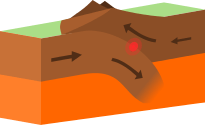
What type of plate boundary is this?
a)
Plate
b)
Divergent
c)
Convergent
d)
Transform
39.
What type of event will occur at this boundary?
a)
Earthquake
b)
Volcano Eruption
c)
Tornado
d)
Mountain Building
40.
A divergent boundary occurs when plates ....
a)
Pull apart
b)
Come together
c)
Slide past each other
d)
subducting
41.
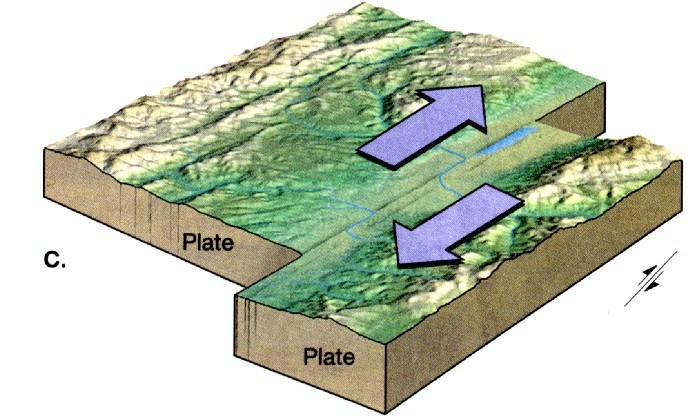
What type of plate boundary is this?
a)
Transform
b)
Convergent
c)
Divergent
d)
Plate
42.
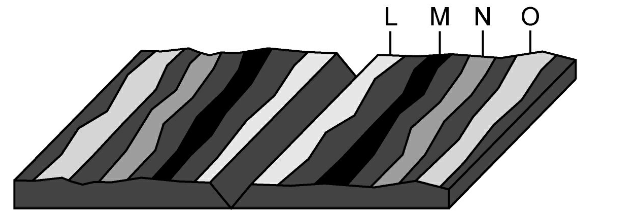
Where would the oldest rock be found?
a)
L
b)
M
c)
N
d)
O
43.
Mountains are created when....
a)
Two continental plates collide
b)
Two oceanic plates pull apart
c)
An Oceanic plate subducts under a Continental Plate
d)
Two continental plates pull apart
44.
A subduction zone is formed...
a)
when one tectonic plate sinks below another
b)
at every type of convergent plate boundary
c)
at every type of divergent plate boundary
d)
at transform boundaries
45.
Where is the point at which the first movement occurs during an earthquake?
a)
Epicenter
b)
Focus
c)
Fault
d)
Plate
46.
Where is the point on the Earth’s surface directly above the focus of an earthquake?
a)
Epicenter
b)
Fault
c)
Hypocenter
d)
Tremor
47.
Which type of wave is the first to arrive after an earthquake occurs?
a)
P Wave
b)
Rayleigh Wave
c)
S Wave
d)
Shear Wave
48.
Which body waves cause particles of rock material to move at right angles to the direction in which the waves are traveling?
a)
Body Waves
b)
P Waves
c)
S Waves
d)
Surface Waves
49.
P Waves can move through which of the following?
a)
Gas
b)
Liquid
c)
Solid
d)
All of these
50.
S Waves can move through which of the following?
a)
Gas
b)
Liquid
c)
Solid
d)
All of these
51.
What is a large ocean wave that results from an underwater earthquake, landslide, or volcanic eruption?
a)
Aftershock
b)
Liquefaction
c)
Seismic Gap
d)
Tsunami
52.
Which travels fastest, always being the first detected by seismic stations?
a)
P waves
b)
S waves
53.
An instrument that detects and measures earthquakes is a 
a)
seismogram
b)
focus seismic map
c)
focus
d)
seismograph 
54.
One of the results of an earthquake can be...
a)
Landside
b)
Tsunami
c)
Property Damage
d)
All of the above.
55.
All of the nonliving parts of an ecosystem are __________.
a)
biotic
b)
biology
c)
abiotic
d)
biography
56.
All of the living AND non-living things in an area that interact with each other are called a/an __________.
a)
community
b)
habitat
c)
population
d)
ecosystem
57.
ALL energy flow for an ecosystem begins with ...
a)
plants
b)
the moon
c)
the sun
d)
algae
58.
What are biotic factors?
a)
dead things
b)
living things/ organisms
c)
weather
d)
plants
59.
What is the chemical equation for cellular respiration?
a)
Glucose + Oxygen -> Carbon dioxide + Water + Energy
b)
Oxygen + Carbon dioxide + Energy  -> Glucose + Water
c)
Carbon dioxide + Glucose -> Oxygen + Water + Energy
d)
Water + Carbon dioxide + Energy -> Oxygen + Glucose
60.
What is the equation for photosynthesis
a)
Water + Carbon dioxide + Energy -> Oxygen + Glucose
b)
Carbon dioxide + Glucose -> Oxygen + Water + Energy
c)
Oxygen + Carbon dioxide + Energy  -> Glucose + Water
d)
Glucose + Oxygen -> Carbon dioxide + Water + Energy
61.
The arrows in a food chain or web represents what?
a)
They point to the organism that is being eaten.
b)
It shows how sunlight flows within an ecosystem.
c)
They show what direction the energy is flowing between organisms. 
d)
They represent how water is transferred within a habitat.
62.
What is this called?
a)
Food Web
b)
Food Chain
c)
Abiotic Factors
63.
What is this called?
a)
Food Web
b)
Food Chain
c)
Abiotic Factors
64.
TRUE or FALSE?
All of the carbon in existence is continually recycled in the carbon cycle.
a)
True
b)
False
65.
Organisms that do not decompose can be buried and become what?
a)
water
b)
nutrients
c)
air
d)
fossil fuels
66.
The average temperature of the surface of Earth has increased approximately 1°C in the past century. Which reason best explains this increase in temperature?
a)
lower levels of ozone in the atmosphere
b)
lower levels of nitrogen in the atmosphere
c)
higher levels of carbon dioxide and other greenhouse gases in the atmosphere
d)
higher levels of oxygen in the atmosphere
67.

How do animals get carbon?

a)

By eating plants and or other animals.

b)

They absorb it from the atmosphere.

c)

From the ground

d)

They do not get carbon from anywhere.

68.

Which of the following are fossil fuels?

a)

Coal, water, oil

b)

Oxygen, coal, oil

c)

Coal, Oil, Natural Gas

d)

None of the above

69.

How is the carbon cycle similar to the water cycle?

a)

Both involve liquid substances falling to the Earth from the atmosphere?

b)

Neither process works at low temperature.

c)

Both involve the transfer of substances between animals, plants, and the Earth.

d)

Both involve the transfer of substances between the earth and outer space.

70.

How do carbon emissions lead to global warming?

a)

By trapping the sun's heat in the atmosphere.

b)

By causing very hot volcanic eruptions.

c)

Rocks become richer in carbon as time goes by.

d)

By increasing the amount of carbon in the earth's crust

71.
Which of the following is the best conclusion that can be made from this graph?
a)
atmospheric carbon dioxide levels have been decreasing since 1960
b)
Hawaii has a lot of carbon dioxide
c)
humans have been working hard to decrease carbon dioxide levels
d)
atmospheric carbon dioxide levels have increased steadily since 1960
72.
T/F: Water vapor is a greenhouse gas
a)
True
b)
False
73.
T/F: Some greenhouse gases are naturally present in the Earth's atmosphere
a)
True
b)
False
74.
Geothermal energy is energy from 
a)
the sun
b)
heat from deep in the earth
c)
wind
d)
inexhaustable
75.
Wind energy is 
a)
generated from moving water
b)
starts with moving air and generates electricity
c)
starts with the sun
d)
comes from the earth
76.
Energy from the sun is called
a)
Biofuels
b)
Solar
c)
Geothermal
d)
Hydroelectric
77.
Nonrenewable resources are
a)
man-made resources
b)
cannot be replaced quickly
c)
can be replaced in a short amount of time
d)
never run out
78.
Based on the data collected, which source of alternative energy is most efficient?
a)
Coal
b)
Wind
c)
Natural gas
d)
Solar
79.
Fossil fuels are also a major source of air pollution and therefore, a major contributor to _____________________!
a)
ozone depletion
b)
global warming
c)
skin cancer
80.
Scientific theories are based on
a)
general assumptions of how systems work.
b)
mathematical principles that can be proven true.
c)
large amounts of data collected over time.
d)
observations from within only one scientific discipline.