wayground logo

Free Printable Worksheets

Font size

S
M
L
XL
Worksheets

zoo final exam review

Total questions: 79

Worksheet time: 53mins

Name
Class
Date
1.

The ability to maintain a constant internal environment is known as...

a)

homeostasis

b)

reproduction

c)

symbiosis

d)

interaction

2.

In this cladogram, what is the ancestral trait?

a)

vertebrae

b)

tail

c)

fur

d)

cranium structure

3.
Because sponges cannot move around they are considered ______. 
a)
sessile
b)
senile
c)
sedementary
d)
spongin
4.

These cells have a sticky, funnel-shaped collar to collect food particles and a flagellum that creates a water current

a)

amoebocyte

b)

ostiocyte

c)

pinacocyte

d)

choanocyte

5.
large opening at the top of a sponge where water exits.
a)
ostia
b)
osculum
c)
orifice
d)
opening
6.
Choanocytes are also known as _____.
a)
epithelial cells
b)
amoeboid cells
c)
collar cells
d)
pore cells
7.

What cells in sponges move around the mesohyl and digest food particles?

a)

Porocytes

b)

Choanocytes

c)

pinacocytes

d)

Amoebocytes

8.
What  is space between the outer cell layer and inner cell layer that has amebocytes, spongin, and spicules it called?
a)
epidermis
b)
mesoglea
c)
mesohyl
d)
gatrodermis
9.
What type of symmetry do cnidarians have
a)
asymmetrical
b)
bilateral
c)
radial
d)
medial
10.
Members of the Cnidarian Class _______ include sea anemones and coral.
a)
Anthozoa
b)
Cubozoa
c)
Hydrozoa
d)
Scyphozoa
11.
What are the organelles inside the cnidocyte stinging cells that inject paralyzing toxins into their prey?
a)
pinacocytes
b)
lysomatocyts
c)
choanocytes
d)
nematocysts
12.
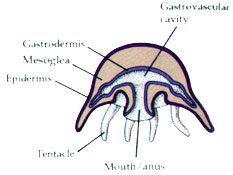
Which body form is represented by this diagram?
a)
Mesoglea
b)
Medusa
c)
Moses
d)
Nematocyst
13.
Polyps are ______, while medusa are ______. 
a)
sessile, motile
b)
motile, sessile
c)
both motile and sessile, just motile
14.
Cnidarians have two body layers: epidermis and ________________. 
a)
Vascodermis
b)
Gastrodermis
c)
Microdermis
d)
Innerdermis 
15.
What is an organism called that can produce both sperm and eggs?
a)
Gemmule
b)
Choanocyte
c)
Hermaphrodite
d)
Asexual
16.
What body form do members of Class Anthozoa have?
a)
medusa
b)
polyp
c)
medusa and polyp
17.

What term means "fake body cavity"

a)

acoelomate

b)

psuedocoelomate

c)

coelomate

18.

What does "regeneration" mean?

a)

Regrow body parts

b)

Same thing as sexual reproduce

c)

Same thing as asexual reproduction

19.

In annelids, setae are

a)

Bristle-like hairs for moving, burrowing, and anchoring

b)

The same thing as cilia

c)

The same thing as a flagella

d)

hairs used for reproduction and identification of mates

20.

What is the purple structure called on this picture of an earthworm?

a)

Clitellum

b)

Cocoon

c)

Covering

d)

Circumference

21.
What are the repeating sections of a tapeworm called?
a)
Segements
b)
Proglottids
c)
Pieces
d)
Tegument
22.
Flatworms have no true body cavity. This means they are ____________________. 
a)
Symmetrical
b)
Sessile
c)
Coelomates
d)
Acoelomates
23.
Which pair is correct?
a)
hookworm - trichinosis
b)
Filarial worms- elephantiasis
24.

Which of the following is NOT a characteristic of Nematodes?

a)

bilateral symmetry

b)

triploblastic

c)

covered in a cuticle

d)

incomplete digestion

25.
Earthworms have setae, which are like bristles that help them ___.
a)
move
b)
eat
c)
reproduce
26.
Earthworms don't have teeth to grind their food so they use another organ to do so. It is called a ___.
a)
crop
b)
gizzard
c)
intestine 
d)
esophagus 
27.
Identify the structure labeled C.
a)
Crop
b)
Gizzard
c)
Stomach
d)
Intestine
28.
Name the structure identified by the letter I.
a)
Intestine
b)
Mouth
c)
Gizzard
d)
Aortic Arches
29.
What structure is labeled E?
a)
Gizzard
b)
Brain
c)
Intestine
d)
Septa
30.

Which class includes the snails and slugs?

a)

Gastropoda

b)

Bivalvia

c)

Cephalopoda

d)

Polyplacophora

31.

Which class includes the squid and cuttlefish?

a)

Gastropoda

b)

Bivalvia

c)

Cephalopoda

d)

Polyplacophora

32.

Which class includes the mussels and oysters?

a)

Gastropoda

b)

Bivalvia

c)

Cephalopoda

d)

Polyplacophora

33.

Which part of the mollusk contains the body organs?

a)

Foot

b)

Mantle

c)

Visceral mass

d)

Radula

34.

Which part of the mollusk is like a toothed tongue for feeding?

a)

Foot

b)

Mantle

c)

Visceral mass

d)

Radula

35.

Which mollusk filter feeds?

a)

Bivalves

b)

Cephalopods

c)

Gastropods

d)

Polyplacophorans

36.

Which mollusk is able to do jet propulsion?

a)

Gastropod

b)

Bivalve

c)

Cephalopod

d)

Polyplacophoran

37.

Which cephalopod has an external shell?

a)

Nautilus

b)

Cuttlefish

c)

Squid

d)

Octopus

38.

Which structure is responsible for secreting the shell?

a)

radula

b)

visceral mass

c)

mantle

d)

umbo

39.

What is the shell of most mollusks composed of?

a)

cement

b)

calcium carbonate

c)

sodium sulfate

d)

potassium protein

40.

What does "mollusca" mean?

a)

soft bodied

b)

soft shelled

c)

with shell

d)

head foot

41.

All mollusks have which of the following?

a)

ink sac

b)

radula

c)

true coelom

d)

closed circulatory system

42.

The innermost layer of the blastocyst is the

a)

endoderm

b)

gastrula

c)

ectoderm

d)

mesoderm

43.

Which organism is not considered a protostome?

a)

platyhelminthes

b)

echinodermata

c)

arthropoda

d)

mollusca

44.

The arrow is pointing to which side of the dog?

a)

cranial

b)

caudal

c)

ventral

d)

dorsal

45.

The arrow is pointing to which side of the dog?

a)

cranial

b)

caudal

c)

ventral

d)

dorsal

46.
what does arthropod mean
a)
bent leg
b)
jointed foot
c)
bent foot
d)
jointed skeleton
47.
which type of breathing involves a lung with folded pleats for increased surface area
a)
gils
b)
book lungs
c)
trachea
d)
aortic
48.

What Subphyla do centipedes belong to?

a)

trilobites

b)

myriapods

c)

chelicerate

d)

hexapods

49.

The arthropod exoskeleton is made of

a)

chitin

b)

melanin

c)

resin

d)

carbohydrates

50.

Which is a danger of Ecdysis or Molting

a)

It is hot lava

b)

at that time they are vulnerable to predators

c)

it takes a very long time to occur

d)

it releases scents to the water predators can follow easily

51.

The 1st pair of walking legs on Cray fish are called: (pinchers)

a)

swimmeretts

b)

thorax

c)

chelipeds

d)

mandibles

52.

What is molting?

a)

Melting with an "o"

b)

The shedding of an exoskeleton

c)

When an arthropod loses it's legs

d)

A way to make chocolate

53.
In which metamorphosis does the nymph look like a miniature copy of an adult?
a)
complete metamorphosis
b)
incomplete metamorphosis
54.
The monarch butterfly goes through which metamorphosis?
a)
complete metamorphosis
b)
incomplete metamorphosis
55.
Lobsters, crab, and shrimp are all examples of .
a)
arachnids
b)
chelicerates
c)
myriapods
d)
crustaceans
56.

What type of circulatory system does an arthropod have?

a)

closed

b)

open

c)

none

57.
Which of the following organisms is NOT an echinoderm?
a)
sea cucumber
b)
sand dollar
c)
nudibranch
d)
brittle starfish
58.
What does the term echinoderm mean?
a)
tube feet
b)
star shaped
c)
spiny skin
d)
stomach foot
59.
Echinoderms have an internal skeleton and a system of fluid-filled tubes called a(n)...
a)
water vascular system
b)
nervous system
c)
notochord
d)
ampulla
60.
Which is an example of a Holothuroidea member? 
a)
sea star
b)
sea cucumber
c)
sand dollar
d)
sea urchin 
61.
Which is an example of an Echinoidea member? 
a)
sea star
b)
sand dollar
c)
sea cucumber
d)
sea lilies 
62.
What type of skeleton do echinoderms have?
a)
Exoskeleton
b)
Hydrostatic skeleton
c)
Endoskeleton
d)
Mesenteric skeleton
63.
Which classes of animals are endotherms?
a)
Birds and Reptiles
b)
Birds and Mammals
c)
Reptiles and Mammals
d)
Mammals and Amphibians
64.
An example from Subphylum Myriapoda would be
a)
Snakes
b)
Spiders
c)
Centipedes
d)
Octopuses
65.
A frog’s tympanic membrane would be most useful for
a)
Enabling the frog to jump long distances
b)
Filtering wastes form the frog's blood
c)
Listening to mating call 
d)
Keeping the frog's eyes from drying out
66.
Has a carapace and plastron
a)
Order Crocodylia
b)
Order Squamata
c)
Order Spenodontida
d)
Order Testudines
67.

Body is covered with scales made out of bony plates

a)

Amphibian

b)

Fish

c)

Birds

d)

Mammals

68.

Reproduces externally

a)

Fish

b)

Amphibian

c)

Bird

d)

Mammal

69.

Body is covered with hair

a)

Fish

b)

Birds

c)

Mammals

d)

Reptiles

70.

This structure is present in all embryos and may or may not be present in adults.

a)

Notochord

b)

Vertebrates

c)

Metamorphosis

d)

Gnatho

71.

Which organisms are in the class Agnatha?

a)

Lampreys

b)

frogs

c)

snakes

d)

birds

72.

What is a characteristic of the class Agnatha?

a)

do not have jaws

b)

go through metamorphosis

c)

can fly

d)

have feathers

73.

Which organisms are classified in the class Amphibia?

a)

Birds

b)

Fish

c)

Snakes

d)

Frogs

74.

Which of the following is a characteristic of the class Amphibia?

a)

do not have jaws

b)

goes through metamorphosis

c)

can fly

d)

have feathers

75.

Which of the following is a characteristic of the class Mammalia?

a)

They have mammary glands to produce milk.

b)

They go through metamorphosis.

c)

They do not have jaws.

d)

They can fly.

76.

Which class of Chordates includes ectothermic tetrapods with dry scaly skin?

a)

Amphibia

b)

Reptilia

c)

Aves

d)

Mammalia

77.

What are the 3 classes of fish?

a)

Class Agnatha

b)

Class Amphibia

c)

Class Chondrichthyes

d)

Class Reptilia

e)

Class Osteichthyes

78.

How many chambers does a fish heart have?

a)

1

b)

2

c)

3

d)

4

79.

Pharyngeal slits, endoskeleton derived from mesoderm and ventral heart are characteristics for

a)

Annelida

b)

Chordata

c)

Cnidaria

d)

Nematoda