
 Worksheets
Plate Tectonic Review
Total questions: 45
Worksheet time: 39mins
Alfred Wegener 's "Continental Drift" proposed that Earth's continents
had once been joined as 3 separate land masses
had once been joined as a single land mass
had never been joined
had always been located at their current locatins
Process in which one tectonic plate is forced beneath another
Transform Boundary
Mid- Ocean Ridge
Rift Valley
Subduction
Place where two tectonic plates slide horizontally past each other
Convergent Plate Boundary
Divergent Plate Boundary
Transform Plate Boundary
Created the Himalayan Mountains
Type of boundary that pushes continental crust upward to form folded mountains.
Transform
Divergent
Convergent: Oceanic to Continental
Convergent: Continental to Continental
Alfred Wegener named his super continent
Eurasia
Pangaea
Laurasia
Wegener Land
Type tectonic plate boundary that produces deep ocean trenches and volcanic mountain chains
Convergent: Continental to Continental
Convergent: Oceanic to Oceanic
Convergent: Oceanic to Continental
Divergent: Ocean to Ocean
Rock samples near ocean trenches are
older than those taken from continental crust
older than those taken near ocean ridges
younger than those taken near ocean ridges
are the same age as those taken near ocean ridges
Volcanic Arc Islands are result of
Convergent: Oceanic to Oceanic Boundaries
Divergent: Oceanic to Oceanic Boundaries
Convergent: Oceanic to Continental Boundaries
Transform Boundaries
Thought to be the driving mechanism of tectonic plate movement
Volcanoes
Earthquakes
Convection Currents in the mantle
Conduction of heat in the mantle
The San Andreas Fault
Is caused by Continental to Continental Plate Conversion
Is caused by a Transform Plate Boundary
Is a result of Oceanic to Continental Plate Conversion
Is a Rift Valley
The two types of crust on the Earth's surface
Continental and Mountainous
Oceanic and Mountainous
Divergent and Convergent
Oceanic and Continental
Other evidence include __________________ that plate tectonics does occurr in the crust of the Earth.
Rock formation, weather, fossils
Mountain formation, fossils, climate
Land features, fossils, climate
Valleys, Ocean trenches, climate
This plate boundary moves land apart, creating an ocean trench or a valley on land : ________________________
Divergent boundary
Transform boundary
Convergent boundary
Mid-Ocean voundary


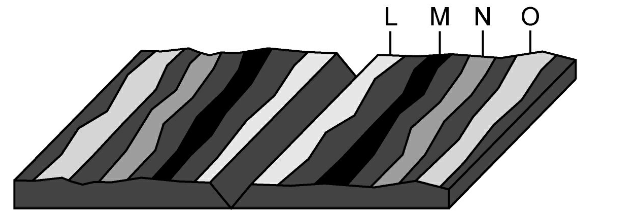
Where would the oldest rock be found?
L
M
N
O

The theory of continental drift was first proposed by _____________.
Thomas Edison
Alfred Wegener
Benjamin Franklin
Harry Hess
What is the main type of rock that makes up the oceanic crust?
Obsidian
Granite
Basalt
Limestone


The tallest mountains on the planet, Himalayan Mountains, are formed at which plate boundary?
Transform
Mountain Building
Volcano
Converging Plates

What does this plate movement cause?
Volcanoes
Earthquakes
Mid ocean ridges
Valleys

What happens at this boundary?
New crust is formed via earthquakes
New crust is formed via sea floor spreading
Crust is destroyed via volcanoes
None of these choices
What is the force that moves the continents?
Human Activity
Convection Currents
Conveyor Belts
Scrat the Squirrel from Ice Age
What does the theory of continental drift state?
The continents were once joined in a super-continent and have moved over time
The continents were made of many small plates that have clumped together over time
The continents are solid rock and do not move
The continents move rapidly due to human activity
Why does Pangaea no longer exist?
It still exists today.
Continental Drift shifted the plates causing it to separate.
Convection Currents shift the plates causing it to separate.
Volcanic activity causes the continents to shift.
Two or more tectonic plates shift horizontally alongside each other is a
Divergent Boundary
Transform Boundary
Convergent Boundary
Subduction
Two or more tectonic plates move away from each other is a
Subduction
Transform Boundary
Divergent Boundary
Convergent Boundary
The difference between oceanic and continental plates is
oceanic plates are more dense and lower elevation.
continental plates are more dense and lower elevation.
oceanic plates are less dense and higher elevations.
continental plates are less dense and lower elevation.
An oceanic plate converges on a continental plate, which one subducts under the other?
Continental Plate
Oceanic Plate


What geologic feature/event would you most likely to find at a divergent boundary between two pieces of continental crust?
Mid-Ocean Ridge
Mountain
Rift Valley
Island Arc

The area where two or more plates meet is called a __________________.
fault
plate boundary
plate edge
ring of fire


hot fluid below or in Earth's crust from which igneous rock is formed
lava
magma
brimstone
obsedian

the term for the process in which new crust is formed on the ocean floor as a result of a divergent boundary
seafloor spreading
Mid-Atlantic ridge
divergent boundary
trench
If new crust is constantly being created at divergent oceanic plates, is Earth getting bigger?
Yes, new crust = bigger Earth
Yes, the core is melting and creating a bigger Earth
No, new crust isn't being created
No, subduction is destroying crust at the same rate as divergent boundaries are creating it

What types of boundaries do these pictures represent? (Top to bottom)
Divergent, convergent, transform
Transform, divergent, convergent
Divergent, transform, convergent

