wayground logo

Free Printable Worksheets

Font size

S
M
L
XL
Worksheets

Pre-Weather Unit Review

Total questions: 50

Worksheet time: 2hrs 40mins

Name
Class
Date
1.
2. A change of state from a liquid to a solid is called....
a)
Melting
b)
Freezing
c)
Evaporation
2.
What happens to particles when they are heated?
a)
They speed up and spread out
b)
They slow down and compress
c)
They stop moving
d)
They move closer together and speed up
3.

Phase change going from a Solid to a Liquid...

a)

Freezing

b)

Condensation

c)

Melting

d)

Sublimation

4.
Which of the following terms identifies the change from a liquid to gas?
a)
Vaporization
b)
Condensation
c)
Deposition
d)
Sublimation
5.
Why does ice float?
a)
Liquid water is less dense than solid water.
b)
Solid water is less dense than liquid water.
c)
Gaseous water is less dense than solid water.
d)
Liquid water is less dense than gaseous water.
6.
What do we know about the density of lamp oil, rubbing alcohol, and vegetable oil?  
a)
The density is greater than 1.0 g/mL
b)
The density is less than 1.0 g/mL
c)
The density is equal to 1.0 g/mL
d)
The density can not be determined
7.
If an object has a density of .6 g/cm^3 and you put it into water, will it sink or float?  
a)
sink
b)
float
8.
If an object has a density of 3.6 g/cm^3 and you put it into water, will it sink or float?  
a)
sink
b)
float
9.
What units are used to measure Density?
a)
cm3/g
b)
g
c)
g/cm3
d)
cm3
10.
Mercury is a metal that is liquid at room temperature and has a density of 13.5 g/cm3.  Which of these metals would sink below the mercury if dropped into a container of mercury?
a)
gold (density=19.3 g/cm3)
b)
lead (density=11.4 g/cm3)
c)
iron (density=7.9g/cm3)
d)
aluminum (density=2.7g/cm3)
11.
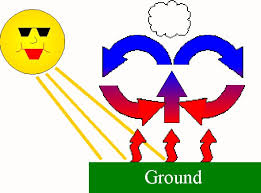
The movement of matter due to differences in density that are caused by temperature variation.
a)
Thermal Conduction
b)
Convection
c)
Radiation
d)
Infrared
12.
The vertical movement of air currents due to temperature variations.
a)
Conduction
b)
Convection Current
c)
Radiation
d)
Heat
13.
Why does warm air rise and cool air sink?
a)
Warm air is less dense than cooler air.
b)
Warm air is more dense than cooler air.
c)
Warm air weighs less than cooler air.
d)
Warm air weighs more than cooler air. 
14.
Why do we see objects as black?
a)
They absorb all the light
b)
They reflect all the light
c)
They absorb some light and reflect 
15.
What happens when light hits a mirror?
a)
it makes a color
b)
it reflects
c)
it makes a rainbow
d)
it passes through
16.
What happens to blue light when it hits a shirt that appears blue?
a)
The light is reflected.
b)
The light is absorbed.
c)
The light is refracted.
d)
The light is blocked.
17.
Copper, Stainless Steel, Carbon Steel, and Zinc were all heated using the same thermal energy.  What material would be the coolest after being heated?
a)
Copper
b)
Carbon Steel
c)
Zinc
d)
Stainless Steel
18.
Water has a specific heat of 4184 J/KgºC.  Wood has a specific heat of 1760 J/KgºC.  What material needs more energy to raise the temperature 1ºC
a)
Wood
b)
Water
c)
Both are the same
19.
Specific heat of water is  4.18 J/g°C. Specific heat of wood is 1.760 J/g°What material needs more heat energy to raise the temperature?
a)
Water
b)
Wood
c)
Both are same
20.
___________ is measured by the unit Joules.
a)
Heat energy
b)
Temperature
c)
Specific heat
21.
A high specific heat means...
a)
It heats up quickly with energy added
b)
It requires more energy to change temperature
22.
This is a measurement of the amount of matter, or 'stuff', in an object or substance.
a)
volume
b)
density
c)
mass
d)
length
23.
What happens when you heat a gas?
a)
It gains mass.
b)
It loses mass.
c)
It increases in volume.
d)
It decreases in volume.
24.
What is volume
a)
the amount of space an object occupies
b)
the amount of matter an object has
25.
Which box has a higher density?  
a)
Box A
b)
Box B
c)
cannot be determined
d)
they are the same
26.
Inside the jar, we added several liquids to test density. The liquids that were most dense were at the _________ of the jar and the liquids that were least dense were at the __________.
a)
Top; bottom
b)
Middle; top
c)
Bottom; top
d)
The density was the same throughout.
27.

What is the feature of the wall of a thermos flask that allows it to maintain the temperature of hot water for a long time?

a)

The outer walls are usually painted with black colours to avoid heat emission from the inside

b)

The inner walls are usually made out of shiny material such as aluminium to avoid heat loss

c)

The inner walls are usually made out of dark and dull material to avoid heat loss

d)

The outer walls are usually painted with black colours to absorb heat

28.

Which can is a better heat absorber and radiator

a)

The dark can

b)

The white can

29.

If we filled both glass with hot coffee, which cup of coffee will probably cools down faster, given thay both cup made up of the same material?

a)

The black cup

b)

The white cup

30.

Which surface is a better heat reflector?

a)

Dark, dull surface

b)

White, shiny surface

31.

When light bounces off of an object into a different direction we call it ___.

a)

absorbtion

b)

refraction

c)

reflection

32.

When light is stored inside of an object and turns into heat energy, we call it ____.

a)

absorbtion

b)

refraction

c)

reflection

33.

What colors are being absorbed?

a)

red, orange, yellow

b)

green, blue, indigo, violet

34.

Why is avoiding a black colored shirt during activities under the hot sun a good idea?

a)

Black is a weak heat absorber

b)

Black is a good heat absorber

35.
Adding salt to water will make the water ___________ dense compared to water without salt.
a)
more
b)
less
36.

Heat transfer by convection is caused by differences in what two things:

a)

Thickness and material

b)

Weight and electricity

c)

Temperature and density

37.
Warm air rises and the cool air sinks demonstrates this type of heat transfer. 
a)
conduction
b)
convection
c)
radiation
d)
Insolation 
38.

When heated, a substance expands and its density...

a)

Increases

b)

Stays the same

c)

Decreases

d)

Fluctuates

39.

The process when a solid turns into a liquid

a)

Evaporation

b)

Sublimation

c)

Freezing

d)

Melting

40.

What is the term given to the temperature at which a solid turns into a liquid?

a)

Boiling point

b)

Melting point

c)

Freezing point

d)

Heating point

41.

________ is the amount of matter in an object.

a)

density

b)

mass

c)

volume

42.

________ is the amount of space that matter takes up.

a)

density

b)

mass

c)

volume

43.

Why do air bubbles rise to the surface of a glass of water?

a)

Because the bubbles are lighter than water

b)

Because bubbles are more dense than water

c)

Because bubbles are less dense than water

44.

The heat absorbed by melting a solid is known as

a)

heat of fusion

b)

heat of solid

c)

heat of liquid

d)

heat of vaporization

45.

Higher temperatures indicate

a)

slower motion of molecules

b)

chemical energy

c)

faster motion of molecules

d)

molecules at rest

46.

The amount of heat needed to change 1 gram of a substance from the liquid phase to the gas phase is ___

a)

Heat of Vaporization

b)

Boiling point

c)

Heat Energy

d)

Phase change

47.

When an object soaks in the light, it _________ light.

a)

absorbs

b)

reflects

c)

refracts

48.

What is happening here?

a)

The object is absorbing all colors because it is transparent

b)

The object is reflecting all colors because it is black

c)

The object is transmitting all objects because it is white

d)

The object is absorbing all colors because it is black

49.

Does the rabbit's white fur absorb or reflect all colors?

a)

Absorb

b)

Reflect

50.

In a lava lamp, the wax blobs went up, then back down. This was because of ______________.

a)

conduction

b)

convection

c)

radiation

d)

electricity