Wayground logo

Free Printable Worksheets

Font size

S
M
L
XL
Worksheets

ACP review

Total questions: 70

Worksheet time: 2hrs 9mins

Name
Class
Date
1.

Which plant would be stiff and rigid?

a)

A

b)

B

2.

Which plant would be wilted or limp?

a)

A

b)

B

3.

What is the tropism where plant responds to external stimiuli of gravity?

a)

gravitropism/geotropism

b)

phototropism

c)

thigotropism

d)

none of the above

4.

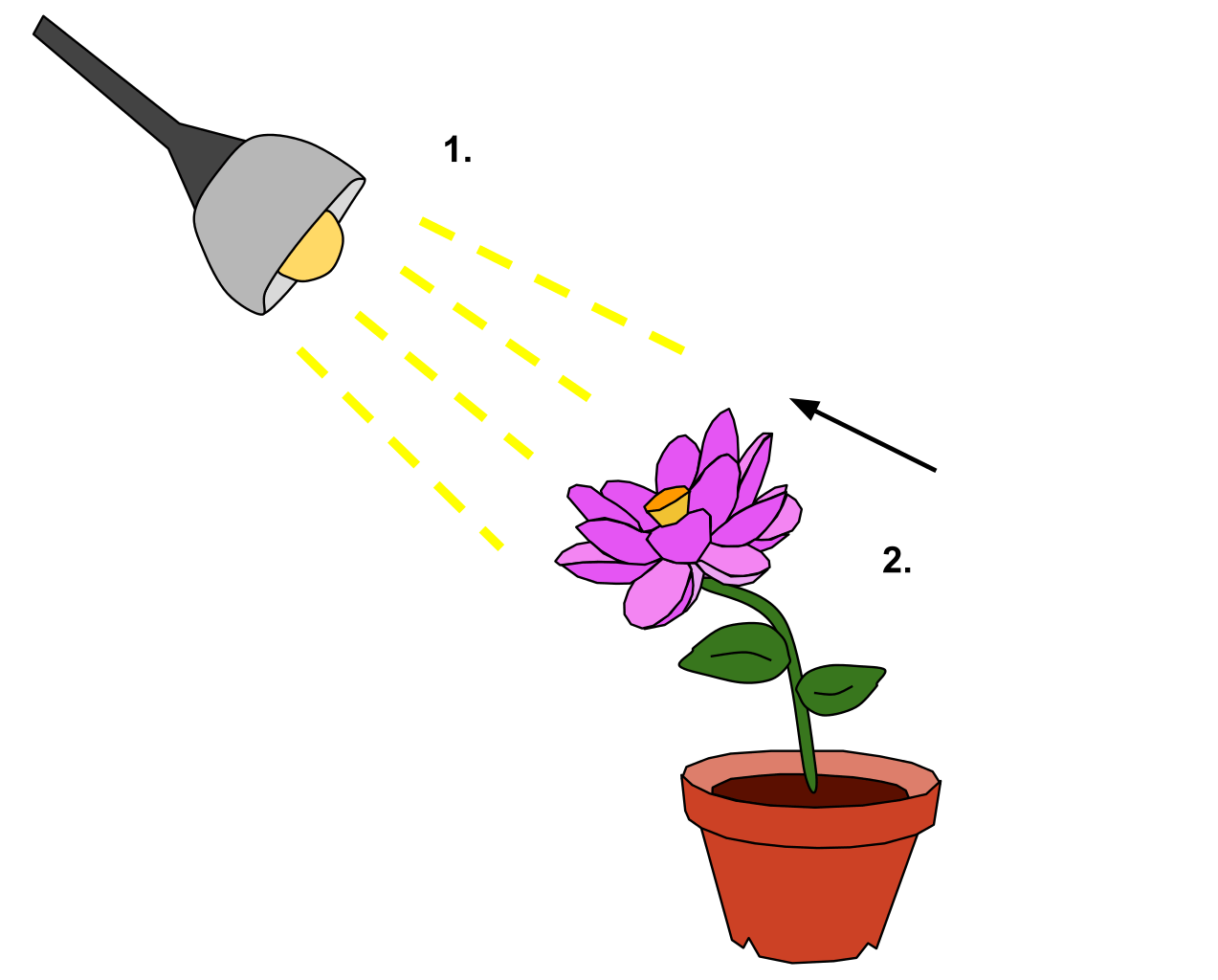
What is the tropism where plants response is to grow towards light?

a)

gravitropism/geotropism

b)

phototropism

c)

thigotropism

d)

none of the above

5.

What is the tropism where plants respond to external stimulus of touch?

a)

geotropism

b)

phototropism

c)

thigotropism

d)

none of the above

6.
Poison Ivy growing on a tree by touch.
a)
Gravitropism 
b)
Phototropism
c)
Thigmotropism
d)
Hydrotropism
7.

Plants curling around a pole or mailbox is an example of:

a)

Phototropism

b)

Germination

c)

Turgor pressure

d)

Thigmotropism

8.

Wilting is a plant's response to:

a)

High turgor pressure

b)

Low turgor pressure

c)

Gravity

d)

Sunlight

9.

When plants grow in towards the light, this is called:

a)

Phototropism

b)

Geotropism

c)

Germination

d)

Thigmotropism

10.

Turgor pressure is a result of water in what plant cell organelle?

a)

Mitochondrion

b)

Nucleus

c)

Cell wall

d)

Vacuole

11.
When a plant grows toward a stimuli it is known as:
a)
Positive
b)
Negative
12.
What does this picture represent? 
a)
thigmotropism
b)
Phototropism
c)
Hydrotropism
d)
Geotropism
13.
What does this picture represent? 
a)
Thigmotropism
b)
Phototropism
c)
Hydrotropism
d)
Geotropism (Gravitropism)
14.
What is mean by homeostasis?
a)
Controls and coordinates body activities through chemical 
b)
controls and coordinates body activities through electrical impulses
c)
For maintenance of a steady state in the internal environment
d)
remove metabolic waste products from the cel
15.
What is involuntary contractions of voluntary muscles to warm up?
a)
Shivering
b)
Sweating
c)
Vasodilation
d)
Vasoconstriction
16.
If the environment gets cold, we will often shiver in order to:
a)
keep body temperature the same as the external temperature
b)
decrease body temperature
c)
increase body temperature
d)
regulate blood pressure
17.

Homeostasis

a)

allows for a wildly fluctuating internal environment

b)

is impossible in vertebrates

c)

is the maintenance of a relatively stable internal environment and often incorporates a form of feedback regulation

18.
Most bacteria that cause sickness in humans grow best at 98.6oF. Sometimes a fever is the body's response to the bacteria. What is the reason for developing a fever?
a)
To lower the temperature of the body to kill the bacteria
b)
The increase the temperature of the body to kill the bacteria
c)
To allow the bacteria to take over
d)
To make you feel miserable
19.

Learning to brush your teeth when you are younger.

a)

learned behavior

b)

instinct

20.

Bees make honey.

a)

learned behavior

b)

instinct

21.

An animal is cold so it moves into the sun. What is the underline phrase?

a)

stimulus

b)

response

22.

You are hungry so you eat some food. What is the underline phrase?

a)

stimulus

b)

response

23.

Getting a drink when you are thirsty. What is the underline phrase?

a)

stimulus

b)

response

24.

What type of situation might trigger the fight-or-flight response?

a)

persistent worrying

b)

long-term stress

c)

a threat from a predator

25.

the normal, balanced state of the body's internal systems

a)

homeostasis

b)

fight or flight

c)

stressor

d)

adrenaline

26.

How many parents are required for asexual reproduction?

a)

none

b)

1

c)

2

d)

4

27.

How do bacteria reproduce?

a)

mitosis

b)

budding

c)

binary fission

d)

regeneration

28.

What is one advantage of asexual reproduction?

a)

offspring are different from parents

b)

diseases are not passed from parent to offspring

c)

it takes a longer time

d)

it takes less time

29.

How many parents are involved with sexual reproduction?

a)

none

b)

1

c)

2

d)

4

30.

When one parent organism produces offspring without meiosis and fertilization:

a)

asexual reproduction

b)

sexual reproduction

31.

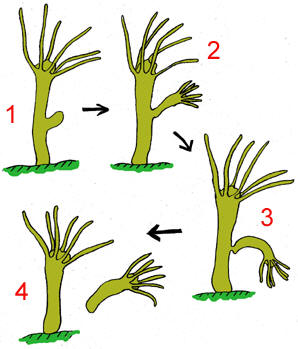
Occurs when an offspring grows from a piece of its parents:

a)

fission

b)

budding

c)

cloning

d)

regeneration

32.

When offspring grow from part of a parent plant:

a)

fission

b)

budding

c)

cloning

d)

vegetative regeneration

33.

How many pairs of chromosomes do humans have?

a)

18

b)

23

c)

26

d)

46

34.

An organism that has been reproduced by sexual reproduction received ____________ of its chromosomes from the male parent.

a)

4

b)

25%

c)

50%

d)

100%

35.

The specific section of DNA that carries the code to control the specific characteristic or trait.

a)

Nucleus

b)

Chromosome

c)

Gene

d)

Allele

36.

Which type of reproduction results in diversity because the offspring are a combination of the parents and genetically different?

a)

Asexual

b)

Sexual

37.

___________________ is a type of asexual reproduction in which a piece of a parent organism breaks off to form an new organism (ex. starfish).

a)

fission

b)

budding

c)

fragmentation

d)

fertiliztion

38.

When a single-celled organism splits into 2 new organisms it is called _________________.

a)

fragmentation

b)

fission

c)

budding

d)

sporulation

39.

When an offspring grows off from the body of a parent organism it is called __________________.

a)

budding

b)

fission

c)

fragmentation

d)

sporulation

40.

How many parents are required for sexual reproduction?

a)

0

b)

1

c)

2

d)

3

41.
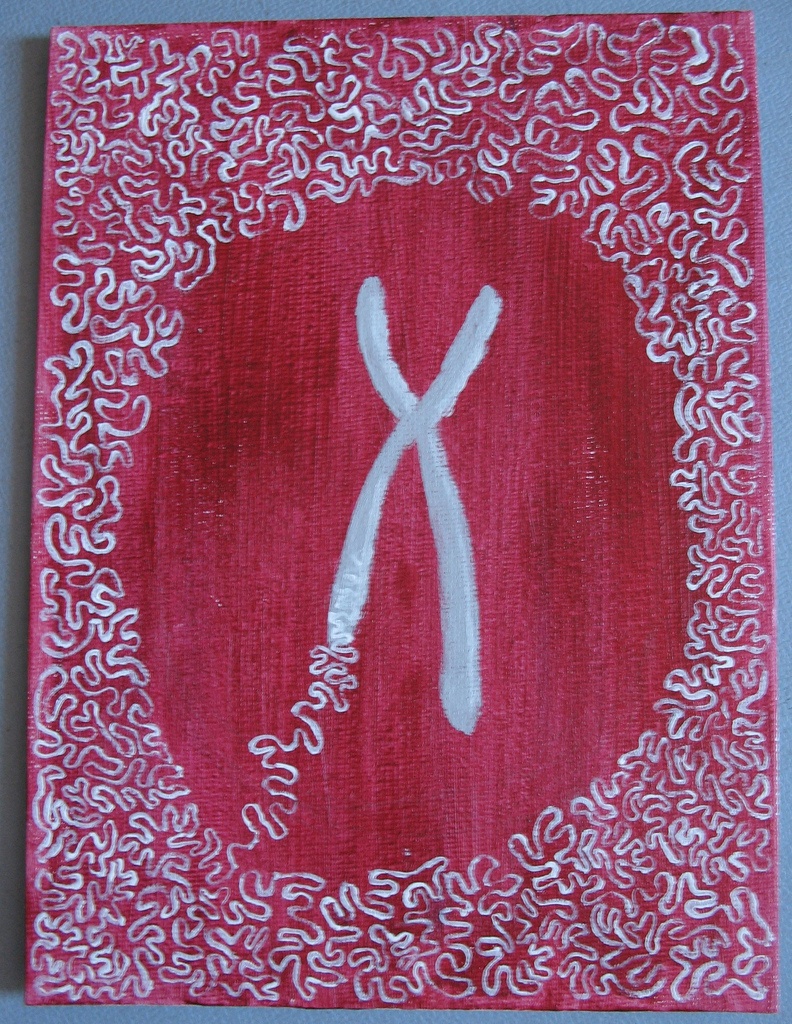
One of the threadlike structures in the nucleus of a cell that contain directions for the cell's activities
a)
variation
b)
pedigree
c)
DNA
d)
chromosome
42.
A characteristic that is passed from parent to offspring
a)
inherited trait
b)
chromosome
c)
pedigree
d)
DNA
43.
The passing of inherited traits from parents to offspring
a)
acquired traits
b)
inherited traits
c)
heredity
d)
genetics
44.
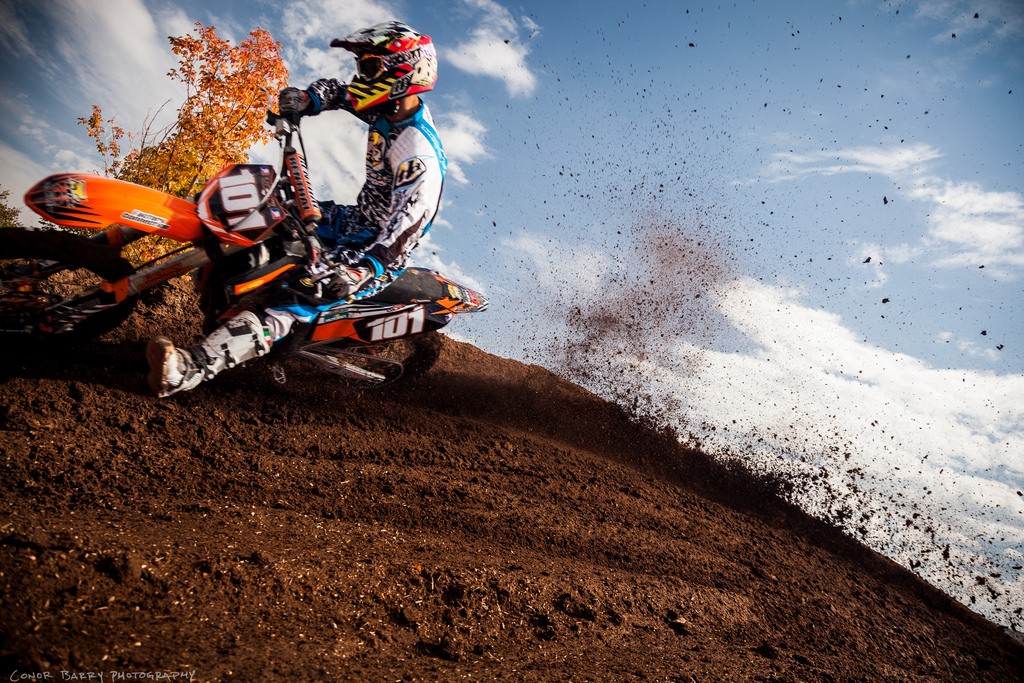
Ability to to ride a motorcycle
a)
inherited triat
b)
acquired trait
c)
genes
d)
Keelan
45.
What is the relationship between DNA and chromosomes?
a)
Chromosomes are made of DNA
b)
DNA is made of chromosomes
c)
DNA and chromosomes are the same thing.
d)
All of the above are correct
46.
Put in order smallest to largest:
a)
Chromosome - DNA - Gene
b)
Gene - DNA - Chromosome 
c)
DNA - Gene  Chromosome
d)
Chromosome - Gene  - DNA
47.
TT,tt,PP,pp,SS,ss are examples of alleles that are?
a)
homozygous
b)
heterozygous
c)
different
d)
homologous 
48.
The exact genetic makeup of an organism, such as RR, Tt, PP is its?
a)
phenotype
b)
dominance
c)
genotype
d)
trait
49.
"The Great White Shark was 20 feet in length.  Phenotype or Genotype?
a)
phenotype
b)
genotype
50.
Females-XX; MalesXY.  A couple has 4 girls.  What is the chance the next child will be a boy?
a)
75%
b)
100%
c)
25%
d)
50%
51.
If "T" is the allele for tall and "t" is the allele for short, then Tt would produce?
a)
tall
b)
short
c)
medium
d)
not enough info
52.
A physical characteristic that can be passed from parent to offspring.
a)
behavior
b)
trait
c)
strong muscles
d)
ability to fly a plane.
53.
Which of the following alleles is homozygous (purebred) recessive?
a)
Tt
b)
tt
c)
TT
d)
t
54.
Which of the following is a phenotype?
a)
Aa
b)
red hair
c)
heterozygous genes
d)
mutated DNA
55.
G = green, g = yellow
The genotype for a yellow plant is...
a)
GG
b)
Gg
c)
gg
d)
all of the choices result in yellow
56.
T = tall an t = short
What is the phenotype for Tt?
a)
short
b)
tall
c)
medium sized
d)
neither tall or short
57.
T - tall and t = short
In the punnett square below, what belongs in the missing square
a)
tt
b)
Tt
c)
Bb
d)
TT
58.
Which of the following is homozygous dominant?
a)
Yy
b)
Y
c)
yy
d)
YY
59.
Is this punnet square true or false?
a)
False, because there should be 3 dominate alleles.
b)
True.
c)
False, because There should be 3 recessive alleles.
d)
I don't know....
60.
What is the purpose of a dichotomous key?
a)
to find a common ancestor
b)
to show the evolution of organisms
c)
to show relationships between organisms
d)
to identify organisms
61.
A dichotomous key for insects is given. To what order does an insect with two pairs of scaly wings belong?
a)
Coleoptera
b)
Heteroptera
c)
Diptera
d)
Lepidoptera
62.
What step do we always start with when using dichotomous keys?
a)
1
b)
2
c)
3
d)
4
63.
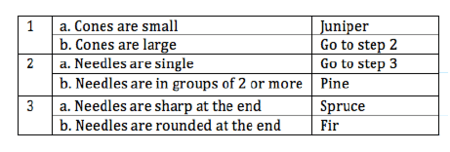
A dichotomous key for trees is provided. Hikers found a tree that has large brown cones and single sharp needles. What species of tree have the hikers found?
a)
Juniper
b)
Pine
c)
Spruce
d)
Fir
64.
When using a dichotomous key to identify organisms, what do we look at?
a)
physical features
b)
weather patterns
c)
environment
d)
diet
65.
Using this dichotomous key, identity the name of the circled fish.
a)
band-tail puffer
b)
spotted goat fish
c)
peacock flounder
d)
trumpet fish
66.
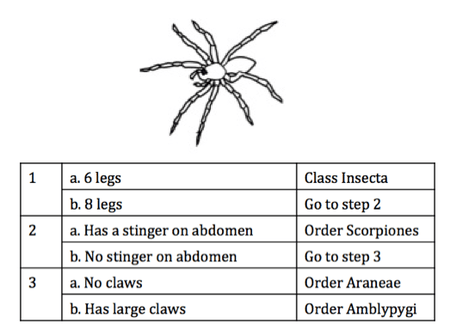
An illustration and a dichotomous key are given. What is the correct classification for this organism?
a)
Class Insecta
b)
Order Amblygygi
c)
Order Araneae
d)
Order Scorpiones
67.

A student discovers an arachnid without a segmented abdomen, and legs longer than its body. The student uses the dichotomous key below to identify it. Which arachnid has the student found?

a)

Whip Scorpion

b)

Wind Scorpion

c)

Daddy long legs

d)

Scorpion

68.

A student discovers an arachnid with a segmented abdomen, long legs, and a tail with no stinger.

The student uses the dichotomous key below to identify it.

1. a) Abdomen segmented.............go to 2

b) Abdomen not segmented ......go to 4

2. a) Abdomen with tail....................go to 3

b) Abdomen without tail...............go to 5

3. a) Tail with stinger..........................Scorpion

b) Tail without stinger.....................Whip scorpion

4. a) Legs longer than body.............Daddy Long Legs

b) Legs not longer than body……….Wind scorpion

5. a) Covered with spines .......................Mite

b) Few spines.....................................Tick

a)

Whip Scorpion

b)

Daddy Long Legs

c)

Mite

d)

Tick

69.

Which leaf is shown in the drawing?

a)

Magnolia

b)

Redbud

c)

Sweetgum

d)

None of the above

70.

Which shark is the picture of?

a)

Cow Shark

b)

Great White Shark

c)

Hammerhead Shark

d)

Saw Shark