
 Worksheets
P8 Forces in balance
Total questions: 38
Worksheet time: 51mins
What is the unit for force?
Joules (J)
seconds (s)
Newtons (N)
meters (m)

How will this object move?
The object will move to the left, as the forces are balanced.
The object will move to the right, as the forces are unbalanced.
The object will move to the left, as the forces are unbalanced.
The object will move to the right, as the forces are balanced.
Which of the following is an example of an unbalanced force?


What is the sum of all forces acting on an object?
Resultant Force
Balanced Force
Unbalanced Force
Applied Force
which of the following is a vector?
velocity
distance
position
speed
direction
Select the correct equation to calculate the moment of a force.
Moment = Force / Distance
Moment = Force x Distance
Force = Moment x Distance
Distance = Moment x Force
The unit of moment is...
Newtons (N)
Newtonmetres (Nm)
Ohms (Ω)
seconds (secs)
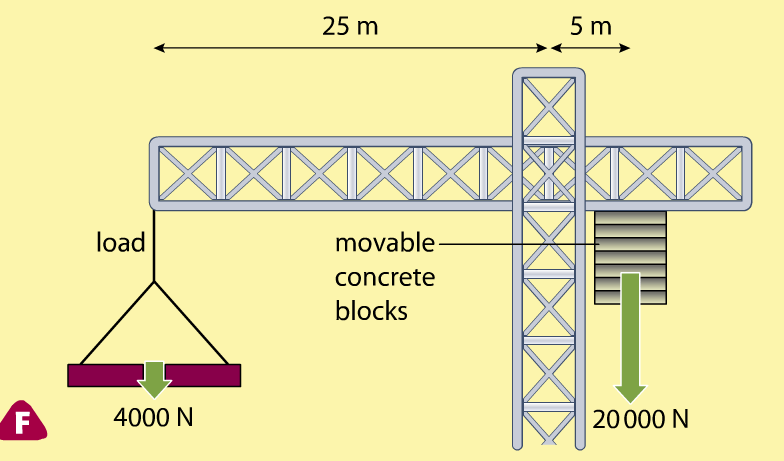

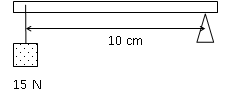
Which situation experiences forces in equilibrium?
a car moving down a hill with increasing velocity
an apple falls from a tree
a rocket accelerates upward
a ship floating above the sea surface

Calculate the moment caused by the spanner on the nut.
(a)
To increase the size of the moment, we can...
increase the size of the force
decrease the size of the force
increase the distance from the pivot
decrease the distance from the pivot

Which gears will turn clockwise if gear A is turned anticlockwise?
B
C
D
E
F
Larger gears produce ______ moments
smaller
larger
no
What is a lever?
Any piece of metal that bends.
Any bar or a rod that's set up to tilt on a fulcrum
Any bar or a rod that's set up to tilt
Any bar that's attached to a pulley
What best describes what a load is?
a type of simple machine
an example of a lever
what you are trying to lift
the effort
When discussing simple machines, what is effort?
a type of simple machine
the force you apply to move an object
what the simple machine is lifting
the point where the lever pivots
What happens if you decrease the distance between the fulcrum and the load?
You can use less force to move the load
You have to decrease the length of the lever
You can use more force to move the load
You have to increase the height of the fulcrum
What is an example of a lever in the real world?
ski slope
wheels on a car
seesaw
kitchen table


The diagram shows a uniform, flat metal sheet hanging freely from a nail at point A. One of the labelled points is at the centre of mass of the metal sheet.
Which point is at the centre of mass?
A
B
C
D
Where will be the centre of mass of a uniform rod lies ?
At its end
At its middle point
At its centre of its cross sectional area
Depends upon its material
Where the center of mass of a circle lies?
At its centre
Anywhere on its radius
Anywhere on its circumference
Anywhere on its diameter
A simple method to find centre of mass of a body uses a ___
stop watch
plumbline
pendulum
gauge
Where do you hang the plumb line when determining the Centre of mass?
It doesn't matter, because it always goes through the CG
Only from the corners
From the point where you are suspending the object
At the right angle
Do all objects have a centre of gravity?
No objects have a centre of gravity
Only some objects have a centre of gravity
Only very heavy objects have a centre of gravity
Yes all objects have a centre of gravity

Diagram shows a stationary trolley (in equilibrium) on an inclined plane.
What can we say about the magnitude of the force, F ?
It is equal to the weight, W
It is greater than the weight, W
It is equal to the component of the weight, W, that is parallel to the slope.
It is equal to the component of the weight, W, that is perpendicular to the slope.

Which method can we use to solve for the resultant force?
Head to Tail method
Tail-to-Tail method
Parallelogram method
Pythagorean method

Two forces F1 and F2 act on an object as in the diagram above.
If F1 and F2 are drawn to scale, the resultant force can be found by measuring the length of the resultant line FR.
Which of the following diagrams shows the correct position of the line FR?


Vector A is directed northward and vector B is directed eastward. Which of the following vector addition diagrams best represent the addition of vectors A and B and the subsequent resultant?
A
B
C
D
E

FINAL QUESTION: TAKE YOUR TIME. REMEMBER A DRAWING WILL HELP!
A Force F is resolved into two components, Fh and Fv at right angles to each other as in the diagram above. Which statement below is NOT true?
Decreasing the angle θ will increase the size of Fh
Increasing the angle θ will increase the size of Fv
Fh and Fv have sizes that when added together give a total equal to the size of F.
Fh and Fv have sizes that when added together give a total greater than the size of F.

