wayground logo

Free Printable Worksheets

NEW

Font size

S
M
L
XL
Worksheets

PS Unit 5 Review

Total questions: 68

Worksheet time: 17hrs 0mins

Name
Class
Date
1.

What Is Matter?

a)

Anything That has mass and takes up space.

b)

Anything that you can see or taste.

c)

What you can touch.

d)

you and go throught this.

2.
What Is Volume?
a)
How heavy something is.
b)
The amount of space taken up by and object.
c)
How a liquid flows.
d)
The international unit of measurement.
3.
Liquids and gases are similar because __________________________.
a)
they both take the shape of their container
b)
they both have their own shape
c)
liquids pour and gases don't
d)
liquids take the shape of the container but gases have their own shape
4.
Gas particles have the ________ kinetic energy because they move the fastest.
a)
least
b)
most
5.

The type of matter with the lowest heat energy and temperature.

a)

gas

b)

solid

c)

liquid

d)

plasma

6.
What phase of matter is shown in the diagram?
a)
solid
b)
liquid
c)
gas
d)
physical changes
7.

Which of the following describes liquids?

a)

definite shape, definite volume

b)

no definite shape, definite volume

c)

no definite shape, no definite volume

d)

no definite shape, no definite volume, electrically charged

8.
Which sentence is true?
a)
If ice is heated up a little, it will turn into a liquid, but if it is heated up even more, it will turn into a gas.
b)
If ice is heated up a little, it will turn into a gas, but if it is heated up even more, it will turn into a liquid.
c)
If ice is heated up a little, it will turn into a liquid, but if it is heated up even more, it will turn into a solid.
d)
If ice is heated up a little, it will turn into a solid, but if it is heated up even more, it will turn into a gas.
9.
Which state of matter?
a)
Solid
b)
Liquid
c)
Gas
d)
Texas
10.
In which state of matter do the particles only vibrate in place?
a)
solid
b)
liquid 
c)
gas 
d)
liquid and gas
11.
Which state of matter generally has the highest velocity of the particles?
a)
Solid
b)
Liquid
c)
Gas
d)
Solid and Liquid
12.
A gas
a)
has a definite shape but no definite volume
b)
has a definite volume but no definite shape
c)
has fast-moving particles
13.
At higher temperatures
a)
particles in an object have less energy
b)
particles in an object move faster
c)
a gas contracts
14.
The opposite phase of melting is 
a)
freezing 
b)
sublimation
c)
condensation 
d)
deposition 
15.
Melting
a)
liquid to solid
b)
solid to liquid
c)
solid to gas
d)
gas to liquid
16.
Freezing
a)
Solid to gas
b)
Liquid to solid
c)
Gas to solid
d)
Liquid to gas
17.
Boiling
a)
liquid to gas
b)
gas to solid
c)
gas to liquid
d)
solid to liquid
18.
Which state of matter has tightly packed molecules?
a)
solid
b)
liquid
c)
gas
19.
What are the states of matter?
a)
solid, liquid, and juice
b)
solid and liquid
c)
solid and gas
d)
solid, liquid, and gas
20.
The drops of water that appear on the outside of a glass of cold juice on a warm day are an example of?
a)
sublimation
b)
condensation
c)
evaporation
21.
Define a liquid.
a)
Indefinite shape, indefinite volume
b)
Definite shape, definite volume
c)
Found in stars
d)
Definite volume, indefinite shape
22.
Which of these is an example of sublimation?
a)
water turning to ice
b)
ice cream dripping
c)
a puddle drying up
d)
dry ice being used to make fog
23.
How are the particles moving in liquids?
a)
Sliding past one another
b)
moving past one another with great speed
c)
vibrating in a fixed postion
24.
What would cause a decrease in particle movement?
a)
decrease atoms
b)
increase in space between atoms
c)
decrease in temperature
d)
increase in mass
25.
The theory that states that all particles in matter are constantly moving; helps to describe the phases of matter
a)
behavior of gases
b)
kinetic theory 
c)
matter matters
d)
temperature 
26.
Gases are described as having a 
a)
definite shape and indefinite volume
b)
indefinite shape and indefinite volume
c)
definite shape and definite volume
d)
indefinite shape and definite volume
27.
Gas particles have the ________ kinetic energy because they move the fastest.
a)
least
b)
most
28.
When a liquid changes its phase and turns into a solid it is known as
a)
condensation.
b)
melting.
c)
vaporization.
d)
freezing or solidification.
29.
When a gas changes its phase and turns into a liquid it is known as
a)
condensation.
b)
sublimation.
c)
vaporization.
d)
freezing or solidification.
30.
When a gas changes its phase and turns into a solid it is known as
a)
deposition.
b)
sublimation.
c)
condensation.
d)
freezing or solidification.
31.
When a solid changes its phase and turns into a gas it is known as
a)
deposition.
b)
melting.
c)
condensation.
d)
sublimation.
32.
All phase changes are
a)
chemical changes
b)
chemical reactions
c)
physical changes
d)
irreversable
33.
During a phase change, the temperature remains the same
a)
True
b)
False
34.
What kind of energy is added to or removed from matter to cause a phase change?
a)
Radiation
b)
Heat
c)
Solar
d)
Wind
35.
What state of matter is X?
a)
solid 
b)
liquid
c)
gas
d)
supercritical fluid
36.
What state of matter is Y?
a)
solid 
b)
liquid
c)
gas
d)
supercritical fluid
37.
What state of matter is Z?
a)
solid 
b)
liquid
c)
gas
d)
supercritical fluid
38.
What is point A?
a)
triple point
b)
critical point
c)
equilibrium point
d)
normal melting point
39.
What state of matter is Y?
a)
solid 
b)
liquid
c)
gas
d)
supercritical fluid
40.
What state of matter is Z?
a)
solid 
b)
liquid
c)
gas
d)
supercritical fluid
41.
What is point A?
a)
triple point
b)
critical point
c)
equilibrium point
d)
normal melting point
42.
What change occurs from F to E?
a)
sublimation
b)
deposition
c)
melting
d)
condensation
43.
What change occurs from E to C?
a)
sublimation
b)
freezing
c)
melting
d)
boiling
44.
What change occurs from C to D?
a)
condensation
b)
vaporization
c)
melting
d)
sublimation
45.
The pressure is increased on a sample of water at 0 °C from 0 mmHg to 800 mmHg.  In order, what changes occur?
a)
deposition, melting
b)
sublimation, melting
c)
condensation, freezing
d)
deposition, freezing
46.
What is true regarding CO2 for temperatures above 31 °C?
a)
It can never be liquified.
b)
It decomposes.
c)
It has a high pressure.
d)
It is a plasma.
47.
What would happen to the liquid substance if the pressure were decreased until a phase change occurred? It would undergo...
a)
melting
b)
vaporization
c)
condensation
d)
sublimation
48.
What is the normal boiling point of this substance?
a)
150 °C
b)
100 °C
c)
-50 °C
d)
0 °C
49.
Water exists as a _____________ at 700 mmHg and 50 °C.
a)
solid
b)
liquid
c)
gas
d)
supercritical fluid
50.
Water exists as a _____________ at 3 mmHg and 50 °C.
a)
solid
b)
liquid
c)
gas
d)
supercritical fluid
51.

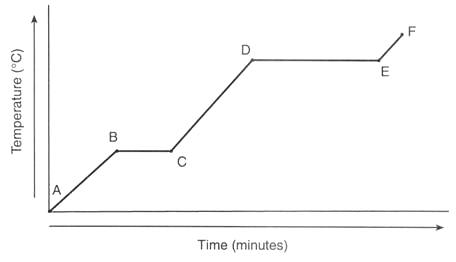
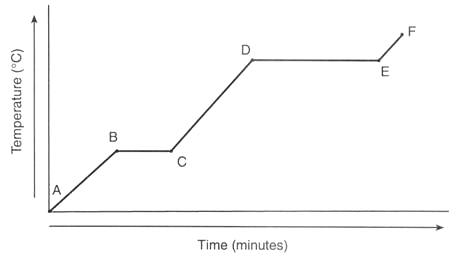
Between which points is the temperature of the substance remaining constant? (Diagram F)

a)

A-B only.

b)

A-B, C-D, E-F

c)

B-C only.

d)

B-C, D-E

52.
True or false: melting and freezing occur at the same temperature!
a)
True
b)
False
c)
I don't know
53.

Are the particles moving faster or slower as time goes on? (Diagram F)

a)

Faster

b)

Slower

54.

A substance's heating curve is shown in the graph. What is its boiling point? (Diagram B)

a)

100 C

b)

60 C

c)

80 C

d)

20 C

55.

Is the substance gaining or losing energy? (Diagram D)

a)

Gaining

b)

Losing

56.

What phase change is occurring at line segment B-C if the graph is exothermic? (Diagram E)

a)

melting

b)

freezing

c)

boiling

d)

condensation

57.

What line segment represents only the solid state? (Diagram F)

a)

A-B

b)

B-C

c)

C-D

d)

D-E

58.

Between which points is the temperature of the substance remaining constant? (Diagram F)

a)

A-B only.

b)

A-B, C-D, E-F

c)

B-C only.

d)

B-C, D-E

59.
What two types of measurements make up DENSITY
a)
Mass and Volume
b)
Temperature and Mass
c)
Grams and Centimeters
d)
Volume and Weight
60.
Jack has a rock. The rock has a mass of 14g and a volume of 2cm3. What is the density of the rock?
a)
7 mL
b)
7 g/cm3
c)
28 g/cm3
d)
1/7 g/cm3
61.
What units can be used to express density?
a)
g/mL
b)
grams
c)
millimeters
d)
milliliters
62.
Frank has an eraser. It has a mass of 4g, and a volume of 2cm3. What is its density?
a)
8 g/cm3
b)
2 g/cm3
c)
1/2 g/cm3
d)
24 g/cm3
63.
Frank has a paper clip. It has a mass of 9g and a volume of 3cm3. What is its density?
a)
3 g/cm3
b)
1/3 g/cm3
c)
27 g/cm3
d)
39 g/cm3
64.
What units are used to measure mass?
a)
g
b)
cm3
c)
g/cm3
d)
cm3/g
65.
What is the formula for density?
a)
density = mass x volume
b)
density = mass / volume
c)
density = mass + volume
d)
density = mass - volume
66.
What is the volume of Object X?
a)
10.0 cm3
b)
15.0 cm3
c)
20.0 cm3
d)
25.0 cm3
67.
Calculate the density of the cube.
a)
2 g/cm3
b)
4 g/cm3
c)
6 g/cm3
d)
8 g/cm3
68.
Frank has an eraser. It has a mass of 4g, and a volume of 2cm3. What is its density?
a)
8 g/cm3
b)
2 g/cm3
c)
1/2 g/cm3
d)
24 g/cm3