wayground logo

Free Printable Worksheets

Font size

S
M
L
XL
Worksheets

physics

Total questions: 66

Worksheet time: 1hrs 6mins

Name
Class
Date
1.

All of the following have the same units except:

a)

inductance.

b)

capacitive reactance.

c)

impedance.

d)

resistance.

2.

A resistor is connected to an AC power supply. On this circuit, the current

a)

leads the voltage by 90°.

b)

lags the voltage by 90°.

c)

is in phase with the voltage.

d)

none of the given answers

3.

A pure inductor is connected to an AC power supply. In this circuit, the current

a)

leads the voltage by 90°.

b)

lags the voltage by 90°.

c)

is in phase with the voltage.

d)

none of the given answers.

4.

If the frequency of the AC voltage across an inductor is doubled, the inductive reactance of that inductor

a)

increases to 4 times its original value.

b)

increases to twice its original value.

c)

decreases to one-half its original value.

d)

decreases to one-fourth its original value.

5.

Which of the following diagrams is the correct phasor diagram for VR, VL and V?

a)
b)
c)
d)
6.
The function of a generator is to change ____. 
a)
mechanical energy to electrical energy
b)
electrical energy to mechanical energy 
c)
electrical energy to chemical energy
d)
chemical energy to electrical energy 
7.

A Capacitor blocks

a)

Only a.c.

b)

Only d.c.

c)

Both ac and dc

d)

None of these

8.

The instantaneous current in an ac circuit is i=2.0 sin314t, what is its frequency?

a)

100 Hz

b)

60 Hz

c)

50 Hz

d)

9.

The instantaneous current in an ac circuit is i=2.0 sin314t, what is rms value of the current.

a)

1.414 A

b)

2.828A

c)

1 A

d)

2 A

10.

An electrical element X when connected to an alternating voltage source has current through it leading the voltage by 2radian. Identify X

a)

Capacitor

b)

Resistor

c)

Inductor

d)

Series LR circuit

11.

If an electric bulb is connected to an AC source, which of the following statement is true about the phase difference between the voltage across the bulb and current flowing in it?

a)

In phase.

b)

Not in phase.

c)

The voltage is leading the current.

d)

The current is leading the voltage.

12.
What does it mean when the electric field lines are close together?
a)
the field is positive
b)
the field is negative
c)
The field is strong
d)
the field is weak
13.
When a glass rod is rubbed with silk and the glass rod becomes positively charged, what happens to the electrons?
a)
they are removed from the rod
b)
they are added to the rod
14.
What do you call the process of charging a conductor by bringing it near another charged object?
a)
induction
b)
polarization
c)
neutralization
d)
conduction
15.
The law of conservation of charge states that...
a)
all atoms have more protons than electrons
b)
only protons can be rubbed off of an atom
c)
charge cannot be created or destroyed
d)
charge cannot be transferred 
16.
During a physics lab, a plastic strip was rubbed with cotton and became positively charged. The correct explanation for why the plastic strip becomes positively charged is that ...
a)
the plastic strip acquired extra protons from the cotton.
b)
the plastic strip acquired extra protons from the charging process 
c)
protons were created as the result of the charging process
d)
the plastic strip lost electrons to the cotton during the charging process 
17.
Insulators are different than conductors in that insulators ____.
a)
do not contain electrons or protons 
b)
 do not contain any charge
c)
have a weaker affinity for electrons 
d)
do not allow charge to freely move 
18.
Consider the conduction charging shown. 
a)
Electrons move from the insulating stand into the sphere.
b)
Protons move from the bar into the sphere.
c)
Electrons move from the charged metal bar into the sphere.
d)
Protons move from the sphere into the negatively charged bar.
19.
A glass rod becomes positively charged when it is rubbed with silk. This net positive charge accumulates because the glass rod
a)
gains electrons
b)
loses electrons
c)
gains protons
d)
loses protons
20.
 A balloon is rubbed against a student's hair and then touched to a wall. The balloon sticks to the wall due to
a)
magnetic forces between the particles of the balloon and the particles of the wall
b)
electrostatic forces between the particles of the balloon and the particles of the wall
c)
magnetic forces between the particles of the wall
d)
electrostatic forces between the particles of the balloon
21.
A negatively charged plastic comb is brought close to, but does not touch, a small piece of paper. If the comb and the paper are attracted to each other, the charge on the paper
a)
must be positive
b)
must be negative
c)
may be neutral or negative
d)
may be neutral or positive 
22.
Two electrically charged identical-sized metal spheres, A (charge of -4) and B (charge of +8). If the spheres are brought into contact, which sphere will have a net gain of electrons?
a)
both A and B
b)
neither
c)
only A
d)
only B
23.
When a plastic rod is rubbed with wool, the wool acquires a positive charge because
a)
protons are transferred from the wool to the rod
b)
protons are transferred from the rod to the wool
c)
electrons are transferred from the rod to the wool
d)
electrons are transferred from the wool to the rod
24.
A positively charged rod is held near the knob of a neutral electroscope. What best describes what will happen to the leaves?
a)
the leaves will spread apart and be positive
b)
the leaves will spread apart and be negative
c)
the leaves will stay closed and be positive
d)
the leaves will stay closed and be negative
25.
Two electrically neutral metal spheres, A and B, on insulating stands are placed in contact with each other. A negatively charged rod is brought near, but does not touch the spheres, as shown in the diagram below. How are the spheres now charged?
a)
A is positive and B is positive.
b)
A is negative and B is positive.
c)
A is positive and B is negative.
d)
A is negative and B is negative.
26.
Which of the following is a false statement about electrostatic force.
a)
Bringing charges closer together strengthen the force.
b)
The electrostatic constant remains the same.
c)
The values of the two charges is always the same.
d)
Electrostatic force can be attractive or repulsive
27.
Two similar metal spheres, A and B, have charges of +2.0 x 10⁻⁶ coulomb and +1.0 x 10⁻⁶ coulomb, respectively. The magnitude of the electrostatic force on A due to B is 4.0N newtons. What is the magnitude of the electrostatic force on B due to A?
a)
2.0N
b)
4.0N
c)
8.0N
d)
1.0N
28.
A metal sphere having an excess of +5 elementary charges has a net electric charge of
a)
8.0 x 10⁻¹⁹ C
b)
8.0 x 10¹⁹ C
c)
1.6 x 10⁻¹⁹ C
d)
5.0 x 10⁻¹⁹ C
29.
A negatively charged rod touches the knob of a neutral electroscope. Which  best represents the distribution of charge on the electroscope.
a)
both the knob and leaves become positive
b)
both the knob and leaves become negative
c)
the knob becomes negative and the leaves become positive
d)
the knob becomes positive and the leaves become negative
30.
How can objects become electrified?
a)
By plugging them in to a socket
b)
Adding acid to them
c)
Rubbing with flannel
d)
Shaking them in the air
31.
When a balloon is rubbed on a sweater in what direction do the electrons move?
a)
From the sweater to the balloon
b)
From the balloon to the sweater
c)
They do not move
d)
They travel to the groud
32.
Which of the following DOES NOT use electrostatics to work?
a)
Dryer sheets
b)
Electric Motor
c)
Photocopier
d)
Van de Graff Generator
33.
If two balloons have the same charge, what will happen if you place them close to each other?
a)
Nothing
b)
They will be attracted
c)
They will pop
d)
They will push each other away.
34.
How do you make an electromagnet stronger?
a)
Add a motor and/or lightbulbs
b)
Add more light bulbs and/or wire coils
c)
add more wire coils and/or a switch
d)
add more wire coils and/or batteries
35.
What is true about electricity and magnetic fields?
a)
Electricity is needed to create any magnet.
b)
Electricity always creates a magnetic field.
c)
Electricity is stronger than a magnetic field.
d)
Electricity prevents magnetic fields from occurring.
36.
What kind of magnet can be turned on and off?
a)
refridgerator magnet
b)
electromagnet
c)
magnetite
d)
iron
37.
A compass needle responds to a magnetic field, because the compass needle is a
a)
A. generator.
b)
B. motor.   
c)
C. magnet.
d)
D. transformer.
38.

name one type of collision::

a)

inertia

b)

elastic

c)

plastic

39.

what is inelastic collision?

a)

conserved energy

b)

energy is not conserved

40.

what is the formula for momentum?

a)

p=vm

b)

p=mv

c)

i=mv

41.

What is magnetic force?

a)

A force exerted by electrically charged particles

b)

A force exerted by magnets that can be felt by objects near a magnet

c)

A force exerted by magnets that makes an object become electrically charged

d)

A force exerted by a magnet only when it physically touches an object

42.

A _______________ is a current-carrying coil of wire with many loops.

a)

magnet

b)

electromagnet

c)

solenoid

d)

compass

43.

How can a magnet be used to produce an electric current?

a)

Hold a magnet next to a piece of wire.

b)

Wrap wire around a magnet.

c)

Spin the magnet around inside a coil of wire.

44.

What happens to the strength of a magnetic field as you move away from the magnet?

a)

The strength of the magnetic field increases.

b)

The strength of the magnetic field doesn't change.

c)

The strength of the magnetic field is doubled.

d)

The strength of the magnetic field decreases.

45.

What type of cell is necessary to make solar cells practical?

a)

primary cells

b)

storage cells

c)

none exist that can hold that much energy

46.
Voltage can be induced in a wire by
a)
a. moving the wire near a magnet.
b)
b. moving a magnet near the wire.
c)
c. changing the current in a nearby wire.
d)
d. all of these
47.
What would happen if I move a bar magnet in and out of a coil of copper wire?
a)
Electric current would disappear 
b)
The magnet would explode 
c)
Electric current will flow through the wire
d)
It would produce a gravitational field
48.
A magnet can move in a coil of wire to produce electricity in which system?
a)
Generator
b)
Motor
c)
Magnet
d)
Transformer
49.
___ Law says that the Induced current is proportional to the change of magnetic flux 
a)
Lenz'
b)
Faraday's
c)
Ampere's
50.

What happens to the galvanometer if the copper rod is moved upwards?

a)

No change

b)

Deflect to the right

c)

Deflect to the left

d)

Deflect to the right and left

51.

Which action will increase the deflection of the galvanometer pointer?

a)

The magnetic pole is reversed

b)

The number of turns of coils is increased

c)

The coil is made from insulated wire

d)

The magnet is slowly pushed into the coil

52.
The voltmeter is at 0 in this image. How would you manipulate the experiment to create electricity (measured in volts)?
a)
Flip the magnet around so the North pole is facing out
b)
Move the magnet back and forth
c)
Take the magnet out
d)
Add more coils around the paper cylinder
53.
What is one way to increase the current in a wire?
a)
Decrease the number of coils
b)
Increase the number of coils
c)
Move the magnet slower
d)
Take the wire off of the magnet
54.
___ Law says that a current produced by an induced emf moves in a direction so that its magnetic field opposes the original change in flux
a)
Lenz'
b)
Faraday's
c)
Ampere's
55.
What would happen if I move a bar magnet in and out of a coil of copper wire?
a)
Electric current would disappear 
b)
The magnet would explode 
c)
Electric current will flow through the wire
d)
It would produce a gravitational field
56.
What benefit is gained by the addition of the iron core in an electromagnet?
a)
It makes a strong magnet weaker
b)
It makes a weak magnet stronger
c)
There is no benefit at all
d)
It lets currents interact with each other
57.

Click all the factors affecting electromagnetic induction

a)

Strength of magnet

b)

The area of the coil

c)

The speed of movement

d)

Number of turns of coil

e)

The position of poles

58.

Based on the picture in red box,

Why the Galvanometer pointer is at the middle?

a)

Current flow through wire

b)

There is change in magnetic flux

c)

No change in magnetic flux

59.
Electromagnetic induction is change in ___________________. 
a)
surface area
b)
magnetic poles
c)
magnetic flux
60.
___ Law defines the magnetic field generated by a long straight wire
a)
Lenz'
b)
Faraday's
c)
Ampere's
61.
Find the direction of the magnetic force.
a)
Into the screen
b)
Out of the screen
c)
Right
d)
Left
62.
Passing a current through a solenoid will produce
a)
a magnetic field
b)
an electric field
c)
a current field
d)
nothing is produced
63.
The unit of magnetic flux is the
a)
Henry
b)
Tesla
c)
Faraday
d)
Weber
64.
13.2 If a magnet is pushed into a coil, voltage is induced across the coil. If the same magnet is pushed
into a coil with twice the number of loops,
a)
a. one-half as much voltage is induced.
b)
b. the same voltage is induced.
c)
c. twice as much voltage is induced.
d)
d. four times as much voltage is induced.
65.
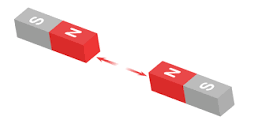
What will happen when these magnets are brought close together?
a)
They will attract each other.
b)
They will repel each other.
c)
Both magnets will turn to the left
d)
Both magnets will turn to the right
66.

Can you produce current in a wire with a magnet that is sitting still?

a)

Yes; having a magnet near a wire is enough to excite the electrons

b)

No; the magnetic field has to be changing to excite the electrons

c)

No; magnets cannot create electricity