wayground logo

Free Printable Worksheets

NEW

Font size

S
M
L
XL
Worksheets

LE Unit 4 Inheritance part 1

Total questions: 44

Worksheet time: 33mins

Name
Class
Date
1.
The twisted ladder shape of DNA is referred to as a ....
a)
Twizzler candy
b)
twisted ladder
c)
double helix
d)
yo mama
2.

What is a gene

a)

A long length of DNA that codes for a chromosome

b)

A short length of DNA that codes for a chromosome

c)

A short length of DNA that codes for a protein.
3.

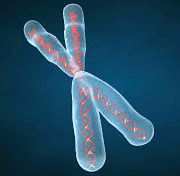
The number of human chromosomes is

a)

23

b)

46

c)

92

d)

64

4.
How are similarities passed from parent to offspring?
a)
through teaching
b)
through learning
c)
through blood
d)
through genes
5.
Which statement about DNA is true?
a)
Different people can have the same copy of DNA in their cells.
b)
DNA is made up of genes that carry hereditary information.
c)
DNA controls the genotype but not the phenotype of an organism.
d)
DNA controls the genotype only in the second and third generations.
Question
6.

Alleles that are present in a genotype but are not expressed are called

a)

recessive

b)

masked

c)

hidden

d)

dominant

7.

A __________ is the visible trait or physical appearance.

a)

Genotype

b)

Dominant

c)

Co-dominance

d)

Phenotype

8.

When the genotype has 2 identical alleles it is known as...

a)

Heterozygous

b)

Co-dominance

c)

Homozygous

d)

Recessive

9.

A ___________ is the genetic makeup or allele combination.

a)

Phenotype

b)

Gene

c)

Genotype

d)

Homozygous

10.
What genotype is missing from this Punnett Square?
a)
RrYy
b)
RRYY
c)
rryy
d)
RrYY
11.

A heterozygous organism shows a mixture of both true-breed traits in this type of inheritance pattern:

a)

incomplete dominance

b)

co-dominance

c)

complete dominance

d)

recessive pattern

12.

A heterozygous organism shows a combination of both true-breed traits in this type of inheritance pattern:

a)

complete dominance

b)

incomplete dominance

c)

co-dominance

d)

Indomitable

13.

Two or more genes control a trait in this type of inheritance pattern:

a)

Multiple Alleles

b)

Several Genes

c)

Polygenetic Traits

d)

Genotype

14.

CROSSING OVER INCREASES

a)

LIFE SPAN

b)

GENETIC VARIATION

c)

THE NUMBER OF OFF-SPRING

d)

ALL ARE TRUE

15.

WHAT TYPE OF CELLS STORE THE GENETIC INFORMATION THAT IS PASSED TO OFF-SPRING

a)

BODY CELLS

b)

MITOSIS

c)

EGG

d)

SPERM

e)

EGG AND SPERM

16.

MEIOSIS

a)

REDUCES THE NUMBER OF CHROMOSOMES BY ONE HALF

b)

PRODUCES UNIQUE SEX CELLS-1N

c)

ALLOWS TRAITS TO BE PASSED TO OFFSPRING

d)

ALL ARE TRUE

e)

INCREASE GENETIC VARIATION

17.

MEIOSIS PRODUCES 4 CELLS-THE CHROMOSOME NUMBER IS ...

a)

DIPLOID

b)

HAPLOID

18.
Which statement best describes the importance of sexual reproduction?
a)
sexual reproduction produces variation in offspring
b)
sexual reprosuction provides regeneration of body parts
c)
sexual reproduction occurs between individuals of the same species
d)
sexual reproduction produces offspring that are identical
19.
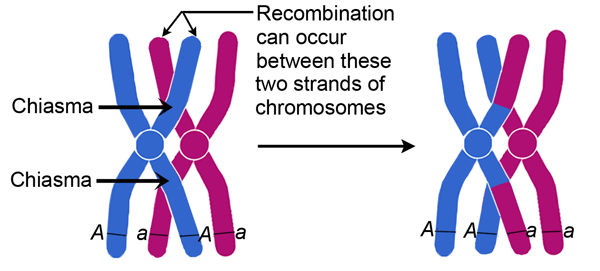
This image shows chromosomes during Prophase 1. Which of the following correctly describes the process shown?
a)
segregation of sister chromatids
b)
condensation and segregation of alleles
c)
mutationin which the DNA content of the gene is altered
d)
crossing - over in which alleles are exchanged
20.
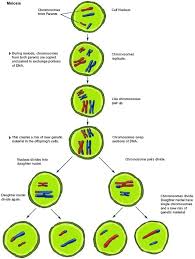
This diagram  shows which cellular process that occurs in organisms?
a)
endocytosis
b)
mitosis
c)
meiosis
d)
phagocytosis
21.
Which of the following sequences represents chromosome # during fertilization?
a)
2n-> n + n
b)
n + n -> 2n
c)
n -> n
d)
2n -> 2n
22.
Based only on the sex chromosomes in a human egg and sperm cells at fertilization, the probability of producing a female is 
a)
25%
b)
50%
c)
75% 
d)
90%
23.

Which of the following is heterozygous?

a)

MM

b)

Mm

c)

mm

24.

Which of the following is homozygous recessive?

a)

PP

b)

Pp

c)

pp

25.

If Y (yellow) is the dominant allele for pea plant seed color, which of the following would produce green seeds?

a)

yy

b)

Yy

c)

YY

d)

gg

26.
A heterozygous long-tusked elephant is crossed with a homozygous recessive short-tusked elephant. What is the probability of the offspring having short tusks?
a)
0%
b)
25%
c)
50%
d)
75%
27.
A brown-furred ewok has 12 babies with a black-furred ewok. 9 ewok babies have black fur, while 3 ewok babies have brown fur. What are the probable genotypes of the parents?
a)
BB and bb
b)
BB and Bb
c)
Bb and Bb
d)
Bb and bb
28.
What is a punnett square?
a)
graph used to predict the possible genotypes of offspring in a given cross
b)
a graph used to predict the possible birth rate of offspring.
c)
a graph used to predict the possible behavioral characteristics an offspring could have
d)
None of the above
29.
Two brown eyed parents (Bb) have a baby. What is the chance the baby is blue eyed?
a)
0 %
b)
25%
c)
50%
d)
75%
30.
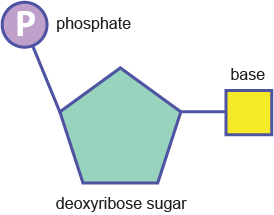
Which 2 molecules form the sides (backbone) of the DNA ladder?
a)
deoxyribose sugar and adenine
b)
deoxyribose sugar and a hydrogen bond
c)
deoxyribose sugar and the nucleus
d)
deoxyribose sugar and phosphate
31.
Nitrogenous bases are joined by which type of bond?
a)
polar bonds
b)
ionic bonds
c)
covalent bonds
d)
hydrogen bonds
32.
What are the three components of a nucleotide?
a)
sugar, hydrogen, nitrogen base
b)
sugar, oxygen, nitrogen base
c)
sugar, phosphate, nitrogen base
d)
sugar, phosphate, protein
33.
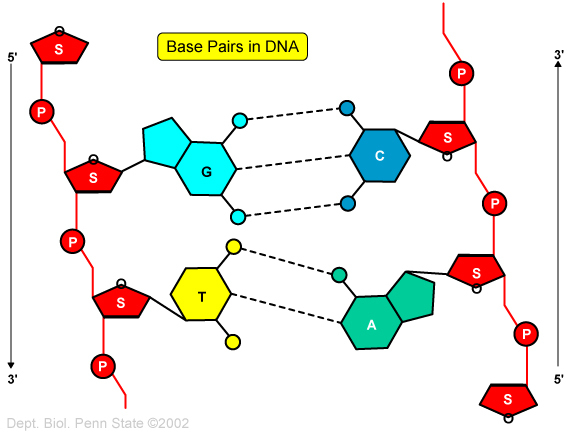
Cytosine always pairs with
a)
Adenine
b)
Thymine
c)
Uracil
d)
Guanine
34.
Nucleotides are made up of a sugar, phosphate, and..?
a)
nitrogenous base
b)
nucleic acid
c)
cholesterol
d)
fatty acid
35.
Which sequence of DNA bases would pair with this partial strand
ATG TGA CAG
a)
ATG TGA CAG
b)
TAC ACT GTC
c)
GTA AGT GAC
d)
CAT TCA CTG
36.
The enzyme that unwinds the DNA to prepare for replication
a)
helicase
b)
replicase
c)
polymerase
d)
synthase
37.
A process in which DNA has the unique ability to make an exact copy of itself.
a)
Replication
b)
Translation
c)
Transcription
38.
Which enzyme is responsible for adding nucleotides?
a)
Topoisomerase
b)
DNA Polymerase
c)
Ligase
d)
Primase
39.
The process of DNA replication is called semi conservative because it results in
a)
none of these
b)
Two DNA molecules.  One original molecule and one with two new strands
c)
two exact copies with new strands
d)
two identical molecules, each with 1 original strand and one new.
40.
Based on the diagram, how many origins of replication are represented?
a)
1
b)
2
c)
3
d)
4
41.
Why does DNA replicate?
a)
To create another copy for the new cell
b)
To create a duplicate copy in case the original gets damaged
c)
To create a new copy to replace the damaged original
42.
If the percentage of DNA is made of 30% Thymine, what is the correct percentage of Guanine?
a)
30
b)
15
c)
20
d)
60
43.
Why is DNA important?
a)
it is very small and very complicated
b)
it's in everything
c)
it serves as the blueprint for traits of all living things
d)
because we eat it every day for energy
44.
Which organelle is DNA usually found in?
a)
cell membrane
b)
vacuole
c)
chloroplast
d)
nucleus