
 Worksheets
Ionic Bonding & Naming Review
Total questions: 50
Worksheet time: 3hrs 30mins
What is the name of CuCl2?
copper (II) chloride
copper chloride
copper (I) chlorite
copper (I) chloride
copper (II) chlorite
What is the formula for cobalt (II) perchlorate
CoCl
CoCl2
CoClO2
Co(ClO4)2
Co(ClO2)4
What is the formula for aluminum hypochlorite?
AlCl3
AlClO
AlClO3
Al(ClO)3
Al3ClO
What is Ca3N2 called?
calcium nitride
calcium (II) nitride
calcium nitrogen
calcium (III) nitride
How would you say Ni3P2?
nickel (II) phosphide
nickel (III) phosphide
nickel phosphide
nickel phosphate
nickel phosphite
manganese (II) carbonate
manganese (IV) carbide
manganese carbonate
manganese (IV) carbonate
manganese (II) carbide
What is the name for VF3?
vanadium fluorate
vanadium (I) fluoride
vanadium (III) fluorite
vanadium (III) fluoride
vanadium fluoride
Strontium (II) oxide
Strontium oxygen
Strontium (I) oxide
Strontium oxide
CaCO3 is called...
calcium carbonate
calcium carbide
calcium carbonite
calcium (II) carbonate
calcium (II) carbonite
Roman numerals tell you the ____ of the _______ cation(s) in an ionic compound.
number; metal
number; nonmetal
charge; metal
charge; nonmetal
What holds an ionic compound together?
Like charges attract
Opposite charges attract
Opposite charges repel
sharing of valence electrons
What is the difference between V3+ and V5+?
V5+ has lost two LESS electrons
V5+ has lost two MORE electrons
V5+ has lost two LESS protons
V5+ has lost two MORE protons
A polyatomic ion is _________.
a groups of atoms that have a charge.
a group of atoms that are neutral.
the charged ion Pa1+
the neutral atom Pa
What is the charge of manganese in MnO3?
+1
+2
+3
+6
None of the Above
A neutral ionic compound must have ________________.
number of cations = number of anions
charge of cations = charge of anions
number and charge of cations = number and charge of anions
What rule should be followed when writing the nonmetal in an ionic compound?
Change the ending to -ide
List it second and change the ending to -ide
List it first and do not change the name
List it first and change the ending to -ide
What is wrong with the name Fluorine potasside?
The ending should NOT be -ide
The ions are written in the wrong order
Fluorine and potassium will NOT form an ionic bond
The name needs a Roman numeral
Ionic bonds form between...
a metal & nonmetal
metals only
nonmetals only
What is the name of Li2SO4?
Lithium sulfide
Lithium sulfur oxide
Lithium sulfate
Lithium sulfite
What is the charge of Fe in FeCl₂?
+1
+2
-1
-2
What is the name of the following formula: Cu3N
copper nitride
copper (III) nitride
copper (I) nitride
copper (I) nitrate
copper (III) nitrate
What is the correct formula for magnesium chlorate?
MgCl2
MgClO3
MgClO2
Mg(ClO3)2
What is the charge of Iron in FePO4?
+3
+4
+1
+2
What is the ionic compound formed between lithium and nitrogen?
LiN3
What is the correct name for NiSO3?
nickel (I) sulfite
nickel (II) sulfite
nickel (II) sulfate
nickel (I) sulfate
nickel (II) sulfide
Ionic bonds are formed by
sharing valence electrons
transferring valence electrons
sharing protons
transferring protons
An atom that has gained electrons has a ___________ charge and called a(n) _________________.
positive, anion
negative, cation
positive, cation
negative, anion
Most of the periodic table is made of ________ that form _________.
nonmetals, anions
metals, anions
metalloids, anions
nonmetals, cations
metals, cations
Which of the following would lose one electron to become stable?
calcium
fluorine
sulfur
lithium
What would be the proper formula when aluminum bonds to bromine?
AlBr
Al3Br
AlBr3
Al2Br
AlBr2
How many valence electrons does calcium have?
2
6
20
40
Which is the proper order for writing an ionic formula?
cation then anion (no changes)
cation then anion (-ide ending)
cation (-ide ending) then anion
anion then cation (no changes)
The conservation of charge states the total number of _______ by cations must equal the total number of _______ by anions.
electrons lost; electrons gained
protons lost; protons gained
electrons gained; electrons lost
protons gained; protons lost
What does the octet rule mean?
Elements are unstable when they have 8 valence electrons
Elements become stable when they have 8 valence electrons.
Elements become stable when they lose 8 valence electrons.
Elements become stable when they gain 8 valence electrons.
When are parentheses needed in an ionic formula?
If a polyatomic ion present
If more than one polyatomic ion unit is necessary to balance it.
If both the cation and anion are polyatomics.
They are always necessary.
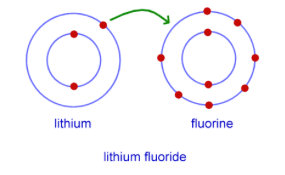
What is the charge of Fluorine after the transfer?
+10
+1
0
-1
+8

Why do we need 2 F's for every 1 Be?
Each F needs 2 electrons
Each F can only accept 1 electron
Be needs to give 1 to become stable
Be needs to accept 2 electrons to become stable.

What would be the formula for this compound?
Fe3N3
FeN
FeN3
Fe3N
None of the Above
What is the formula for tartric acid?
H2C4H4O6
HC4H4O6
HTa
H2Ta
What is the formula for arsenous acid?
H3AsO3
HAsO3
HAsO
H3AsO
HAsO
H2SO3
H2SO
H2SO4
HS2
HN3
fluorous acid
there will always be one
Write the formula for chloric acid.
HClO2
Write the formula for phosphorous acid.
HPO3
H3P
H3PO4
H3PO3
H3PO
When naming oxyacids, change "-ite" to:
-ate
-ic
-ous
-ite
When naming oxyacids, change "-ate" to:
-ate
-ic
-ous
-ite

This is an image of the giant ionic lattice representing Sodium Chloride, what is represented by the -?
Cl ion
Cl atom
Na atom
Na ion

