
 Worksheets
Rocks and Water Review
Total questions: 82
Worksheet time: 1hrs 8mins
The type of rock that forms layers and sometimes contains fossils. These are formed by deposition, compaction and cementation.
Igneous Rock
Sedimentary Rock
Metamorphic Rock


What kind of rock is formed when tiny pieces of rock and fossilized plants and animals get stuck together?
Igneous rock
Sedimentary rock
Metamorphic rock
Which is an example of Precipitation?
Snow
Air
Clouds
Trees


This rock was another type of rock that was heated and compressed over time. What type of rock is this?
Sedimentary
Igneous
Metamorphic

What is the water cycle?
The process of water changing from liquid to gas.
The three states of water.
The process of water melting.
The continuous movement of water between the air and land.
The process by which sediments move from one place to another from wind or rain is called...
Deposition
Erosion
Weathering

Hail is an example of...
Evaporation
Condensation
Precipitation
Accumulation
The type of rock formed when magma and lava cool and make mineral crystals
Igneous Rock
Metamorphic Rock
Sedimentary Rock

This rock started as molten magma but transformed after a volcano erupted. What type of rock is this?
Sedimentary
Igneous
Metamorphic

Atmosphere
Ground Water
Condensation
What process is used to form sedimentary rocks?
Lava cools and hardens to form a rock.
Weathering, Erosion, Deposition, Compaction, Cementation
Extreme heat and pressure from inside the Earth turn rocks into new rocks.
Magma trapped under the Earth's surface cools and solidifies.
When natural forces move weathered rock and soil from one place to another.
Compaction
Deposition
Erosion
This rock was formed when magma cooled very slowly inside the Earth. What specific type of rock is it?
Intrusive Igneous Rock
Extrusive Igneous Rock
Foliated Metamorphic Rock
Clastic Sedimentary Rock


The picture shows...
Evaporation
Condensation
Precipitation
Accumulation
What do you think is the energy source for the water cycle?
The sun
The stars
Your teacher
The moon
The three groups of rocks are classified by
How they form
Color
Grain size
Chemical Composition

Water getting into cracks of rocks then freezing and breaking the rock apart is an example of _________.
weathering
erosion
deposition

The process of turning from a liquid into vapor.
Precipitation
Evaporation
Condensation
Collection

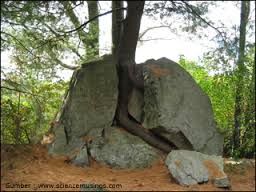
This rock should be classified as
hard rock
igneous rock
metamorphic rock
sedimentary rock


the process by which a substance changes from a gaseous state to a liquid state.
Condensation
Collection
Precipitation
Evaporation
A type of change that describes the breaking down or dissolving of rocks or minerals.
Erosion
Deposition
Weathering
This rock was found near the mouth of a volcano. What type of rock is this?
Sedimentary
Extrusive Igneous
Metamorphic


According to the diagram, how does magma become an igneous rock?
Melting
Cooling
Heat and Pressure
Compaction and Cementation

What happens during condensation?
Water falls down as rain, sleet, hail, or snow.
Water vapor turns into water droplets and forms clouds.
Water gets warm and changes from liquid water to water vapor.
Water flows back into oceans, rivers, and lakes.

Rain, sleet, hail, and snow are examples of...
Evaporation
Condensation
Precipitation
Accumulation


What causes water to evaporate?
The moon
The clouds
The sun
What is deposition?
Dropping off sediment
Movement of sediment
Breaking down of sediment
What has to increase for metamorphism to occur?
weathering and erosion
temperature and pressure
melting and cooling
compaction ad cementation
A series of processes by which rocks are transformed from one type to another.
Rock Cycle
Water Cycle
Nitrogen Cycle
Which of the following IS NOT true about groundwater?
Groundwater is the largest freshwater source on Earth.
Groundwater is freshwater beneath Earth’s surface.
Groundwater is the largest liquid freshwater source for humans.
Groundwater can maintain streamflow during times of drought.
The top of an aquifer is known as:
the water table.
an artesian well.
the hydraulic gradient.
a geyser.
What does the quantity of groundwater that can be stored depend upon?
It depends upon the porosity of the underground rock.
It depends upon the pH of the groundwater.
It depends upon the underground depth of the storage system.
It depends upon the temperature of the underground rock.
What is the source of heat for hot springs?
It is provided by the cooling of igneous rock.
It is provided by the transformation of metamorphic rock to sedimentary rock.
It is provided by the warming process of soil moisture.
It is provided by plate subduction at convergent boundaries.
Which of the following depicts an artesian well?


According to the Karst map, in which of the following states would sinkholes be extremely rare?
North Dakota
Texas
Florida
Missouri

Fertilizer can seep through the ground to reach groundwater, what effect can it have?
Fertilizer can cause groundwater to reverse flow
Fertilizer can cause groundwater to freeze
Fertilizer can cause groundwater to become undrinkable
It will seep into the school

Sunken land surface due to underlying compression of earth material as a result of the removal of groundwater is
subsidence
point source water pollution
groundwater
Dotties water bowl

When water flows across the surface of the earth it is called?
Watershed
River
Run Off
Rain
All of the water in the ground is not fresh water. Much of the deep groundwater and water below oceans is _?_
saline
solid
frozen
fresh
Pressure from within an aquifer can naturally force water up and out of the ground. This is called a flowing ? well.
pressurized
stagnant
aquifer
artesian
The process by which groundwater is replenished and can occur naturally through infiltration is called - groundwater ? .
recharge
renergize
discharge
expulsion

In the diagram, letter A best represents:
Runoff
Watershed
Water Table
Confining Layer

Which of the layers is composed of impermeable material?
Layer B: the unconfined aquifer
Layer C: the unconfined aquifer
Layer C: the confining layer
Layer D: the unconfined aquifer

Out of all the water on Earth, how much is freshwater?
100%
70%
30%
3%

What type of glacier covers huge areas of land?
alpine
continental
till
moraine

What type of glacier forms in a mountainous area?
Alpine
continental
till
moraine

unsorted rock material deposited directly by ice as it melts
glacial drift
stratified drift
till
glacier

which type of moraine forms along each side of a glacier?
medial moraine
lateral moraine
ground moraine
terminal moraine
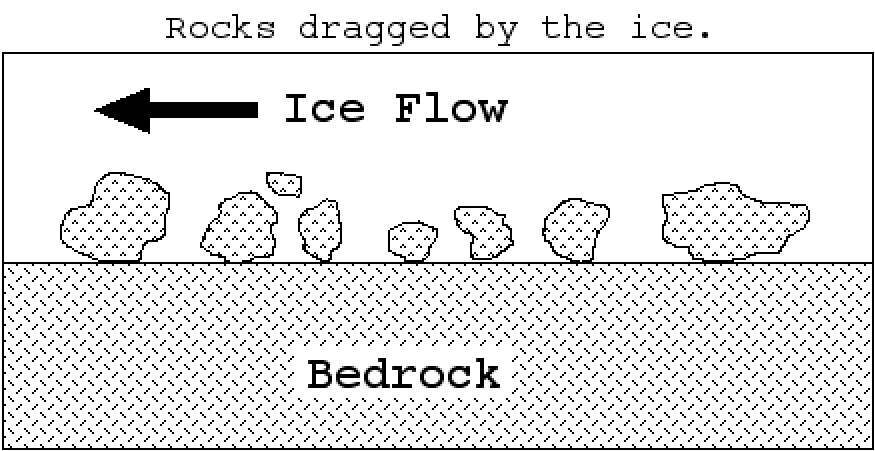
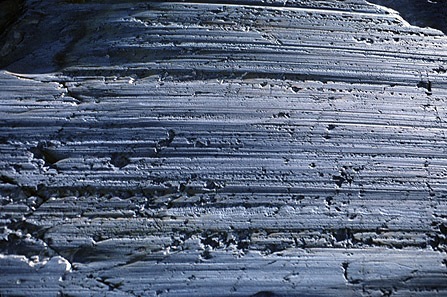
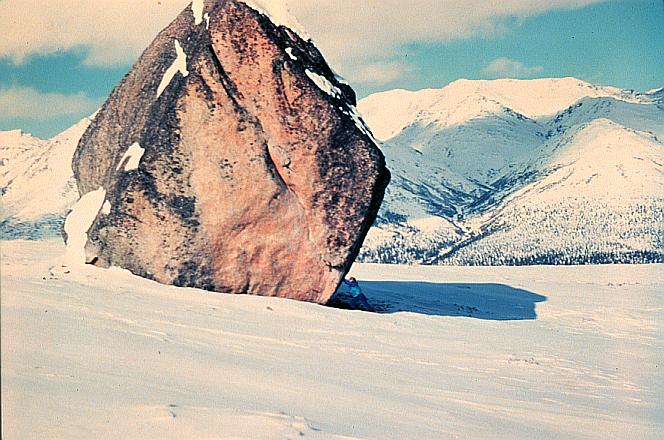

The cross sections show a three-stage sequence in the development of a glacial feature. Which glacial feature has formed by the end of stage 3?
kettle lake
finger lake
drumlin
parallel scratches

The diagram represents a stream valley. Which diagram below best shows how this valley might be modified after a glacier has moved through it?





All rivers flow...
down hill
south except a few
south in the Northern Hemisphere
north in the Southern Hemisphere

A satellite image of an area in Ohio shows a river with slight bends along its length. A second satellite image taken of the same area 10 years later shows the same river with a different course. What is the best explanation for the difference in the shape of the river's course between the two satellite images?
Wind blew waves across the water surface, eroding away the bank on one side of the river until the river's course changed its shape
Regular freezing and thawing of the river split the soil along the river banks, changing the shape of the river
Water eroded the banks of the river and deposited the eroded soil on opposite banks, causing the river to form tighter bends
Acid rain chemically weathered the banks along the river, forcing the river to wind back and forth

Which particles will be transported by a stream moving at a velocity (speed) of 5 cm/s?
pebbles, sand, silt, and clay, only
sand, silt, and clay, only
silt and clay, only
clay, only
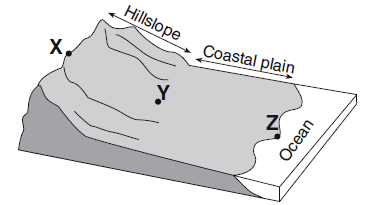
Compared to the stream speed between point X and point Y, the stream speed between point Y and point Z is most likely
greater, since the slope of the land decreases
greater, since the slope of the land increases
less, since the slope of the land decreases
less, since the slope of the land increases

Erosion is most likely greatest at locations
A and B
B and C
C and D
D and A
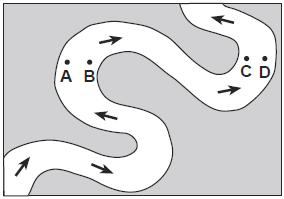
Which two locations have the fastest water flow?
A and B
B and C
C and D
D and A

What is the name of the largest sediment that can be transported by a stream moving at a velocity of 100 centimeters per second (cm/s)?
silt
sand
pebbles
cobbles

At which point does the greatest stream erosion occur?
A
B
C
D

The process in which sediment settles out (drops to the bottom) of the water or wind that is carrying it
Weathering
Erosion
Sedimentation
Deposition

The accompanying cross section illustrates the general sorting of sediment by a river as it flows from a mountain to a plain. Which factor most likely caused the sediment to be sorted in the pattern shown?
velocity (speed) of the river water
hardness of surface bedrock
the eroding agent (wind, water, or glacier)
temperature of the water
What do we call the volume of water that flows past a given point in a certain time period?
Oxbow
Discharge
Gradient/slope
Meander
What do we call a bend or curve in a slow-moving river?
Meander
Tributary
Discharge
Slope
Which erodes/breaks down more rock:
A fast-moving stream
A slow-moving stream

