
 Worksheets
Pre-Cal. 4.1 Quiz
Total questions: 25
Worksheet time: 2hrs 5mins

Which of the following represents the correct transformation of 4^x
Reflection about the x-axis
Reflection about the y-axis
Horizontal Shift
Vertical shift

Which of the following represents the correct transformation of 5^x
Reflection about the x-axis
Reflection about the y-axis
Horizontal Shift
Vertical shift

Which of the following shows the correct transformation of the graph 5^x. Select all that apply.
Reflection about the x-axis
Reflection about the y-axis
Vertical Shift upward by 10
Vertical shift to downward by 10
Horizontal shift to the right by 10

Which of the following shows the correct transformation of the graph 2^x. Select all that apply.
Reflection about the x-axis
Reflection about the y-axis
Vertical Shift upward by 4
Vertical shift downward by 4
Horizontal shift to the right by 9

Which of the following shows the correct transformation of the graph 2^x. Select all that apply.
Reflection about the x-axis
Reflection about the y-axis
Horizontal Shift to the left by 9
Vertical shift downward by 4
Horizontal shift to the right by 9

Which of the following is not correct about the transformation of the graph 2^x
Reflection about the x-axis
Reflection about the y-axis
Horizontal Shift to the left by 9
Vertical shift downward by 6
Horizontal shift to the right by 9
What is the parent function of f(x)=2(1/2)x-7
f(x)=2
f(x)=(1/2)
f(x)=2x
f(x)=(1/2)x
What is the transformation of f(x)=2(1/2)x-7
stretch by 2
down 7
shrink by 1/2
down 7
stretch by 2
up 7
shrink by 1/2
up 7
What is the parent function of f(x)=-1/3(2)x+3
f(x)=1/3
f(x)=2
f(x)=2x
f(x)=(1/3)x
What is the transformation of f(x)=-1/3(2)x+3
reflect
shrink by 1/3
up 3
shrink by 1/3
up 3
reflect
stretch by 2
up 3
stretch by 2
up 3
What is the transformation of f(x)=(1/2)x+4-3
stretch
left 4
down 3
left 4
down 3
right 4
up 3
stretch
right 4
down 3
What is the transformation of f(x)=(3)x-2+1
left 2
down 1
left 2
up 1
right 2
down 1
right 2
up 1
What is the transformation of f(x)=-3(4)x-2-5
reflect, stretch
right 2, down 5
stretch
right 2
down 5
reflect, shrink
left 2, down 5
shrink
left 2
down 5

What is the domain of the exponential function?
all real numbers
y > -1
y < -1
x > -1
What is the range of the exponential function?
all real numbers
y > -1
y < -1
x > -1
What is the horizontal asymptote of the exponential function?
y = 0
y = -1
x = 0
x = -1

What is the domain of the exponential function?
all real numbers
y > 3
y < 3
x > 3
What is the range of the exponential function?
all real numbers
y > 3
y < 3
x > 3

What is the domain of the exponential function?
all real numbers
y > -3
y < -3
x > -3
What is the range of the exponential function?
all real numbers
y > -3
y < -3
x > -3
What is the horizontal asymptote of the exponential function?
y = 0
y = -3
x = 0
x = -3
Which of the following is NOT a true statement?
The horizontal asymptote is a line the graphs get close to but never touches or cross.
The domain of exponential functions is all real numbers.
The range of exponential functions is ALWAYS greater than the horizontal asymptote.
If the graph reflects over x-axis, the range of exponential functions is less than the horizontal asymptote.
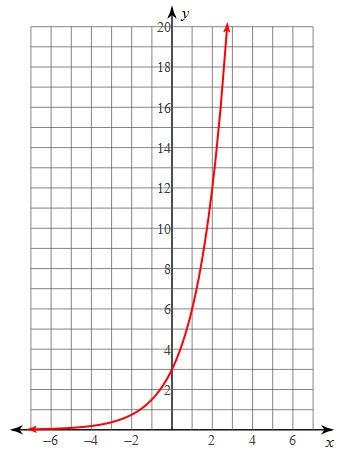
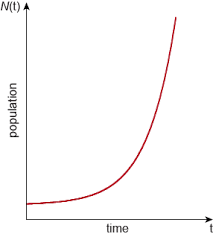

Which represents exponential decay?
A
B
C
D

