
 Worksheets
H DNA Replication and Protein Synthesis Review
Total questions: 56
Worksheet time: 28mins

Which letter in the picture below depicts the leading strand in DNA replication?
A
C
B
None of the above
Which letter in the picture below depicts the lagging strand in DNA replication?
A
C
B
None of the above
DNA replication runs from ______' to _____' and is said to be ______________________
5, 3, antiparallel
3, 5, antiparallel
5, 3, parallel
3, 5, parallel
This enzyme is capable of breaking Hydrogen bonds found between the bases of DNA
Ligase
DNA Helicase
DNA Polymerase
Primase
Which enzyme seals okazaki fragments together on the lagging strand?
RNAse H
Helicase
Polymerase
Ligase
Which enzyme is responsible for adding DNA nucleotides during DNA replication?
Topoisomerase
DNA Polymerase
Ligase
Primase
This enzyme synthesizes short RNA sequences to guide DNA Polymerase
Primers
Primase
DNA Polymerase
RNAse H
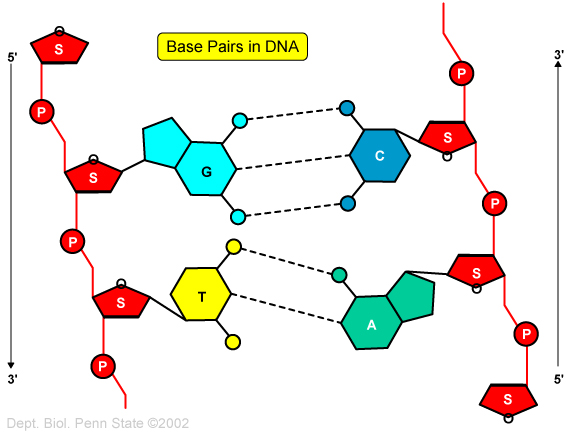

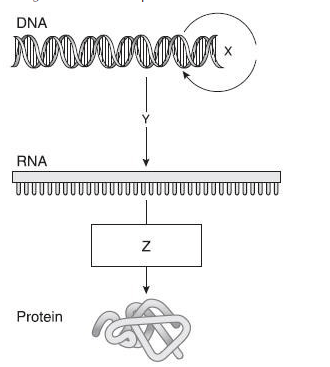

The 3' end of DNA is marked by a(n)
Phosphate Group
Hydroxyl Group
Carboxyl Group
Carbonyl Group
What type of bond connects the phosphates and the sugars of nucleic acid backbones?
phosphate
ionic
covalent
hydrogen
di-sulfide


During DNA replication, the enzyme DNA polymerase is only able to add new nucleotides onto the ________ end of the DNA daughter strand.
3'
5'
leading
lagging
Carbohydrates have the elements C,H,O
Lipids have the elements C,H,O
Proteins have the elements C,H,O,N
What elements are found in Nucleic Acids?
CHONP
CHON
CHO
CHONPS

The letter I is the
leading strand
lagging strand
RNA daughter strand
discontinuous strand

Replication is occurring AWAY FROM the replication fork on strand
I, the leading strand
I, the lagging strand
H, the leading strand
H, the lagging strand
DNA strand has the following bases AAGCCA what are the bases on the complementary strand
GGCTTA
TTGGGA
CCAGGT
TTCGGT
T/F: DNA polymerase is an enzyme that assists with hydrolysis reactions
false
true

The transfer of genetic info from DNA to RNA is called
translation
transcription
initiation
elongation
Translation consists of which of the following?
conversion of genetic info from the language of nucleic acids to the language of proteins
conversion of genetic info from DNA to RNA
addition of nucleotides to a DNA template
DNA replication
How many codons are in the following mRNA sequence?
UUAAACGGUCCGGAA
1
3
4
5
6
How many amino acids will be created from the following mRNA sequence?
UUAAACGGUCCGGAA
1
3
5
6
Which of the following enzymes catalyzes the linking together of RNA nucleotides to form RNA?
DNA Polymerase
RNA Polymerase
DNA Primase
RNAse H
What is the first step in the transcription of DNA into mRNA?
RNA Polymerase binds to the promoter region on the template DNA strand.
RNA Polymerase adds nucleotides to the mRNA to create matching base pairs.
RNA Polymerase breaks the DNA strand so that it exists as a short segment corresponding to the length of an mRNA.
RNA Polymerase breaks in half and each half binds to a different strand of DNA
Which is the best description of initiation?
its when new nucleotides are added to the RNA
its when the RNA Polymerase and RNA molecule detach
Its when the RNA Polymerase attaches to the DNA to start transcription
Its when the DNA Polymerase attaches to the DNA to start transcription
Which is the best description of elongation?
its when new nucleotides are added to the RNA
its when the RNA Polymerase and RNA molecule detach
Its when the RNA Polymerase attaches to the DNA to start transcription
Its when the DNA Polymerase attaches to the DNA to start transcription
Which is the best description of termination?
its when new nucleotides are added to the RNA
its when the RNA Polymerase and RNA molecule detach
Its when the RNA Polymerase attaches to the DNA to start transcription
Its when the DNA Polymerase attaches to the DNA to start transcription
What is the name given to the sequence of nucleotides in DNA that signals the end of a gene and therefore the end of transcription?
terminator sequence
stop codon
transfer sequence
RNA stopase
Where does transcription take place?
nucleus
cytoplasm
ribosome
golgi body
Where does translation take place?
nucleus
cytoplasm
lysosome
golgi body


What is the function of the poly-A tail and 5' cap in mRNA?
to add modified guanine to the 3' end of the mRNA
to indicate the site of translational termination
to code for the binding of RNA polymerase to the DNA
to help protect the mRNA from degradation by enzymes
What is the anticodon on the tRNA that binds to the mRNA codon for the DNA sequence AAA?
TTT
UUU
UUA
AAA


5'-AUG-UCU-UCG-UUA-UCC-UUG-3'
T-G-A-C-C-A
T-G-A-G-C-A

What type of mutation is shown in the diagram?
Point mutation - missense
Frameshift Mutation - deletion
Frameshift Mutation - addition
Point mutation - nonsense
Small segments of RNA that transport amino acids to the ribosomes for the polypeptide chain
tRNA
rRNA
mRNA
siRNA
Which of the following is NOT directly necessary for translation to occur?
tRNA
ribosome
DNA template
mRNA
Which of the following is NOT directly necessary for transcription to occur?
promoter
RNA polymerase
DNA template
ribosome
What signals the end of a polypeptide chain during translation?
a stop codon
the terminator sequence
a splicing enzyme
the finishing protein
What type of Mutation is this to the sentence "THE CAT WAS FUN":
THE BAT WAS FUN
Substitution Mutation
Deletion Mutation
Insertion Mutation
AGA-TTC-ATA-GCG
Mutant-
AGA-TTC-AAT-AGC-G

