
 Worksheets
Ecology Parts 3&4_old curriculum
Total questions: 69
Worksheet time: 53mins
Which factor promotes competition between organisms in an ecosystem?
cycling of minerals
limited resources
decomposition of organic matter
presence of saprophytes
Two closely related species of birds live in the same tree. Species A feeds on ants and termites, while Species B feeds on caterpillars. The two species coexist successfully because
each occupies a different niche
they interbreed
they use different methods of reproduction
birds compete for food
When an animal consumes plant matter the relationship is
Herbivory
Predation
Prey
Hunting
Interspecific relationships
Those among the same species
Those among different species
A sea cucumber is an animal that lives in the ocean. An imperial shrimp will ride on the back of the sea cucumber as a way of easy travel through the ocean. The sea cucumber is not helped or harmed. Which type of relationship do these animals have?
Commensalism
Parasitism
Predation
Mutualism
Ostriches and gazelles are two animals that live in Africa. They graze for food near each other because they help each other spot predators. The gazelle has excellent eyesight, but poor hearing, and the ostrich has excellent hearing, but poor eyesight. These two animals will alert one another when danger is near. Which term best describes this relationship?
Predation
Commensalism
Mutualism
Parasitism
A person eats undercooked meat from an animal infected with tapeworms. The tapeworm then lives in the person’s intestines and absorbs important nutrients that the person needs. This tapeworm causes harm to the person. Which type of relationship is described?
Predation
Commensalism
Parasitism
Mutualism
Barnacles are sea creatures that create a home by attaching themselves to whales. The whales are unaffected by the barnacles. Which term best describes this symbiotic relationship?
Commensalism
Parasitism
Predation
Mutualism
A cuckoo and a warbler are both birds. A cuckoo will find the nest of warbler instead of building her own, and she harms the warbler by knocking a warbler egg out of nest and laying her own. When the warbler mother returns, she isn’t aware of the switch. The warbler will then raise the baby cuckoo bird instead of her own baby. Which term best describes this relationship?
Predation
Parasitism
Commensalism
Mutualism
In which relationship do organisms kill and eat other organisms to obtain energy and nutrients?
Predation
Commensalism
Mutualism
Parasitism
Both cheetahs and lions hunt for gazelle on the African Savannah. The type of relationship between the lion and cheetah is...
Parasitism
Commensalism
Competition
Mutualism

What are some examples of cryptic coloration to avoid detection?
STICK INSECTS
LEAF INSECTS
SNOWSHOE HARES
ALL OF THE ABOVE

Some butterflies have spots on their wings that look like snake eyes. This is called
warning coloration
Instinct
Learned Behavior
mimicry
cryptic coloration

Poison dart frogs are brightly colored. What would you call this defense mechanism?
warning coloration
mimic coloration
deceptive coloration
cryptic coloration

This frog is hard for predators to spot. What defensive mechanism does it have?
warnning coloration
Escape mechanism
Defensive armor
Cryptic coloration

What type of camouflage is the octopus exhibiting?
mimicry
cryptic coloration
warning coloration
self-decoration

Animals that are heavily relied upon to prevent collapse of an ecosystem are known as
apex predators
detritivores
producers
keystone species
An organism that gets its energy by feeding on producers in the food chain
Primary Consumer
Tertiary Consumer
Organism
Secondary Consumer
When two or more individuals or population attempt to obtain a single resource
Competitive Exclusion
Environmental Interactions
Ecosystem
Limited Resources
In the woods, there are hawks and robins. They both try to occupy the same niche by competing for worms as the only source of food in that same area at that same time. The hawks outcompete the robins, and the robins are forced to leave that area. This is an example of:
Mutualism
The competitive exclusion principle
Commensalism
Neutralism

What is this picture describing?
It is describing how two organisms cannot occupy the same niche in the same place at the same time through the competitive exclusion principle.
It is illustrating the intercompetitive inclusion principle.
It is describing the amount of time it takes for bacteria to reach exponential growth.
It is illustrating the mutualistic relationship between two organisms when they live in the same niche.

This photo is showing the same ecosystem in 2 scenarios: one with the sea otter and one without the sea otter. In the ecosystem without the sea otter, the ecosystem dynamics are completely changed. What term best describes the sea otter?
Niche
Climax community
Pioneer species
Keystone species
T/F: Biodiversity is a good thing because it provides variety in an ecosystem.
True
False


Position that an organism occupies based on what it eats
Producer
Trophic level
Heterotroph
Consumer
Eats dead organisms and returns nutrients to soil
Autotroph
Decomposer
Biomass
Carnivore
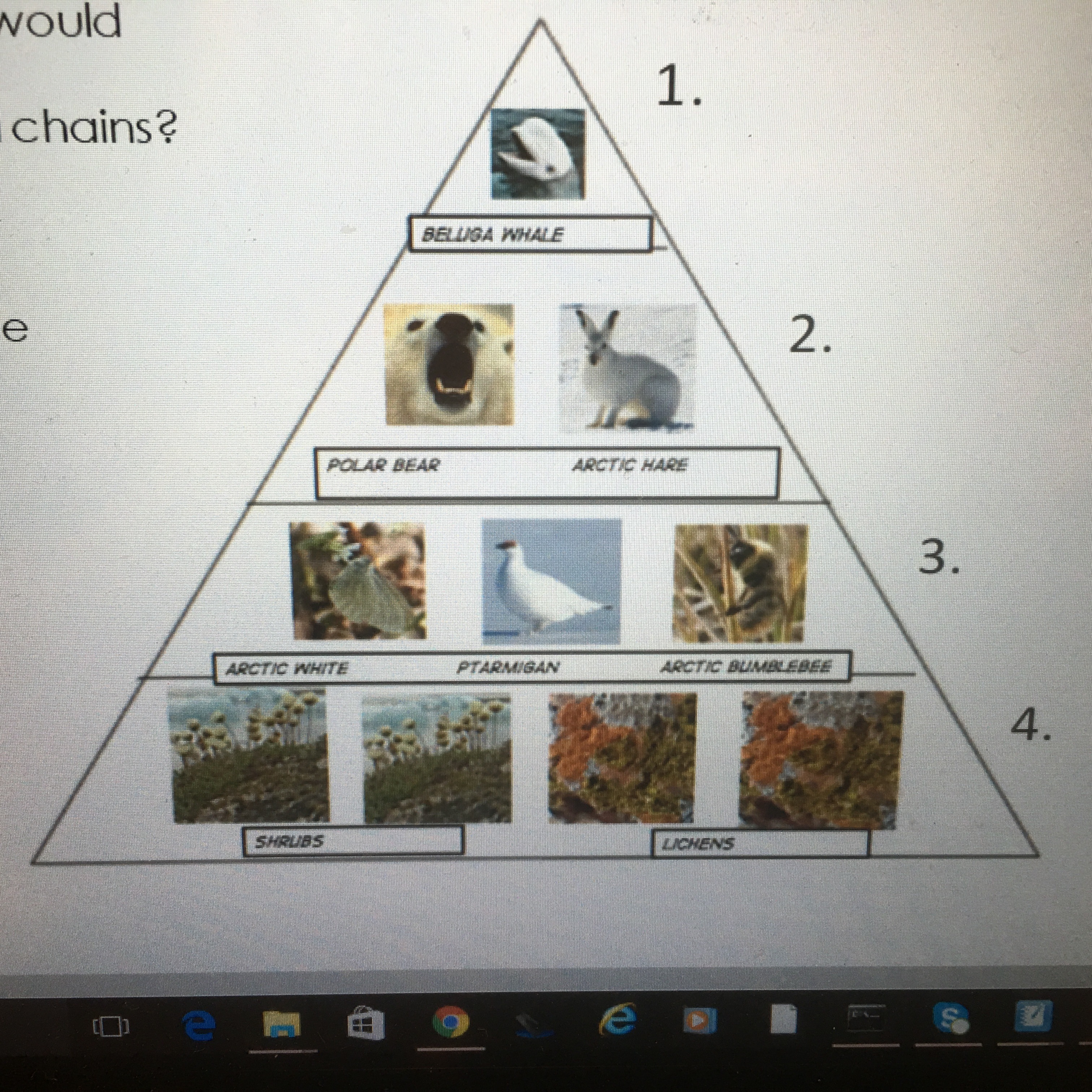
Which organisms eat only producers?
Secondary Consumers
Apex Predators
Tertiary Consumers
Primary Consumers
Which level is found at the top?
Primary Consumers
Tertiary Consumers
Producers
Secondary Consumers
What does an energy pyramid show?
Energy flow in a community
Longest lifespans
The stronger animal the higher it is on the pyramid
What would happen if the primary consumers died out?
the producers would grow and the secondary and tertiary consumers would die
producers would die out
consumers would grow

On average, what amount of percentage does the energy decrease as it goes up the pyramid?
100%
1000%
10%
1%
Can heterotrophs make their own food?
Yes
No


The diagram represents different levels of a marine food pyramid. Between which two levels is the greatest amount of energy transferred
R and Q
S and R
T and S
U and T



In the food web pictured here, flies provide energy for...
Dragonflies, Turtles, & Frogs
Slugs & Fish
Water Weeds & Algae
Snakes, Frogs, & Kingfishers
What limits the length of a food chain in an ecosystem?
The size of the individual organisms
Competition between organisms
The loss of energy between trophic levels
Natural selection

Which category of organisms is correctly described in this table?
A
B
C
D

The diagram represents a pyramid of energy. What level does the letter X represent?
Light
Primary consumers
Abiotic environment
Producers
What is lost between trophic levels and cannot be recycled?
Heat
Nitrogen
Carbon compounds
Biomass
The measure of an animal's efficiency in converting feed mass into the desired output is called
the food conversion ratio.
the movement restriction calculation.
the mass output solution.
the commercial dairy standard.
The unit for energy in an energy pyramid is
kJ m-1 y
kJ m-2 y-1
kJ-1 m-1 y-2
kJ m-1 y-2
How is energy lost between trophic levels?
excretion.
lost as heat from respiration.
not being ingested.
all of the above.

If the grasshopper were to be removed completely from the food web, what organism would be most affected?
The squirrel
The shrew
The deer
The rabbit

In an experiment on the transfer of biomass from one trophic level to the next, some ecologists discovered that as much as 93% of biomass was transferred to the next trophic level. What is the likely effect of this discovery on the food chain involving these parasitic wasps?
The energy pyramid will be inverted
The food chain will be more stable.
The food chain will become a food web
The food chain will be longer.

The diagram shows the food web for an aquatic ecosystem in which letters R–Z represent individual species.
Which organism is a tertiary consumer?
T
U
W
Y
A food _______ consists of many overlapping food ________.
web, chains
chain, webs
pyramid, webs
web, pyramids
The diagram represents a pyramid of energy. The level labeled X has 400 kJ/m2/yr2 of energy, and the level above it has 35 kJ/m2/yr2. If when you drew this, you drew level X to be 14 cm long, how long would the 2nd level need to be?
1.22 cm
1.4 cm
2 cm
10 cm
4 cm

