
 Worksheets
Module 7 Review (GA)
Total questions: 60
Worksheet time: 3600secs

Which part of an atom forms a bonds with other atoms?
protons
neutrons
valence electrons
Check all the boxes that describe a proton.
in the nucleus
outside the nucleus
positive charge
no charge
negative charge
Check all the boxes that describe a neutron.
in the nucleus
outside the nucleus
positive charge
no charge
negative charge
Check all the boxes that describe an electron.
in the nucleus
outside the nucleus
positive charge
no charge
negative charge

Atomic # is the number of
protons
neutrons
electrons
This determines what the element is.
protons
neutrons
electrons

What do you add together to get the atomic mass?
protons
neutrons
electrons

Isotopes are elements that have the same number of protons, but different # of ____________
neutrons
electrons
electron shells

Vertical columns on the periodic table are
groups
periods

Horizontal rows on the periodic table are
groups
periods

They have the same number of electron shells
groups
periods

They have the same number of valence electrons
groups
periods
They have similar chemical properties
groups
periods
Which particles make up the nucleus of an atom?
protons and neutrons
protons and electrons
electrons and neutrons

For a given element, the atomic number indicates the number of _____
protons
neutron
electrons

What is the mass number and atomic number ?
Mass number = 7, atomic number = 14
Mass number = 14, atomic number = 7
What are valence electrons?
# of electrons in the nucleus
# of electrons on the inner shell
# of electrons on the outer shell

How many protons are in this element?
79
197
118
How many neutrons are in this element?
79
197
118
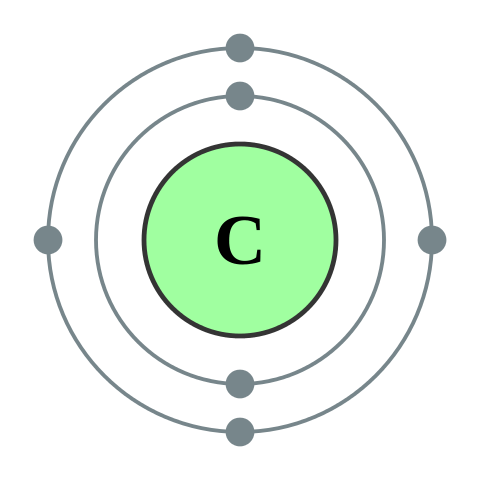
This element has ________ valence electrons & _______ electron shells.
4, 2
2. 4

Which two elements have properties in common?
Nitrogen and Phosphorous
Nitrogen and Oxygen

Which elements have 3 electron shells?
Group 3
Period 3
Group 13

Which elements have 4 valence electrons?
Period 4
Group 4
Group 14

Use the Periodic Table
How many electron shells does Neon (Ne) have?
1
2
3
4
If an atom is neutral, then the # of protons = the # of ______
electrons
neutrons
The modern periodic table of elements is arranged by
Number of neutrons
Atomic Mass
Atomic number
Silicon is a semiconductor and has properties of both metals and nonmetals. What type of element is Silicon?
Metal
Nonmetal
Metalloid

Look at the periodic table that is provided. Where would metals be located?
to the left of the table
to the right of the table
in the zigzag line


The only nonmetal on the left side of the periodic table.
Oxygen
Calcium
Hydrogen
Elements that are normally in a gas form, that are dull, brittle, poor conductors of heat & electricity, & have low melting points
Metals
Nonmetals
Metalloids
Usually solid elements that are good conductors of heat & electricity, shiny, & high melting points.
Metals
Nonmetals
Metalloids
As ____ evolved, they changed Earth’s atmosphere by producing oxygen.
photosynthetic bacteria
fish
trilobites

What fossil is the oldest?
d
b
a

Which is true?
Fossil A and C are the same age
Fossil B is older than fossil C
Fossil D is older than fossil C
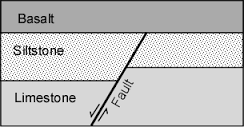
What are the relative ages of the features in order from oldest to youngest?
Limestone, Siltstone, Basalt, Fault
Limestone, Siltstone, Fault, Basalt

An intrusion is always ___________ than the rock layers to the sides of it and under it.
younger
older
The Precambrian includes the formation of Earth in space & accounts for ___% of Earth's History.
10%
25%
50%
87%

Scientists chose where units of geologic time began and ended based on major changes in lifeforms & landforms.
True
False

Which of the following correctly lists the layers in order from oldest to youngest?
E, C, B
E, B, C,
A, D, C

Which layer is OLDER? Fault E or Intrusion D?
Fault E
Intrusion D

Is the rock layer with the trilobite fossils older or younger than the rock layers with the dinosaurs fossils?
older
younger
the same age

Which is true?
Layer 10 is the oldest layer.
Layer 2 and layer 7 are the same relative age.
Layer 2 and layer 9 are the same relative age.

An igneous rock that forms below the Earth's surface is called an __________
intrusion
extrusion

An igneous rock that forms on Earth's surface is known as
an extrusion
an intrusion

Which feature of this rock strata is the youngest?
B
D
A
E

Trilobites can be used to study the passage of geologic time because:
they burrow into sediments
their physical features changed through time
they lived in the oceans

During which geologic time or era did humans first appear?
Cenozoic
Mesozoic
Paleozoic
Precambrian

Which of the following organisms formed last on Earth?
Trilobites
Dinosaurs
Fish
Mammals

Which fossil makes the best index fossil?
Fossil 1
Fossil 2
Fossil 3

What is the best reason that fossil #4 is NOT a good index fossil?
It is not widespread
it is not short-lived (in numerous layers)
It is in half of the outcrops
How many grams are left after 1 half life?
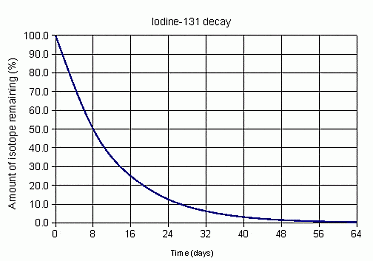

Which diagram best represents the percentage of this radioactive isotope sample that will remain after 2 half-lives?


The % of the parent isotope remaining after 1 Half Life.
50%
25%
12.5%
6.25%
Which two statements describe absolute age?
found using radioactive isotopes in igneous rock
age in years
describes if something is older or younger
found by comparing index fossils and/or which layer is lower
The length of time required for half of the radioactive atoms in a sample to decay is its...
era
eon
half-life
Which two statements describe relative age?
found using radioactive isotopes in igneous rock
age in years
describes if something is older or younger
found by comparing index fossils and/or which layer is lower

