wayground logo

Free Printable Worksheets

Font size

S
M
L
XL
Worksheets

Nervous System Review 1

Total questions: 75

Worksheet time: 56mins

Name
Class
Date
1.

Which of the following is a function of neurotransmitters?

a)

open potassium channels

b)

relay messages across the synapse

c)

open calcium channels

d)

open sodium channels on the next neuron

2.

Which part of the neuron receives information?

a)

soma

b)

dendrite

c)

axon

d)

nucleus

3.

What represents the resting potential

a)

1 and 6

b)

2 and 3

c)

3 and 4

d)

4 and 5

4.

What is the space between neurons called?

a)

neurotransmitter space

b)

soma

c)

cell body

d)

synapse

5.

Which human body system is responsible for detecting, processing, and responding to stimuli?

a)

Circulatory

b)

Nervous

c)

Immune

d)

Skeletal

6.

Anything that causes a response is called a ____________?

a)

homeostasis

b)

reflex

c)

stimulus

d)

organ system

7.

The nervous system has two main divisions: the central and the peripheral nervous systems. Check all of the parts of the CNS.

a)

Brain

b)

Nerves

c)

Spinal Cord

8.

Our spinal cord is protected by the vertebrate of our backbone. What two systems are interacting?

a)

Nervous and Muscular

b)

Nervous and Endocrine

c)

Nervous and Respiratory

d)

Nervous and Skeletal

9.

Which of the following represents an involuntary action?

a)

Walking

b)

Talking

c)

Chewing

d)

Digesting food

10.

Thinking, memory, and emotions happen here.

a)

cerebellum

b)

cerebrum

c)

medulla

d)

neuron

11.

Which part of the brain is labeled 4?

a)

cerebrum

b)

cerebellum

c)

brain stem

d)

spinal cord

12.

Which part of the brain is labeled 1?

a)

cerebrum

b)

cerebellum

c)

brain stem

d)

spinal cord

13.

Which part of the brain is labeled 5?

a)

cerebrum

b)

cerebellum

c)

brain stem

d)

spinal cord

14.
What is the purpose of the myelin sheath on the axon?
a)
To maintain temperature
b)
To improve conductivity
c)
To protect the axon
d)
To release neurotransmitters
15.
Sensory neurons carry nerve impulses from the sense organs and internal organs (like your stomach) to the
a)
peripheral nervous system (PNS)
b)
central nervous system (CNS)
c)
muscles
d)
sense organs
16.
What is NOT part of the peripheral nervous system (PNS)?
a)
axons
b)
sensory receptors
c)
spinal cord
d)
motor neurons
17.
a signal molecule that transmits nerve impulses across synapses
a)
neuron
b)
neurotransmitter
c)
nerve
d)
action potential
18.
The part of the neuron that takes information away from the cell body is called a(n) _____________.
a)
dendrite
b)
axon
c)
cell body
d)
Schwann cell
19.
Label the Neuron-What does the letter "H" represent?
a)
Myelin Sheath
b)
Axon
c)
Axon Terminal
d)
Dendrite
20.
Label the Neuron-What does the letter "F" represent?
a)
Myelin Sheath
b)
Axon
c)
Axon Terminal
d)
Dendrite
21.
Label the Neuron-What does the letter "C" represent?
a)
Dendrite
b)
Axon
c)
Axon Terminal
d)
Cell Body
22.
Label the Neuron-What does the letter "A" represent?
a)
Dendrite
b)
Axon
c)
Myelin Sheath
d)
Node of Ranvier
23.
The long, fiber like part of a neuron which the cell sends information to receiving neurons
a)
axon 
b)
dendrite
c)
axon terminal
d)
gene
24.

Which statement best describes a reflex arc?

a)

Slow response that you have to think about

b)

Rapid response to protect body from harm

25.

Where would the nerve impulse start in this reflex arc?

a)

A

b)

C

c)

D

d)

E

26.

_____ neurons carry messages away from the central nervous system and out to muscles or glands. The RED neuron in diagram.

a)

sensory

b)

motor

c)

inter

d)

central

27.

Which way does an impulse travel

a)

From dendrite to axon and out axon terminal

b)

From axon to axon and out dendrite terminal

c)

From axon to dendrite and out axon terminal

d)

From cell body to dendrite and out axon terminal

28.
What is "stimuli"?
a)
A major organ in the brain that is a part of the nervous system. 
b)
What your body does to a change or a signal. 
c)
A change or a signal your body receives. 
29.
A_______is what your body does in reaction to a stimuli. 
a)
reaction
b)
response
c)
change
30.

Name an effector in this diagram.

a)

A

b)

B

c)

D

d)

E

e)

F

31.

An example of a reflex action includes

a)

Touching a butterfly

b)

Brushing your hand against the side of your body

c)

Touching a hot stove

d)

Your legs moving as you walk

32.

In a reflex arc, the sensory neuron leads to the ___________ and the motor neuron leads to the __________

a)

Spinal cord, CNS

b)

CNS, muscle

c)

Spinal cord, muscle

d)

Muscle, CNS

33.

What number(s) on the graph represents the Repolarization?

a)

1

b)

2

c)

4

d)

6

34.

Which is NOT a function of the nervous system?

a)

gathering information

b)

responding to a stimulus

c)

maintaining homeostasis

d)

secreting hormones

35.
This insulating material forms a layer, around the axon of a neuron.  It enables electrical signals to travel down the axon at higher speeds.
a)
neuron
b)
myelin sheath
c)
dendrite
d)
neurotransmitter
36.

The primary structural unit of the nervous system is the _____________.

a)

Axon

b)

Neuron

c)

Neuroglia

d)

Astrocyte

37.
The nerve cell that carries impulses from a sense receptor to the brain or spinal cord is a _____________.
a)
Motor Neuron
b)
Sensory Neuron
c)
Relay Neuron
38.
Astrocytes are responsible for:
a)
producing cerebrospinal fluid
b)
creating the blood brain barrier
c)
producing myelin sheath
d)
destroying cancer cells
39.
______ send signals away from neurons whereas ______ receive signals from other neurons. 
a)
dendrites; axons
b)
axons; dendrites
c)
synapses; dendrites
d)
axons; synapses
40.
The skeletal muscle are controlled by the ____ nervous system.
a)
somatic
b)
autonomic
c)
peripheral
d)
central
41.
The smooth muscles and glands are controlled by the ___ nervous system.
a)
somatic
b)
autonomic
c)
peripheral
d)
central
42.
____ are cells found between neurons and blood vessels
a)
oligodendrocytes
b)
astrocytes
c)
microglia
d)
Schwann Cells
43.
____ help destroy bacterial cells and cellular debris.
a)
oligodendrocytes
b)
astrocytes
c)
microglia
d)
Schwann Cells
44.
These cells have the same function as oligodendrocytes, but are packed within the myelin.
a)
dendrites
b)
astrocytes
c)
microglia
d)
Schwann Cells
45.
Neurons consist of: (chose all that apply)
a)
cell body
b)
axon
c)
dendrite
d)
astrocytes
e)
microglia
46.
___ consists of neurons encases in myelin.
a)
white matter
b)
grey matter
c)
glands
d)
microglia
47.
The ____ function of the nervous system refers to information beign interpreted so that the brain can make decisions.
a)
reflex
b)
excitatory
c)
integrative
d)
motor
48.

The gaps between Schwann cells

a)

myelin sheath

b)

synaptic cleft

c)

nodes of ranvier

d)

axon terminal

49.

connect the sensory and motor neurons in a neural pathway

a)

interneurons

b)

efferent neurons

c)

afferent neurons

d)

proprioceptors

50.

type of reflexes that secrete saliva, changes in pupil size, and digestion

a)

autonomic

b)

sympathetic

c)

somatic

d)

voluntary

51.

The innermost membrane, or meningeal layer

a)

periosteal

b)

dura

c)

arachnoid

d)

pia

52.

schwann cells form the myelin sheath around the

a)

nodes of ranvier

b)

axon

c)

dendrites

d)

nucleus

e)

cell body

53.

what is the correct order of a reflex arc

a)

receptor - sensory neuron - integration - motor neuron - effector

b)

effector - sensory neuron - integration - motor neuron - receptor

c)

sensory neuron - receptor - integration - effector - motor neuron

54.

What type of reflex involves skeletal muscles

a)

somatic

b)

sympathetic

c)

parasympathetic

d)

autonomic

55.

What is the main function of the nervous system?

a)

to inhale oxygen and exhale carbon dioxide

b)

to break down food consumed by a person for nutrients

c)

to control the body's activities by relaying messages

d)

to control the body's movements

56.

True or False: the cell body of a neuron has a nucleus.

a)

True

b)

False

57.

Which part of the brain controls senses, thinking, and memory?

a)

cerebrum

b)

cerebellum

c)

medulla

58.

Which part of the brain controls balance and coordination?

a)

cerebrum

b)

cerebellum

c)

medulla

59.

True or False: the right side of the brain controls the right side of your body, while the left side of the brain controls the left side of your body.

a)

True

b)

False

60.
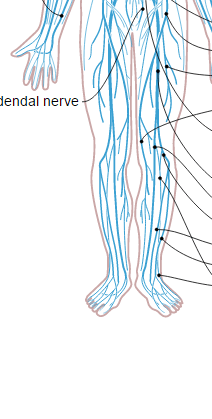
This is a picture of the 
a)
peripheral nervous sysyem
b)
central nervous system
c)
respiratory system
d)
circulatory system
61.
Which of the following describes the relationship between sensory neurons and motor neurons?
a)
Motor neurons bring a stimulus input to the brain and sensory neurons carry a movement output. 
b)
Sensory neurons tell motor neurons what to do.
c)
Sensory neurons bring a stimulius input to the spinal cord or brain and the brain or spinal cord sends a motor neuron  response.
d)
Sensory neurons do more than motor neurons
62.
Identify the lobe of the brain that is highlighted.  
a)
frontal
b)
temporal
c)
occipital
d)
parietal
63.
Identify the lobe of the brain
a)
frontal
b)
temporal
c)
occipital
d)
parietal
64.
What is the largest area of the brain that controls everything conscious?
a)
Cerebellum
b)
Cerebrum
c)
Diencephalon
d)
Brain Stem
65.
Possesses the Sensory Cortex
a)
Frontal Lobe
b)
Occipital Lobe
c)
Temporal Lobe
d)
Parietal Lobe
66.

What part of the brain deals with the thalamus and hypothalamus?

a)

Brain Stem

b)

Cerebellum

c)

diencephalan

d)

cerebrum

67.

The part of the PNS that controls involuntary actions

a)

autonomic nervous system

b)

somatic nervous system

c)

organic nervous system

d)

reflexive nervous system

68.
The part of the nervous system that consists of nerves that branch out from the CNS (central nervous system) and connect to other body parts
a)
Sympathetic
b)
Parasympathetic
c)
Autonomic
d)
Peripheral
69.
This part of the neuron stores then releases neurotransmitters into the synapse.
a)
Axon 
b)
Dendrite
c)
Myelin Sheath
d)
Axon Terminal
70.
Which part of the brain controls vital functions such as breathing and heart rate?
a)
Diencephalon
b)
Frontal Lobe
c)
Brain Stem
d)
Cerebellum
71.
This part is known as the "Little Brain" and is in charge of balance and coordinating movements.  
a)
Thalamus
b)
Reticular Formation
c)
Hypothalamus
d)
Cerebellum
72.
These neuron processes transmit information from the sensory organs to the central nervous system
a)
efferent
b)
afferent
73.
These neuron processes transmit information from the central nervous system to the muscles and glands
a)
efferent
b)
afferent
74.

Voluntary muscle movement is coordinated by what part of the brain?

a)

Temporal

b)

Occipital

c)

Frontal

d)

Parietal

75.

What part of the brain deals with appetite and temperature control?

a)

Cerebellum

b)

Cerebrum

c)

Hypothalamus

d)

Brain stem