
 Worksheets
Y11 Organic Chemistry
Total questions: 67
Worksheet time: 36mins
the name of this compound C4H10
METHANE
HEXENE
BUTANOIC ACID
BUTANE

Classify the compound based on the functional group present.
alkane
alkene
alkyne
aromatic
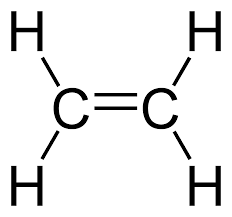
Which homologous series contains a C=C double bond?
alkanes
alkenes
alcohols
carboxylic acids
Crude oil is made up of:
Ethane
Butane
A mixture of different hydrocarbons
Extremely large hydrocarbons which are broken up once extracted
A fraction of crude oil is made up of:
Hydrocarbons of similar chain lengths
Numbers
Large hydrocarbons
Alkenes only
Different fractions in crude oil are separated by:
Cracking
Fractional Distillation
Filtration
Crystalisation
Shorter hydrocarbons have:
Higher boiling points
Lower boiling points
Petrol is used for:
Fuel in cars
Fuel in aircraft
Domestic heating and cooking
Road surfacing
Gases/LPG are used for:
Fuel in cars
Fuel for large ships
Roof and road surfacing
Domestic heating and cooking
Kerosene (paraffin) is used for:
Fuel for cars
Domestic heating and cooking
Fuel in aircraft
Fuel for large ships and in power stations
Diesel oil is used for:
Fuel in all cars
Fuel in aircraft
Road and roof surfacing
Fuel in some cars and larger vehicles
Fuel oil is used for:
Fuel in some cars and larger vehicles
Fuel for large ships and in some power stations
Roof and road surfacing
Fuel for cars
Bitumen is used for:
Fuel for large ships and in some power stations
Roof and road surfacing
Fuel in aircraft
Fuel in cars

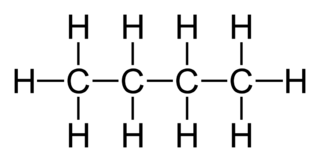
What is the structure shown?
Methane
Propane
Ethane
Butane

Where do long chain hydrocarbons collect?
At the top
In the middle
At the bottom

Where do short chain hydrocarbons collect?
At the top
In the middle
At the bottom
What does viscosity tell you about a hydrocarbon?
How easy it is to ignite
How easily it flows
What it's boiling point is
What it's freezing point is
The shorter the hydrocarbon, the more viscous it is
True
False
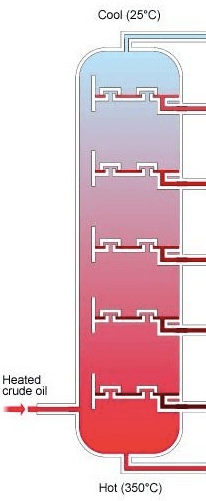
What process happens as the crude oil enters the fractionating column?
Evaporation
Condensation
Combustion
What process happens at each level in the fractionating column?
Evaporation
Condensation
Combustion
What term is given to a compound which contains atoms of carbon and hydrogen only?
alkene
hydrocarbon
alkane
saturated
Alkenes have the general formula:
CnH2n
CnH2n+1
CnH2n+2
CnHn
Alkanes have the general formula:
CnH2n
CnH2n+1
CnH2n+2
CnHn
Fractional distillation separates crude oil based on the different __________ of the molecules in the mixture
melting point
boiling point
freezing point
chemical reactivity
Molecules collected at the bottom of the fractionating column tend to be...
more viscous, less flammable and less volatile
less viscous, more flammable and more volatile
more viscous, more flammable and less volatile
less viscous, less flammable and more volatile
Molecules collected at the top of the fractionating column tend to be...
more viscous, less flammable and less volatile
less viscous, more flammable and more volatile
more viscous, more flammable and less volatile
less viscous, less flammable and more volatile
What are the 2 products of complete combustion?
carbon dioxide + hydrogen
carbon dioxide + water
carbon monoxide + water
carbon monoxide + hydrogen
What does a fuel react with when it burns?
oxygen
water
carbon dioxide
methane
What is the term given to the process by which longer chain hydrocarbons are broken down into shorter length alkanes and alkenes?
fractional distillation
evaporation
cracking
polymerisation

Name the following hydrocarbon
alkane
pentene
pentane
alkene
C10H22 --> C5H12 + C3H6 + ?
C2H4
C3H4
CO2
CH4
When testing for alkenes (unsaturation) bromine water turns from...
orange --> blue/black
colourless --> pink
orange --> colourless
orange --> clear

C3H8
Which of the following shows the structure of ethene?


As the number of carbons increases in the boiling point generally...
increase
decrease
stay the same
varies
Which of the following would have the highest boiling point?
C3H8
C4H8
C5H12
C22H44
As the number of carbons increases the flammability generally...
increase
decrease
stay the same
varies
As the number of carbons increases the viscosity generally...
increase
decrease
stay the same
varies
As the number of carbons increases the volatility generally...
increase
decrease
stay the same
varies
Which of the following would have the highest flammability?
C3H8
C4H8
C5H12
C22H44
Which of the following would have the highest viscosity?
C3H8
C4H8
C5H12
C22H44
Which of the following would have the highest volatility?
C3H8
C4H8
C5H12
C22H44

What is the functional group of alcohols?
–NH2
–COOH
–CHO
–OH
–NO2

Name this compound...
methane
methene
methanol
methoxymethane
Which microorganism can be used to produce ethanol in drinks?
MRSA
Yeast
E. Coli
Bacteria
Which process makes ethanol through anaerobic respiration of yeast?
Filtration
Intoxication
Fermentation
Distillation

What is the name of this alcohol?
(a)
Which is the correct functional group in alkenes?
C=C
OH
COOH
Alkenes don't have a functional group
Which is the correct functional group in carboxylic acids?
C=C
OH
COOH
They don't have a functional group
Which is the correct functional group in alkanes?
C=C
OH
COOH
Alkanes don't have a functional group
Complete combustion of ethanol gives (a) and water as the products
What is a monomer?
The process by which a polymer is made
A long molecule consisting of many repeating molecules
A short molecule which joins others to make long molecules
A short molecule which joins others to make long atoms
What is a polymer?
The process by which a polymer is made
A long molecule consisting of many repeating molecules
A short molecule which joins others to make long molecules
A long molecule consisting of many repeating atoms

