
Font size
 Worksheets
9 General, Term2 , CA2 Revisions
Total questions: 109
Worksheet time: 2hrs 43mins
What is the correct formula for the Mechanical advantage
input force ÷ output force
output force ÷ input force
input force × output force
input work ÷ output work
What is the correct formula for the efficiency
( input work ÷ output work ) × 100%
( output work ÷ input work ) × 100%
input work × output work
input force ÷ output force

depending on the next diagram, calculate the mechanical advantage
0.42
3.2
2.3
4.2
depending on the next diagram, calculate the mechanical advantage
0.42
3.2
2.3
4.2

depending on the next diagram, calculate the efficiency
105%
85%
95%
100%
is the ability to do work and cause change.
System
Energy
Work
Force
is a single or a group of objects with an
imaginary boundary.
System
Energy
Work
Force
The unit of energy is ______.
joules
newton
Joules/second
Newton-meter
The energy stored in an object due to interactions
between objects is ____ energy.
kinetic
potential
heat
electrical
The energy possessed by an object due to its
motion is _____.
kinetic
potential
heat
electrical
E = ½ mV2 Apply this formula to calculate
kinetic energy
potential energy
heat energy
electrical energy
E = mgh Apply this formula to calculate
kinetic energy
Gravitational potential energy
elastic potential energy
electrical energy
which factor affecting The gravitational potential energy
the speed
The mass
The temperature
The volume
Energy released during nuclear fission or fusion
kinetic
Nuclear
heat
electrical
energy stored in the bonds of the compounds
kinetic
Nuclear
Chemical
electrical
Energy produced when a rise in temperature causes atoms
and molecules to move faster and collide with each other
kinetic
Nuclear
Chemical
Thermal
What type of energy inside the fule
kinetic
nuclear
heat
chemical
The energy equivalent to the mass of a particle at rest in an
inertial frame of reference ( E = mc2 )
kinetic energy
rest energy
Chemical energy
Thermal energy
which factor affecting The gravitational kinetic energy
the speed
The shape
The temperature
The volume
which of the following energy forms is a potential enegry
kinetic
Nuclear
heat
electrical

Identify the energy conversions taking place in the next diagram
Chemical to electrical
Thermal to chemical
chemical to mechanical
chemical to light

Identify the energy conversions taking place in the next diagram
Chemical to electrical
Thermal to chemical
chemical to mechanical
electrical to light

Identify the energy conversions taking place in the next diagram
Chemical to electrical
thermal to chemical
chemical to mechanical
electrical to light
A baseball with a mass of 1.0 kg is moving at a speed of 10.0 m/s. What is baseball’s kinetic energy from this
motion?
100 J
50 J
1000 J
40 J
A car doubles its speed from 50 km/h to 100 km/h.
By how many times does the kinetic energy from
the car’s forward motion increase?
2 times
4 times
6 times
8 times
An 8.0 kg history textbook is placed on a 1.50 m high desk.
find the gravitational potential energy of the textbook-Earth system relative to the floor?
80 J
100 J
120 J
140 J
The law of conservation of energy states that ____.
Energy can be destroyed
Energy can be created
Energy decreases over time
Energy cannot be created or destroyed, but
can be transformed from one form to
another
Friction causes mechanical energy to be converted
into which form?
thermal energy
kinetic energy
nuclear energy
potential energy

Which energy transformation is happening from
position A to B?
Kinetic energy to GPE
GPE to kinetic energy
Thermal energy to mechanical energy
Mechanical energy to chemical energy
Which energy transformation is happening from
position B to C ?
Kinetic energy to GPE
GPE to kinetic energy
Thermal energy to mechanical energy
Mechanical energy to chemical energy

At what point on the ball’s path is the kinetic
energy of the ball the least?
Point A
Point B
Point C
Point D
At what point on the ball’s path is the potential
energy of the ball the greatest?
Point A
Point B
Point C
Point D

According to the graph, which is the best estimate
for the kinetic energy from the rock’s falling
motion after the rock has fallen for 2 s?
0 J
50 J
100 J
200 J
According to the graph, which is the best estimate
for the potential energy from the rock’s falling
motion after the rock has fallen for 2 s?
100 J
500 J
600 J
200 J
According to the graph, which is the best estimate
for the potential energy from the rock’s falling
motion after the rock has fallen for 4 s?
0 J
50 J
100 J
200 J

A body falls down in a place where all force of friction are negligible and the energy vs time graph is shown below.
a. Which graph corresponds to kinetic energy?
graph A
graph B
graph C
A body falls down in a place where all force of friction are negligible and the energy vs time graph is shown below.
a. Which graph corresponds to potential energy?
graph A
graph B
graph C
A body falls down in a place where all force of friction are negligible and the energy vs time graph is shown below.
a. Which graph corresponds to mechanical energy?
graph A
graph B
graph C
The law of conservation of energy states that ____.
Energy can be destroyed
Energy can be created
Energy decreases over time
Energy cannot be created or destroyed, but
can be transformed from one form to
another
Friction causes mechanical energy to be converted
into which form?
thermal energy
kinetic energy
nuclear energy
potential energy
Which energy transformation is happening from
position A to B?
Kinetic energy to GPE
GPE to kinetic energy
Thermal energy to mechanical energy
Mechanical energy to chemical energy
Which energy transformation is happening from
position B to C ?
Kinetic energy to GPE
GPE to kinetic energy
Thermal energy to mechanical energy
Mechanical energy to chemical energy
At what point on the ball’s path is the kinetic
energy of the ball the least?
Point A
Point B
Point C
Point D
At what point on the ball’s path is the potential
energy of the ball the greatest?
Point A
Point B
Point C
Point D
According to the graph, which is the best estimate
for the kinetic energy from the rock’s falling
motion after the rock has fallen for 2 s?
0 J
50 J
100 J
200 J
According to the graph, which is the best estimate
for the potential energy from the rock’s falling
motion after the rock has fallen for 2 s?
100 J
500 J
600 J
200 J
According to the graph, which is the best estimate
for the potential energy from the rock’s falling
motion after the rock has fallen for 4 s?
0 J
50 J
100 J
200 J
A body falls down in a place where all force of friction are negligible and the energy vs time graph is shown below.
a. Which graph corresponds to kinetic energy?
graph A
graph B
graph C
A body falls down in a place where all force of friction are negligible and the energy vs time graph is shown below.
a. Which graph corresponds to potential energy?
graph A
graph B
graph C
A body falls down in a place where all force of friction are negligible and the energy vs time graph is shown below.
a. Which graph corresponds to mechanical energy?
graph A
graph B
graph C

The bob of the pendulum shown below has a mass of 2 𝑘𝑔. The motion started from position A at a height of 1.5 m . The string is massless and the frictional forces and air resistance are negligible. Use 𝑔=10.0 𝑚⁄𝑠2
a. Find the mechanical energy for the bob at position A.
10 J
20 J
30 J
40 J
The bob of the pendulum shown below has a mass of 2 𝑘𝑔. The motion started from position A at a height of 1.5 m . The string is massless and the frictional forces and air resistance are negligible. Use 𝑔=10.0 𝑚⁄𝑠2
a. Find the potential energy for the bob at position A.
10 J
20 J
30 J
40 J
The bob of the pendulum shown below has a mass of 2 𝑘𝑔. The motion started from position A at a height of 1.5 m . The string is massless and the frictional forces and air resistance are negligible. Use 𝑔=10.0 𝑚⁄𝑠2
a. Find the kinetic energy for the bob at position A.
0 J
20 J
30 J
40 J
The bob of the pendulum shown below has a mass of 2 𝑘𝑔. The motion started from position A at a height of 1.5 m . The string is massless and the frictional forces and air resistance are negligible. Use 𝑔=10.0 𝑚⁄𝑠2
a. Find the potential energy for the bob at position B.
0 J
20 J
30 J
40 J
The bob of the pendulum shown below has a mass of 2 𝑘𝑔. The motion started from position A at a height of 1.5 m . The string is massless and the frictional forces and air resistance are negligible. Use 𝑔=10.0 𝑚⁄𝑠2
a. Find the kinetic energy for the bob at position B.
0 J
20 J
30 J
40 J
The bob of the pendulum shown below has a mass of 2 𝑘𝑔. The motion started from position A at a height of 1.5 m . The string is massless and the frictional forces and air resistance are negligible. Use 𝑔=10.0 𝑚⁄𝑠2
a. Find the mechanical energy for the bob at position B.
0 J
20 J
30 J
40 J
The bob of the pendulum shown below has a mass of 2 𝑘𝑔. The motion started from position A at a height of 1.5 m . The string is massless and the frictional forces and air resistance are negligible. Use 𝑔=10.0 𝑚⁄𝑠2
a. Find the mechanical energy for the bob at position C.
0 J
20 J
30 J
40 J
The bob of the pendulum shown below has a mass of 2 𝑘𝑔. The motion started from position A at a height of 1.5 m . The string is massless and the frictional forces and air resistance are negligible. Use 𝑔=10.0 𝑚⁄𝑠2
a. Find the potential energy for the bob at position C.
0 J
20 J
30 J
40 J
The bob of the pendulum shown below has a mass of 2 𝑘𝑔. The motion started from position A at a height of 1.5 m . The string is massless and the frictional forces and air resistance are negligible. Use 𝑔=10.0 𝑚⁄𝑠2
a. Find the kinetic energy for the bob at position C.
0 J
20 J
30 J
40 J
What is the output power for a computer using an
energy of 2000 J in 100 s?
10 W
20 W
30 W
40 W
A microwave oven with a power rating of 1000 W
is turned on for 5 s. Calculate the energy used by the
microwave.
0.005 J
40.0 J
200 J
5000 J

depending on the next diagram, What is the KE of the ball
( 3 kg ) at point A ( 10 m ) above the ground level,
zero, Because the ball not moving
150 J
300 J
450 J
depending on the next diagram, What is the PE of the ball
( 3 kg ) at point A ( 10m ) above the ground level,
zero, Because the ball not moving
150 J
300 J
450 J
depending on the next diagram, What is the ME of the ball
( 3 kg ) at point A ( 10m ) above the ground level,
zero, Because the ball not moving
150 J
300 J
450 J
depending on the next diagram, What is the PE of the ball
( 3 kg ) at point C at the ground level,
zero, Because the height is zero
150 J
300 J
450 J
depending on the next diagram, What is the KE of the ball
( 3 kg ) at point C at the ground level,
zero, Because the height is zero
150 J
300 J
450 J
depending on the next diagram, What is the ME of the ball
( 3 kg ) at point C at the ground level,
zero, Because the height is zero
150 J
300 J
450 J
depending on the next diagram, What is the PE of the ball
( 3 kg ) at point B ( 5 m ) above the ground level,
zero, Because the height is zero
150 J
300 J
450 J
depending on the next diagram, What is the KE of the ball
( 3 kg ) at point B ( 5 m ) above the ground level,
zero, Because the height is zero
150 J
300 J
450 J
depending on the next diagram, What is the ME of the ball
( 3 kg ) at point B ( 5 m ) above the ground level,
zero, Because the height is zero
150 J
300 J
450 J
The nucleus of an atom consists of ____
protons only
neutrons only
electrons only
both protons and neutrons
The particles with no electric charge are______.
protons only
neutrons only
electrons only
both protons and neutrons
The particles with positive electric charge are______.
protons only
neutrons only
electrons only
both protons and neutrons
In a neutral atom, the number of protons are equal
to the number of ___.
electrons
neutrons
electrons plus neutrons
electrons minus neutrons
The particles with negative electric charge are______.
protons only
neutrons only
electrons only
both protons and neutrons
All the isotopes of the same element must have the
same ______.
number of protons
number of electrons
number of neutrons
Number of neutrons plus the protons
All the isotopes of the same element must have the
different ______.
number of protons
number of electrons
number of neutrons
Number of neutrons plus the protons
Mass number is the number of ______in an atom.
.
protons
electrons
electrons plus the protons
neutrons plus the protons
the atomic number is the number of ______in an atom.
protons
electrons
electrons plus the protons
neutrons plus the protons
What keeps the particles of a nucleus together?
Strong force
Weak force
Electromagnetic force
Gravity

depending on the next element, What is the atomic number
2
4
6
8
depending on the next element, What is the mass number
2
4
6
8
depending on the next element, What is the number of protons in the nucleus?
2
4
6
8
depending on the next element, What is the number of neutrons in the nucleus?
2
4
6
8
Which of the following describes the electric
forces between protons. Tick all the correct answers.
Weak forces
Strong forces
Short range
Long range
Which of the following describes the nuclear
forces between protons. Tick all the correct answers.
Weak forces
Strong forces
Short range
Long range

In which nucleus are the protons and neutrons held
more tightly together?
small
large
Both small and large
Neither small nor large
In less massive elements ( less than 20 Protons ) an isotope is stable
when the ratio of neutrons to protons ( n/p ) is about _____.
1:1
1:2
2:3
3:2
In more massive elements ( more than 20 Protons ) an isotope is stable
when the ratio of neutrons to protons ( n/p ) is about _____.
1:1
1:2
2:3
3:2
________ is the process of nuclei decaying and
emitting matter and energy.
Explosion
Radioactivity
Chemical reaction
Nuclear binding
The formula for the rest mass energy is ____.
E= mc2
E = 1/2 mV2
E= mgh
E = f.d
Mass-energy equivalence is apparent during _____.
Chemical reactions
Nuclear reactions
Both chemical and nuclear reactions
Neither chemical nor nuclear reactions
A small amount of mass is the same thing as a very
large amount of _____.
density
volume
energy
speed

The graph below shows the mass-energy
equivalence. How are the mass and energy related?
𝐸 ∝ 𝑚
𝐸 ∝ 𝑚2
𝐸 ∝ 1/𝑚
𝐸 ∝ 1/𝑚2
The graph below shows the mass-energy
equivalence. Which of the following can be used to calculate the
speed of light from the graph?
𝑐 = 𝑠𝑙𝑜𝑝𝑒
𝑐 = 𝑠𝑙𝑜𝑝𝑒/2
𝑐 = √𝑠𝑙𝑜𝑝𝑒
𝑐 = √𝑠𝑙𝑜𝑝𝑒/2
How much energy is equal to 1.0 kg mass?
9.0 × 10¹⁶ 𝐽
6.0 × 10¹⁶ 𝐽
9.0 × 10⁸ 𝐽
6.0 × 10⁸ 𝐽
Which of the following is an equipment to detect
nuclear radiations? Select all the correct answers.
Tracer
Geiger counter
A wire chamber
Voltage source
A ________ is a radioactive isotope that doctors use
to locate molecules in an organism
Tracer
Geiger counter
A wire chamber
Voltage source
If 10 g of iodine 131 is given to a patient, how much is left after 24 days? The half-life of iodine-131 is 8 days.
1.25mg
1.25g
10g
10mg
How many grams are left after 1 half life?
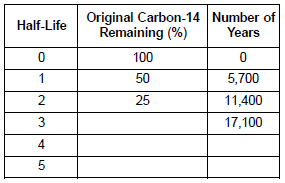
After 22,800 years, approximately what percentage of the original carbon-14 remains?
15%
12.5%
6.25%
3.125%
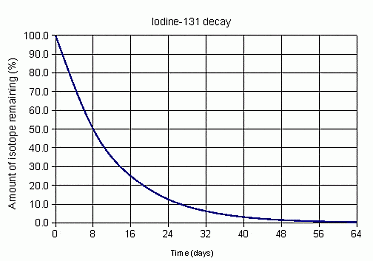
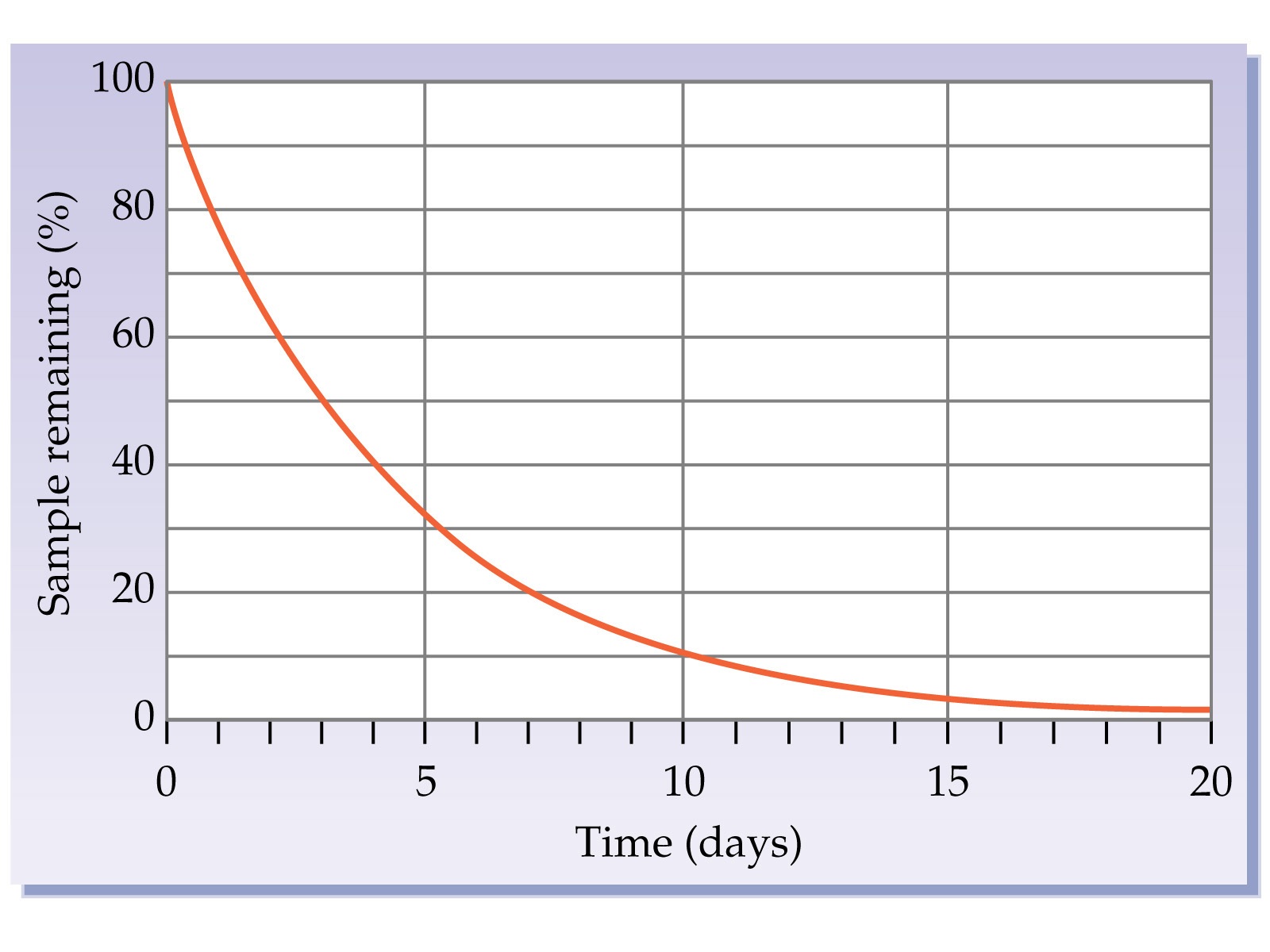
What is the Half Life of this isotope?
3 days
5 days
8 days
10 days
Which of the radioactive tracer isotopes is used to
detect problems in the thyroid?
Carbon-14
Technetium-99
Iodine-131
Uranium-235
If a radioactive material has a 10y half-life,
what fraction of the material will be left after
30 y?
One-half
One-third
One fourth
One-eighth
A daughter nucleus is the ______.
nucleus before the nuclear decay
nucleus after the nuclear decay
energy released during the nuclear decay
radiation emitted during the nuclear decay

