wayground logo

Free Printable Worksheets

Font size

S
M
L
XL
Worksheets

Unit 3B Review

Total questions: 101

Worksheet time: 3hrs 22mins

Name
Class
Date
1.
What is a series of events a cell goes through as they grow and divide?
a)
Cell Division
b)
Cell Cycle
c)
Cytokinesis
d)
Mitosis
2.
What is the longest stage of the cell cycle called?
a)
Cytokinesis
b)
M phase
c)
Interphase
d)
G1 Phase
3.
During what stage does the G1, S and G2 phases happen?
a)
Interphase
b)
M phase
c)
Mitosis
d)
Cytokinesis
4.
During which stage of the cell cycle does mitosis and cytokinesis occur?
a)
Interphase
b)
S phase
c)
M phase
d)
G1 phase
5.
During what phase of the cell cycle does cell division occur?
a)
Interphase
b)
M phase
c)
S phase
d)
G2 phase
6.
During what phase of the cell cycle is DNA replicated?
a)
G1 phase
b)
S phase
c)
G2 phase
d)
M phase
7.
During what phase of the cell cycle does the cell grow?
a)
G1 phase
b)
S phase
c)
M phase
d)
Cytokinesis
8.
During what phase of the cell cycle does the cell prepare for mitosis?
a)
G1 phase
b)
S phase
c)
G2 phase
d)
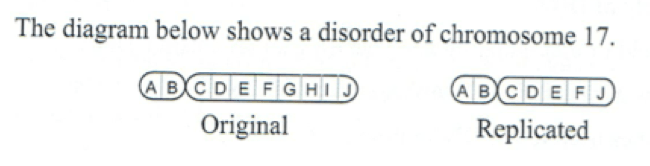
M phase
9.
Put the following stages of mitosis in order: anaphase, prophase, metaphase, and telophase. 
a)
prophase, metaphase, telophase, anaphase
b)
prophase, anaphase, metaphase, telophase
c)
prophase, metaphase, anaphase, telophase
d)
prophase, telophase, metaphase, anaphase
10.
Put the following stages of the cell cycle in order: G2, S, G1, M. 
a)
G1, S, G2, M
b)
S, G1, G2, M
c)
G1, M, G2, S
d)
M, G1, S, G2
11.
Put the following in order: G2, G1, S, mitosis, cytokinesis. 
a)
G1, G2, S, Mitosis, cytokinesis
b)
G1, S, G2, Mitosis, cytokinesis
c)
G1, G2, S, cytokinesis, mitosis
d)
G1, S, G2, cytokinesis, mitosis
12.
True or False. 
After a cell goes through cytokinesis, it starts mitosis all over again.
a)
True
b)
False
13.
What phase is this cell in?
a)
Cytokinesis
b)
Mitosis
c)
Prophase
d)
Metaphase
14.
What phase is this cell in?
a)
Mitosis
b)
Interphase
c)
Anaphase
d)
Telophase
15.
What part of the cell cycle is this cell in?
a)
Mitosis
b)
Interphase
c)
Telophase
d)
Cytokinesis
16.
In what phase do the chromosomes line up in the middle of the cell?
a)
Cytokinesis
b)
Metaphase
c)
Prophase
d)
Telophase
17.
In what phase does chromatin condense to form chromosomes?
a)
Mitosis
b)
Interphase
c)
Prophase
d)
Anaphase
18.
In what phase do the chromosomes get pulled apart into sister chromatid to opposite sides of the cell?
a)
Prophase
b)
Interphase
c)
Metaphase
d)
Anaphase
19.

Which stage of the cell cycle is MOST critical for ensuring that daughter cells are identical?

a)

G1

b)

S

c)

Prophase

d)

G2

20.
After mitosis and cytokineses, one cell becomes...
a)
Two identical cells
b)
Two genetically different cells
c)
Four identical cells
d)
Four genetically different cells
21.
Before a cell can divide, what must happen?
a)
Nothing, it is always ready to divide
b)
The number of chromosomes must be cut in half
c)
The number of chromosomes must double
d)
The number of chromosomes must triple.
22.

Another name for a reproductive cell is a:

a)

gamete

b)

embryo

c)

bone cell

d)

muscle cell

23.
A is:
B is:
C is:
a)
A: chromatid
B: centromere
C: chromosome
b)
A: chromosome
B: chromatid
C: centromere
c)
A: chromosome
B: centromere
C: chromatid
d)
A: centromere
B: chromosome
C: chromatid
24.
Most of the cells in the human body are produced by
a)
mitosis
b)
meiosis
25.
Fruit fly body cells have 8 chromosomes. After mitosis, you would expect a resulting fruit fly daughter cell to have ...
a)
16 chromosomes.
b)
46 chromosomes.
c)
8 chromosomes.
d)
4 chromosomes.
26.

The male reproductive cell is called

a)

egg

b)

zygote

c)

sperm

d)

mitosis

27.

The female reproductive cell is called

a)

zygote

b)

sperm

c)

fertilization

d)

egg

28.

Why do we need meiosis?

a)

To double the number of chromosomes going into gametes

b)

To halve the number of chromosomes going into gametes

c)

To triple the number of chromosomes going into gametes

d)

To not change the number of chromosomes going into gametes

29.
In Meiosis if the parent cells has 40 chromosomes, then how many will the daughter cells have 
a)
40
b)
10
c)
20
d)
18
30.
A cat has a total of 38 chromosomes in its body cells.  How many in its gametes?
a)
38
b)
19
c)
76
d)
10
31.

A 2n cell of a bat has 44 chromosomes, how many chromosomes will you find in one of his gametes

a)

23

b)

22

c)

44

d)

88

32.
Mitosis produces cells with haploid or diploid number of chromosomes?
a)
Haploid
b)
Diploid
33.
Body cells have diploid or haploid number of chromosomes?
a)
Haploid
b)
Diploid
34.
The enzyme that unwinds the DNA to prepare for replication
a)
helicase
b)
replicase
c)
polymerase
d)
synthase
35.
Which sequence of DNA bases would pair with this partial strand
CAT TCA CTG
a)
ATG TGA CAG
b)
TAC ACT GTC
c)
GTA AGT GAC
d)
CAT TCA CTG
36.
A process in which DNA has the unique ability to make an exact copy of itself.
a)
Replication
b)
Translation
c)
Transcription
37.

DNA replication results in

a)

2 completely new DNA molecules

b)

2 DNA molecules that each contain a strand of the original

c)

1 new DNA molecule and 1 old

d)

1 new molecule of DNA

38.

Site where replication begins

a)

Polymerase action site

b)

Replication fork

c)

Replication Origin

d)

In the front

39.

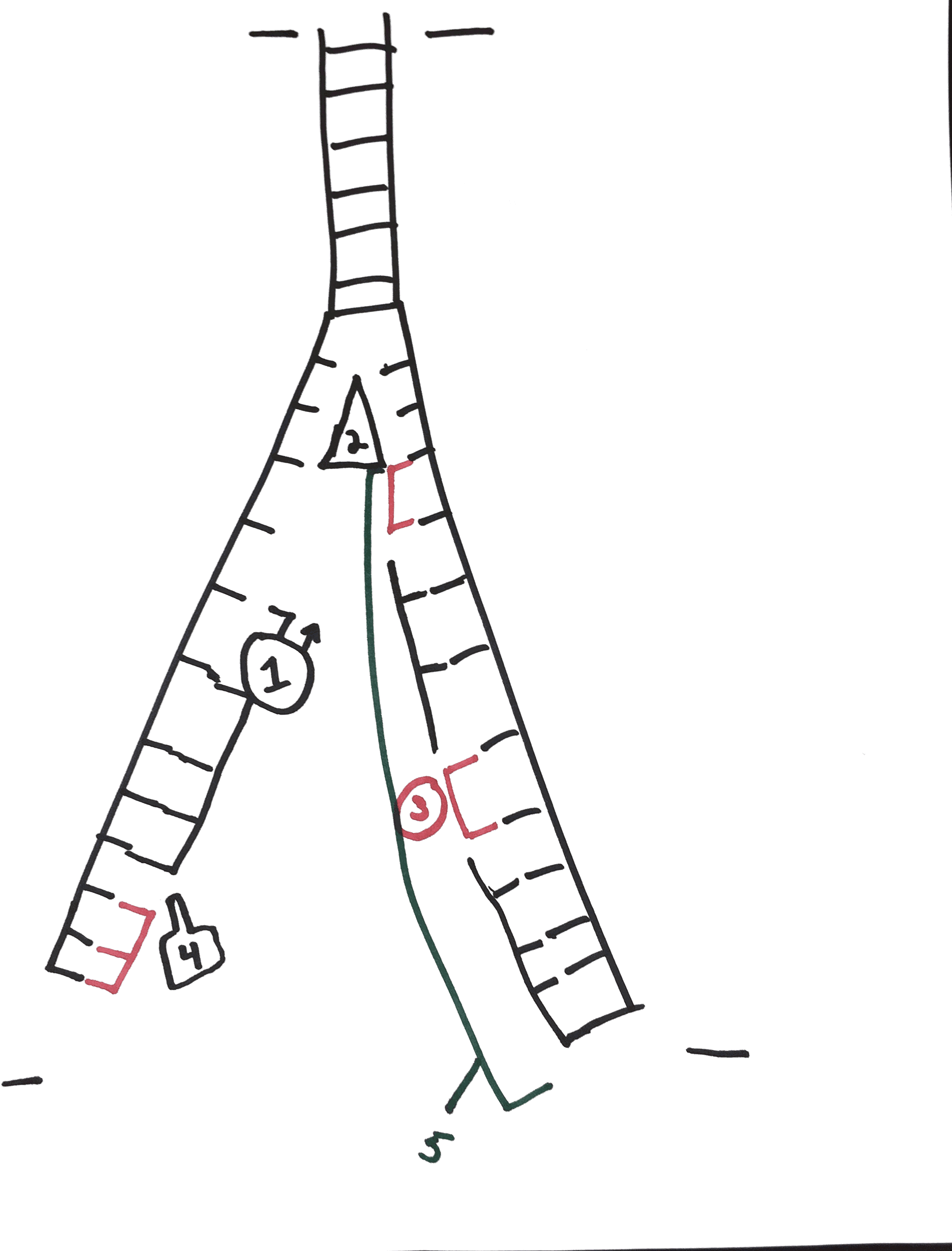
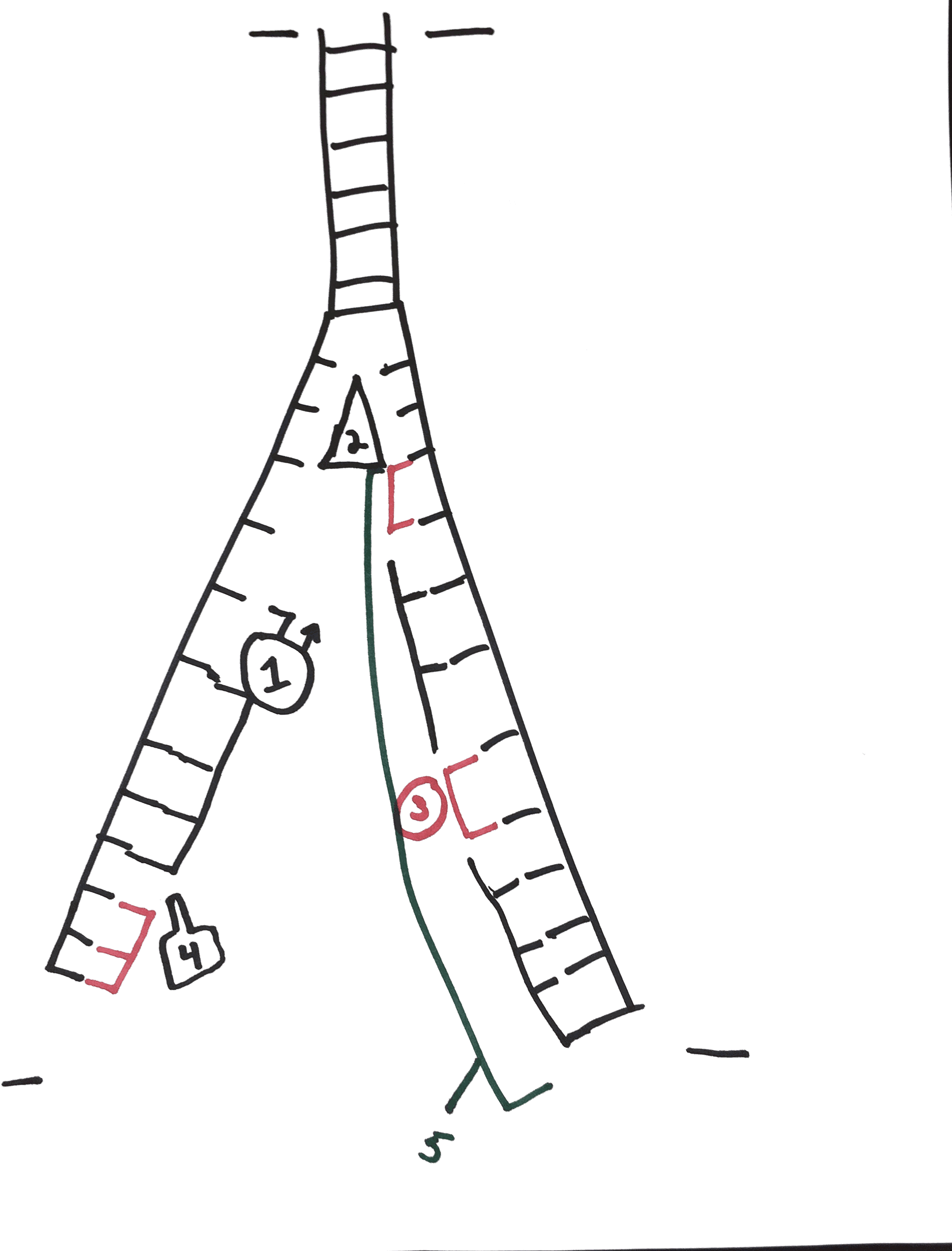
#1 in the picture above (builder)

a)

Helicase

b)

Primase

c)

Polymerase

d)

Ligase

40.

#3 setting Primers

a)

Ligase

b)

Helicase

c)

Polymerase

d)

Primase

41.
A DNA nucleotide contains all of the following, except...
a)
Deoxyribose
b)
Phosphate group
c)
Nitrogenous base
d)
Cholesterol
42.
If a strand reads:
3' A A A T T T C 5'
The matching strand would read...
a)
5' T T T A A A G 3'
b)
3' T T T A A A G 5'
c)
5' A A A T T T C 3'
d)
3' U U U A A A G 5'
43.
This picture is illustrating the ____ nature of DNA.
a)
anti-parallel
b)
deoxyribosic
c)
helical
d)
radioactive
44.

The picture below shows the steps of DNA replication beginning with step one and ending with step three.


​Because you are reusing the old, or parent, DNA strand DNA replication is said to be

a)

Semi- Conservative

b)

Semi-discontinuous

c)

Continuous

d)

Fully-Conserveative

45.

Match he nucleotide with its complementary nucleotide. (DNA to DNA).


Cytosine-

a)

Thymine

b)

Guanine

c)

Adenine

46.

Which enzyme is responsible for adding the free nucleotides to the replicating DNA? ​

a)

DNA Helicase

b)

DNA Ligase

c)

DNA polyermase

d)

RNA Polymerase

47.

Which is the first step?

a)

DNA Helicase unwinds original DNA strand

b)

RNA Primase lays down RNA primer for new nucleotide bases.

c)

DNA polymerase builds new strands by bring in new nucleotide bases.

d)

Ligase glues together all fragments

48.

Which is the last step?

a)

DNA Helicase unwinds original DNA strand

b)

RNA Primase lays down RNA primer for new nucleotide bases.

c)

DNA polymerase builds new strands by bring in new nucleotide bases.

d)

Ligase glues together all fragments

49.

The directionality of DNA is said to be ___________, because it is side by side by goes in opposite directions.

a)

Anti-directional

b)

Parallel

c)

Anti-parallel

d)

Perpendicular

50.

Which of the following are differences in the structure between RNA and DNA

a)

DNA uses deoxyribose sugar, RNA uses sugar ribose

b)

DNA pairs Adenine with Uracil, RNA pairs Adenine with Thymine

c)

DNA is a double helix, RNA is a single helix

d)

DNA pairs Adenine with Thymine, RNA pairs Adenine with Uracil

51.

Which organelle is the location where protein is made?

a)

Ribosome

b)

Nucleus

c)

Cytoplasm

d)

Nucleotide

52.

During transcription, this type of ribonucleic acid is responsible for copying the DNA and brining it out of the nucleus.

a)

tRNA

b)

mRNA

c)

rRNA

d)

dRNA

53.

When these bond together, they form a protein

a)

Amino Acids

b)

Peptide Bonds

c)

Ribose

d)

Nucleotides

54.

A string of nucleotides that contain the information to make a specific protein

a)

Ribose

b)

Amino Acids

c)

tRNA

d)

Gene

55.

During translation, this type of ribonucleic acid is responsible for delivering amino acids to help make a protein.

a)

mRNA

b)

rRNA

c)

tRNA

d)

dRNA

56.

How many amino acids are found on one tRNA?

a)

20

b)

4

c)

1

d)

3

57.

Which of the following is the complementary mRNA sequence to this DNA strand: AACTGAA

a)

UUGACUU

b)

TTGACTT

c)

AACTGAA

d)

AACUGAA

58.

Which of the following is the tRNA that will be used to decode to this DNA strand: AACTGA

a)

AAC and TGA

b)

TTG and ACT

c)

UUG and ACU

d)

AAC and UGA

59.
which process is shown?
a)
diffusion
b)
repiration
c)
recombination
d)
translation
60.
When an extra base is inserted into the DNA sequence of a gene, the protein doesn't work. Which explains why?
a)
the base increases rate of translation
b)
the base causes DNA to be transcribed in opposite direction
c)
the inserted base causes the codons in the sequence to be incorrect for the desired protein
d)
the base signals enzymes to translate DNA rather than RNA
61.
What molecules do both DNA and RNA contain?
a)
uracil
b)
nucleotides
c)
thymine
d)
deoxyribose
62.
The genetic material of an organism is composed of
a)
lipids
b)
proteins
c)
deoxyribonucleic acids
d)
complex carbohydrates
63.
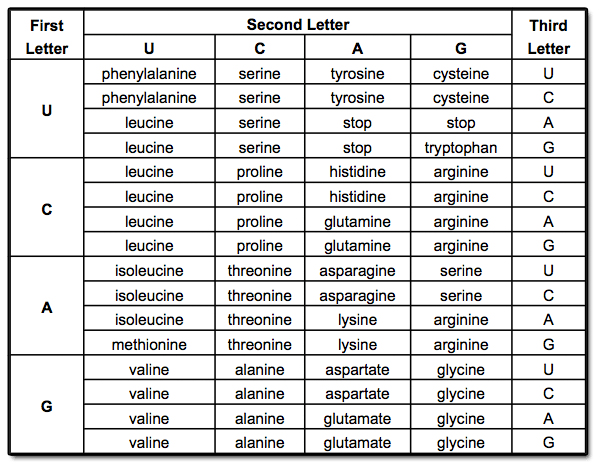
A scientist puts nucleotide chains of UUUUUU in a test tube under conditions allowing protein synthesis. Soon they are only amino acids chains of phenylalinine. What does the experiment indicate?
a)
phenylalanine is composed of uracil
b)
UUU codes for phenylalanine
c)
protein synthesis malfunctions in test tubes
d)
proteins contain one kind of amino acids
64.
Genetic info flows in one direction. Which best represents this flow?
a)
DNA-protein-RNA
b)
Protein-RNA-DNA
c)
RNA-protein-DNA
d)
DNA-RNA-protein
65.
Which process?
a)
mutation
b)
transcription
c)
respiration
d)
translation
66.
An RNA polymer is composed of subunits known as
a)
polysaccharides
b)
ribose molecules
c)
nucleotides
d)
uracil molecules
67.
The process to go from DNA to mRNA is _______
a)
translation
b)
transcription
c)
replication
68.
The process to go from mRNA to a protein is called ____
a)
transcription
b)
rRNA
c)
replication
d)
translation
69.
The main function of tRNA is to...
a)
carry a message that, when translated, forms proteins
b)
form a portion of ribosomes
c)
string together complementary RNA and DNA strands
d)
bring amino acids from the cytoplasm to the ribosomes
70.
Choose the nucleotide sequence of the RNA strand that would be complementary to the following strand: 
GTAGTCA
a)
UATUAGA
b)
ACGACTG
c)
CAUCAGU
d)
CATCAGT
71.
What amino acid is represented by the codon UUA?
a)
Phenylalanine
b)
Tyrosine
c)
Leucine
d)
Stop codon
72.
What is the three base sequence of mRNA that codes for a single amino acid?
a)
Anticodon
b)
Codon
c)
Protein
73.
What is the location in the cell for transcription?
a)
nucleus
b)
cytoplasm
c)
ribosome
d)
mitochondria
74.
Which of the following is the site of translation?
a)
vacuole
b)
lysosome
c)
nucleus
d)
ribosome
75.

A mutation is defined as:

a)

A change in the cell's structure

b)

Anything that changes in an embryo

c)

Any change in the physical features of a human

d)

A change in the DNA sequence

76.

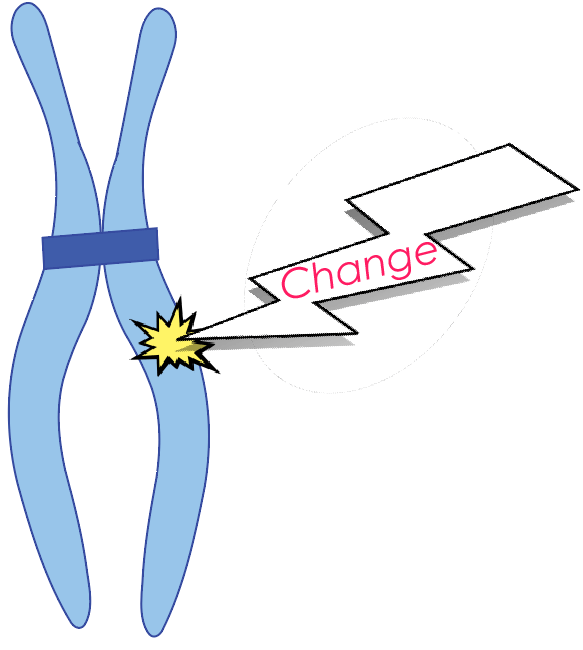
A change in a gene, group of genes or chromosome that results in a change in the proteins

a)

Replication

b)

Mutations

c)

Translation

d)

Transcription

77.

One nucleotide base is changed so only one amino acid

is affected

a)

Chromosomal mutation

b)

Point Mutation

c)

Translocation

d)

Inverse Mutation

78.

A point mutation where one nucleotide base replaces an original nucleotide base

a)

Inversion Mutation

b)

Chromosomal Mutation

c)

Translocation

d)

Substitution Mutation

79.

A nucleotide base is inserted or deleted shifting the entire DNA sequence. Entire protein will be changed.

a)

Substitution Mutation

b)

Silent Mutation

c)

Frameshift Mutation

d)

Translocation

80.

A frameshift mutation where a nucleotide base

is removed from the DNA sequence.

a)

Deletion Mutation

b)

Substitution Mutation

c)

Translocation

d)

Silent Mutation

81.

A frameshift mutation where a nucleotide base is added

to the DNA sequence

a)

Insertion Mutation

b)

Deletion Mutation

c)

Substitution Mutation

d)

Chromosomal Mutation

82.

Mutations that involve parts of or all of

a chromosome

a)

Replication

b)

Substitution

c)

Chromosomal Mutation

d)

Transcription

83.

Part of a chromosome

is deleted

a)

Deletion Mutation-Gene

b)

Translocation

c)

Deletion Mutation -Chromosomal

d)

Crossing Over

84.

Part of a chromosome is repeated

a)

Gene Mutation

b)

Point Mutation

c)

Deletion Mutation

d)

Duplication Mutation

85.

Part of a chromosome is reversed.

a)

Inversion Mutation

b)

Deletion Mutation

c)

Translocation

d)

Point Mutation

86.

Part of one chromosome is transported and attached

to a non-homologous chromosome

a)

Inversion Mutation

b)

Translocation Mutation

c)

Duplication Mutation

d)

Point Mutation

87.

Failure of homologous chromosomes

to separate during meiosis.

Results in gametes with either one extra or one missing chromosome.

a)

Translocation

b)

Nondisjunction

c)

Replication

d)

Transcription

88.

What mutation has occurred here?

T-G-A-C-C-A

T-G-A-G-C-A

a)

Substitution

b)

Deletion

c)

Insertion

d)

Frameshift

89.

DNA molecule segment is : TTA-CGC-AAG

The mutated DNA segment is TTC-GCA-AG. This is an example of ___ mutation.

a)

Substitution

b)

Deletion

c)

Insertion

d)

Inversion

90.
Which of the following would result in a frameshift mutation?
a)
Insertions only
b)
Substitution only
c)
Deletion only
d)
Insertions and Deletions
91.
Are all mutations bad?
a)
Yes
b)
No
c)
Maybe?
92.

Mutated DNA sequences that can be passed from parent to offspring --

a)

occur in somatic cells

b)

occur in gametic cells

c)

are rejected by meiosis

d)

only occur if the parent is exposed to harmful substances
93.
What type of chromosomal mutation has occurred?
a)
substitution
b)
insertion
c)
deletion
d)
nondisjunction
94.
What mutation has occurred here? 
T-G-A-C-C-A
T-G-A-G-C-A
a)
Substitution
b)
Deletion
c)
Insertion
d)
Frameshift 
95.
Which mutation will cause translation to stop? 
a)
Mutations 1 and 3 only
b)
Mutation 1 only
c)
Mutation 2 only
d)
Muations 1, 2, 3
96.

Would a mutation in the DNA of a skin cell be passed on to an organism's offspring?

a)

Yes, because any change to the DNA is passed on to the offspring

b)

Maybe. Gametes only use half of the body's genetic code. It might get the copy of a gene that wasn't mutated.

c)

No. Only mutations that occur in the gametes are passed on to the offspring

d)

Without knowing the animal, it would be hard to tell whether or not the mutation would be passed on.

97.
A change in a single nucleotide in a gene sequence is called a...
a)
Point Mutation
b)
Single Error
c)
Mono Mutation
d)
Isolated Mutation
98.

What type of mutation is shown in the diagram?

a)

Point mutation - missense

b)

Frameshift Mutation - deletion

c)

Frameshift Mutation - addition

d)

Point mutation - nonsense

99.
Structure (b) is a ____.
a)
chromosome
b)
chromatid
c)
centromere
100.
What is the next phase of mitosis?
a)
Prophase
b)
Metaphase
c)
Anaphase
d)
Telophase
101.

What is shown in this image?

a)

chromatin

b)

a chromosome

c)

2 homologous chromosomes

d)

a centromere