
 Worksheets
biology module 11 review
Total questions: 64
Worksheet time: 34mins
In DNA, adenine bonds with ______________.
Guanine
Thymine
Cytosine
Adenine
In DNA, guanine bonds with ______________.
Adenine
Guanine
Cytosine
Thymine
Which sequence of DNA bases would pair with this partial strand?
ATG TGA CAG
ATG TGA CAG
TAC ACT GTC
GTA AGT GAC
UAC ACU GUC
Regarding eukaryotes, in what organelle is DNA usually found?
cell membrane
vacuole
chloroplast
nucleus
Which shows the correct complementary base pairing for DNA?
C-A, T-G
A-G, C-T
C-G, U-A
T-A, G-C
The building block of nucleic acids are nucleotides. Nucleotides are composed of a sugar, a phosphate group, and a _______-containing base.
oxygen
hydrogen
nitrogen
carbon
_______ is the sugar found in DNA.
Sucrose
Glucose
Deoxyribose
Ribose
Which 2 molecules form the sides ("rails") of the DNA ladder?
deoxyribose sugar and adenine
deoxyribose sugar and a hydrogen bond
deoxyribose sugar and an amino acid
deoxyribose sugar and a phosphate group

If a DNA molecule consists of 29% Guanine, how much Cytosine will it contain?
29%
58%
21%
71%
A nucleotide is made up of three parts: which of these is not one of those parts?
sugar
phosphate
lipid
base

The process of DNA _______ is the exact copying of a DNA molecule.
replication
translation
transcription
translocating

Which of the following best describes the shape of a DNA molecule?
double helix
triple helix
ring-shaped
single helix

DNA codes for...
simple sugars
proteins
lipids
fatty acids
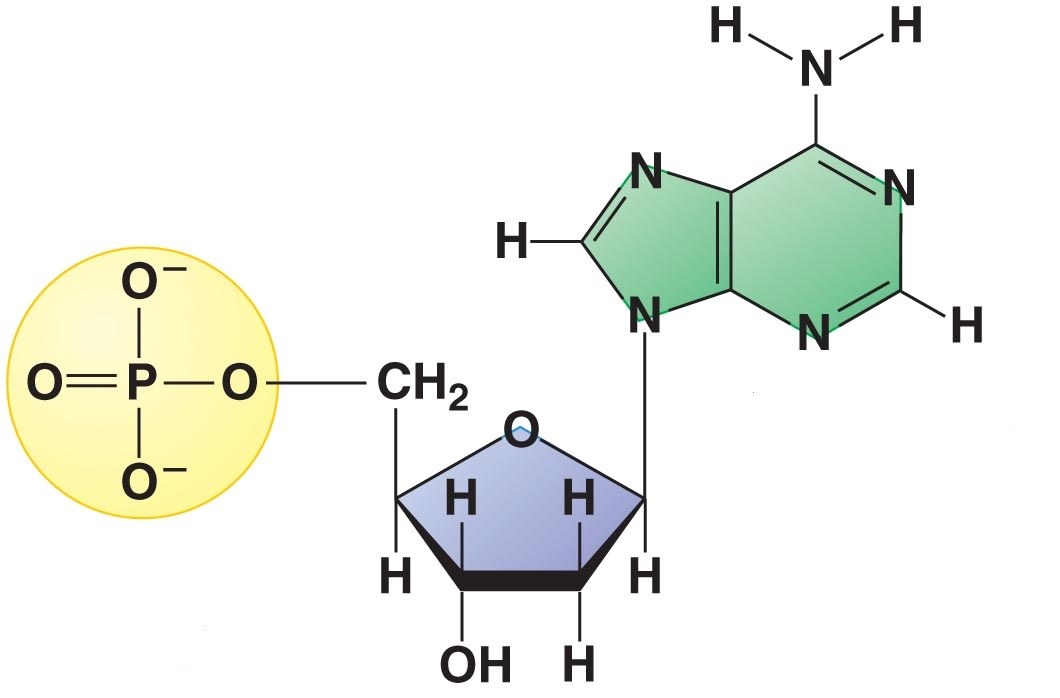
Name this structure
lipid
nucelotide
polypeptide
amino acid
Which two scientists were the first to build the double helix model of DNA?
Watson and Crick
Wilkins and Franklin
Wilkins and Crick
Watson and Franklin
The enzyme that unzips the DNA to prepare for replication is known as
helicase
replicase
polymerase
synthase


What does this image show?
the double helical structure of DNA
the triple helical structure of DNA
the double helical structure of RNA
the triple helical structure of RNA
What did Erwin Chargaff conclude from his experiments?
Nitrogen bases are held together by peptide bonds
A and T and C and G always occur in equal amounts
Proteins are the carriers of genetic information
C and G rarely occur in eukaryotic organisms
What was Watson and Crick's main scientific accomplishment?
Building the first accurate model of DNA.
Isolating strains of pneumonia causing bacteria.
Determining base pairing rules.
Discovering the process of genetic transformation.
From his work with mice and pneumonia-causing bacteria, Frederick Griffith discovered what?
Replication
Transcription
Transformation
Translation


Rosalind Franklin's famous "Photo 51" allowed Watson and Crick to determine the _______ of DNA.
helical shape
triple backbone
nitrogen bases
hydrogen bond configuration

What are the three main types of mutations?
insertions, deletions, and substitutions
deletions, segmentations, and substitutions
insertions, segmentations, and substitutions
What type of mutation has occurred?
Normal=GAGCTCGACAGA
Mutant= GAGCTCCACAGA
segmentation
substitution
insertion
deletion
What type of mutation has occurred?
Normal=GAGCTCGACAGA
Mutant=GAGCCGACAGA
substitution
deletion
insertion
segmentation
What type of mutation has occurred?
Normal=GAGCTCGACAGA
Mutant= GAGCTCCGACAGA
segmentation
substitution
insertion
deletion
Deletion and insertion mutations can cause
frameshifts.
replication.
translation.
protein synthesis.

Who worked with Rosalind Franklin to publish X-ray crystallography images of DNA?
James Watson
Francis Crick
Maurice Wilkins
Alfred Hershey
What scientist was trying to find a cure for pneumonia?
James Watson
Frederick Griffith
Maurice Wilkins
Oswald Avery
Which scientist first determined that DNA was the transforming factor from the pneumonia bacteria experiments?
Francis Crick
Alfred Hershey
Martha Chase
Oswald Avery

How does RNA differ from DNA?
RNA contains uracil and deoxyribose
RNA contains ribose and thymine
RNA contains uracil and ribose
RNA contains adenine and ribose


The process of making proteins in the ribosomes based on instructions from messenger RNA is called
transcription
transformation
translation
molecular biology


If a strand of DNA contains 20% thymine, how much guanine would be present?
30%
20%
80%
10%

What does this picture represent?
an amino acid
a lipid
a nucleotide
a DNA molecule
mRNA is made in the _______.
nucleus
ribosome
mitochondria
cytoplasm
The actual decoding of mRNA to a protein is called ?
translation
replication
transcription
nuclear fission
The building blocks of proteins are _______.
carbohydrates
sugars
lipids
amino acids
A sequence of three letters associated with mRNA is called a/an _______.
anticodon
codon
tri code
gene
What organelle does the mRNA attach to in order to make the protein?
ribosome
mitochondria
chloroplast
lysosome
During protein synthesis, an mRNA strand is transcribed from the following strand of DNA: GCG TTA CCT. What is the complementary mRNA strand?
CGC UUT CCT
CGC AAU GGA
GCG UUA CCU
CGC AAT GGA

