wayground logo

Free Printable Worksheets

Font size

S
M
L
XL
Worksheets

Chemical reactions and rates of reaction CUA review

Total questions: 80

Worksheet time: 4hrs 0mins

Name
Class
Date
1.

When we investigate the rate of reaction we are looking at the...

a)

amount of product formed

b)

speed of reaction

c)

concentration of reacting particles

d)

combining reactants with products

2.
Which factors increase the rate of a reaction.
a)
increasing temperature
b)
increasing concentration
c)
increasing surface area
d)
all of these
3.
Increase in temperature of the reactants can do one of the following
a)
Slow collision frequency
b)
Allow less effective collision between the particles
c)
Neutralise the reaction
d)
increase collision between the particles thus increasing the rate.
4.
Why does a catalyst increase the rate of reaction?
a)
it produces extra energy for the reactants
b)
it increases the speed of the reactant particles
c)
it increases the frequency of particle collisions
d)
it reduces the activation energy of the reaction 
5.
Which of the following increase the reaction rate?
a)
less surface area
b)
lower temperature
c)
an inhibitor
d)
increased concentration
6.
Why don't all collisions between particles cause a reaction?
a)
the particles also need to collide with a catalyst
b)
not all the particles collide with enough energy
c)
not all the particles collide at a high enough temperature
d)
the particles need to collide with each other twice
7.
To slow down a chemical reaction you will do one of the following:
a)
Place the reactants in hot water
b)
Place the products in ice bath
c)
Place the reactants in a ice bath
d)
Keep stirring the reactants with a stirring rod
8.

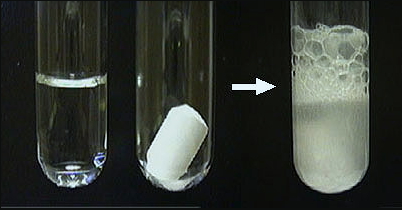
How could we make this reaction happen more quickly?

a)

Decrease the concentration of the acid

b)

crush the chalk to increase the surface area

c)

Put the test tube in an ice bath

9.

When surface area is decreased the rate of reaction...

a)

Decreases, because there are LESS possible sites for correct collisions

b)

Increases, because there are LESS possible sites for correct collisions

c)

Decreases, because there are MORE possible sites for correct collisions

d)

Increases, because there are MORE possible sites for correct collisions

10.

In which type of reaction do ions in two compounds switch places?

a)

synthesis

b)

decomposition

c)

single replacement

d)

double replacement

11.

The equation is an example of which type of chemical reaction? NaCl + AgF -->NaF + AgCl

a)

synthesis

b)

decomposition

c)

single replacement

d)

double replacement

12.

This equation is an example of which type of chemical reaction? Zn + 2HCl--> ZnCl2 + H2

a)

synthesis

b)

decomposition

c)

single replacement

d)

double replacement

13.

Which of the following chemical reactions illustrates a decomposition reaction?

a)

4H2 + 2O2 --> 2H2O

b)

2H2O --> 2H2 + O2

c)

6CO2 + 6H2O --> C6H12O6 + 6O2

d)

4KI + 2Cl2 --> 4KCl + 2I2

14.

Which phrase describes what happens to atoms in a chemical reaction?

a)

never lost or gained, just rearranged

b)

sometimes lost, never rearranged

c)

sometimes lost, gained, or rearranged

d)

lost or gained, never rearranged

15.

Which of the following chemical equations is balanced?

a)

Ca + 2O2 --> 2CaO2

b)

3Ca + O2 --> 3CaO2

c)

3Ca + 2O2 --> 5CaO2

d)

Ca + O2 --> CaO2

16.

The equation is an example of which type of chemical reaction? 2Na + Cl2 --> 2NaCl

a)

synthesis

b)

decomposition

c)

single replacement

d)

double replacement

17.
_P4+_O  _P2O3
a)
3 P4+1 O→ 2 P2O3
b)
1 P4+1 O→ 2 P2O3
c)
1 P4+ 3 O→ 2 P2O3
d)
1 P4+ 2 O→ 3 P2O3
18.
_AgNO3 + _Cu _Cu(NO3)2 + _Ag
a)
2 AgNO3 + 2 Cu → 3 Cu(NO3)2 + 1 Ag
b)
2 AgNO3 + 1 Cu → 1 Cu(NO3)2 + 2 Ag
c)
1 AgNO3 + 2 Cu → 2 Cu(NO3)2 + 1 Ag
d)
3 AgNO3 + 2 Cu → 3 Cu(NO3)2 + 2 Ag
19.
_BaS + _PtF2  _BaF2 + _PtS
a)
1 BaS + 1 PtF2 → 1 BaF2 + 1 PtS
b)
4 BaS + 2 PtF2 → 1 BaF2 +  1 PtS
c)
1 BaS + 2 PtF2→ 2 BaF2 +  2 PtS
d)
1 BaS + 3 PtF2 →1 BaF2 +  2 PtS
20.
_Al + _HCl →_H2 + _AlCl3
a)
2 Al + 2 HCl → 2 H2 + 6 AlCl3
b)
3 Al + 3 HCl → 6 H2 + 2 AlCl3
c)
1 Al + 1 HCl → 3 H2 + 1 AlCl3
d)
2 Al + 6 HCl → 3 H2 + 2 AlCl3
21.
_K + _Cl2 _KCl
a)
2 K + 16 Cl2 → 8 KCl
b)
2 K + 1 Cl2 → 2 KCl
c)
3 K + 4 Cl2 → 3 KCl
d)
1 K + 1 Cl2 →1 KCl
22.
_NaF + _Br2 _NaBr + _F2
a)
1NaF + 2 Br2 →1 NaBr + 2 F2
b)
2NaF + 2 Br2 → 2 NaBr + 2 F2
c)
2 NaF + 3 Br2 → 1 NaBr + 2 F2
d)
2 NaF + 1 Br2 → 2 NaBr + 1 F2
23.
Balance this equation,            Al2O3 ---> Al + O2 
a)
Cannot be balanced
b)
2Al2O3 ---> 2Al + 3O2 
c)
2Al2O3 ---> 4Al + 3O2 
d)
3Al2O3 ---> 2Al + O2 
24.
Balance this equation,            Al2O3 ---> Al + O2 
a)
Cannot be balanced
b)
2Al2O3 ---> 2Al + 3O2 
c)
2Al2O3 ---> 4Al + 3O2 
d)
3Al2O3 ---> 2Al + O2 
25.
Balance this equation:  H2 + N2 → NH3
a)
 H2 + 4N2 → NH3
b)
 H2 + 3N2 → 2NH3
c)
 3H2 + N2 → 2NH3
d)
 2H2 + 2N2 → 2NH3
26.
How many total atoms are represented?         4Al2O3
a)
2
b)
8
c)
5
d)
20
27.
Substances that enter into a chemical reaction (found to the left side of the arrow) 
a)
product
b)
reactant
c)
chemical
d)
balanced equation
28.
The large number in front of a chemical formula or compound is the ___________. 
a)
coefficient
b)
product
c)
physical
d)
chemical
29.
In every balanced chemical equation, each side of the equation has the same number of ____.  
a)
coefficients
b)
moles
c)
molecules
d)
atoms of each element
30.
Is the following equation balanced or unbalanced?
Fe + S --> FeS
a)
balanced
b)
unbalanced
31.
When balancing equations what does
 -->
mean?
a)
subscript
b)
equals
c)
it is just an arrow
d)
yield
32.
What is the part of the chemical equation in green called? 
Fe + S --> FeS
a)
products
b)
reactants
c)
yield
d)
chemical formula
33.
In this model, the reactants are...
a)
2H2O
b)
H2O2
c)
2H2
d)
O2
34.
In this model, the PRODUCTS are 
a)
2KI and 2KNO3
b)
2KI and Pb(NO3)2
c)
PbIand 2KI
d)
PbIand 2KNO3
35.
CxHy +O--> H2O + CO2
a)
Decomposition
b)
Double replacement
c)
Combustion
d)
Single Replacement
36.

What type of reaction is reaction A?

a)

Synthesis

b)

Decomposition

c)

Single replacement

d)

Double replacement

37.

What type of reaction is reaction B?

a)

Synthesis

b)

Decomposition

c)

Single replacement

d)

Double replacement

38.

What type of reaction is reaction D?

a)

Synthesis

b)

Decomposition

c)

Single replacement

d)

Double replacement

39.

Which of the following will increase the rate of a reaction? Click all that apply.

a)

Decreasing temperature

b)

decreasing concentration

c)

adding a catalyst

d)

decreasing surface area

40.

As temperature decreases, what happens to the rate of reaction?

a)

increases

b)

decreases

c)

stays the same

d)

it fluctuates fast to slow

41.

What reaction has the following general formula:

A + CD --> C + AD

a)

Combination

b)

Decomposition

c)

Single Replacement

d)

Double Replacement

e)

Combustion

42.

What reaction has the following general formula:

AB + CD --> CB + AD

a)

Combination

b)

Decomposition

c)

Single Replacement

d)

Double Replacement

e)

Combustion

43.

What type of Reaction is this?

a)

Combination/Synthesis

b)

Decomposition

c)

Single Replacement

d)

Double Replacement

e)

Combustion

44.

Which chemical reaction always starts with a hydrocarbon that reacts with oxygen and produces carbon dioxide and water?

a)

Decomposition

b)

Synthesis

c)

Combustion

d)

Single Replacement

45.

Balance this reaction:

____ NaF + ____ Br2 ---> ___ NaBr + ____ F2

a)

3,1,2,1

b)

1,2,3,4

c)

2,1,2,1

d)

1,2,1,2

46.
Which generalized equation represents a decomposition reaction?
a)
A + BC → AC+ B
b)
A + B → AB
c)
AB → A + B
47.
Which generalized equation represents a decomposition reaction?
a)
A + BC → AC+ B
b)
A + B → AB
c)
AB → A + B
48.

What is the Law of Conservation of Mass?

a)

It states that matter cannot be created or destroyed.

b)

It states that energy cannot be created or destroyed.

c)

It states that matter can be created or destroyed.

d)

It states that sound can be created or destroyed.

49.

Balance this equation

_Al +_HCl --> _H2 +_AlCl3

a)

2,6,3,2

b)

it's already balanced

c)

4,12,3,4

d)

2,1,4,5

50.

Determine the coefficients to make the following equation balanced?

__N2 + __O2--> __NO

a)

1, 1, 1

b)

1, 1, 2

c)

2, 2, 2

d)

1, 2, 2

51.
The large number in front of a chemical formula or compound is the ___________. 
a)
coefficient
b)
product
c)
physical
d)
chemical
52.
How many oxygens are in Al₂(SO₄)₃?
a)
4
b)
12
c)
7
d)
24
53.

How many Magnesium atoms are in 10MgCl2?

a)

10

b)

5

c)

20

54.

How many Hydrogen atoms in 3(NH₄)₂CrO₄?

a)

4

b)

2

c)

8

d)

24

55.
The red numbers in the image below represent ________
a)
subscripts
b)
coefficients
c)
I don't know, and don't want to try
d)
None of the answers are correct
56.

To balance an equation you should:

a)

ONLY change subscripts.

b)

ONLY change coefficients.

c)

Change BOTH subscripts and coefficients.

57.

How many atoms of oxygen are represented in the picture?

a)

2

b)

3

c)

5

d)

6

58.

What factor that would affect the rate of reaction is being displayed in the image?

a)

Temperature

b)

Catalyst

c)

Surface area

d)

Concentration

e)

Agitation

59.

What factor that would affect the rate of reaction is being displayed in the image?

a)

Temperature

b)

Catalyst

c)

Surface area

d)

Concentration

e)

Agitation

60.

 Δ\Delta  What does the Δ above the arrow represent in the chemical reaction?What\ does\ the\ \Delta\ above\ the\ arrow\ represent\ in\ the\ chemical\ reaction?  

a)

A Catalyst

b)

A reactant

c)

A product

d)

Heat added

61.

What does then (aq) represent in the following chemical equation?

a)

Solid

b)

Liquid

c)

Gas

d)

Aqueous

e)

Catalyst

62.

What does (MnO2) represent in the following chemical equation?

a)

Solid

b)

Liquid

c)

Gas

d)

Aqueous

e)

Catalyst

63.

Which of the following is in a gaseous state?

a)

H2O2

b)

H2O

c)

O2

d)

MnO2

e)

None are a gas

64.

Which of the following are the products in the reaction? Check all that apply.

a)

H2O2

b)

H2O

c)

O2

d)

MnO2

e)

All of the above

65.

Using a bundle of small twigs to start a fire, verses one large log represents which factor that would affect the rate of reaction?

a)

Temperature

b)

Catalyst

c)

Surface area

d)

Concentration

e)

Agitation

66.

What is the general reaction scheme for a single replacement reaction?

a)

A + B --> AB

b)

AB --> A + B

c)

A + CD --> C + AD

d)

AB + CD --> CB + AD

e)

CxHy+O2 > CO2+H2OC_xH_y+O_2\ ->\ CO_2+H_2O

67.

What type of reaction is the following:
 2H2+O2>2H2O2H_2+O_2->2H_2O  

a)

Combination

b)

Decomposition

c)

Single Replacement

d)

Double Replacement

e)

Combustion

68.

What type of reaction is the following:
 BaCl2+2KI > 2KCl + BaI2BaCl_2+2KI\ ->\ 2KCl\ +\ BaI_2  

a)

Combination

b)

Decomposition

c)

Single Replacement

d)

Double Replacement

e)

Combustion

69.

What type of reaction is the following:
 2KI > 2K + I22KI\ ->\ 2K\ +\ I_2  

a)

Combination

b)

Decomposition

c)

Single Replacement

d)

Double Replacement

e)

Combustion

70.

What type of reaction is the following:
 2NaHCO3> Na2CO3+CO2+H2O2NaHCO_3->\ Na_2CO_3+CO_2+H_2O  

a)

Combination

b)

Decomposition

c)

Single Replacement

d)

Double Replacement

e)

Combustion

71.

What type of reaction is the following:
 2C4H10 +13O2 > 8CO2+10H2O2C_4H_{10}\ +13O_2\ ->\ 8CO_2+10H_2O 

a)

Combination

b)

Decomposition

c)

Single Replacement

d)

Double Replacement

e)

Combustion

72.

What type of reaction is the following:
 Ag3N + 3HBr>3AgBr+H3NAg_3N\ +\ 3HBr->3AgBr+H_3N 

a)

Combination

b)

Decomposition

c)

Single Replacement

d)

Double Replacement

e)

Combustion

73.
Coal contains carbon and other elements. Carbon dioxide forms when coal burns in the presence of oxygen. Which of these is the best evidence that a chemical reaction occurs when coal burns?
a)
The shape of the coal changes
b)
Oxygen is present
c)
A new substance is produced
d)
Coal is made up of more than one element
74.
At the end of chemical reactions, what is the total mass of the reactants compared to the total mass of the products?
a)
the product is doubled
b)
the product is half the mass of the reactants
c)
the mass is the same
d)
the mass changes depending on the reaction
75.

Harrison is making cake. He prepares some batter and places it into the oven. Harrison realizes a gas, carbon dioxide, is coming out of the batter as it bakes.


Harrison está haciendo pastel. Prepara un batido y lo mete en el horno. Harrison se da cuenta de que sale gas, dióxido de carbono, de la masa mientras se hornea.


Which options are true about carbon dioxide?

¿Qué opciones son ciertas sobre el dióxido de carbono?

a)

It is a new gas that forms during baking.

b)

It is made of atoms that did not exist before.

c)

It is the dough changing states from solid to gas.

d)

It is formed from the atoms of the batter

76.
Balance this reaction: ____ BaS + ____ PtF2 ---> ____ BaF2 + ____ PtS
a)
1,1,1,1
b)
1,2,1,1
c)
1,1,1,2
d)
2,1,1,1
77.
Which number should go in the blank?
_ H2 + O2 -> 2 H2O
a)
1
b)
2
c)
3
d)
0
78.

What physical state symbol should be included for water?

a)

(s) - solid

b)

(l) - liquid

c)

(g) - gas

d)

(aq) - aqueous

79.
__NaClO--> __NaCl + __O2
a)
2,2,2
b)
2,2,3
c)
3,2,2
d)
1,2,3
80.
Which problem is balanced?
a)
PbO2 + 2H2
b)
SO2 + H20 --> H2SO4
c)
2Na + 2H2O --> 2NaOH + H2