Wayground logo

Free Printable Worksheets

Font size

S
M
L
XL
Worksheets

Natural Selection

Total questions: 60

Worksheet time: 58mins

Name
Class
Date
1.
Which of these is an example of natural selection?
a)
The largest animal in a population will have more opportunities for reproduction.
b)
Several species of organisms work together so that they all succeed.
c)
One species takes all the resources in an environment leaving none for others.
d)
Organism that are best suited to an environment tend to survive and reproduce more often.
2.
Breed an organism for a desired trait is the definition of
a)
selective breeding
b)
natural selection
c)
natural breeding
d)
biological evolution
3.
Evolution works by 
a)
individuals changing to suit their environment
b)
Individuals learned new traits and pass them on
c)
sudden change in the environment cause a species change 
d)
small changes pass down through many generations
4.

A gene pool consists of

a)

all of the genes, including all the different alleles, that are present in a population

b)

some of the genes, including the different alleles, that are present in a population

c)

all of the genes that are present in all populations

d)

all of the genes, including all the different alleles, that are present in all populations

5.

The number of times a particular allele appears in a gene pool is known as the

a)

population of the allele

b)

relative percentage of the allele

c)

frequency of the allele

d)

evolution of the allele

6.
Genetic drift is change in the allele frequency of a population due to...
a)
random chance
b)
natural selection
c)
non-random mating (sexual selection)
d)
artificial selection
7.
This mechanism of evolution occurs when populations migrate.
a)
Extinction
b)
Gene flow
c)
Genetic drift
d)
Natural Selection
8.
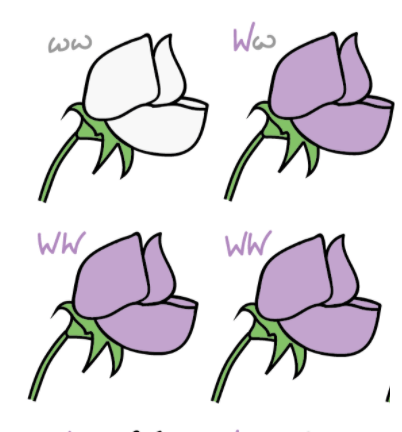
What is this an example of?
a)
diversity of species
b)
variation
c)
vestigial structures
d)
DNA studies
9.
What is the name of the process in which the most favorable traits are passed onto the next generation?
a)
Genetic drift
b)
Gene pool
c)
Gene flow
d)
Natural selection
10.

Which answer is more appropriate?

a)

Traits are good or bad.

b)

Traits can be harmful or hurtful depending on the environment.

c)

Traits are always helpful or hurtful, regardless of the environment.

d)

Traits are helpful or bad.

11.

Why are advantageous traits more likely to be passed onto offspring?

a)

Because the parents are more likely to survive and reproduce.

b)

Because they come from dominant alleles.

c)

Because they come from recessive alleles.

d)

Because the trait is an acquired phenotype.

12.

Why are advantageous traits more likely to be passed onto offspring?

a)

Because the parents are more likely to survive and reproduce.

b)

Because they come from dominant alleles.

c)

Because they come from recessive alleles.

d)

Because the trait is an acquired phenotype.

13.

Three or more alleles for a particular gene

a)

sex linked

b)

multiple alleles

c)

codominance

d)

incomplete dominance

14.

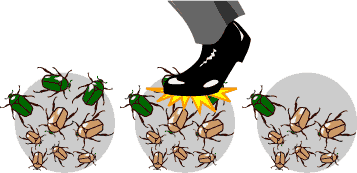
Someone steps on some bugs and randomly removes their alleles from the population. This is an example of

a)

gene flow

b)

genetic drift

c)

speciation

d)

allele frequency

15.

There are 3 T alleles and 7 t alleles in a population. Calculate the frequency of the recessive allele.

a)

30%

b)

70%

c)

10%

d)

4%

16.

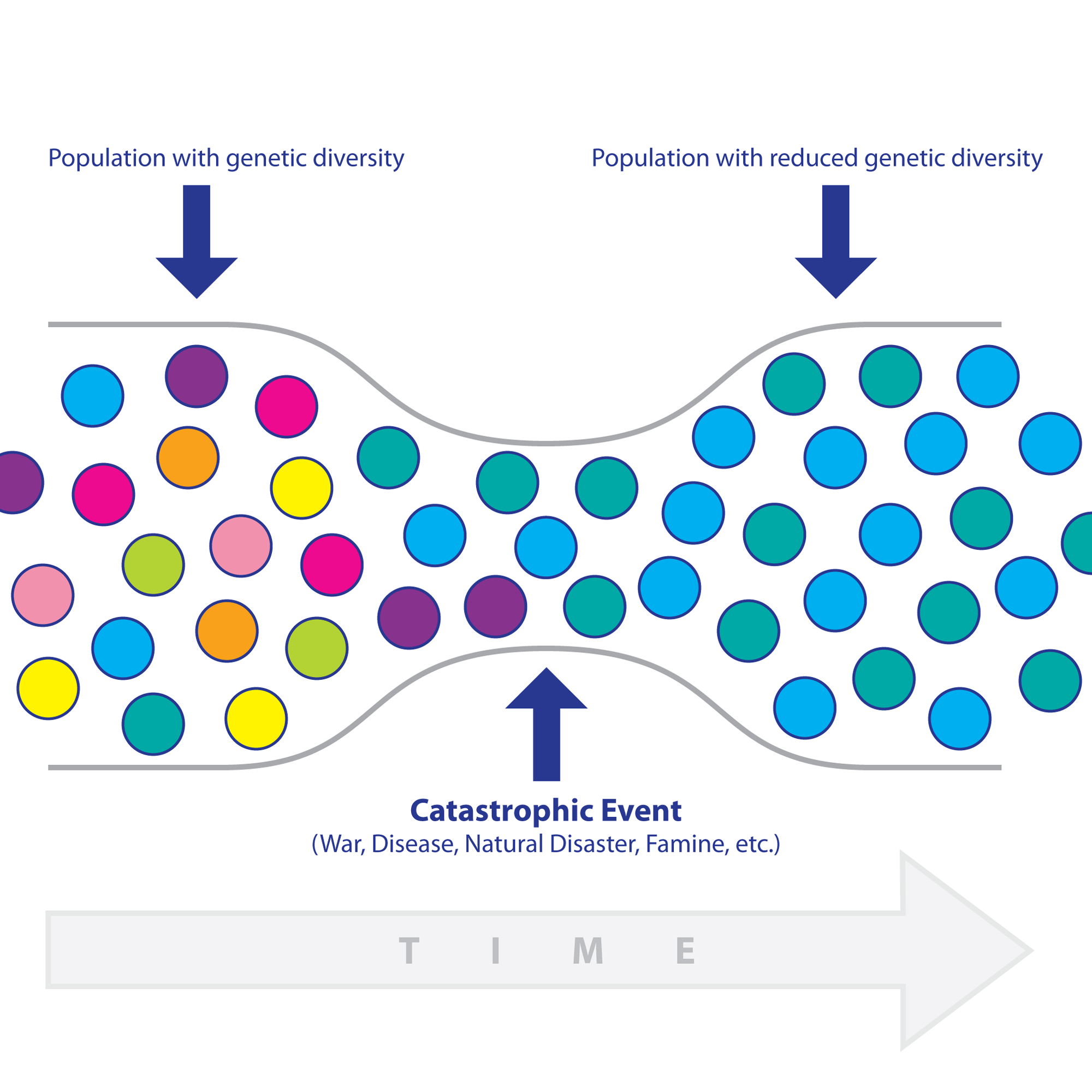
A drastic reduction in the size of a population that can change allele frequencies is called

a)

the bottleneck effect

b)

the founder effect

c)

the gene flow effect

d)

the Thanos effect

17.

Alleles that improve survival will decrease in frequency in the next generation.

a)

True

b)

False

18.

Which is NOT an assumption of Hardy-Weinberg?

a)

natural selection

b)

large populations

c)

no mutations

d)

no migration

e)

random mating

19.

If a population of lizards is isolated on an island, with no new immigrants over many years, any new genetic variations are most likely to come from

a)

recessive alleles

b)

natural selection

c)

mutations

d)

speciation

20.

What is the frequency of the dominant allele in this population?

a)

30%

b)

50%

c)

63%

d)

37%

21.

If all 5 Hardy-Weinberg assumptions are true, a population is said to be in genetic equilibrium. This means

a)

it is evolving

b)

it is not evolving

22.

An allele combination (BB, Bb, or bb) is called a

a)

phenotype

b)

genotype

c)

mutation

d)

gene flow

23.

Small populations are more prone to genetic drift than large populations.

a)

True

b)

False

24.

Select ALL of the following that violate the Hardy-Weinberg assumptions and would lead to a change in allele frequencies in a population.

a)

natural selection

b)

large population

c)

no mutations

d)

nonrandom mating

e)

no migration

25.

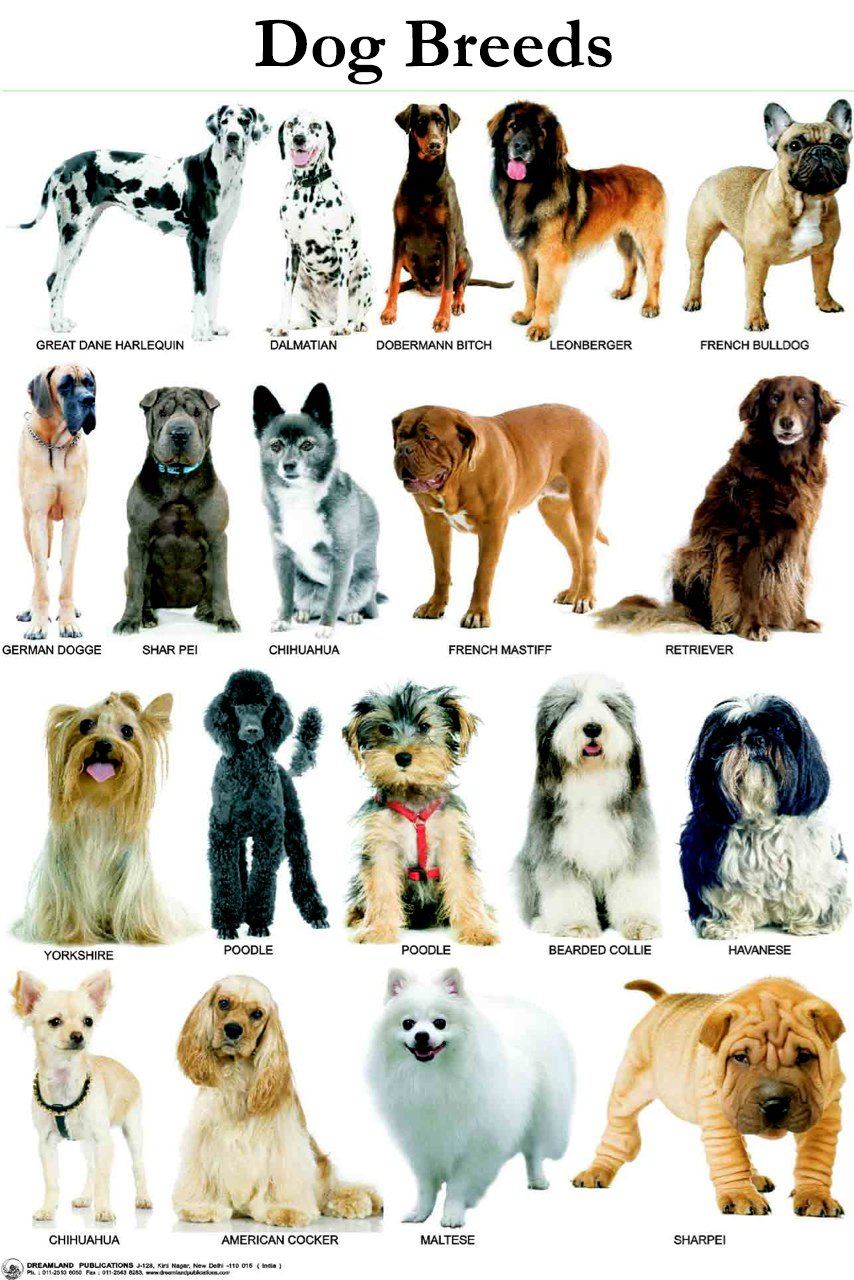
Dog breeding is an example of

a)

natural selection

b)

genetic drift

c)

speciation

d)

artificial selection

26.
What is founder effect?
a)
Any change in the allelic frequencies in a population that is due to chance
b)
›A small sample of a population settles in a location separated from the rest of the population
c)
  The process in which humans select for or against particular features in organisms
d)
›Members of one sex choose mates with particular features
27.
What is genetic drift?
a)
The movement of genes in/out of a population
b)
A small, random change in the DNA
c)
Any change in the allelic frequencies in a population that is due to chance
d)
›The process in which humans select for or against particular features in organisms
28.
What is genetic drift?
a)
The movement of genes in/out of a population
b)
A small, random change in the DNA
c)
Any change in the allelic frequencies in a population that is due to chance
d)
›The process in which humans select for or against particular features in organisms
29.
What does the Hardy-Weinberg equilibrium measure?
a)
changes in allele frequencies
b)
numbers of mutations
c)
goodness of fit
d)
genetic diversity
30.
What type of selection is this?
a)
Directional Selection
b)
Stabilizing Selection
c)
Disruptive Selection
d)
Natural Selection
31.
Which is a mechanism for change in allele frequency?
a)
gene flow
b)
genetic drift
c)
natural selection
d)
all answers are correct
32.
In the Hardy-Weinberg theorem, p refers to what?
a)
The frequency of the dominant allele.
b)
The frequency of the homozygous genotype.
c)
The frequency of the recessive allele.
d)
The frequency of the homozygous dominant.
33.

You sample a population of butterflies and find that 42% are heterozygous for a particular gene. What would be the frequency of the recessive allele in this population?

a)

0.30

b)

0.49

c)

0.70

d)

Allele frequency cannot be estimated from this information.

34.
A population of 150 individuals has an allele frequency of 0.3 for the dominant allele (B) and a frequency of 0.7 for the recessive allele (b). Use the Hardy-Weinberg equation to determine the frequency of the genotype (bb).
a)
0.09
b)
0.42
c)
0.49
d)
0.21
35.
In the Hardy-Weinberg Equation, q2 is the frequency of what?
a)
The recessive allele 
b)
the dominant allele
c)
the recessive genotype
d)
the dominant genotype
36.
What does the variable q represent?
a)
Frequency of the heterozygote genotype
b)
Frequency of the homozygous recessive genotype
c)
The frequency of the recessive allele
d)
The frequency of the dominant allele 
37.
What type of selection is this?
a)
Directional Selection
b)
Stabilizing Selection
c)
Disruptive Selection
d)
Natural Selection
38.
This makes an organism more suited to its enviornment
a)
species
b)
lifespan
c)
adaptation
d)
mutation
39.

Natural selection results in change in a population's _____________ traits over time.

a)

inherited

b)

acquired

40.

Brown mice survive and reproduce in their desert environment better than white mice because owls can see and eat the white mice more easily. In this situation, what part of the environment is doing the selecting?

a)

predator

b)

soil composition

c)

mouse fur color

d)

sexual preferences

41.

A phenotype that improves an organism’s chance of survival in their environment is considered a(n) ____________.

a)

natural selection

b)

adaption

c)

speciation

42.

How does a species change over time?

a)

by adapting to the environment

b)

changes in the gene frequencies in a population

c)

acquiring new traits

d)

they do not change

43.

Which does NOT cause genetic variation?

a)

crossing over in meiosis

b)

mutations

c)

acquired traits

44.
Genetic differences between organisms of the same species
a)
Variation
b)
Adaptation
c)
Behavior
d)
Environment
45.
The struggle for existence against other members of an organisms species is
a)
Competition
b)
Natural Selection
c)
gene flow
d)
genetic drift
46.
A group of similar organisms that can mate with each other and produce fertile offspring is called a species.  
a)
True  
b)
False
47.
Mutations are important because they bring about
a)
death of the organism in which they develop
b)
genetic variation needed for a population to evolve
c)
benefits for the individual, not for the population
d)
Hardey-Weinberg equilibrium within a population
48.
Why are advantageous traits more likely to be passed onto offspring?
a)
Because they are more likely to survive and reproduce.
b)
Because they come from dominant alleles.
c)
Because they come from recessive alleles.
d)
Because the trait is an acquired phenotype.
49.

The different forms of a gene are called

a)

traits

b)

pollinators

c)

alleles

d)

hybrids

50.

What type of inheritance is determined by multiple genes and there can be a range of traits?

a)

Codominance

b)

Incomplete dominance

c)

Polygenic traits

51.
Homozygous is when...
a)
the alleles are the same
b)
the alleles are different
c)
the alleles are absent
d)
the alleles are present
52.
This is when a trait is controlled by more than one gene.
a)
Multiple alleles
b)
Polygenetic inheritance
c)
Codominance
d)
Incomplete Dominance 
53.

individuals with alleles for an extreme type are more likely to survive and reproduce

a)

stabilizing selection

b)

directional selection

c)

disruptive selection

d)

genetic drift

54.

the selection pressure favors the extreme phenotypes, dividing the population into 2 distinct groups

a)

directional selection

b)

stabilizing selection

c)

geographic selection

d)

disruptive selection

55.

Individuals with intermediate traits are more likely to survive and reproduce

a)

stabilizing selection

b)

directional selection

c)

adaptive radiation

d)

disruptive selection

56.

Tall kelp have a distinct advantage over shorter kelp in receiving needed sunlight in their ocean environment

a)

directional selection

b)

disruptive selection

c)

stabilizing selection

d)

sexual selection

e)

artificial selection

57.

Aspen trees that are over 25 m tend to blow over in high winds; aspen that are under 15 m don't get enough sun

a)

directional selection

b)

stabilizing selection

c)

disruptive selection

d)

artificial selection

e)

sexual selection

58.

snails with a forward spiral and snails with a backward spiral have an advantage in their environment

a)

directional selection

b)

stabilizing selection

c)

disruptive selection

d)

artificial selection

e)

sexual selection

59.

Fish that produce 40,000+ eggs have greater fitness than fish that produce less than this number

a)

directional selection

b)

stabilizing selection

c)

disruptive selection

d)

artificial selection

e)

sexual selection

60.

Light-colored oysters would blend into the rocks in the shallows, and the darkest would blend better into the shadows. The ones in the intermediate range make them easier prey.

a)

directional selection

b)

stabilizing selection

c)

disruptive selection

d)

artificial selection

e)

sexual selection