Wayground logo

Free Printable Worksheets

Font size

S
M
L
XL
Worksheets

Force and Motion

Total questions: 120

Worksheet time: 2hrs 12mins

Name
Class
Date
1.

Match the graph to the description:

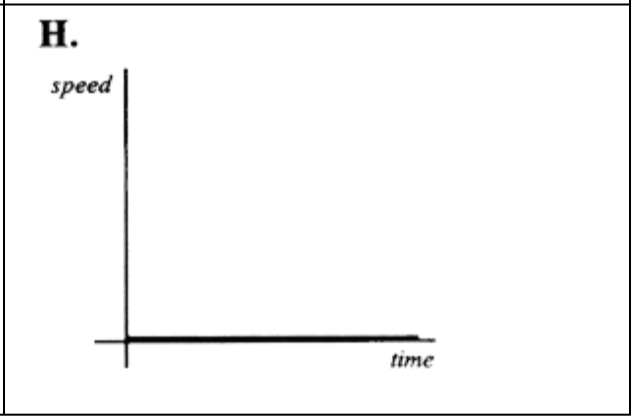
"The car is stopped."
a)
b)
c)
d)
2.

Match the graph to the description:

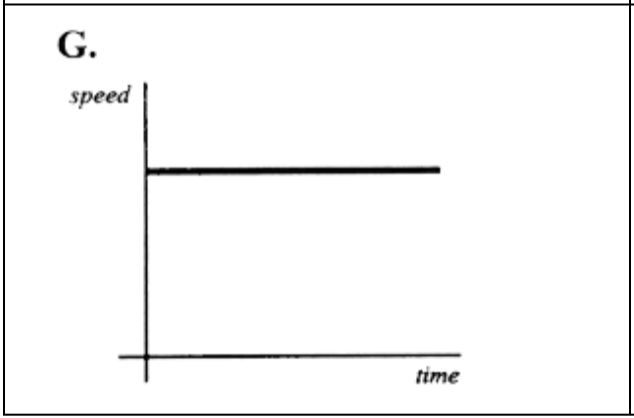
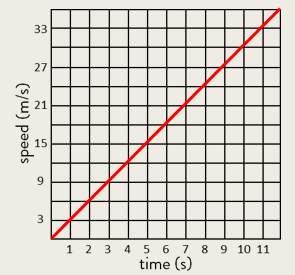
"The car is traveling at a constant speed."

a)
b)
c)
d)
3.

Match the graph to the description:

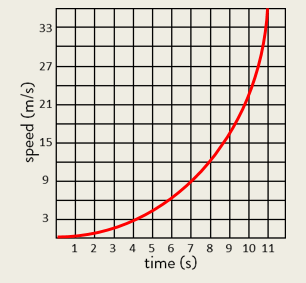
"The car is accelerating speeding up (positive acceleration)."

a)
b)
c)
d)
4.

Match the graph to the description:

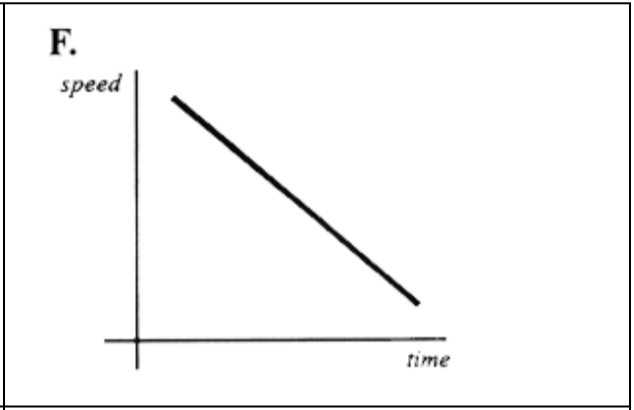
"The car is slowing down (negative acceleration)."
a)
b)
c)
d)
5.

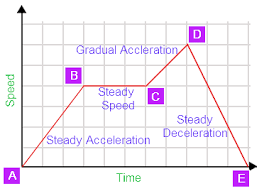
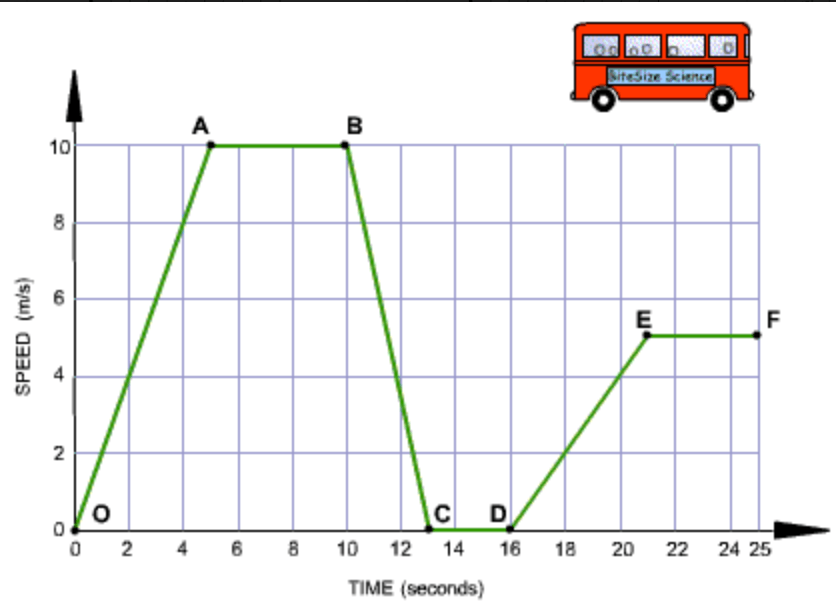
Segment O-A: The bus is _________________. It's speed changes from 0m/s to 10 m/s in 5 seconds.

a)

accelerating

b)

decelerating

c)

constant speed

d)

at rest

6.

Segment A-B: The bus is moving at a _________________ of 10 m/s for 5 seconds.

a)

accelerating

b)

decelerating

c)

constant speed

d)

at rest

7.

Segment B-C: The bus is _________________. It is slowing down from 10 m/s rest in 3 seconds.

a)

accelerating

b)

decelerating

c)

constant speed

d)

at rest

8.

Segment C-D: The bus is _________________. It has stopped.

a)

accelerating

b)

decelerating

c)

constant speed

d)

at rest

9.

Segment D-E: The bus is _________________. It is gradually increasing it's speed.

a)

accelerating

b)

decelerating

c)

constant speed

d)

at rest

10.

Segment E-F: The bus is moving at a _________________ of 5 m/s for 4 seconds.

a)

accelerating

b)

decelerating

c)

constant speed

d)

at rest

11.
A train travels 25 km in .5 hrs. How fast is the train going?
a)
25 miles/hr
b)
5 miles/hr
c)
125 km/hr
d)
50 km/hr
12.
What is the equation to calculate distance?
a)
distance = speed/time
b)
distance = time/speed
c)
distance = speed/distance
d)
distance = speed x time 
13.
A car travels 30 miles/hr for 3 hours, calculate the distance it will travel
a)
90 miles
b)
10 miles
c)
600 miles
d)
90 km
14.
A boat travels at 22 km/hr for 10 hrs, what distance will it travel?
a)
220 miles
b)
2.2 km
c)
220 km
d)
22 km
15.
What is the speed of a man who runs 10 miles in 1 hr?
a)
20 miles
b)
10 m/min
c)
10 miles/hr
d)
20 hrs
16.
A man runs at 10 m/min for 5 min, what distance will he run?
a)
10 miles
b)
10 m
c)
5 m
d)
50 m
17.
A speed boat travels 200 miles at a speed of 20 miles/hr. How much time will it take to travel the 200 miles?
a)
10 hrs
b)
10 miles
c)
400 hrs
d)
100 km
18.
Dave runs a 400 m race with a speed of 4 m/s. What time will it take him to finish the race?
a)
400 minutes
b)
100 minutes
c)
100 seconds 
d)
.25 seconds 
19.
Which of the following is a unit of speed?
a)
km/hr
b)
hr
c)
km
d)
s
20.
Which of the following is a unit of time?
a)
km/hr
b)
hr
c)
km
d)
mi
21.
Which of the following is a unit of distance ?
a)
miles/hr
b)
hr
c)
km
d)
min
22.
Which of the following is a unit of distance ?
a)
miles/hr
b)
mi
c)
s
d)
min
23.
Which of the following is a unit of time?
a)
sec
b)
mi
c)
m/s
d)
km
24.
Which of the following is a unit of speed ?
a)
sec
b)
mi
c)
m/s
d)
min
25.
Mrs. Avery speed walked 2 miles in 10 minutes, what is her speed?
a)
0.2 miles/min
b)
2 miles/min
c)
20 miles/min
d)
40 miles/min
26.
Dr. Barkley drives his speed boat 22 km at 45 km/hr how, how long will it take him to go the 22 km?
a)
48 hrs 
b)
0.48 hrs
c)
990 hrs
d)
45 min
27.
Mr. Hoppe drives his race car for 4 hrs at 150 miles/hr. How far will he travel?
a)
600 km
b)
60 miles
c)
6 miles
d)
600 miles
28.
What is the speed of a car that travels 400 m in 20 minutes?
a)
20 miles/hr
b)
20 m/min
c)
800 m/min
d)
200 miles/hr
29.
What is the equation to calculate speed?
a)
speed = distance/time
b)
speed = time/distance
c)
speed = time x distance 
d)
speed = speed/time 
30.
What is the equation to calculate time?
a)
time = speed/distance
b)
time = distance/speed 
c)
time = speed x distance 
d)
time = distance x speed
31.
What equation do I use to calculate speed?
a)
S = D/T
b)
T = D/S
c)
D=TS
32.
What equation do I use to calculate time?
a)
S = D/T
b)
T = D/S
c)
D=TS
33.
What equation do I use to calculate distance?
a)
S = D/T
b)
T = D/S
c)
D=TS
34.
What key word tells me I'm measuring speed?
a)
how fast
b)
how far
c)
how long
35.
What key word tells me I'm measuring time?
a)
how fast
b)
how far
c)
how long
36.
What key word tells me I'm measuring distance?
a)
how fast
b)
how far
c)
how long
37.
What unit would I use when measuring speed?
a)
m/sec
b)
meters
c)
seconds
38.
What unit would I use when measuring time?
a)
m/sec
b)
meters
c)
seconds
39.

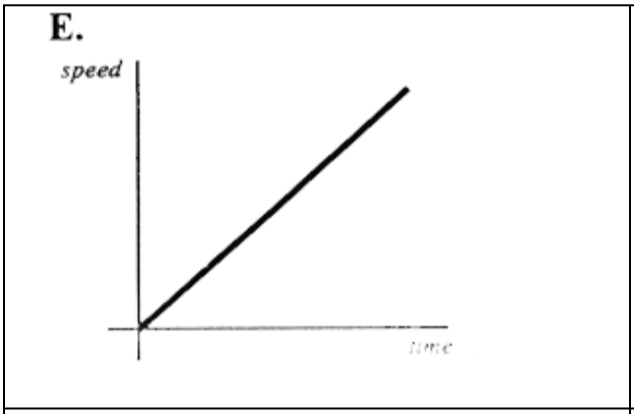
What is this graph showing?

a)

Gradually slowing down

b)

Gradually speeding up

c)

Constant speed

d)

Stopped

40.

What is this graph showing?

a)

At rest

b)

Acceleration

c)

Constant speed of 1 m/s

d)

Gradually speeding up

41.

What is this graph showing?

a)

Constant speed

b)

Gradually speeding up

c)

Gradually slowing down

d)

At rest

42.
a)

Accelerating gradually

b)

Stopping

c)

Slowing down constantly

d)

Speeding up constantly

43.

What is this graph showing?

a)

Fast constant speed

b)

Slow constant speed

c)

At rest

d)

Accelerating

44.

What is this graph showing?

a)

Constantly slowing down

b)

Constantly speeding up

c)

Acceleration

d)

Returning to starting point

45.

What is this graph showing?

a)

Two objects speeding up constantly

b)

Two objects slowing down constantly

c)

Two objects accelerating

d)

Two objects at rest

46.

What is this graph showing?

a)

Fast constant speed

b)

Slow constant speed

c)

Accelerating

d)

At rest

47.

What is the graph showing?

a)

Slowing down moving toward start

b)

Speeding up moving toward start

c)

Slowing down moving away from start

d)

Speed up moving away from start

48.

What is the graph showing?

a)

Speeding up moving away from start

b)

Speeding up moving towards start

c)

Slowing down moving towards start

d)

Slowing down moving away from start

49.

What is the graph showing?

a)

Constant speed towards start

b)

Constant speed away from start

c)

Acceleration away from start

d)

Acceleration towards start

50.
a)

Slows down toward start

b)

Slows down away from start

c)

Speeds up while toward start

d)

Speeds up away from start

51.

What is the graph showing?

a)

Slows down toward start

b)

Speeds up toward start

c)

Slows down away from start

d)

Speeds up away from start

52.

What is the graph showing?

a)

Constant high speed

b)

Stopped

c)

Accelerating

d)

Constant low speed

53.

What is the graph showing?

a)

Constant speed away from start

b)

Constant speed toward start

c)

Accelerating away from start

d)

Stopped toward start

54.

What is this graph showing?

a)

Gradually slowing down

b)

Gradually speeding up

c)

Constant speed

d)

Stopped

55.

What is this graph showing?

a)

At rest

b)

Acceleration

c)

Constant speed of 1 m/s

d)

Gradually speeding up

56.
a)

Accelerating gradually

b)

Stopping

c)

Slowing down constantly

d)

Speeding up constantly

57.

What is this graph showing?

a)

Constantly slowing down

b)

Constantly speeding up

c)

Acceleration

d)

Returning to starting point

58.

At what point is the speed the greatest?

a)

C-D

b)

B-C

c)

A-B

d)

D-E

59.

A negative acceleration means that your object is _____.

a)

doing nothing

b)

moving in circles

c)

speeding up

d)

slowing down

60.

What is happening during point A to B?

a)

not moving

b)

increasing speed at a constant rate

c)

moving at a constant speed

d)

moving at 10 m/s2 acceleration

61.

What is happening during point C to D?

a)

not moving

b)

increasing speed at a constant rate

c)

moving at a constant speed

d)

moving at 0 m/s2 acceleration

62.
A car travels 300 km in 6 hours. What is the average speed of the car (in km/hr)?
a)
0.02 km/hr
b)
1,800 km/hr
c)
50 km/hr
d)
50 km
63.
What is the speed of a jet plane that flies 7200 km in 9 hours ( in km/hr)
a)
800 km/hr
b)
80 km/hr
c)
800 hrs
d)
64,800 km/hr
64.
A storm is moving toward your house at a speed of 20 km/hr.  It is now 60 km away from your house.  In what time will the storm reach your house?
a)
0.3 hours
b)
1200 hours
c)
3 km
d)
3 hours
65.
An airplane leaves Orlando, FL and travels 540 miles to Washington D.C. The flight takes 90 minutes. What is the speed of the plane?
a)
0.17 m/s
b)
6 m/s
c)
6 s 
d)
480 m/s
66.
A rocket is launched from the launch pad at a speed of 700 km/hr.  How far will the rocket have traveled after 1.0 hour?
a)
699 km
b)
700 km
c)
350 km
d)
700 hours
67.
A hot air balloon traveled 2.5 hours at a speed of 450 km/hr. What distance did it travel?
a)
87 m/s
b)
1300 m/s
c)
180 km
d)
1,125 km
68.
What is the average speed of a walker who walks 500 m in 400 seconds?
a)
1.25 m/s
b)
100 m/s
c)
0.8 m/s
d)
200,000 m/s
69.
A truck travels down the highway at a speed of 110 km/hr.  How long does the trip last if the truck covered 2200 km?
a)
0.05 hours
b)
20 hours
c)
2,090 hours
d)
242,000 hours
70.

Which of the following is an example of balancing forces?

a)

A Book resting on the table.

b)

A pencil is knocked off the desk.

71.

Which of the following is an example of an unbalanced force?

a)

A book resting on the table.

b)

A pencil that is knocked to the ground.

72.

A push or a pull is called a

a)

Gravity

b)

Force

73.

What is Newton's 1st Law?

a)

For every action there is an equal and opposite reaction.

b)

An object at rest will stay at rest, an object in motion will stay in motion, unless an unbalanced force acts upon it.

74.

What is Newton's 2nd Law?

a)

For every action there is an equal and opposite reaction.

b)

Acceleration depends on two variables, the mass of the object and the amount of force.

75.

What is Newton's 3rd Law?

a)

For every action there is an equal and opposite reaction.

b)

Acceleration depends on two variables, the mass of the object and the amount of force.

76.

What explains why objects resist changes in their state of motion?

a)

gravity

b)

inertia

c)

force

d)

friction

77.

What explains a quantity that has BOTH speed and direction?

a)

Inertia

b)

Force

c)

Speed

d)

Velocity

78.

Newton's Second Law is based on two variables, they are .....

a)

mass and the amount of force

b)

gravity and friction

79.

Newton's first law states that an object must travel at a constant speed and in ___________, unless an unbalanced force acts on it.

a)

in a circle

b)

a wave like manner

c)

the same direction

80.

What would happen if a ball was kicked is space?

a)

It continues in the same direction, speeding up as it goes.

b)

It continues in the same direction, speeding up as it goes.

c)

It continues to move in the same direction unless it hits something or is affected by gravity or another force.

81.

Which way would a swimmer push to move forward in the water?

a)

To the left

b)

Forward

c)

Backward

d)

To the right

82.

The reason a boat bounces off the dock when it hits it.

a)

The boat and the dock repel each other.

b)

When the boat exerts a force on the dock, the dock exerts a force on the boat.

83.

Looking at the image. Decide if this is balanced or unbalanced.

a)

Unbalanced

b)

Balanced

84.

Looking at the image. Decide if this is balanced or unbalanced.

a)

Unbalanced

b)

Balanced

85.

Suppose an Astronaut floating in space throws a rock. What will happen to the rock?

a)

It will continue to move in the same direction, speeding up as it moves.

b)

It will continue to move at the same speed and in the same direction until it is acted upon by another force.

86.

The force that prevents a ball rolling on the ground from continuing on it's path forever is...

a)

Friction

b)

Gravity

c)

Inertia

87.

If an object is accelerating, then the forces actin on it must be:

a)

Balanced

b)

Unbalanced

88.

The ___________ of the car was 65 kph.

a)

Speed

b)

Velocity

89.

Newton made rules that describe patterns of events in nature. These are called ....

a)

Laws

b)

Ideas

90.
According to Newton’s first law of motion, a moving object that is not acted on by an unbalanced force will
a)
remain in motion.
b)
eventually come to a stop.
c)
change its momentum.
d)
accelerate.
91.
Which law explains when a magician pulls a tablecloth out from under dishes and glasses on a table without disturbing them.
a)
Law 1
b)
Law 3
92.
A person steps out of the boat and onto the dock.  As the person moves forward onto the dock, the boat moves backward.  Which statement best describes the backward motion of the boat as the person steps forward?
a)
For every action there is an equal and opposite reaction.
b)
Every mass exerts a force on every other mass.
c)
An object at rest tends to stay at rest.
d)
Friction opposes the motion of an object.
93.
A person in car  slides to the right when going through a very sharp left turn on the highway. 
a)
1st Law
b)
2nd Law
c)
3rd Law
94.
a)
1st
b)
2nd
c)
3rd
95.
Acceleration is due to a force put on an objects mass. 
a)
1st
b)
2nd
c)
3rd
96.
F = MxA
a)
1st
b)
2nd
c)
3rd
97.
Object at rest stays at rest.
a)
1st
b)
2nd
c)
3rd
98.
Action/Reaction
a)
1st
b)
2nd
c)
3rd
99.
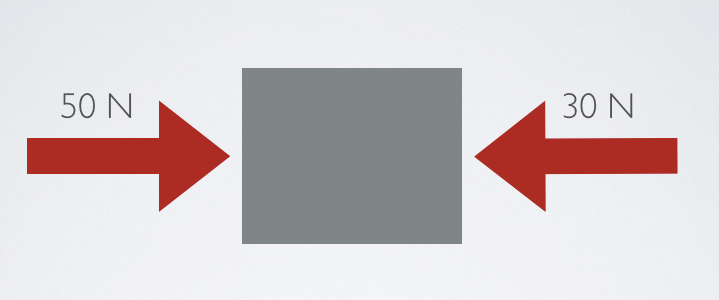
What is the net force and the direction of movement?
a)
50 Newtons, Left
b)
50 Newtons, Right
c)
500 Newtons, RIght
d)
450 Newtons, LEft
100.
What law of motion does this picture represent?
a)
Newtons 1st law
b)
Newtons 4th law 
c)
Newtons 3rd law 
d)
Newtons 2nd law
101.
What Newtons law does this picture represent
a)
Newtons 2nd law 
b)
Law of gravity 
c)
Newtons 1st law
d)
Newtons 5th law
102.
How will this object move? 
a)
It won't move. 
b)
It will move to the right. 
c)
It will move to the left. 
d)
It will move up. 
103.
How will this object move? 
a)
It won't move. 
b)
It will move to the right. 
c)
It will move to the left. 
d)
It will move in both directions. 
104.
What is the net force?
a)
30 N left
b)
25 N right
c)
5 N left
d)
55 N right
105.
What is the net force?
a)
40 N left
b)
0 N Balalnced
c)
400 N right
d)
40 N right
106.
Which could be an example of a balanced force?
a)
An asteroid moving at a constant speed through space 
b)
A car accelerating from a stop sign
c)
A box of dishes falling from a counter 
d)
A rocket taking off 
107.
What is the net force?
a)
10 N
b)
0 N
c)
25 N
d)
1 N
108.

Force is a -

a)

push or pull

b)

only a push

c)

only a pull

d)

none of the above

109.
Calculate the net force of the object in the image shown.
a)
20N
b)
35N
c)
5N
d)
25N
110.
What is the unit for FORCE? 
a)
N (Newtons)
b)
lbs (pounds)
c)
g (grams)
d)
m/s (meters per second)
111.
Newtons 1st law of motion states:
a)
An object in motion will stay in motion and an object in rest will stay in rest unless acted upon by and unbalance force.
b)
For every action there is an equal and opposite reaction. 
c)
Acceleration is produced when a force. acts on a mass. 
d)
The greater the mass  the greater the amount of force needed to change its motion. 
112.
The law of inertia is also known as which law of motion?
a)
Newtons first law of motion. 
b)
Newtons second law of motion. 
c)
Newtons third law of motion. 
d)
Inertia has nothing to do with the laws of motion. 
113.

How much force is needed to accelerate a 25kg bowling ball at 2m/s2.

a)

50N

b)

5N

c)

12.5N

d)

100N

114.

If a 2kg bird is pushed by the wind with a force of 2N, how fast does the bird accelerate?

a)

1 m

b)

2 m/s2

c)

4m/s2

d)

1 m/s2

115.
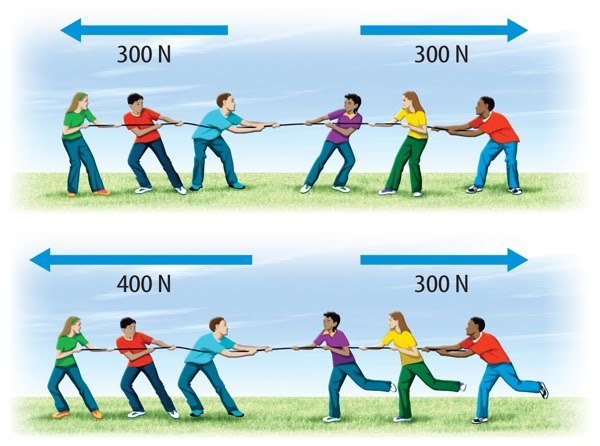
Which one is balanced?
a)
top
b)
bottom
c)
both
116.
A wheeled cart is moving to the right at a constant speed.  Two forces of equal magnitude are acting upon the cart. Which of the following best describes the forces and motion of the cart?
a)
Balanced Forces, Constant Speed
b)
Balanced Forces, Acceleration
c)
Unbalanced Forces, Constant Speed
d)
Unbalanced Forces, Acceleration
117.
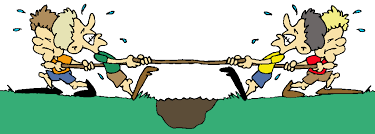
If these teams are pulling with the same amount of force what will happen?
a)
The boy in blue will win.
b)
They will not move at all.
c)
The boy in red will win.
d)
Both will fall down.
118.
What is the net force?
a)
400 N Up
b)
400 N Down
c)
- 400 N Down
d)
800 N Down
119.
Which of the blocks above has balanced forces acting on it?
a)
A
b)
B
c)
C
d)
D
120.

two forces acting in opposite directions on an object, and do not cause a change in motion; equal in size

a)

Force

b)

Balanced Force

c)

Unbalanced Force

d)

Inertia