
 Worksheets
8th Grade Phys Sci Review 5 - S8P5abcd
Total questions: 130
Worksheet time: 1hrs 5mins
The transfer of charge without contact between materials is induction.
True
False
A material that allows electricity to pass through easily is a conductor.
True
False
A material that does not allow electrons to move through it easily is a conductor.
True
False
Static electricity is not generally produced by friction, conduction, or induction.
True
False
The movement of static electricity as charges move off an object, sometimes seen or felt as a spark (lightning), is Static Electricity
True
Fasle
A device used to convert chemical energy into electric energy made up of a group of cells connected together is called a Battery.
True
Fasle
An object can become electrically charged if it gains or loses which particles?
volts
neutrons
protons
electrons
A charged object (A) comes in to contact with an uncharged object (B). In the process, object A loses electrons and object B gains electrons. Which of the following is true?
Object B lost protons
Object B has no charge
Object B now has a positive charge
Object B now has a negative charge
Which of the following best describes a magnetic field?
a measure of the length of the magnet
an invisible region that surrounds the south pole of a magnet
an invisible region that surrounds the north pole of a magnet
a region around a magnet in which you can measure magnetic forces
How does Earth’s magnetic field compare with that of a bar magnet?
their magnetic fields increase with size
the attractive force of the magnetic fields is greatest at the poles
the attractive force of their magnetic fields is greatest at the center
electric current causes them to lose magnetism

The students continued their experiments on force fields, this time investigating magnetism. One group student set up the demonstration you see here. “Oh wow!” Sarah exclaimed. “It’s magic!” Is it magic? Which statement best explains how the center magnet is able to hover between two other magnets?
the magnets are stacked so that like poles are facing one another
the opposite poles of each magnet are facing each other so they repel
the middle magnet is repelling the top magnet while attracting the bottom
the middle magnet is attracted to the top magnet but pulled down by gravity

Jason places a bar magnet on a flat surface and covers it with a sheet of paper. Then he evenly sprinkles a layer of iron filings on top of the paper. Which of the following diagrams indicates the most likely arrangement of the filings on the paper?
Figure A
Figure B
Figure C
Figure D
Candice learns that all magnets have two magnetic poles. Which of the following observations would best support this statement?
When a bar magnet is cut in half, each half has a north pole and a south pole.
the north pole of a compass needle is attracted to the south pole of a bar magnet
when an electric current flows through a wire, a magnetic field forms around the wire
the strength of a horseshoe magnet’s magnetic field decreases as the magnet is pulled away from another object

Using the image below, where is the magnetic field of this magnet the strongest?
Position A
Position B
Position C
Position D

Objects can be charged in many ways. In the image below, a student is rubbing a balloon on her head.
What method is this student using to charge the balloon?
friction
repulsion
induction
conduction
What is the difference between charging by conduction and charging by induction?
during conduction, charges move between objects that briefly touch; during induction, charges move between objects that are rubbed together
during induction, charges move between objects that briefly touch; during conduction, charges move between objects that are rubbed together
during conduction, charges move between touching objects; during induction, charges are redistributed within an object that is near another object
during induction, charges move between touching objects; during conduction, charges are distributed within an object that is near another object
Two charged particles are near each other, but they do not touch. Which process is possible?
charging by friction
charging by induction
charging by conduction
charging only happens between objects that touch
Two neutrally charged balloons are touching. What will happen if a negatively charged rod is brought near one of the balloons without touching it?
the balloons will move toward each other
the balloons will move away from each other
electrons on the balloons will move toward the rod
electrons on the balloons will move away from the rod
Two neutrally charged balloons are touching. What will happen if a positively charged rod is brought near one of the balloons without touching it?
the balloons will move toward each other
the balloons will move away from each other
electrons on the balloons will move toward the rod
electrons on the balloons will move away from the rod
Which of the following is an electrical insulator?
copper
rubber
aluminum
iron
A science lab has copper wire coasted with rubber tubing, a plastic vial, and a pair of cotton gloves. Which of these materials is not an electrical insulator?
copper wire
cotton gloves
plastic
rubber tubing
Which of the following is the best definition of electromagnetism?
the use of electricity to create magnets
the use of magnets to generate electricity
the interaction between electricity and magnetism
the appearance in nature of objects that have both electric and magnetic fields
An engineer is building an electrical device. She wants to use a material that will give her the most control over the amount of electric charge that flows through a circuit. Which material should she use?
conductor
insulator
electromagnet
tube

Observe the photo of an electromagnet.
Electric current flows through the wire. What is the name for this coiled wire that is wrapped around the iron core of the electromagnet?
generator
solenoid
transformer
trapezoid
How do an electric motor and electric generator differ?
one uses a permanent magnet, while the other uses temporary magnets
one produces electrical energy, while the other produces thermal energy
one contains moving parts, while the other has only parts that do not move
one uses an electric current to produce motion, while the other uses motion to produce an electric current
When the current in an electromagnet increases, what does its magnetic field do?
changes direction
gets stronger
gets weaker
does not change
Which change would result in a stronger generator or electromagnet?
reducing the number of batteries
increasing the voltage of the battery
substituting another metal for the iron core
decreasing the number of coils around the iron core

Students want to test several objects to see if they are insulators or conductors of electricity. They make this testing device.
Select two steps from below the instructions into the correct boxes to complete the instruction list below:
Step 1: Assemble the testing device as show in the picture.
Step 2:
Step 3:
Step 4: Make the observation
Step 5: Make a conclusion based on the observation
Connect the two clips together
Place the object between the two clips
Connect one clip to one side of the object.
Connect one clip to each end of the object.
Touch the object to one side of the battery

Students want to test several objects to see if they are insulators or conductors of electricity. They make this testing device.
Step 1: Assemble the testing device as show in the picture.
Step 2: Place an iron bar between the two clips
Step 3: Connect one clip to each end of the object
Step 4: Make the observation
Step 5: Make a conclusion based on the observation
Select one possible observation and its matching conclusion to explain the results of this experiment.
the light bulb glows
the object is a conductor
the object is an insulator
the light bulb does not glow

A student is planning an investigation to determine the relationship between magnetism and the movement of electrical charge in a circuit. A diagram of the circuit is shown.
The student is planning to make changes to the circuit to see how the changes will affect the number of paper clips that are picked up by the electromagnet. What is the likely effect of the magnetic field if the student adds more coils?
increase
decrease
no change
In a parallel circuit the current
makes one circle
stays in one path
splits and goes through more than one component
What is the difference between a parallel circuit and a series circuit?
A series circuit has one path that electricity flows through. In a parallel circuit, energy is passed through each load through its own pathway.
A parallel circuit has one path that electricity flows through. In a series circuit, energy is passed through each load through its own pathway.


What are three examples of forces/fields?
Magnetism, Friction, and Mass
Magnetism, Electricity, and Gravity
Magnetism, Gravity, and Sunlight
Magnetism is a
Force
Power
Form of Energy.
Form of Electricity
The Sun has more gravity than the planets in our solar system because the Sun is
hotter
more massive
made of plasma
undergoing fusion
You can watch static electricity in action by rubbing an inflated balloon against your hair. Your hair will actually stand on its end! It does this because each hair becomes charged, and they all repel one another.
However, eventually, your hair will return to normal. Why is this?
The charge accumulated in your hair eventually just disappears.
The charge accumulated in your hair is eventually converted to neutral particles.
The charge accumulated in your hair is eventually broken down by the nuclear force.
The charge accumulated in your hair is eventually transferred to the surrounding environment.
There are three ways objects can become electrically charged. They are friction, induction and
conduction
Convection
radiation
polarization

How would a bar magnet orient itself relative to this planet’s magnetic field?
A
B
C
D

A group of students is investigating the different factors that affect the strength of an electric motor. A diagram of the motor is shown.
A. Reduce the size of the axle running through the center of the motor.
B. Increase the number of coils of wire within the two sections of the motor.
C. Decrease the voltage of the power source being used to operate the motor.
D. Place the permanent magnets and coils of wire farther apart inside the motor.

Magnets and electromagnets can both be used to pick up metal items like iron nails.
Although they are alike, there is a difference between magnets and electromagnets. An example of this is that increasing the current running through the electromagnet's wire will make it stronger.
What is another difference?
Increasing the amount of wire loops will increase the strength of an electromagnet
There is no other difference between electromagnets and magnets.
Electromagnets are always stronger than regular magnets.
Decreasing the voltage will increase the strength
An electric generator transforms mechanical energy into electrical energy. This process could be done by which of these?
Using wind to spin a magnet around.
Connecting a battery to a coil of wire.
Turning a wheel that contains electrons.
Spinning a coil of wire near a large magnet.
A magnet has two poles, a North and South. What happens when two magnet's South poles are placed near each other?
They attract
They do nothing
They move sideways
They repel each other
There are various ways to increase the strength of an electromagnet. You can increase the amount of loops around a metal core, you can increase the core size and
decrease the voltage
you can increase the voltage
spread out the amount of loops
that is it...
The following material is not a good electrical conductor
Plastic
Copper
Iron
human body


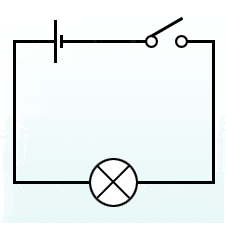
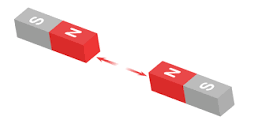
The direct transfer of electrical energy from one object to another that it is touching
Conduction
Mass
Induction


A circuit must have
a battery and wires,
battery, wires, and nothing else
battery, wires, and a load.
A series circuit has
more than one pathways.
one pathway.
none of the above.
A circuit without a load will cause the battery to catch fire.
false
true
A load in a circuit can be
a light bulb
a fan
a toaster
all of the above


Gravity is a force between any two objects with mass. Why doesn't a person feel a gravitational force between him/herself and another person?
A person doesn't exert a gravitational force.
The two gravitational forces cancel each other out.
The gravitational forces of people is so small it is overshadowed by that of Earth.
There are so many people we are actually balanced by all the different gravitational forces.
The moon orbits our Earth. The opposite would never be true; the Earth would never orbit the moon. One reason is due to the force of gravity. The object ____________ has a greater gravitational force and that determines what satellites orbit around it
with the greater mass
containing mostly water
with a thicker atmosphere
with the greater diameter
An astronaut travels to the moon. What is true regarding her mass and weight?
Her mass and weight are greater on Earth.
Her mass and weight are the same on the moon as on Earth.
Her mass is the same on the moon and Earth, but her weight is greater on Earth.
Her weight is the same on the moon and Earth, but her mass is greater on Earth.
Which is an example of gaining a static charge by conduction?
Rubbing a balloon against your hair.
Shuffling your shoes across a carpet.
Bringing a charged rod near an electroscope.
Touching your car on a cold day and getting a shock.
If you hold a balloon by a string and the balloon moves toward your sweater and sticks there, what would you infer?
That the balloon and the sweater have no charges.
That the balloon and the sweater have like charges.
That the balloon and the sweater have neutral charges.
That the balloon and the sweater have opposite charges.
What process is the method by which a neutral object obtains an electrical charge?
convection
discharge
induction
radiation
Friction, conduction and induction are three ways of creating a static charge on an object. Which method or methods will produce the same charge on two objects?
Friction Only
Conduction Only
the neutrally charged wall.
another negatively charged balloon.
After turning off the television, you approach it. As you get close, but not touching it, the hairs on your arm start to stand up. This is an excellent example of static charge built up by
conduction
convectin
friction
induction
Sandy rubs a rubber rod with a piece of animal fur. The total charge of the system before rubbing is zero. The system is made up of the rubber rod and the fur. Initially, the charge on the rod is zero and it is electrically neutral. The same is true for the fur. When Sandy rubs the rubber rod with the fur, the rubber rod acquires negative (-) charges. How does the system change, overall, based on the law of conservation of charge?
The total charge of the system is now negative rather than neutral.
Although the rod becomes negatively charged, the piece of fur remains neutral.
If the rod becomes negatively charged, then the fur becomes positively charged.
Both the rod and the piece of fur have become negatively charged during the rubbing.
Describe how you can cause the two leaves at the bottom to repel each other and stay that way.
Bring a positive and negative object near the top.
Bring a negative object near the top.
Bring a positive object near the top.
Touch the electroscope with any charged object.
Laundry in a clothes dryer often becomes charged with static electricity while drying. Which of these best explains why a clothes dryer often generates static electricity?
Short circuits in the dryer charge the laundry.
Heat from the dryer charges the air and produces lightning.
Clothes with metal pieces conduct electricity in the dryer.
Electrons are transferred as clothes rub against each other in the dryer.
Air
Conductor
Insulator
Pencil Lead
Conductor
Insulator
Glass
Conductor
Insulator
Lemon Juice
Conductor
Insulator
Renaldo and Nasreen build an electromagnet by wrapping a wire around a nail and connecting the wire to both terminals of a battery. When they test the electromagnet, it can pick up 6 paper clips. Their teacher wants all groups to pick up at least 10 paper clips. What could Renaldo and Nasreen do to increase the number of paper clips their electromagnet picks up?
make the wire longer
remove the nail from the center of the wire
increase the number of loops of wire around the nail
spread the loops of wire apart on the nail so they do not touch
A simple motor converts _________________ energy into ___________________ energy.
magnetic; electrical
electrical; magnetic
electrical; mechanical
mechanical; electrical
Donna is attempting to make an electromagnet to pick up old nails in and around her driveway. Which of these materials would be best to use for the core in order to make the strongest electromagnet to pick up the most nails?
water
iron nail
wooden stake
plastic tube
A generator consists of a rotating wire coil placed in a magnetic field. This process transforms mechanical energy into _________.
nuclear energy
chemical energy
electrical energy
gravitational energy
Students hypothesized that by running an electric current through the wire of the apparatus shown here, they could cause a non-magnetic nail to exhibit magnetic properties. What would be a reasonable way to test this?
Weigh the nail first while before turning the current on and again while the current was on.
Put the nail in water before turning the current on and again after turning the current off.
Examine the nail under a microscope before turning the current on and again after turning the current off.
See if iron filings will stick to the nail before turning the current on and again while the current was on.
In order to generate electricity from mechanical energy, one essential element needed to transform the energy into electrical energy is
a steam turbine.
a mechanical linkage.
a large piece of iron.
a magnet or magnetic field.
You are learning about energy transformations in science class. Sally's group made this electromagnet using a battery and some wire. Describe the energy transformation you see here.
electrical to magnetic
magnetic to electrical
mechanical to magnetic
electrical to chemical
Brady connected the loose wire to the battery and created an electromagnet. He picked up 45 thumb tacks with his electromagnet, though his goal was to pick up 50 thumb tacks. What could Brady do to increase the strength of his electromagnet and pick up more thumbtacks?
Use fewer coils of wire.
Use a screw instead of a nail.
Use two batteries instead of one.
Replace the nail with a piece of steel.
This is a machine that converts electrical energy into mechanical energy.
electricity
electromagnet
generator
motor
This is a machine that will convert mechanical, nuclear, or chemical energy into electrical energy.
electricity
electromagnet
generator
motor
A force of attraction/repulsion due to the spin of electrons.
magnetism
electromagnet
generator
motor
This is a flow of electrons that creates a charge, one of the fundamental forms of energy.
electricity
electromagnet
generator
motor
Which image represents a gaining of a charge on the leaves of the electroscope by conduction?


Which image represents a gaining of a charge on the leaves of the electroscope by induction?
The invisible field that surrounds a magnet.
magnets
magnetic poles
magnetic force
magnetic fields
One of the first applications of magnets
MRI machines
Compasses for navigation
Magnetic healing and Medicine
Computers
Magnets can exert forces on other objects with out touching them
True
False
When magnetic field lines are close together
It shows a stronger filed
It shows a weaker field
It shows the flow of electrons
It shows the charge of the magnet
The region of a magnet that has the strongest field
Poles
The middle
The top
The bottom


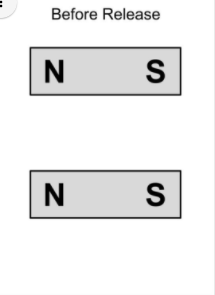

Why would the two magnetic trains move together?
There is too much force.
The magnets are not touching.
The magnetic force pushes the trains apart.
The magnetic force will pull the trains together.
Electric charge at rest on an object that can be positive or negative is called static electricity.
True
False

