
Font size
 Worksheets
Electrochemistry
Total questions: 35
Worksheet time: 27mins
___________ electrode is an inert electrode.
Copper
Iron
Carbon
Zinc
Which equation shows what happen to chloride ions at the anode.
Cl- --> Cl + e-
2Cl- --> Cl2 + 2e-
Cl2 - -> 2e- + 2Cl-
Cl2 + 2e- --> 2Cl-
Choose the half-equation that shows the discharge of aluminium ion.
Al3+ - 3e- --> Al
Al2+ + 3e- --> Al
Al3+ + 3e- --> Al
Al3+ --> Al + 3e-
Ionic compounds do not conduct electricity when they are solid because,
their electrons are not free to move
their ions are free to move
their ions are not free to move
their electrons are free to move
What change is observed at cathode during electrolysis of aqueous copper(II) chloride using carbon electrode
Nothing
pink solid deposit
bubbles of green gas
colourless gas
What are the ions present in molten Al2O3?
Al2+ and O3-
Al2- and O3+
Al3+ and O2-
Al3- and O2+
Oxidation is loss of electron. Where does oxidation take place during electrolysis.
At anode
In the electrolyte
At the circuit
At cathode
The negatively charged ions are attracted to the ________.
anode
cathode
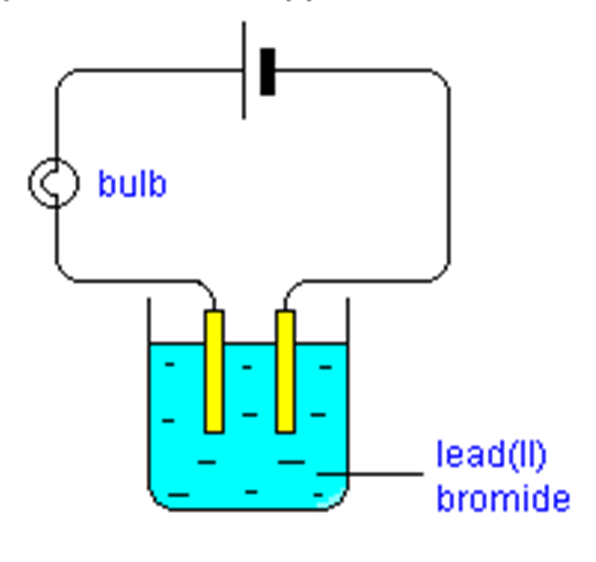
The diagram shows the electrolysis of lead(II) bromide using inert electrodes. Why does the bulb only light up when the lead(II) bromide is melted?
Bromine atoms in lead(II) bromide are converted to ions when it is melted
Electrons flow through the lead(II) bromide when it is melted
The ions in lead(II) bromide are mobile charge carriers in the molten state.
There are no ions in solid lead(II) bromide
In electrolytic cell that uses aqueous copper(II) sulfate as electrolyte and copper plates as electrodes, what is the product at the anode?
Oxygen gas and water
Copper metal
Copper(II) ions
Hydrogen gas
Anions get discharged by ________ electrons at the ___________
gaining, cathode
losing, anode
gaining, anode
losing, cathode
Positive ions (cations) move towards the cathode (-) where they will discharge by....
Breaking apart
Losing electrons
Clumping together.
Gaining electrons
What is the half-equation for the discharge of hydroxide ions?
2O2- --> O2 + 4e-
OH- --> OH + e
4OH- --> 2H2O + O2 + 4e-
2H2O + O2 + 4e- --> 4OH-
What factors do not affect the products of electrolysis in the electrolysis of aqueous magnesium chloride using graphite electrodes?
position of ions in the electrochemical series
concentration of ions in the solution
type of electrodes
What ions are present in molten aluminium oxide?
Al3+, O2-, H+, OH-
Al3+, O2-
Al3+, OH-
Electroplating is an industrial process where objects are coated by a thin layer of a nonreactive metal by electrolysis. What should be used as the cathode in this process?
Graphite electrode
The electroplating metal
The object to be electroplated
Magnesium ribbon

The picture shows electrolysis of copper(II) sulphate solution using graphite electrodes. Besides formation of brown solid on the cathode, what other observations can be made?
The mass of graphite anode decreases.
The blue colour solution becomes paler.
Bubbles of gas form at the anode.
The blue colour solution becomes darker.


